
The author explains why the Galaxy S9 was their last Samsung phone. They disliked its slippery, fragile glass construction, which broke after about two months, as well as Samsung’s software. The article also discusses wireless charging, repairability, hardware specifications, and the design shift from plastic to glass.
After leaving Samsung, the author chose an ASUS ROG Phone II for its large battery, then used an iPhone 13 and a Ulefone Armor X31 Pro as a backup. They now use an iPhone 17 Pro Max and rarely use the Ulefone.
I hated the glass front and back on my Samsung Galaxy S9. Why put so much glass on something I have to carry around and hold every day? I thought it was a fucking stupid design.
My hands get dry because of my work. If I then hold something that is even slightly wet, it can feel like trying to hold ice. The S9 was awful for me in that respect. I had it for about two months before I dropped it and the glass broke.
I’m someone who keeps a phone until I feel I need to replace it. Before the S9, I had a Galaxy S6, and before that a Galaxy S II. I wasn’t buying every new Samsung that came out.

From the Galaxy S II to glass and metal
Samsung’s move towards glass had already happened by the time I owned the S6. In its March 2015 explanation of the S6 and S6 edge’s design, Samsung described them as its first phones made entirely from glass and metal. It emphasised their reflective backs, aluminium frames and more expensive-looking finish. The ordinary S6 and the S6 edge were separate designs; the curved sides of the display were the edge model’s feature.
The S9 continued that direction with glass on both faces, a metal frame and a curved display. Samsung announced it on 25 February 2018, and the main international launch followed on 16 March. My box is for the ordinary 64 GB S9, rather than the larger S9+.
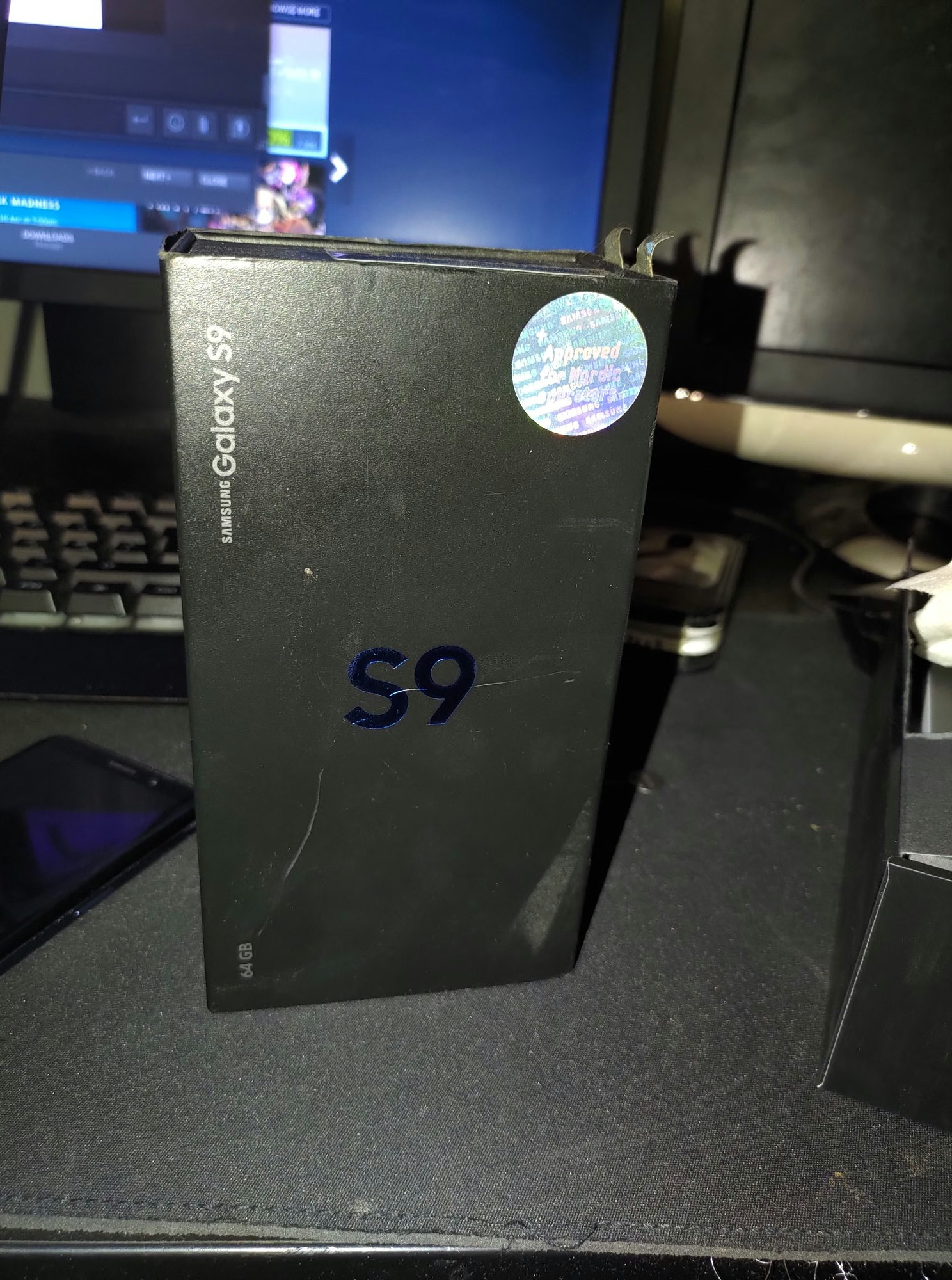

The standard S9 had a 5.8-inch Super AMOLED display, 4 GB of RAM and a 3,000 mAh battery. Its single rear camera had a mechanical aperture that could switch between f/1.5 and f/2.4. The S9+ added a second rear camera and had a larger display and battery. Both phones had AKG-tuned stereo speakers, wireless charging and IP68-rated water and dust resistance. Those were the main features in Samsung’s launch specifications.
Samsung also moved the fingerprint reader below the rear camera, where it is visible in my photograph. In interviews with the development team in April 2018, Samsung said that changes to the fingerprint sensor, side buttons and bezels came from user feedback. It also said it had fitted thicker, more durable glass.
Why manufacturers put glass on the back
Wireless charging is one practical reason for a glass back. Corning’s explanation of the technology describes a coil in the charging pad transferring energy to a coil inside the phone through a changing magnetic field. A metal back can develop circulating electrical currents that waste some of that energy as heat. Glass avoids that particular problem. It also gives manufacturers the shiny, reflective finish Samsung was promoting with the S6.
Glass is one option, though. Nokia was already using polycarbonate plastic for the Lumia 920 in 2012. In its explanation of those materials, Nokia discussed polycarbonate’s suitability for antennas, NFC and wireless charging. A phone can support wireless charging without having a glass back.
There are consequences when that glass is glued into the phone. iFixit’s S9 teardown, published on launch day, gave it a repairability score of 4/10. The teardown praised the modular components but criticised the adhesive holding the battery and glass in place. Opening the phone involved heating and cutting through the rear adhesive while working around the fingerprint-reader cable; repairing the screen required substantial disassembly. Glass on both sides also increased the risk of breaking something while getting inside.

I had enough of Samsung’s software as well
The glass wasn’t my only complaint. I hated Samsung’s software too. By the S9, I had enough, and it became my last Samsung phone.
At release, the S9 ran Android 8 Oreo with Samsung’s own interface on top. It later received Android 10 and One UI 2; Samsung’s update log for the SM-G960F records that upgrade in February 2020.
In WIRED’s March 2018 review, Brendan Nystedt praised the display, camera, speed and speakers, while criticising the amount of Samsung software, the camera app and the fragile glass construction. Notebookcheck’s test of the Exynos-powered SM-G960F also praised the display and camera but found disappointing battery runtime and heat under load.
The S9 is also well beyond Samsung’s current routine firmware-support list. As of 4 November 2026, it is absent from Samsung’s published security-update scope. Samsung now offers up to seven years of security support for selected newer Galaxy devices, following a policy extension introduced in January 2024. That newer policy does not include the S9.
The ROG Phone II and its big battery
After the S9, I bought an ASUS ROG Phone II. The big battery was the reason I went for it.
The ROG Phone II has a 6,000 mAh battery, compared with the S9’s 3,000 mAh. ASUS paired it with a 6.59-inch 120 Hz AMOLED display, a Snapdragon 855 Plus processor and 30 W HyperCharge. Its September 2019 international announcement presented it as a gaming phone, complete with ultrasonic AirTrigger controls and accessories.
The layout also reflected that purpose: ASUS put a charging connection on the side so a cable could sit out of the way when the phone was held horizontally, and fitted front-facing stereo speakers.
The iPhones and the backup that I barely use
After the ASUS, I had an iPhone 13. Before moving on to the iPhone 17 Pro Max, I also bought a Ulefone Armor X31 Pro as a backup and media phone. I wanted to use that for media instead of running down the iPhone 13’s battery.
Ulefone announced the Armor X31 Pro in December 2024 with a 6,050 mAh battery, a 6.56-inch 120 Hz display, 5G and Android 14 at launch. It was sold as a rugged phone. Mine was a low-cost backup, but the touchscreen often missed touches and registered input inaccurately.
I now use an iPhone 17 Pro Max. Apple introduced that model in September 2025 with an aluminium unibody, Ceramic Shield 2 on the front and Ceramic Shield on the back.
I still have the Ulefone, but I hardly use it since getting the iPhone 17 Pro Max.
Photographs: Kiba Snowpaw.