
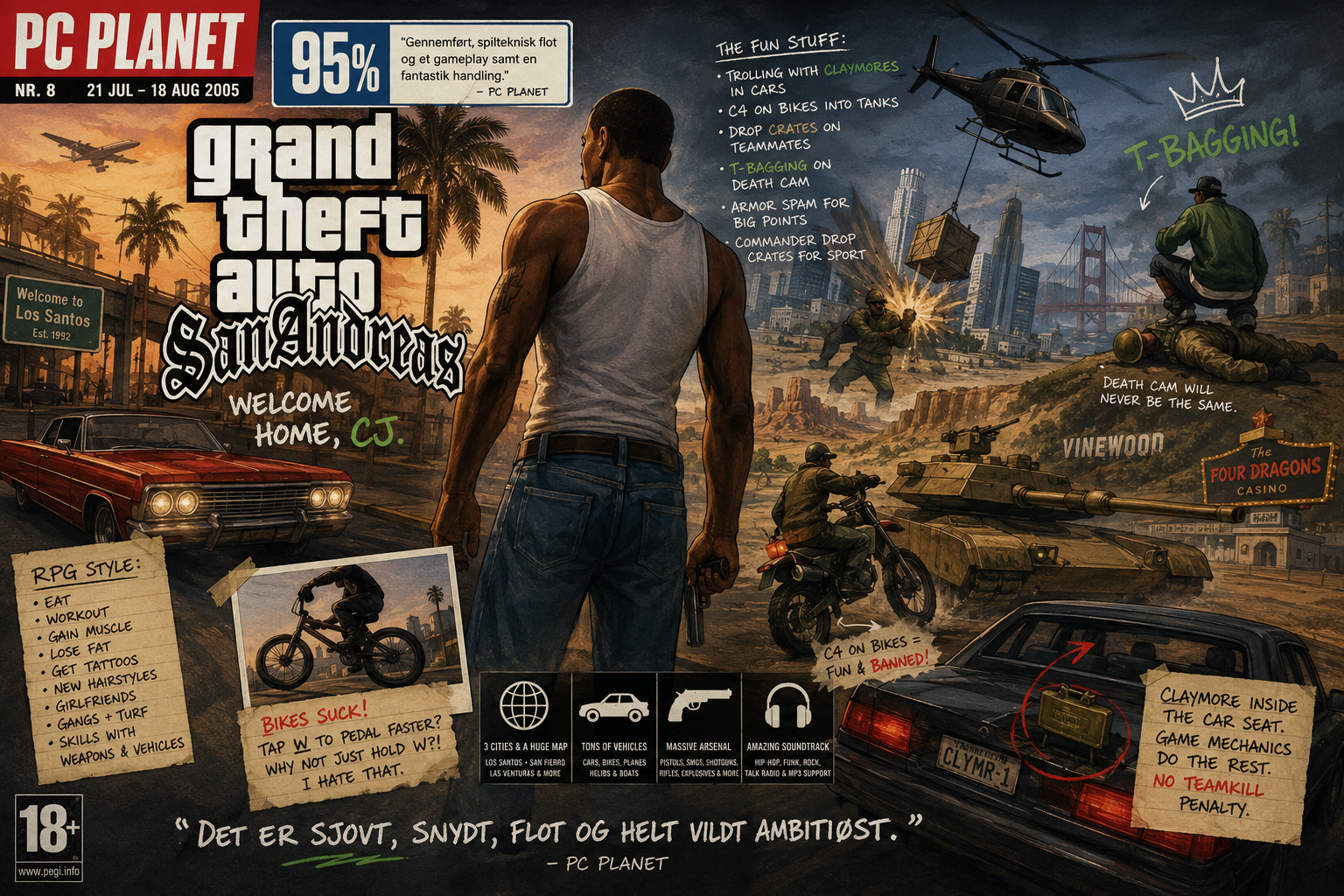
PC Planet gave Grand Theft Auto: San Andreas 95% in 2005. I grew up with GTA, played the original on PlayStation, went through London, GTA 2, GTA III and Vice City, and still never particularly liked San Andreas. The opening bicycle sequence is one of the first things I remember about it, mostly because I hated the bloody controls.
That score came from PC Planet Denmark, issue 8, covering 21 July to 18 August 2005. The magazine was looking at the newly released PC version. Three cities, countryside, desert, character statistics, swimming, aircraft, gangs and enough side activities to keep someone occupied for ages. There was plenty for a reviewer to get excited about.
I wanted to enjoy playing it. Having a larger map and more things to do did not solve the parts that annoyed me. San Andreas expanded GTA in directions I could appreciate without wanting to spend my evenings dealing with all of them.
The GTA I started with
I liked the first GTA’s view from above. Tiny cars, heavily pixelated streets and a city spread out underneath me. It almost felt like looking down from heaven while causing complete chaos on the ground. The graphics were crude, but I could see where I was going and get straight into the game.
The telephone-box missions are part of what I remember most. Hear a phone ringing, take a job, steal a vehicle and see how badly everything goes. I even remember a mission involving a truck and a building, although the exact details are much less clear after all these years. I played that PlayStation version a lot. GTA did not need a cinematic camera behind my shoulder to keep me interested.
I liked GTA: London 1969 too. My PlayStation copy used the original GTA disc as part of its startup. London disc in, swap to the original GTA when asked, then put London back in to play. I remember that process clearly. It was an expansion that depended on another physical game, and every time I started it, the disc swapping reminded me of that dependency.
GTA 2 never worked as well for me. I preferred the first game’s look and feel. Adding gangs and changing the presentation did not automatically make it the one I wanted to play. That happened long before San Andreas, so this is hardly the first time my favourite GTA failed to line up with whichever entry had more features.
When GTA III sounded impossible
I remember reading about GTA III in a PC magazine and trying to understand how the hell a computer would handle it. Instead of looking down at the buildings, I would be walking between them. Streets, cars and people would surround the character. I could get out of a vehicle and look around from ground level.
Coming from the old overhead games, that sounded like an absurd amount of work for the hardware. I was used to seeing a whole chunk of the city at once, represented with very limited detail. Now the game was supposed to turn that into somewhere I could physically stand and drive through. Magazine screenshots gave me time to imagine it before I could see what it actually did.
My GTA III memories also include the PlayStation 2 version’s rough edges. Roads could go transparent or disappear, and I remember falling through the map. There was a strange aircraft-audio incident I witnessed with three other people too. I remember the sound seeming to pass through somewhere it should not. I would not try to diagnose an engine bug from that memory now, but the incident stayed with me.
Those problems did not stop the move into 3D from being impressive. I could finally look back at the police car chasing me. A pavement, an alley or a building had a different presence when the character stood beside it. GTA III gave me the streets I had been looking down on, with all the mess that came from trying to build them on that hardware.
Vice City followed with Tommy Vercetti, the 1980s setting and a soundtrack that suited the place so well that driving around became a big part of its appeal. I played Vice City more than San Andreas. By then, I knew GTA could work in 3D. San Andreas had to keep me interested in what it added.
CJ has a good reason to come home
San Andreas starts in 1992. Carl “CJ” Johnson returns to Los Santos after five years in Liberty City because his mother has been murdered. His family is falling apart, Grove Street Families have lost ground and the neighbourhood is in trouble. Corrupt officers led by Frank Tenpenny make his return worse almost immediately.
That gives CJ more to work with than simply being the person who accepts the next mission. Sweet is his brother, with resentment about CJ having left. Kendl has her own life and relationship with Cesar. Ryder and Big Smoke belong to the old circle CJ returns to. The people around him bring history into the conversations, even before the game starts sending him across the state.

I find CJ easier to connect with than GTA III’s silent Claude. Young Maylay gives him a voice that can carry frustration, sarcasm and reluctance as well as confidence. Samuel L. Jackson’s Tenpenny is immediately recognisable, but the performance also gives that corrupt cop a presence the old character model could never manage by itself.
The opening has a fairly direct problem: CJ has come back after something he cannot fix has already happened. His mother is gone. His brother is angry. The old neighbourhood has changed. That is a strong foundation for the story, and I prefer it to the increasingly ridiculous jobs and conspiracies the campaign gets tangled up in later.
Once the story moves through the countryside, San Fierro and Las Venturas, it grows into organised crime, government work, casinos and much larger operations. The changing locations give the campaign variety, but I think the family and neighbourhood material makes the strongest start. The wider it gets, the easier it is for those original relationships to disappear behind another elaborate job.
Food, muscle and another statistic to improve
PC Planet picked out the RPG elements, and there were good reasons for that. CJ’s body could change. Eating affected his fat, exercise developed his physical condition and the gym let players build muscle. Stamina, weapon proficiency and vehicle skills developed through use. Clothes, haircuts and tattoos gave him another layer of customisation.
These were visible changes. A heavier CJ and a muscular CJ looked different on screen. Weightlifting had its own exercise interface, with power, repetitions and a muscle indicator. Rockstar made improving the character into something the player physically performed rather than simply choosing an upgrade from a menu.

I can appreciate the work that went into it. I still do not particularly want to spend my GTA time doing virtual weightlifting. A body-management system can be amusing when I first discover it, then become another thing asking for attention. The fact that the character changes does not make every repetition enjoyable.
The same problem runs through some of the skills. Using a weapon improves proficiency. Riding, driving and flying develop their own abilities. Progression makes sense, but it also means the character begins with limitations that the player works through by repeating activities. I want that repetition to be interesting. A statistic going up is not enough on its own.
The vehicle schools concentrate that training into tests. Driving, boating, motorcycling and flying become things to practise and pass. There is considerable variety there, but the campaign also ties some training into its progress. These systems affect how the game moves along; they are not all little distractions that can be forgotten without touching anything else.
Swimming was a proper improvement
CJ being able to swim made a much clearer difference to me. Vice City’s Tommy Vercetti could survive all sorts of violence and then die because he ended up in deep water. San Andreas finally let the character swim and dive. Water became somewhere the player could go.
Diving brought an oxygen meter and lung-capacity progression. It also gave Rockstar space for underwater collectibles and missions involving the water. The 50 oysters scattered around the state are one example. The screenshot below shows both the underwater view and the breath meter, so the limit is visible while CJ is submerged.

That addition opens up movement I could not do in the earlier 3D games. I do not have the same reaction to it that I have to stopping at a gym or feeding another character meter. There is a practical difference between giving me another route through the world and giving me another routine to maintain.
Why I hate that damn bicycle
The bicycle is where San Andreas starts losing me almost immediately. CJ gets put on a BMX near the beginning, and the early Grove Street sequence brings more cycling. I wanted to settle into the city and the controls. Instead, I was already annoyed with the way the game expected me to pedal.
On the original PC controls, holding W pedals normally; repeatedly tapping W pedals faster. That distinction matters. I can hold acceleration in a car and get continuous effort from the engine. On the bicycle, getting the faster effort means repeatedly hitting the key. The original console versions used the same basic idea with their acceleration button.

I understand what repeated input represents. CJ is putting more effort into pedalling. I can already see his legs doing that. Having to hammer the control does not make me feel more involved in the ride; it makes me pay attention to my finger and the key.
If I hold acceleration, I want the character to keep putting that effort in. Let his stamina limit how long he can sustain it. Making me keep tapping is the irritating part, especially when speed matters and holding the key gives a different result.
This is a small system in a very large game, but it sits right at the entrance. I remember it because it bothered me, and the game’s size never made that feeling disappear. Every list of San Andreas features can include bicycles. My list of reasons I did not enjoy it includes the same thing.
Three cities were a hell of an achievement
Los Santos, San Fierro and Las Venturas give San Andreas a much wider range of places than the previous games. Los Santos draws on Los Angeles and the early-1990s West Coast setting. San Fierro brings San Francisco’s hills and bridges. Las Venturas brings Las Vegas’s casinos and neon, surrounded by desert.
Between those cities are small towns, country roads, forests, mountains and stretches where the nearest skyscraper is nowhere in sight. Leaving Los Santos changes the scenery and the pace. The countryside gives bikes, cars and aircraft different surroundings to move through, rather than putting every activity on another city street.
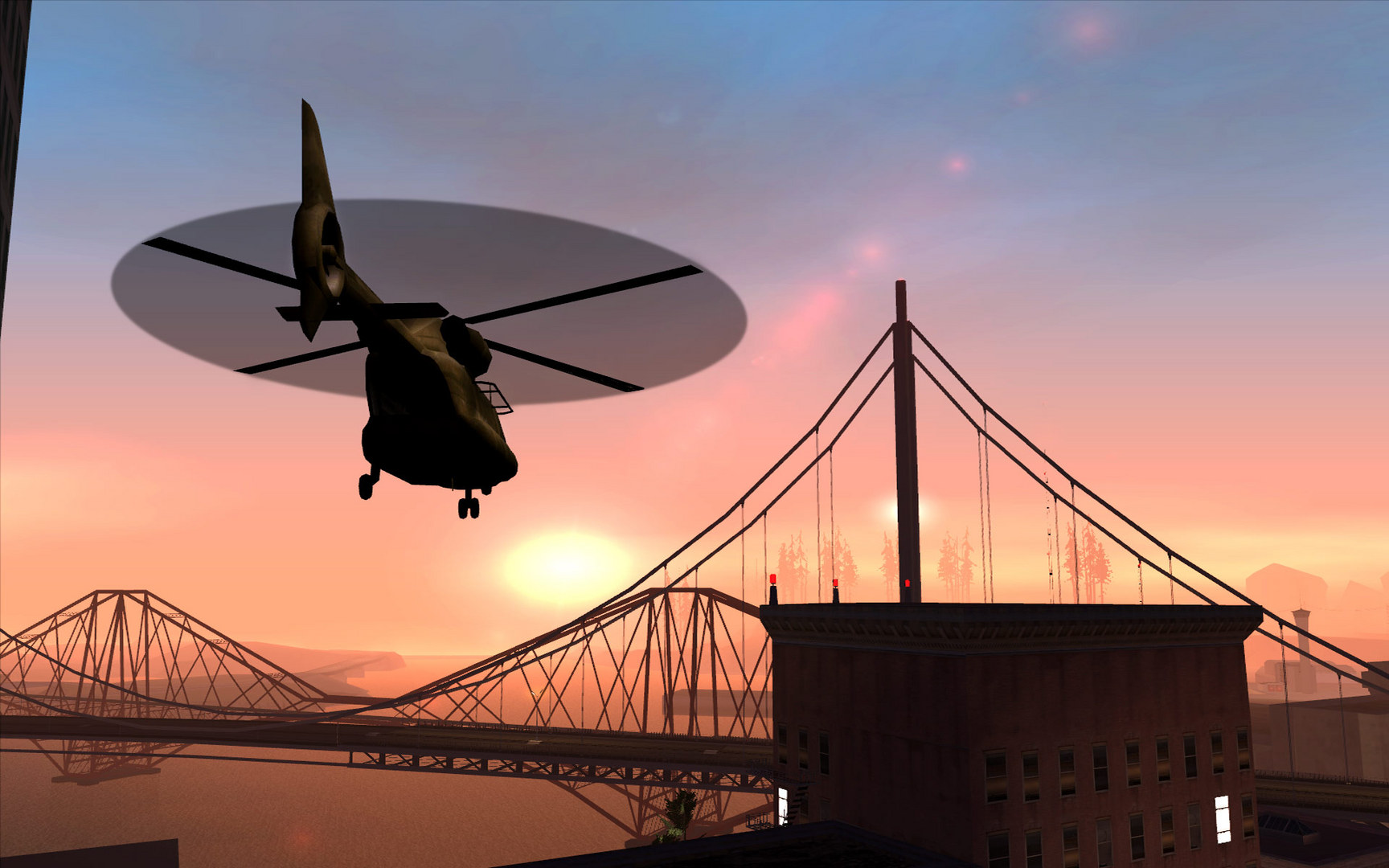
Aircraft make sense in a world that has somewhere to fly. Boats have a coastline and waterways to use. A car journey can carry CJ through different environments instead of bringing him back to a familiar block a minute later. Rockstar gave the expanded vehicle selection an expanded setting to work in.
PC Planet praised the PC version’s greater draw distance. For a game built around this much space, seeing further matters. More of the landscape remains visible, and a distant route or skyline can help the world feel connected. The higher resolutions also made the presentation clearer than the PlayStation 2 release.
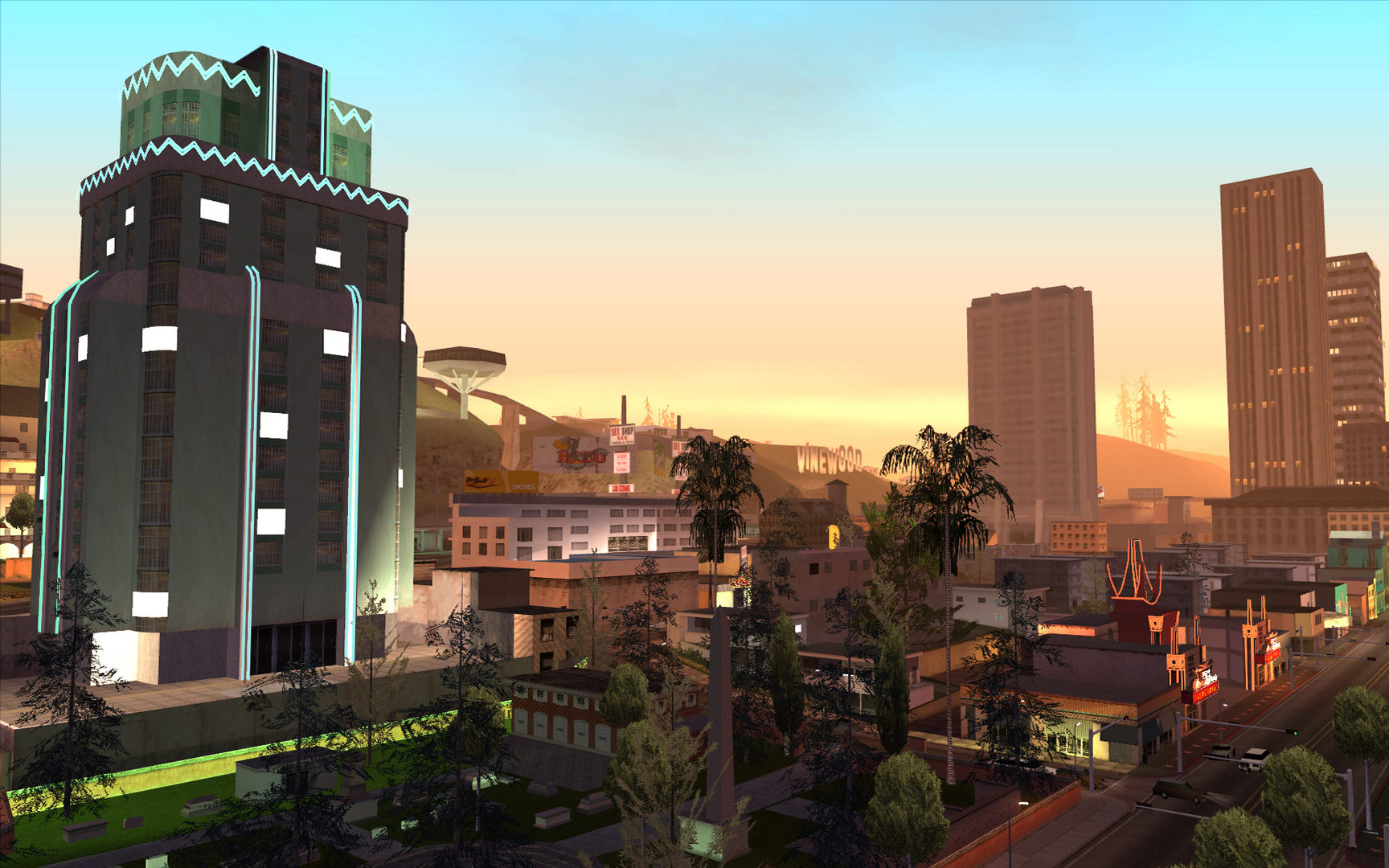
I still do not enjoy travelling further just because the game has more land. GTA III was more concentrated. Vice City had a setting I liked spending time in without the same amount of character maintenance. San Andreas can take longer to move between the things I actually want to do, and another stretch of road does not always improve the evening.
That problem has become even more familiar with newer open worlds. A map gets larger, the activity list grows, and somehow the amount of time I am enjoying myself does not grow with it. San Andreas was doing this long before the modern obsession with filling a map with icons. Its size deserves credit. I also want a reason to spend time crossing it.
Old graphics with a recognisable place behind them
PC Planet compared San Andreas with games such as Half-Life 2 and found the raw graphical quality less impressive. That was fair. The faces are simple, the hands are crude, textures are low resolution and plenty of buildings look basic when inspected closely. The PC improvements did not turn it into a different generation of game.
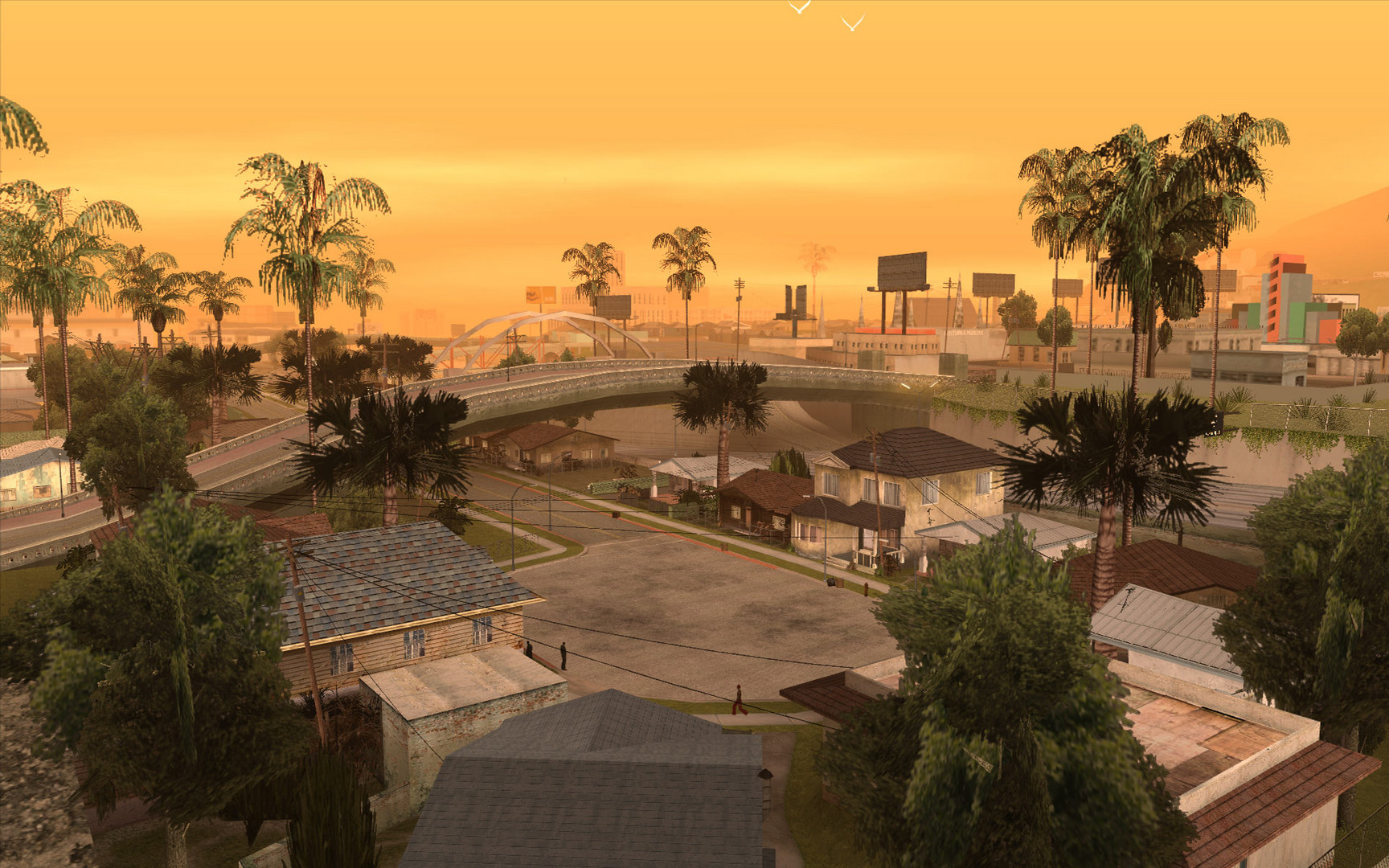
Los Santos still has a look I recognise immediately: palms, low houses, power lines, graffiti, gang colours and warm evening light. A lowrider on one of those roads fits the setting before anybody has said a word. San Fierro and Las Venturas change the architecture and atmosphere enough to make the journey visible.
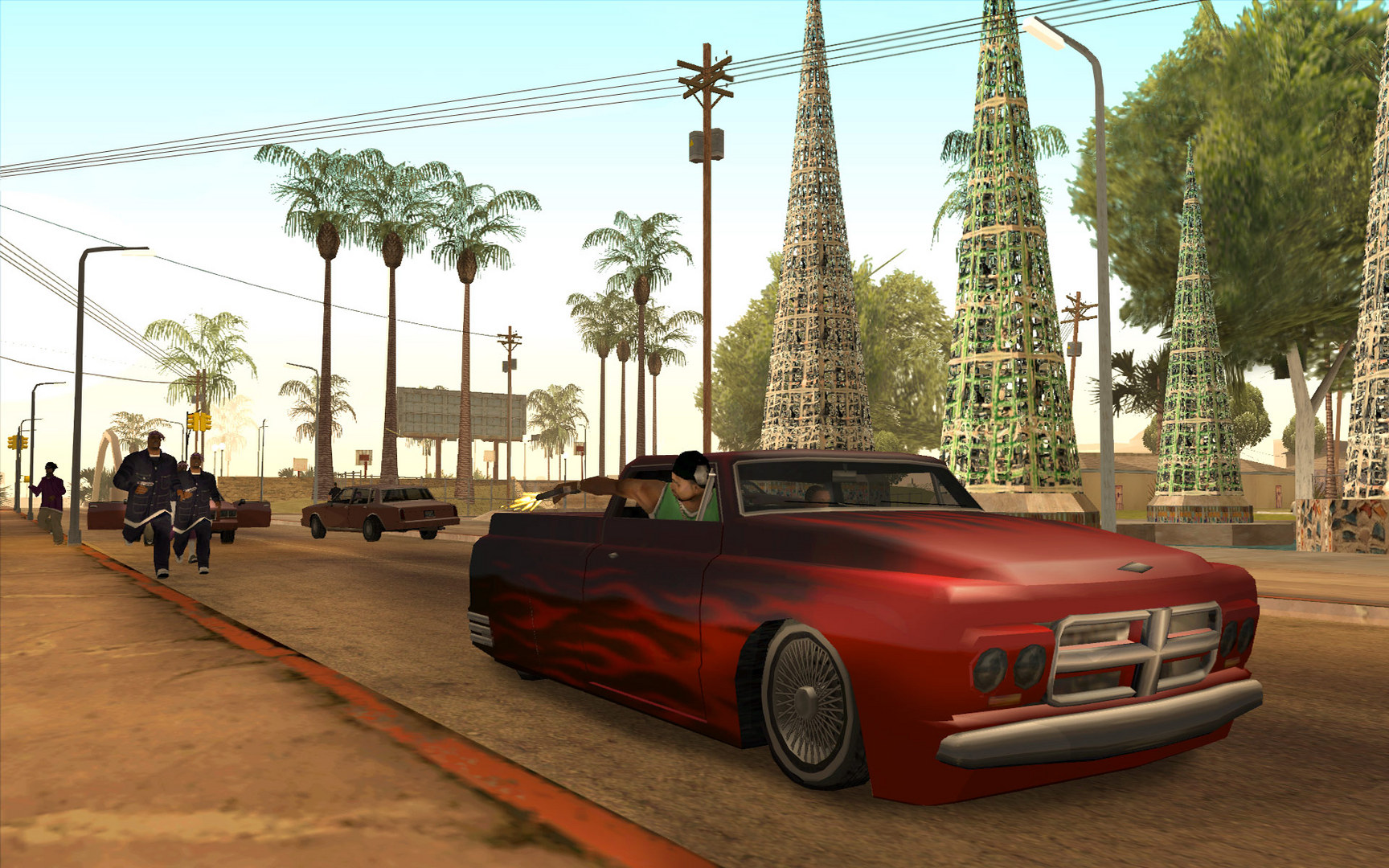
The game had to carry traffic, people, vehicles and a large landscape on PlayStation 2-era hardware. Simpler models and textures helped make that possible. I can notice the limitations without forgetting how much was being fitted around them. The old overhead GTA games also had a clear identity despite showing very little detail. San Andreas is more elaborate, but the setting still matters more to its appearance than a close-up of somebody’s angular hand.
The radio is one of the strongest parts
San Andreas gives its world a lot of character through the radio. Hip-hop and gangsta rap suit Los Santos, but there is also funk, soul, rock, country, house and talk programming. The stations let the sound change as much as the scenery does. A long drive is easier to tolerate when there is something good playing.
PC Planet considered the soundtrack substantial but a little less cohesive than Vice City’s. I understand that. Vice City’s 1980s selection had a very focused identity. San Andreas covers a broader musical range, which gives it variety without always giving me the same attachment to the overall selection.
The PC version’s User Track Player was a good addition. Players could put their own music into the game. Rockstar’s PC manual describes radio mode, which mixes user tracks with commercials, along with random and sequential playback. It let a local music collection fit into the game’s radio system.
That suited the way music was kept on PCs in that period. MP3 folders and ripped CDs were ordinary things to have on the machine. Being able to use that collection while driving around San Andreas was a practical PC feature. It also meant I could change what I heard without losing the surrounding engine noise, traffic and conversations.
The voices help carry the story through those old graphics too. CJ and Tenpenny are the obvious examples, but the whole cast gives the different parts of the state their own tone. I can dislike the bicycle and the extra routines while still enjoying how much personality comes through the speakers.
Combat, street chaos and repeating the same mission
The familiar GTA loop is still underneath everything: driving, fighting, shooting, escaping the police and taking jobs that tend to end badly for somebody. San Andreas adds gang territory, recruitment and weapon proficiency around that foundation. The coloured areas on the radar make the gang presence part of the city rather than leaving it entirely inside dialogue.

PC Planet also praised the civilians for reacting more to their surroundings. Traffic, pedestrians, gang members and police can all interfere with whatever the player is trying to do. A chase gets messier when another driver occupies the road. A fight attracts more people. That interaction gives the streets some of the unpredictability GTA needs.
The older mission structure is less pleasant when something goes wrong. Companions can behave badly, and a failed objective can mean repeating a journey and preparation before getting another attempt at the difficult part. Getting back to the challenge should not require doing a long stretch of easy material again.
I can deal with a game being difficult. Repetition is what wears me down. If I made a mistake in the actual fight or chase, let me try that part again. San Andreas belongs to a period when repeating the approach was a fairly normal part of failing a mission. Age does not make that more enjoyable now.
There is plenty to do. I do not want to do all of it.
Taxi work, vigilante missions, firefighting, ambulance jobs, burglaries, trucking, quarry work, races, schools, gambling, dating, clothes, property and collectibles all compete for time around the campaign. Some activities give money or rewards, others change CJ’s skills or appearance. It is a considerable amount of game to fit into one release.
There is also room to ignore the story and cause trouble. Steal an aircraft, drive somewhere unfamiliar, fight the police or see what happens when a chase gets out of hand. Those are the sorts of freedoms that made GTA interesting to begin with, and the state gives players more places to use them.
I do prefer the way these activities sit inside the old game to the daily challenges, premium currencies and constant spending prompts that have become so common in modern games. San Andreas lets a player spend time modifying cars or exercising without turning that activity into a live service schedule. The character systems can annoy me, but they belong to the game I started.
Still, a long activity list cannot make me interested in every item on it. I do not want to visit the gym merely because muscle can increase. I do not want to keep cycling merely because cycling has a skill level. If I spend more time dealing with the systems than enjoying what they let me do, I am going to put the game down. That is where a lot of San Andreas loses me.
What the PC release changed in 2005
The PlayStation 2 version arrived in 2004. The original PC and Xbox releases followed on 7 June 2005 in North America and 10 June 2005 in Europe, according to Take-Two’s launch announcement. That is the PC release PC Planet was reviewing, rather than a later mobile conversion or The Definitive Edition.
PC Planet described improvements to resolution, draw distance and loading, along with support for the player’s own music. The content was already familiar from the PlayStation 2 game. Better presentation made it a more attractive version without changing the basic systems I disliked.
| Original PC hardware listing | Requirement |
|---|---|
| Minimum processor | 1 GHz Pentium III or AMD Athlon |
| Minimum memory | 256 MB RAM |
| Minimum graphics | 64 MB graphics card, GeForce 3 or better |
| Installation space | 3.6 GB minimum; 4.7 GB for a full installation |
| Recommended memory and graphics | 384 MB RAM; 128 MB graphics card, with GeForce 6 series recommended |
Those figures show how far hardware has moved. The full installation could fit into 4.7 GB, and the minimum RAM was 256 MB. The game still had to manage the changing traffic, people, vehicles and scenery while the player moved through it. I remember thinking the move into 3D sounded impossible; a few years later, Rockstar was fitting three cities and their surroundings into this sort of specification.
The old hardware figures need to stay separate from current software requirements. Rockstar’s present support page includes modern Windows and account requirements alongside those old specifications. Those later requirements do not describe what a Danish retail buyer installed in June 2005.
The Danish price in PC Planet
The review listed 339 DKK as the Danish retail price. That was a new-game price in 2005, separate from what an old disc might cost second-hand now.
| Danish listing | US dollars | Euros | British pounds |
|---|---|---|---|
| 339 DKK | Approx. US$55.35 | Approx. €45.42 | Approx. £31.61 |
Currency equivalents use European Central Bank reference rates for 21 July 2005: €1 = 7.4638 DKK, US$1.2187 and £0.6960. These are historical conversions of the Danish listing, without an inflation adjustment.
Hot Coffee happened right beside this magazine issue
The issue’s cover period starts on 21 July 2005. On 20 July 2005, the ESRB revoked San Andreas’ American Mature rating over the hidden sexual material exposed by the Hot Coffee modification. The two dates are only a day apart.
The ESRB found the material on the final PC, Xbox and PlayStation 2 discs. It was inaccessible in normal play, but third-party modifications or console accessories could expose it. The existing stock could be relabelled Adults Only, or replaced with versions that removed the hidden content and retained the Mature rating. Retailers were told to stop sales until corrective action was taken.
The FTC’s later case concerned the representations about the game’s content in its advertising and packaging. This became a major part of San Andreas’ history, alongside the world, music and missions people actually bought it to play. PC Planet’s enthusiastic PC review belongs to that same very specific period.
The later remaster makes modern gaming harder to defend
San Andreas gives me plenty to criticise without pretending that every older release was perfect. GTA III’s bugs are part of my own memories. San Andreas has controls and mission repetition I dislike. But the industry managed to create another problem around these games when it replaced their digital listings with a remaster.
In October 2021, Rockstar announced that the existing GTA III, Vice City and San Andreas versions would be removed from digital stores ahead of The Definitive Edition. Contemporary reporting recorded that decision. It changed what new customers could buy just as Rockstar was preparing to sell updated versions of the same games.
Then, on 19 November 2021, Rockstar acknowledged the remasters’ launch problems, admitted that their quality had fallen below its standards and announced that the classic PC versions would return as a bundle in the Rockstar Store. Taking away the original purchase options and then having to restore them after the replacement’s poor launch is a miserable way to treat these games and their players.
That is a concrete example of what annoys me about modern gaming. A famous name and a promise of improvements are supposed to carry the purchase, while the players get to discover how much fixing the product still needs. Rockstar already had the games. It already had decades of people caring about them. It still reached the point of apologising for the quality of their updated release.
I think we should stop buying digital games as consumers. I want more control over the version I keep, and I want the original releases to remain available. The San Andreas listing on Steam now explicitly says the game is no longer sold there. A publisher’s decision about its next product can change the choices available for an older one.
A disc can come with its own copy protection and compatibility problems. San Andreas’ original PC listing even names SecuROM. A box alone is no guarantee of an unrestricted game. I still prefer being able to keep the old media and work with that release over relying entirely on whatever version a company wants to sell through its current storefront.
GTA V did not bring me back either
I completed GTA V once on Xbox 360 and thought it was shit. I did not get a lasting desire to replay it. More technology, a bigger production and another famous GTA release still failed to give me the attachment I had to some of the older games.
When I look at the years of attention GTA V has had, I think GTA Online, fan modifications and role-playing communities explain a lot of that staying power. Those are the parts that keep producing new situations, videos and reasons for people to gather around it. My interest in repeating the single-player campaign is much lower.
I spent more time with GTA IV than Vice City, although I never finished GTA IV. I remember getting stuck around Three Leaf Clover, and I remember The Ballad of Gay Tony separately as an add-on. My experience of the series is spread across different games and different machines; San Andreas being the favourite in somebody else’s list does not make it the one I want to return to.
GTA VI is not an automatic purchase for me either. At this point, I may not bother unless I can try it for free. I have already watched GTA go from little overhead cars to enormous 3D worlds. Another increase in size or graphical detail has to come with something I actually want to play.
PC Planet’s 95% is still on the page
The magazine had a lot to praise in 2005. I can see it in the cities, the changing character, the range of vehicles and the amount of game Rockstar fitted into that release. I also keep coming back to the experience of playing it: the tapping, the routines and the stretches where I would rather get on with something else.
I never particularly liked San Andreas, and revisiting the reasons behind that 95% does not change it. I still prefer the GTA that had me listening for a telephone, stealing a car and getting straight into trouble. San Andreas gave me a whole state. It also put me on that damn bicycle.
Sources and image credits
Gameplay video: My GTA: San Andreas — Part 01 PC recording, published on my YouTube channel on 28 September 2021.
Magazine: PC Planet Denmark, issue 8, 21 July–18 August 2005: 95% review score and 339 DKK listed price. Release and technical sources: Take-Two’s June 2005 release announcement, Rockstar’s original San Andreas Steam listing, Rockstar’s PC manual and the original game’s control reference. Rating history: ESRB, 20 July 2005, and FTC, June 2006.
Images: The scenery, crew and lowrider images are Rockstar’s official original-game screenshots, hosted in its Steam gallery. The cycling image is from Cubed3; the gym image is from GTA Wiki’s archive; the underwater image is via GamesRadar+; the aiming image is via Sportskeeda. These are external images of the original game, credited beside each image, and are not my personal captures. Game imagery © Rockstar Games.