

I tried The Sims 2 when it was new, but it never did much for me. Most of the other names on this page meant nothing to me. That was my first reaction to the building and life simulator list in issue 7/2005 of Dansk PC Gaming World: eight ranked games, and hardly anything I had actually spent time playing.
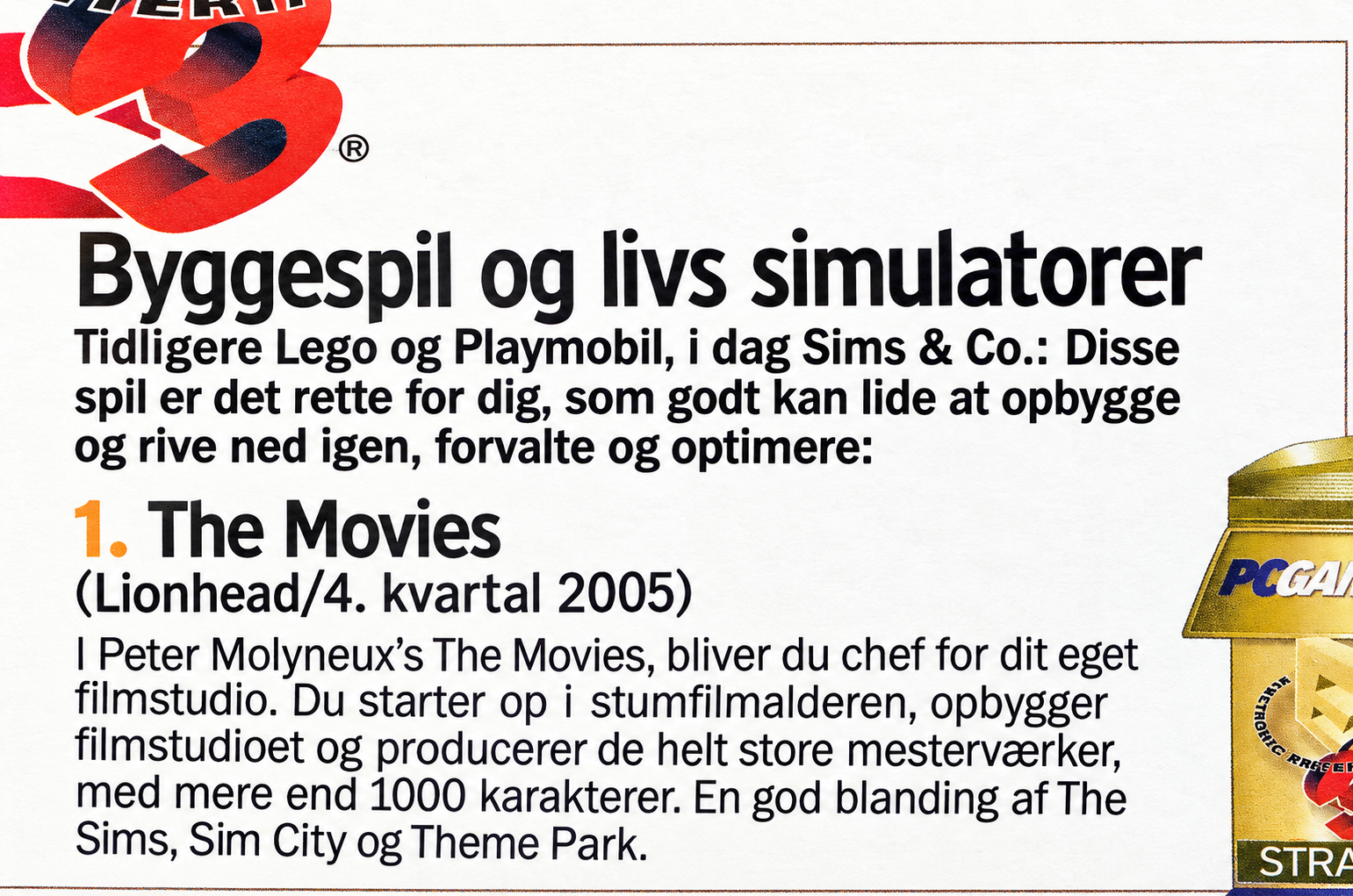
The Danish heading was “Byggespil og livs simulatorer.” The introduction went from LEGO and Playmobil to The Sims and similar PC games: build things, tear them down, manage them and optimise them. That description covers a lot. On this page it stretched from running a Hollywood studio to organising dates, trading in space, managing a zoo and choosing an ice-hockey team.
This was mostly a preview list. The dates beside the names were release forecasts, and several games were still being sold to readers through promises. Two slipped into 2006. The last two entries also have years in their titles that do not match the games being described. I have already looked at the same issue’s military-strategy ranking; this page is another fairly loose collection of things the editors expected to be worth watching.
1. The Movies
First place went to The Movies, with Lionhead and Peter Molyneux doing much of the work in the sales pitch. Start in the silent-film era, build a studio and make films. The magazine promised more than 1,000 characters and described the result as a mixture of The Sims, SimCity and Theme Park. It expected the game in the fourth quarter of 2005.
Lionhead’s finished game had three connected jobs: build the studio, manage the stars and make the films. Sets and facilities needed staff and maintenance. Actors and directors had moods, ambitions and experience in particular genres, so the people side could interfere with the production schedule. Research brought new technology, sets and costumes as the studio moved through the decades.
The filmmaking tools were the more unusual part. The original PC manual describes choosing sets, scenes, actors and costumes in the Advanced Movie Maker, then adding music, dialogue and subtitles in post-production. These were assembled from the game’s available scenes, with adjustable props, lighting and other options. A player could produce a film and export it, rather than simply watch a successful studio make its balance sheet go up.

The Windows game arrived in November 2005. Its PC Metascore is 84, and it won BAFTA’s Simulation award in 2006. The magazine’s enthusiasm had something behind it. This was an ambitious idea that made it into a well-received finished game.
Even so, The Movies never caught my attention. Lionhead and Molyneux were names I associated with Black & White. Elsewhere in this issue, Black & White 2 got a tiny corner and a single sentence, while the film-studio game took first place here. The game I cared about barely got room. I can understand the choice after looking at what The Movies actually offered, but that ordering still feels upside down to me.
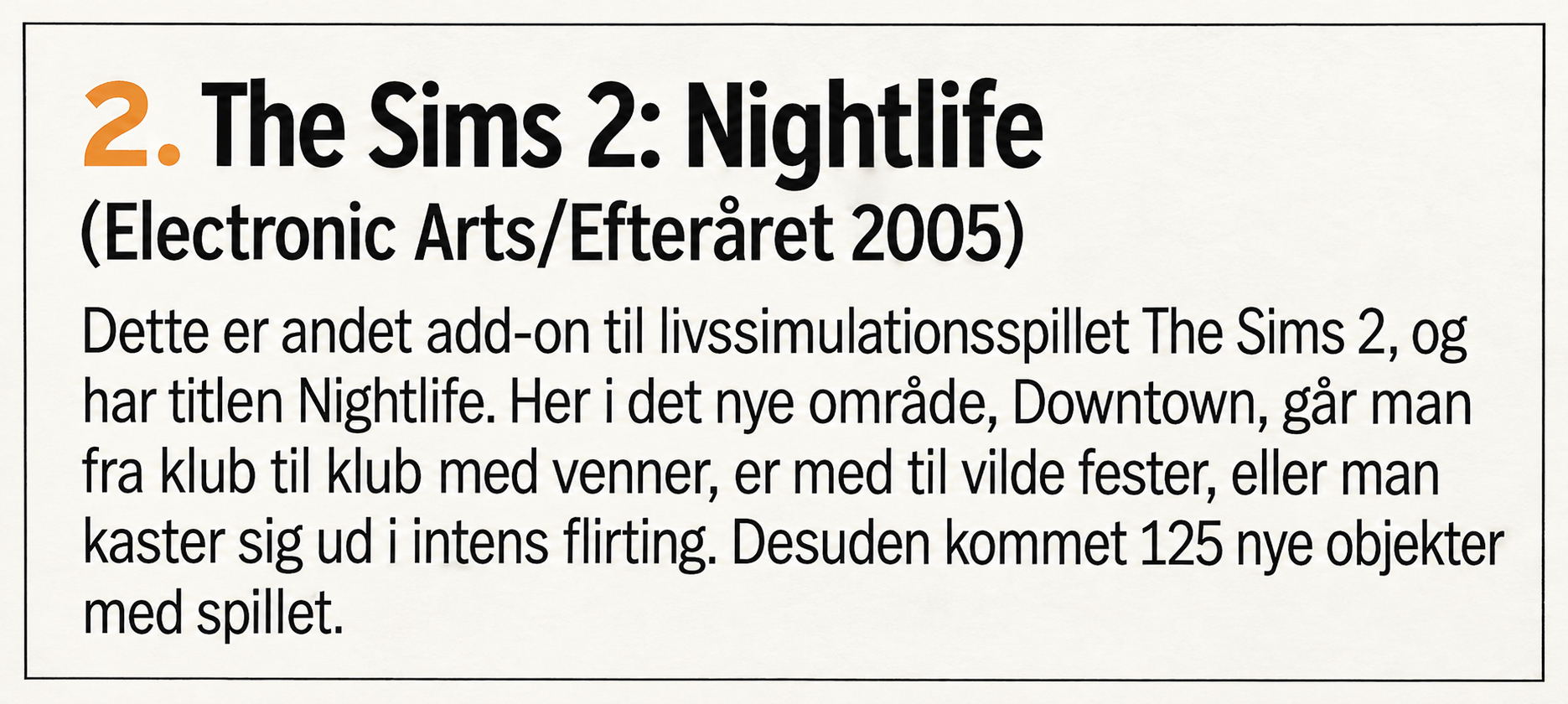
2. The Sims 2: Nightlife
The second entry was an expansion, not another standalone life simulator. Nightlife followed University as the second major expansion for Maxis’s The Sims 2. The clipping highlights Downtown, clubs, parties, flirting and 125 new objects, with an autumn 2005 release window.
EA’s launch announcement confirms the North American release on 13 September 2005 and advertised more than 125 objects. DJ booths, karaoke, poker and the electro-dance sphere helped players build places for their Sims to go out. Cars supplied another way to travel to work or community lots. The Pleasure aspiration, romantic chemistry, vampires and the matchmaker gave the expansion more to do than decorate another house.
Dates and group outings also had their own timed events and success meters. The Sims’ interactions could improve or ruin an evening. Underneath those additions, the familiar wants, fears and needs still ran the characters’ daily lives. Hunger, comfort, hygiene and social needs did not disappear because a Sim wanted a night out. Multiplayer.it’s contemporary walkthrough explains how the dating and outing systems worked alongside the existing simulation.

It earned a Metascore of 76. Second place is understandable: the magazine was looking at a substantial expansion to a very prominent PC game, with an easy-to-explain theme. Someone already interested in their Sims’ relationships had a clear reason to pay attention.

My experience was much smaller. I tried The Sims 2 around its release, and I think it was just the base game. I never got into it. Shilka may have liked it more than I did, but it did not become a game I kept returning to.
I own many of the expansion discs now. Those came later, when second-hand Sims games had become cheap and common. They are practically given away in second-hand shops. I did not follow every expansion as it arrived in the shops in the 2000s; I collected the discs long afterwards.
That second-hand market is one reason I think we should stop buying digital games as consumers. Somebody else’s discs can reach my collection. A used Steam game cannot be sold on in the same way: Valve’s Subscriber Agreement restricts account and subscription transfers to cases it expressly permits. I want to keep copies and pass them on, without a storefront deciding whether that transaction is allowed. Cheap old expansion discs make that difference very concrete.
3. X3: Reunion
Putting X3: Reunion beside Nightlife shows how broad this category was. Egosoft’s game combines spaceflight, combat, trading and an economy in which players can own ships and factories. It fits the managing and optimising part of the introduction, although getting a cargo ship through space is a long way from getting a Sim through a date.
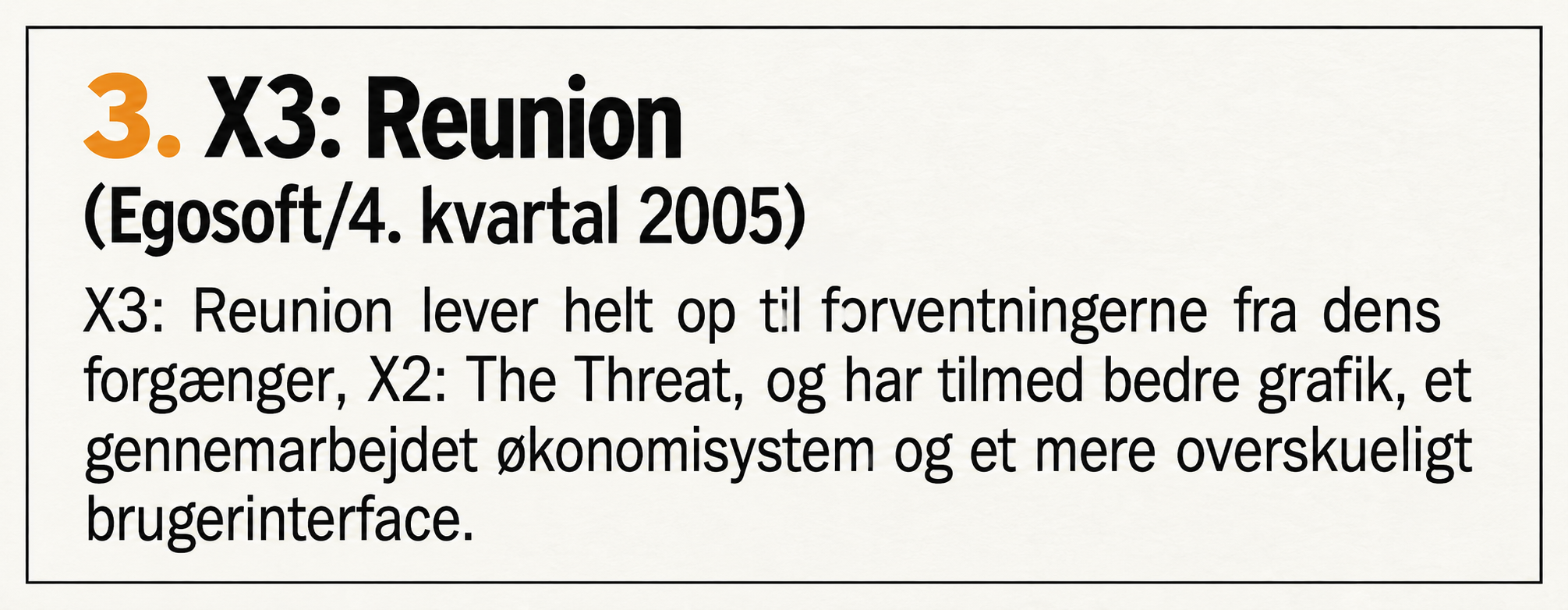
The magazine praised better graphics, a reworked economy and a clearer interface than X2: The Threat. The attraction was the freedom to work within a large universe: carry goods, look for profitable trades, fight, build stations and expand a business. The economy was a system to learn, with production, supply, demand and competing traders affecting opportunities.
Its trading screens make the management side obvious. Stock, prices, cargo capacity and the player’s standing matter as much as the ship outside the window. A large balance alone does not make every item available. This is a space simulation built around menus and interconnected systems as well as flying and shooting.

The confident preview looks worse beside the launch problems. Egosoft’s 28 October 2005 update announcement lists a random crash when entering a sector, audio synchronisation fixes, reduced memory consumption, shader optimisations, menu changes and improvements to factory placement. Those are fairly important things to be fixing as the game reaches customers. The PC aggregate on Metacritic is 71.
Later patches improved the game. The 2.0 Bala Gi Research Missions update also added content, including a player headquarters and more ships; the current publisher listing describes those additions. That later version deserves to be considered separately from the state of the original release.
I am fed up with games reaching customers before basic crashes and performance problems are sorted out. Seeing the same sort of fixes in a 2005 launch does not make today’s unfinished releases any less bloody annoying. It shows how long players have been expected to tolerate this. Third place looks too generous if we judge what arrived at launch, rather than the game after years of repairs.
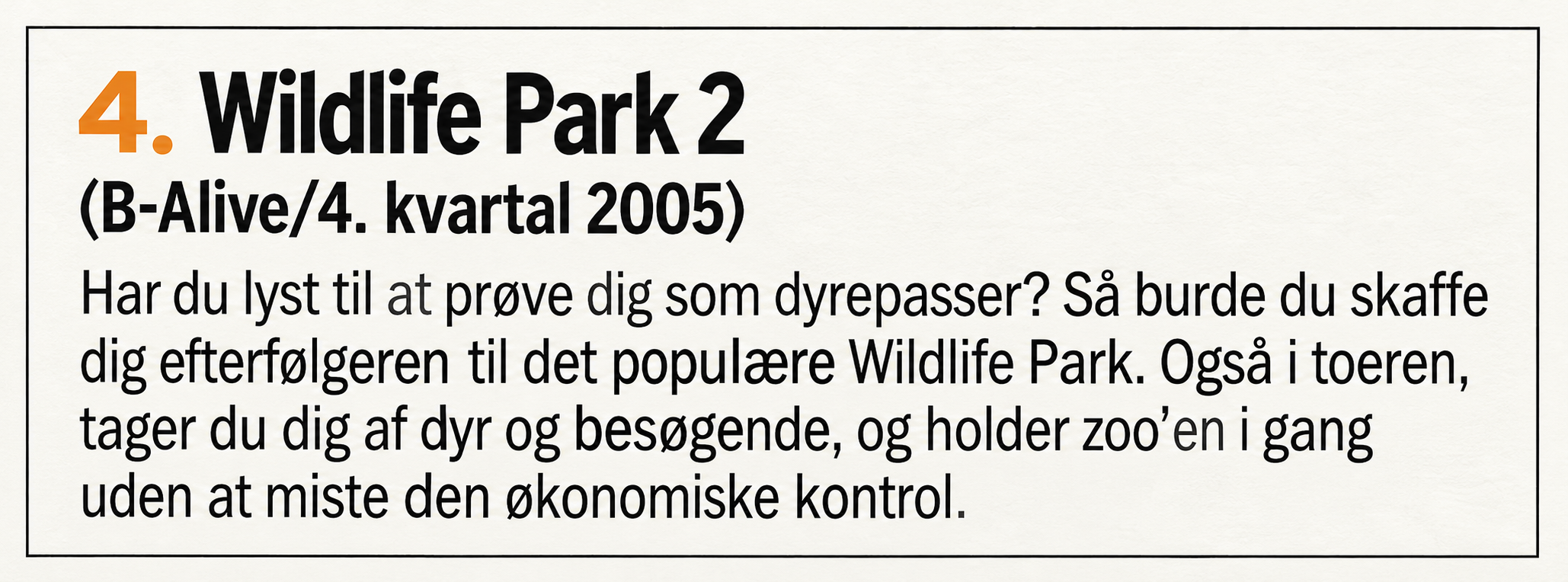
4. Wildlife Park 2
Wildlife Park 2 was a much more obvious building-game choice. B-Alive’s zoo simulation asked players to care for animals, satisfy visitors and keep the park running financially. The magazine expected it in the fourth quarter of 2005. It actually arrived in 2006, so this was another forecast rather than a verdict on a finished release.
The publisher’s description lists 50 animal species, 30 plant species and 20 missions, alongside free-play maps. Enclosures, terrain, water, vegetation and equipment all formed part of the park. Keepers, gardeners and veterinarians handled different jobs. Animals could breed, age and interact with their surroundings, while visitors needed facilities such as food outlets and entertainment.
Animal care involved more than dropping an animal into a fenced rectangle. The terrain and climate had to suit it, and status icons drew attention to its needs. The water simulation and landscaping tools also let players create streams and waterfalls. Research could even introduce extinct animals. There was plenty of scope for construction and management beyond the short “be a zookeeper” description on the magazine page.

Metacritic has no PC Metascore for it because too few professional reviews are indexed. The two listed reviews are positive. There were nevertheless limits to its animal simulation: Gamesaktuell’s 2006 review criticised predators that failed to catch prey and animals wandering away from food and water. The park still needed keepers and fences rather than becoming a self-sustaining ecosystem.
The game later gained numerous expansions, including Crazy Zoo, Marine World and Dino World. The 2005 preview was the beginning of a much larger series of animal and park-building releases.
5. RollerCoaster Tycoon 3: Soaked!
Fifth place went to the first expansion for RollerCoaster Tycoon 3. The June 2005 forecast was broadly right: Atari announced a North American release for 21 June 2005. The developer was Frontier Developments, also responsible for the base game.
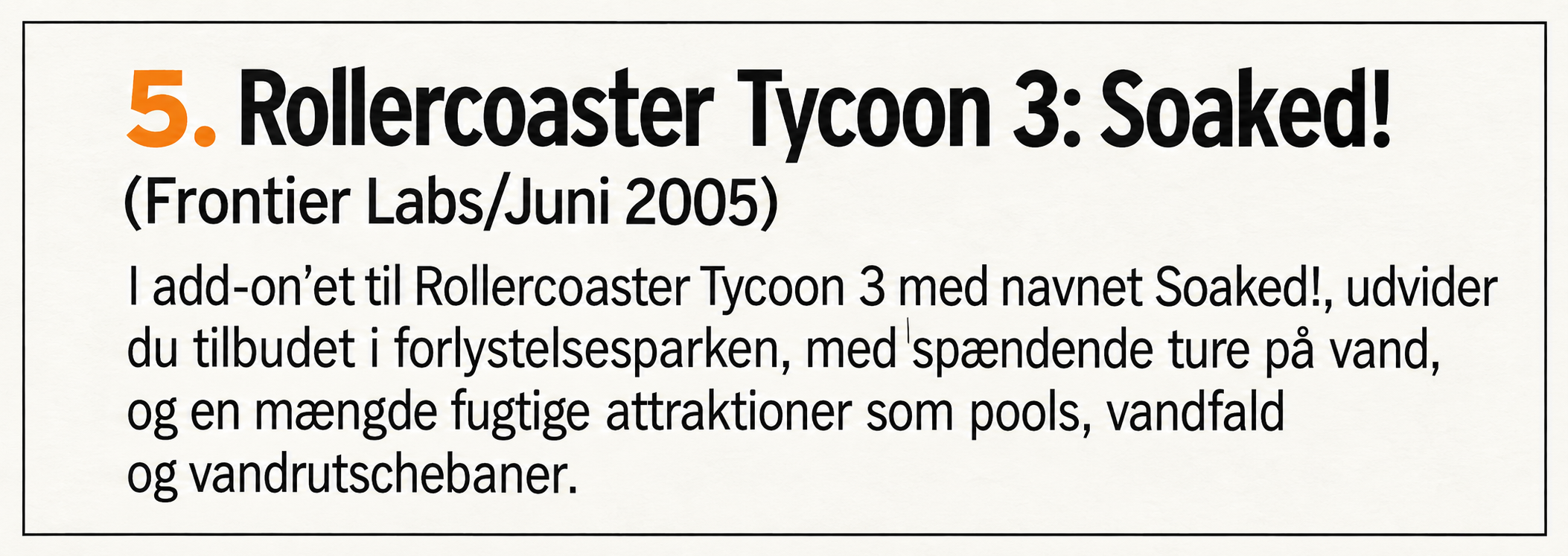
The expansion extended the existing park-building game with water parks. Pools, flumes, slides, wave pools and other water attractions gave players another kind of park to design, along with marine shows. They still had guests to satisfy, attractions to operate and a park layout to manage. It required the base game; this was an addition to a working simulation rather than a new standalone title.
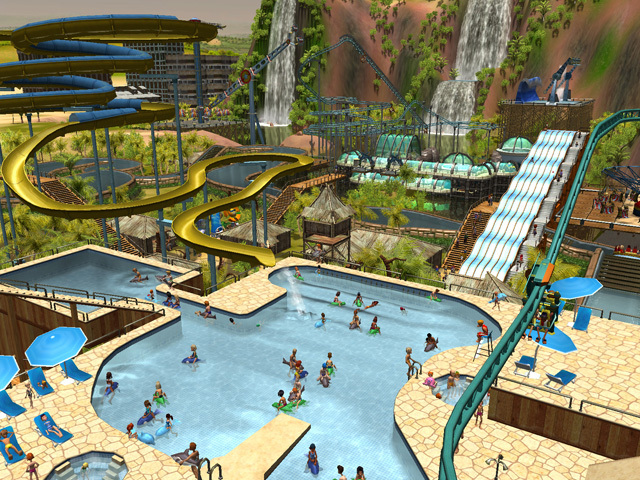
Its Metascore of 79 reflects a generally favourable response. The additions were substantial enough to give existing players more to build and manage. As a match for the magazine’s category, this seems a stronger choice than some of the higher entries.
I would question putting it below X3. That is partly about the troubled space-game launch, but it is also about what this particular list claimed to cover. Designing an amusement park and expanding it with a whole water-park system fits the LEGO-to-PC introduction extremely well. The Tycoon name was familiar to me; this particular expansion still was not one I spent time with.
6. Tycoon City: New York
Deep Red’s Tycoon City: New York had a simple fantasy: start as an entrepreneur and build a commercial empire in Manhattan. The preview gave it a fourth-quarter 2005 window. The finished Windows game followed in February 2006, with the North American date recorded as 21 February.
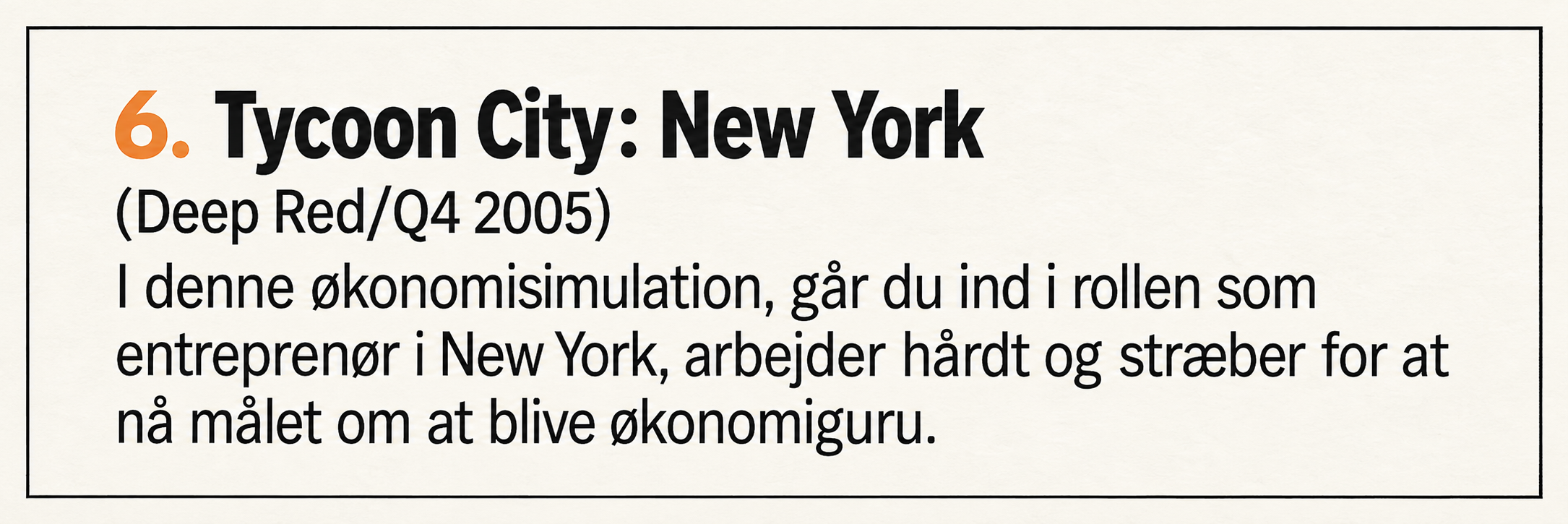
The focus was individual businesses and the people around them. The original manual explains checking citizens’ needs, choosing suitable shops or services and upgrading them to attract more customers. A business had a sphere of influence, so its location and improvements affected who knew about it. Different neighbourhoods and customers called for different businesses.
It offered a guided Build New York campaign and a sandbox mode. As the player developed an area, the game filled in supporting businesses or residential properties. The publisher listing advertised more than 100 business types, from restaurants and nightclubs to theatres and larger commercial buildings. The New York setting gave the game recognisable streets, districts and landmarks rather than an anonymous patch of land.

The eventual Metascore was 67. Contemporary criticism often came down to attractive presentation and accessibility without enough challenge or economic depth. The city and the business-building idea were appealing, but the response was much more ordinary than the ambition of becoming Manhattan’s great business mogul might suggest.
Sixth place does not look unreasonable. The setting and business-building idea were easy to understand, but the finished game did not earn the reception of the stronger entries on this page.
7. NHL Eastside Hockey Manager 2005
The hockey entry is where the printed year goes wrong. The clipping says NHL Eastside Hockey Manager 2006, but gives the release date as 27 May 2005. That date matches the European release of NHL Eastside Hockey Manager 2005 in Sports Interactive’s own archive.
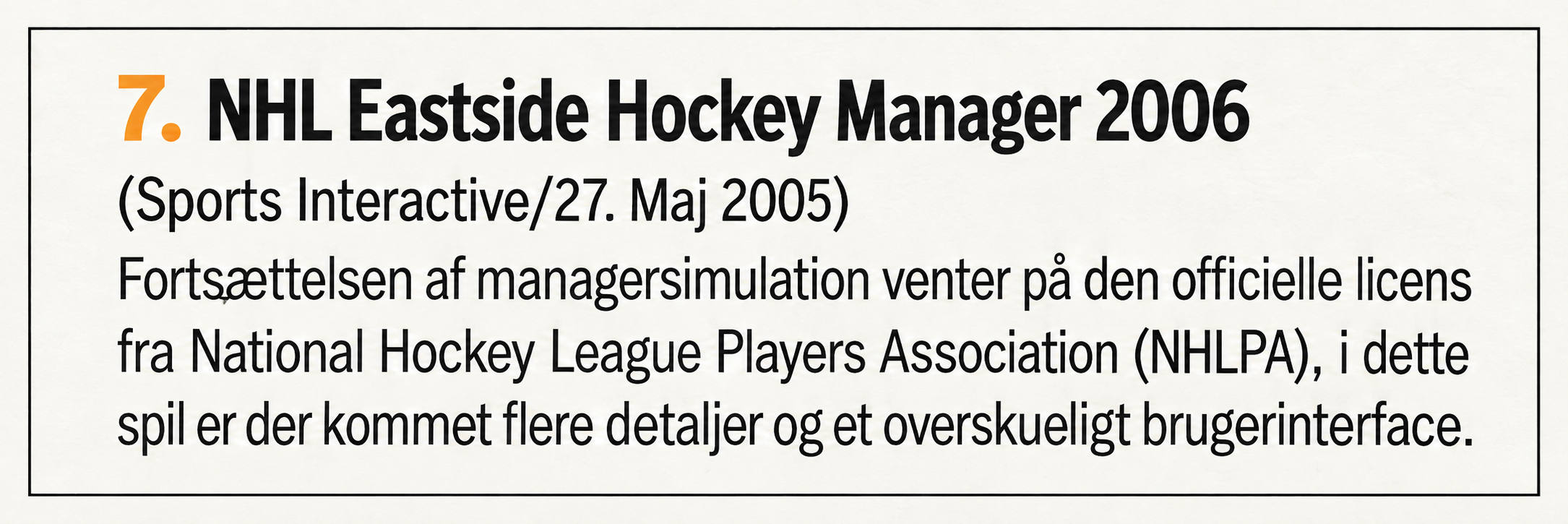
The preview mentioned the NHLPA licence, extra detail and a clearer interface. The finished game’s interface was brought closer to Football Manager after player feedback. Its database grew to more than 30,000 players and staff, with the AHL and ECHL among the additions. Training camps expanded player development, and a tactical 2D match view gave managers a way to follow the action.

North America received the game on 27 September 2005 with updated rosters and rules for the 2005–06 season, including the NHL salary cap. Its PC Metascore is 82. The next named release in Sports Interactive’s archive is NHL Eastside Hockey Manager 2007, released in September 2006, rather than an intervening 2006 edition.
Seventh place therefore hides a well-regarded, detailed management game. It was also aimed at a very specific audience. A 2D hockey match, player contracts and a large statistics database have little in common with the visual construction of a theme park, even though both involve management. Ice-hockey management never interested me enough to get into this one.
8. Football Manager 2006
The last clipping prints Footballmanager 2005, then predicts a release in the fourth quarter of 2005 and mentions conversations with players at half-time. Those details point to Football Manager 2006. The previous PC edition had already arrived on 5 November 2004; Sports Interactive records the 2006 edition’s release as 21 October 2005.
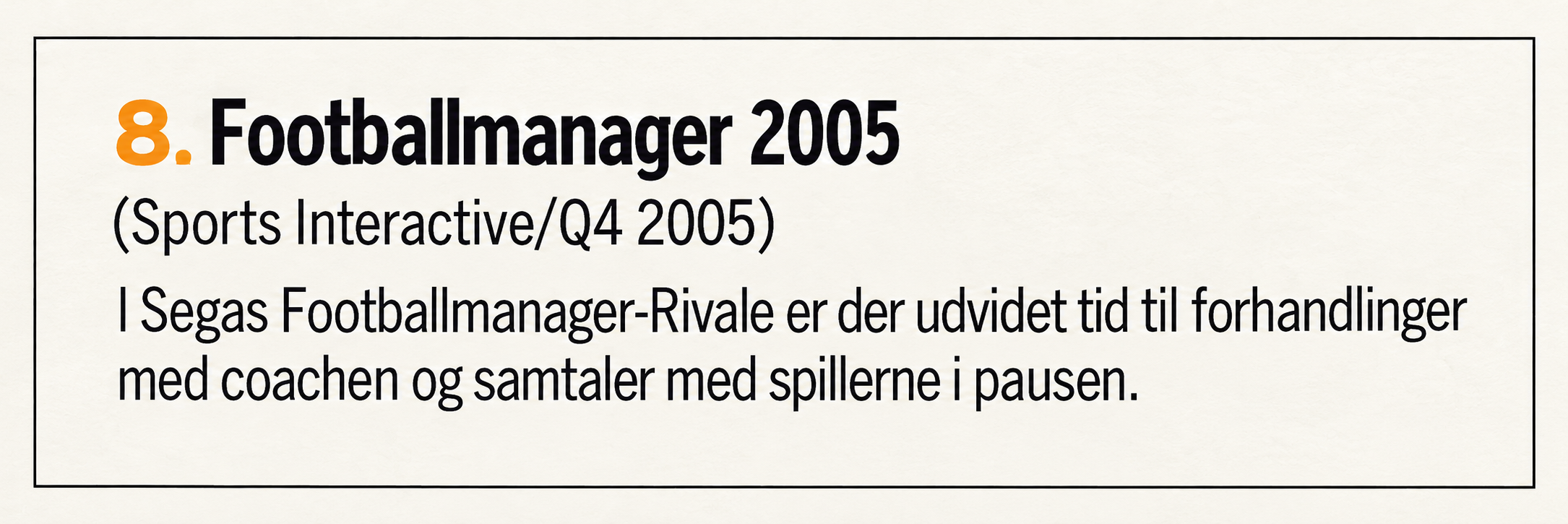
Half-time team talks were a new feature in that edition, with post-match talks also part of the system. Managers could address the team and individual performances, while the revised training system made coaches’ attributes and assignments more significant. Miles Jacobson discussed those changes in GameSpot’s May 2005 interview, months before release.
The match engine was still presented through 2D players and extensive information. The decisions happened around selection, tactics, training, contracts and relationships with the squad and board. The new in-game help was intended to make that depth easier to approach, rather than remove it. This was a management simulation with a great deal happening behind its comparatively plain screens.

Sports Interactive’s archive displays a Metacritic score of 89, and BAFTA nominated it for the 2006 Simulation award won by The Movies. Last place looks particularly strange if the ranking is supposed to predict strong management games. It makes more sense as a reflection of how much excitement the editors attached to each preview.
With the hockey title a year too high and the football title a year behind, the two labels look like an accidental swap. The dates and described features are better guides than the printed years. Football management was another part of PC gaming I never got into.
The ranking after release
The magazine had a defensible first choice in The Movies. Nightlife also made sense as a prominent expansion. I am less convinced by X3 in third place given its launch problems, or by putting both Sports Interactive games at the bottom when their finished versions were so well received. Soaked! also looks too low for a category supposedly centred on building and managing.
The list mixes finished-game quality, familiarity, visual appeal and expectations. Two expansion packs depended on games people already owned; two other entries missed the predicted year. A zoo, a film studio, a space economy and a football club are all systems to manage, but that does not make their audiences interchangeable.
| Magazine rank | Game | Original PC release | Critical reception |
|---|---|---|---|
| 1 | The Movies | November 2005 | 84/100, Metacritic; BAFTA Simulation winner in 2006 |
| 2 | The Sims 2: Nightlife | September 2005 | 76/100, Metacritic |
| 3 | X3: Reunion | Late 2005 | 71/100, Metacritic; substantial launch fixes |
| 4 | Wildlife Park 2 | 2006 | No Metascore; two indexed professional reviews |
| 5 | RollerCoaster Tycoon 3: Soaked! | June 2005 | 79/100, Metacritic |
| 6 | Tycoon City: New York | February 2006 | 67/100, Metacritic |
| 7 | NHL Eastside Hockey Manager 2005 | May 2005 in Europe; September in North America | 82/100, Metacritic |
| 8 | Football Manager 2006 | October 2005, PC | 89/100, Metacritic, shown in SI’s archive; BAFTA Simulation nominee in 2006 |
Magazine source: Dansk PC Gaming World, issue 7/2005. Magazine photographs: Kiba Snowpaw. The eight magazine clippings shown here have been restored with AI for readability.