
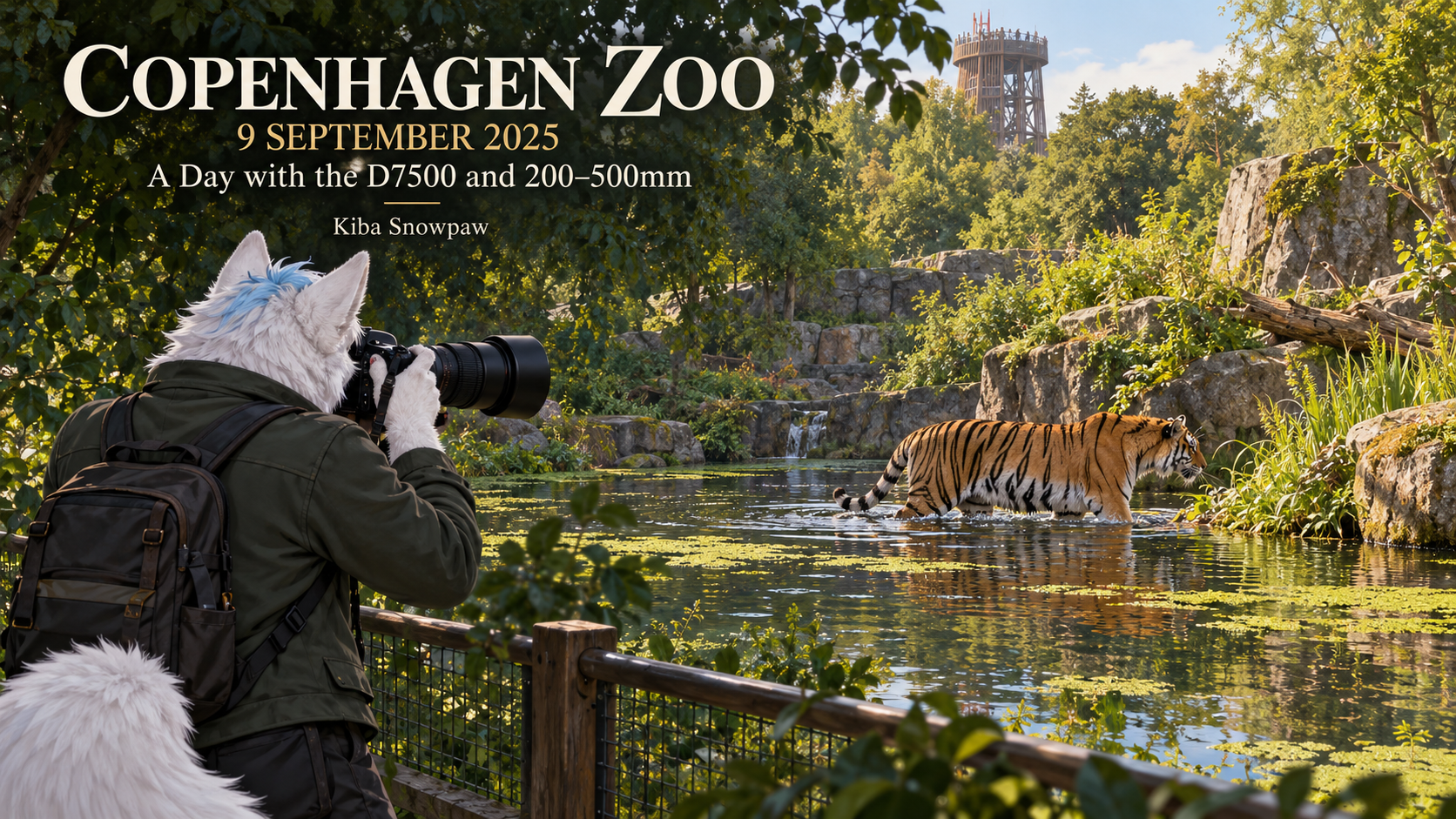
On 9 September 2025, I was back at Copenhagen Zoo with my Nikon D7500 and the AF-S Nikkor 200–500mm f/5.6E ED VR. I started with the flamingos. Several had their heads tucked into their feathers, leaving these big pink shapes standing against the dark greenery. There was plenty to photograph before anything even moved.
With a lens like this, I tend to get pulled into the smaller details: an eye, the edge of a feather, a paw hanging over a ledge. This visit went from birds resting beside the water to a tiger moving through a bright green pool, with a polar bear, prairie dogs and penguins along the way.

Back at Copenhagen Zoo with the 200–500mm
Copenhagen Zoo is in Frederiksberg, beside Frederiksberg Have and Søndermarken. It began in 1859, founded by Niels Kjærbølling. There is a lot of history behind the place, but once I have an animal in the viewfinder, I am usually concentrating on something much smaller than the whole zoo.
The 200–500mm suited that way of photographing. At 200mm I could leave some of the surroundings in the frame; at 500mm I could get right into a bird’s face or the tiger’s whiskers. On the D7500’s normal DX image area, that zoom gives roughly the same framing as 300–750mm on a full-frame camera. Nikon lists the lens at about 2.3kg with its tripod collar, before adding the camera. It is a substantial thing to carry around. Nikon’s lens specifications cover the constant f/5.6 maximum aperture and vibration reduction.
That reach also means a narrow view. A small bird can fill the frame, but when a larger animal is close, 200mm is already quite tight. I moved between head portraits and wider views throughout the visit, rather than staying at 500mm for everything. The wider tiger photographs are at 220–310mm; the very close side portrait is at 500mm.
I have written separately about getting the 200–500mm in August 2025. Here it was doing the job I bought a long lens for: photographing animals, including the little ones that are easy to walk past.
Older reference map of Copenhagen Zoo

For a present-day visit, use Copenhagen Zoo’s current map.
Inca terns, a tucked-up duck and more flamingos
The adult Inca tern gave me a much cleaner outline than the resting flamingos. Dark grey feathers, a red bill and those white curls beside its face. At 500mm, the curled feathers and the small yellow patch at the base of the bill were easy to pick out.


The brown youngster looks quite different. Its bill is dark, the feathers have pale edges, and the adult’s white moustache has not developed properly yet. Young Inca terns really do start out with this browner plumage and dark bill and feet; they gradually acquire the adult appearance. Louisville Zoo’s species account describes both stages.
Inca terns (Larosterna inca) belong to the Pacific coast of South America, especially the rocky coasts and islands of Peru and Chile around the Humboldt Current. They eat fish and other small marine prey, taking food near the surface and sometimes stealing scraps from other animals. They nest in colonies, using protected crevices and cavities. They can also use old nesting cavities made by other seabirds.
The Australian shelduck was standing with its head turned back into its feathers. Its chestnut breast and the white around the eye still show clearly. The bird had tucked away most of the part I would normally try to focus on.

Australian shelducks (Tadorna tadornoides) come from south-western and south-eastern Australia. They favour freshwater wetlands and also use other waters when fresh water is accessible. Much of their feeding is grazing on grass, with algae, insects and molluscs also included. The female’s white eye-ring is a useful identification feature. The Australian Museum has more on their habitat and diet.
I came back to the flamingos for closer views. The group photograph is mostly feather shapes and folded necks; the portraits show the eyes, the long curved bills and the different shades within the pink. In the photograph with two heads together, the necks run through the frame in different directions. I like that arrangement more than another row of birds standing side by side.


These are American flamingos (Phoenicopterus ruber), also called Caribbean flamingos. In the wild they live around shallow lagoons, coastal wetlands and saltwater or brackish waters in the Caribbean region and nearby parts of the Americas, with a separate population in the Galápagos. They feed with their bills turned upside down, filtering small organisms and other food from the water. Carotenoid pigments in foods such as algae and small crustaceans contribute to the pink and reddish feathers. The Smithsonian explains the colour and filtering mechanism in more detail.
Lions with their paws over the edge
From the birds I moved on to the lions. One was lying on a raised ledge with its front paws hanging over the edge. I kept a wider view for that photograph because the ledge and the dangling paws were the whole point of the pose.

Then I went closer. With the head upright, the eyes and whiskers stand out against the rock. With the head down, the ledge becomes a pillow and the front paws sit beside the face. There was very little movement between some of the photographs, but the position of the head changed the picture quite a lot.


Lions (Panthera leo) live mainly in scattered populations across sub-Saharan Africa, with a surviving Asian population in and around India’s Gir landscape. They use grassland, savanna, scrub and more wooded habitats. Their prey includes large mammals such as zebra and wildebeest, although they also take smaller animals and scavenge. Smithsonian’s lion account describes that range of habitats and food.
Unlike the mostly solitary tiger, lions live in prides. Related females and their young form the core of many prides, with males joining or holding access to the group. They spend a substantial part of the day resting, with much hunting around dusk and at night. The zoo’s lion page discusses their social life and resting behaviour. On this visit, the resting part was very much what I had in front of the camera.
The close portraits were taken at 500mm, f/7.1, 1/160 second and ISO 500. That is a much slower shutter than I used later at the tiger. It suited a quieter subject, although at this focal length a small movement can still spoil the detail around the eyes.
The polar bear in the pool
At the polar bear, I had a white head above the water and a dark nose pointed upward. In the wider photograph, a hooded crow is standing on the rock behind it. I kept the crow in that frame; it gives the scene another small thing to notice once you have looked at the bear.

At 500mm, almost all of that setting disappears. The wet fur separates into little clumps, the nose fills much more of the picture, and the bear’s closed eyes change how the face looks. The wider photograph and the close portrait are only seconds apart.

Polar bears (Ursus maritimus) live around the Arctic, including Greenland, Canada, Alaska, Russia and Svalbard. Sea ice is central to their lives because it gives them a platform for hunting seals. Ringed and bearded seals provide the high-fat food they are adapted to live on. A bear may wait at a seal’s breathing hole or approach one resting on the ice. Polar Bears International describes their habitat and seal-based diet.
As warming lengthens ice-free periods in parts of their range, bears can have less time to hunt and longer periods living on stored fat. Fish, plants and occasional land prey do not simply replace a reliable supply of seal blubber.
Photographing this pale fur against darker water meant paying attention to the highlights. A bright coat can lose its texture while the rest of the scene still looks fairly dark. Here I could keep both the fur and the wet black nose visible.
Prairie dogs getting on with the digging
The prairie dogs brought the camera back down to the soil. One had its head beside a burrow entrance, with loose earth around its front feet. In another photograph, two were close together and one was looking up while the other faced away.


I used 200mm for both of these views. There was enough animal in the frame without cutting away all the soil and the hole. The earth matters in a photograph of a digging animal; a head portrait alone would have lost most of what it was doing.
Black-tailed prairie dogs (Cynomys ludovicianus) are social ground squirrels from the North American Great Plains, with a native range extending from southern Canada into northern Mexico. They eat mainly grasses and other leafy plants, with occasional insects. Their colonies are often called towns, and family groups occupy connected burrows with chambers below ground.
They also change the grassland around them. Digging turns and aerates soil, grazing changes the vegetation, and burrows provide shelter used by other species, including burrowing owls. Smithsonian’s prairie dog account covers their food, burrows and role in the grassland.
The settings changed noticeably between the two photographs: 1/200 second at ISO 250 for the first, and 1/2500 second at ISO 2500 for the second, both at f/7.1. A much faster shutter gives more room for a sudden movement, but it also means needing more light or a higher ISO.
Humboldt penguins up close
At the penguins, I concentrated on the heads. The younger bird has a softer grey face, with the eye and bill standing out against it. The adult has the much stronger black-and-white pattern and the exposed pink skin around the base of the bill.


Humboldt penguins (Spheniscus humboldti) come from the Pacific coast of Peru and Chile, where the cold, nutrient-rich Humboldt Current supports the fish they feed on. Their food includes small fish such as anchovies, as well as squid and crustaceans. They breed along rocky coasts and islands, using sheltered nest sites.
Their wings work as flippers underwater. The streamlined body and close-packed feathers suit swimming in cold water, and the dark back and pale underside help camouflage them when viewed from above or below. Copenhagen Zoo’s Humboldt penguin account explains those adaptations. Young penguins develop their adult markings gradually, as described in SeaWorld’s guide to penguin appearance.
The connection to the Inca terns is quite close: both belong to that productive stretch of South American coast. They use it differently, with the tern taking prey near the surface and the penguin pursuing it underwater.
For the young penguin portrait, I was at 500mm, f/13, 1/2500 second and ISO 10,000. That is a high ISO, and the fine detail pays for it. Opening the aperture would have let in more light and allowed a lower ISO at the same shutter speed, with a shallower area in focus. For this quiet portrait, I had room to make that trade-off.
The tiger, the green water and a lot of photographs
The tiger took up a large part of my shooting. First there were leaves and branches around the face, then more open views as it moved. The stripes stand out in a clean portrait, but among the plants the outline breaks up surprisingly quickly.
Copenhagen’s tigers are Amur tigers, also known as Siberian tigers. Their wild home is the forested Russian Far East and north-eastern China. They hunt animals such as deer and wild boar, usually approaching under cover before making a short attack. Unlike lions, adult tigers generally live and hunt alone, apart from mothers raising young. San Diego Zoo’s tiger account describes their hunting, habitats and solitary lives.
The photographs by the pool were the ones I kept coming back to. The orange coat sits against dark water and a bright green surface layer, while the white around the face stays clear. In the closer pool photograph, the tiger is looking almost directly toward the camera, with the body running across the frame behind the head.

On the bank, I photographed the tiger walking toward me, one front paw planted ahead of the other. At 270mm I could keep the whole head and the front legs in the frame.

A little later there is the wider pool view, with more water around the tiger and its body lower in the pool. It gives the animal some space instead of filling the whole photograph with its face.

Tigers are strong swimmers and readily use water. Copenhagen Zoo notes that its Amur tigers use bathing to cool down. Their thick winter coats suit cold forest climates, but water is quite a normal part of a tiger’s life too.
I used several different framings here. The wider pool photograph shows the setting and the position of the body. At 500mm, the side portrait is about the eye, nose and whiskers. The background becomes much less definite and the face carries the picture.

Most of this sequence was at f/10 and 1/3200 second, with ISO around 8000–10,000. The walking photograph was at 270mm, the wider swimming photograph at 220mm, and the close side portrait at 500mm. The fast shutter helped preserve detail during movement, but the high ISO added visible grain. The lens could open to f/5.6, so there was room to trade some depth of field for more light.
Vibration reduction helps with camera shake. It does not stop a tiger’s head or paw moving during an exposure. That is the difference I have to work with when an animal goes from resting to walking while I am still holding the same camera and lens.
Later in the sequence, the tiger was resting with its head turned back and its striped body filling the lower part of the frame. After the open water, it was back against leaves and darker cover.

Amur tigers face threats from poaching and the loss and fragmentation of their forests. Protecting them also means protecting the deer and wild boar they depend on. Copenhagen Zoo lists the Amur tiger as endangered. San Diego Zoo describes the conservation threats.
Cockatoos in the trees
The birds under the foliage were a different light problem. Bright gaps between leaves sat behind very dark feathers, and branches crossed through the view. The red-tailed black cockatoo had its head lowered into its feathers while preening, with its crest raised above it.

Red-tailed black cockatoos (Calyptorhynchus banksii) are native to Australia and occur in woodland and other wooded habitats across different parts of the country. Their strong bills open woody fruits to reach seeds; the particular plants they rely on vary between populations. They also depend on suitable tree hollows for nesting. The Australian Museum explains their food and appearance and the differences across their range.
The galah was much easier to separate from the tree: pink face and breast, pale crown and grey wings. It was still partly framed by leaves, but that pink gave me something much clearer to work with.

Galahs (Eolophus roseicapilla) live across much of Australia. They use a variety of wooded habitats, often near water, and commonly gather in flocks. They eat seeds, especially those of grasses and crops, often feeding on the ground. Nesting takes place in tree hollows, with both parents helping incubate the eggs and care for the young. The Australian Museum’s galah account has more about that side of their lives.
Both bird photographs were at 500mm, 1/3200 second and ISO 12,800. The black cockatoo was at f/10 and the galah at f/9. These are among the tougher photographs for fine detail: high ISO, foliage and strong differences between light and shade. I still wanted the preening posture and the galah sitting in the tree, rather than only keeping birds that happened to stand in easy light.
Budgies and rock-wallabies
The budgerigars were sitting together on a branch in front of the aviary building. Their yellow faces and green bodies were bright in the sunlight, with the dark barring across their backs showing clearly. The wall and bars remain part of the background in this photograph.
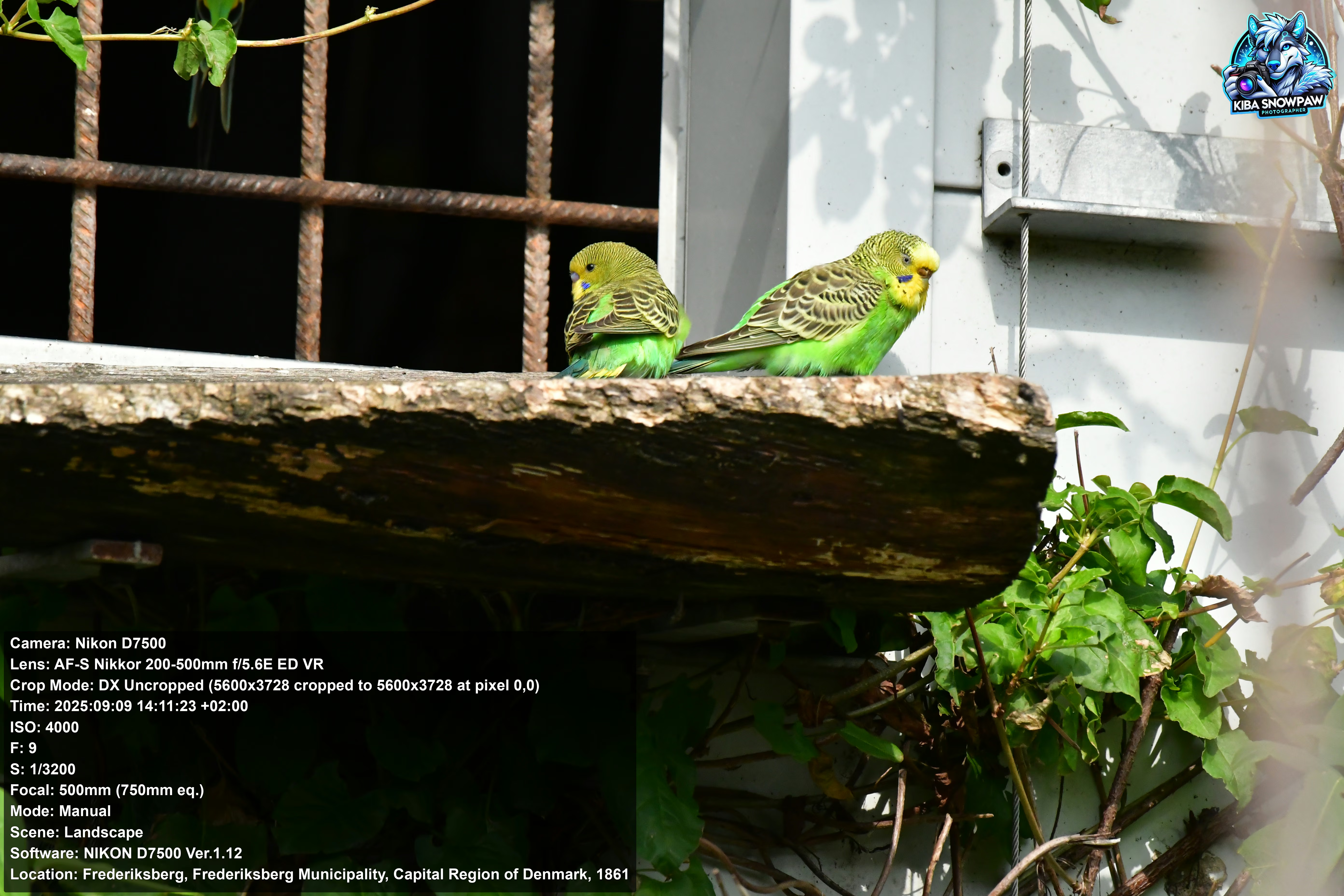
Budgerigars (Melopsittacus undulatus) are wild Australian parrots. Across much of the mainland, flocks move through open country as food and water conditions change. Their diet is mainly the seeds of native grasses and herbs. Rain can create the conditions for feeding and breeding, and nests are made in tree cavities. The familiar green-and-yellow colouring is the wild form; the many blue, white and other varieties come from captive breeding. The Australian Museum describes their range, food and nomadic behaviour.
My last photographs here were of the yellow-footed rock-wallabies in Mary’s Australian Garden. At 500mm, the first profile is mostly ears, eye, muzzle and the reddish fur around the shoulder. In the later photograph, the animal is facing more toward me with its head lowered, and the ears catch the light above the grey coat.


Yellow-footed rock-wallabies (Petrogale xanthopus) live among rocky outcrops, cliffs, gorges and steep slopes in semi-arid parts of eastern and southern Australia. They shelter among the rocks during hot weather and emerge to eat grasses, herbs and browse. Their agility suits that broken terrain. The orange-yellow limbs, grey body and white cheek and side stripes are characteristic markings. A young wallaby continues developing in its mother’s pouch for months after birth. The Australian Museum’s species account describes their food, habitat and development.
For these last portraits I stayed at 1/3200 second and f/9, with ISO moving from 4000 to 8000 between the two frames. The close side view is the one where I most like the fur detail around the cheek and the clean outline of the ears.
Photographs and animal references
Animal photographs: Kiba Snowpaw, Copenhagen Zoo, 9 September 2025. The older reference map is credited to Copenhagen Zoo. The zoo’s 2024 animal inventory provides the collection’s species names, including the American flamingo, Australian shelduck, Inca tern and red-tailed black cockatoo. Further habitat, diet and behaviour sources are linked beside the relevant animals.