
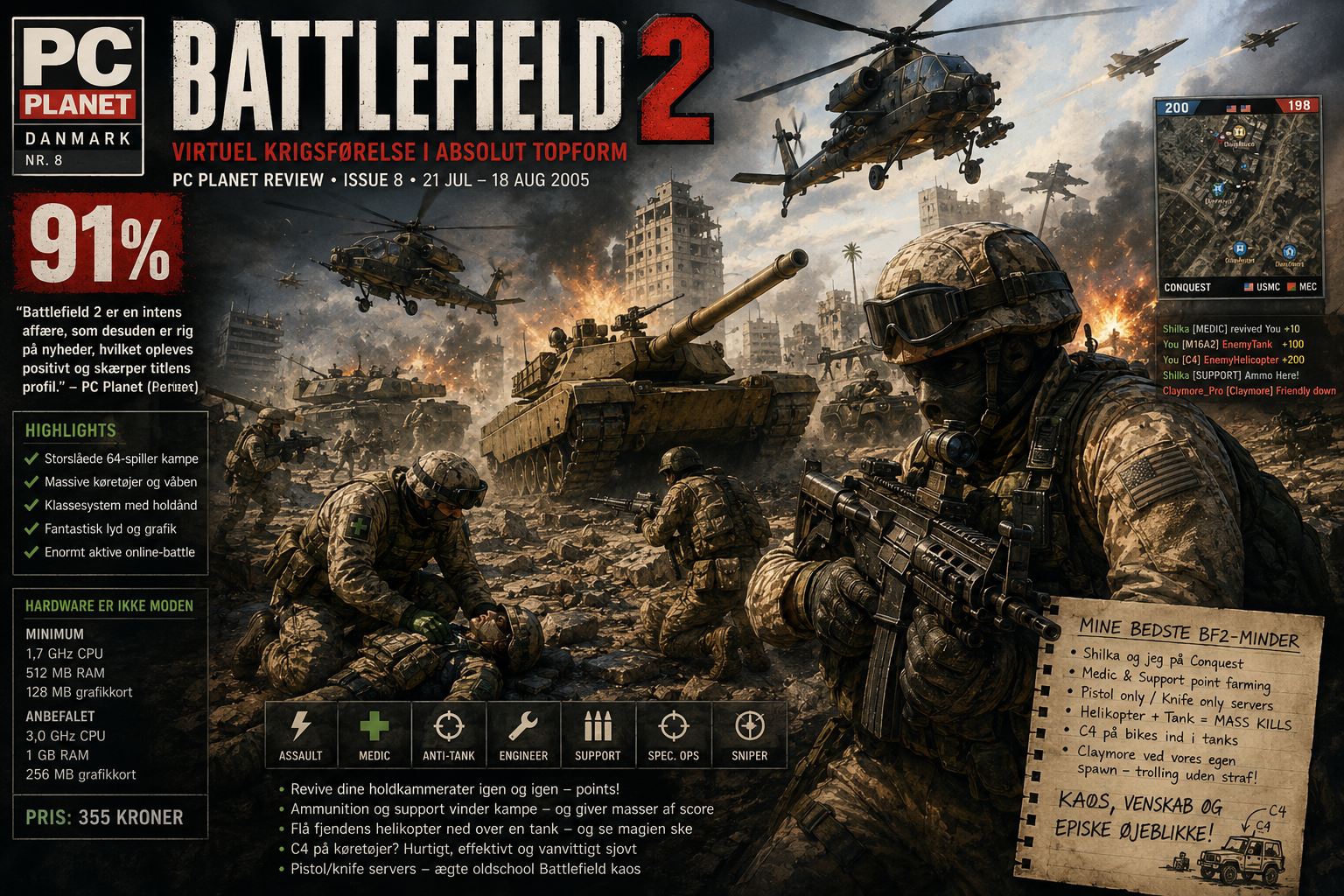
I liked Battlefield 2. I still do. This is one of the few multiplayer games my friend Shilka and I spent a lot of time playing together, and that is why it stays with me. I have been gaming since the 1980s. I have seen enough shooters come and go to know that a huge battlefield and some pretty explosions do not automatically make a good game. BF2 gave us things worth remembering. Some were good teamwork. Some were complete stupidity. We enjoyed both.
PC Planet Denmark gave it 91% in issue 8, covering 21 July to 18 August 2005. The magazine listed a price of 355 kroner and described the warfare as being in absolute top form. That is a big score, but this time I understand it. I would not give the entire package that score today. The missing campaign, the technical trouble and the dependence on other players matter too much to me. But put Shilka on the server, give us a Medic kit, some ammunition bags and vehicles we could cover in C4, and I can see exactly where the enthusiasm came from.

A flag could give you a reason to do almost anything
Battlefield 2 was released for Windows in June 2005, developed by DICE and published by EA. The United States Marine Corps, the Chinese People’s Liberation Army and the fictional Middle Eastern Coalition fought across modern battlefields. Up to 64 people could share an online match. Conquest supplied the basic job: capture flags, hold territory and wear down the other team’s tickets. Those flags also gave you places to spawn. Losing a position could change where your whole team entered the fight, so territory mattered beyond colouring the map.
I liked how little explanation that needed. There is the flag. They have it. We want it. The interesting part was everything between deciding that and actually getting there. Walk across open ground and a sniper might ruin it. Take a tank and somebody could be waiting with anti-tank weapons. Bring a Medic and an attack that should have collapsed might keep going. A helicopter could transport people or make the entire approach miserable. It gave us a clear objective without deciding every movement for us. That is the kind of freedom I want in a shooter.

Big maps were useful, but size was not a free victory
What made the flags good was that losing one could make the next fight harder. You were not simply collecting coloured circles. A useful spawn position shortened the journey back. Losing it could leave the squad approaching from farther away, through ground the enemy could watch. That gave attacks a purpose. I could understand why we were moving without needing a briefing scene every five minutes.
It also meant a bad round could keep feeding itself. Lose the useful positions, lose the vehicles or lose the squad leader and the trip back becomes worse. The winning side gets more freedom while the losing side struggles to organise a response. I do not need every match to be equal until the last second, but there is a difference between being beaten and spending the rest of the round waiting to be beaten again. A large map cannot fix that by itself. Sometimes it just gives the losing team a longer walk.
I like space when it gives me choices. I like less space when it keeps a fight readable. BF2 needed both, and that depended on how many people were actually playing, which map layout was running and whether anybody bothered defending the flags behind the frontline. Having 64 players on the server did not mean 64 people were doing something useful. A few squads could create a proper battle. A crowd could turn the same map into noise.
Seven classes, and shooting was only part of the job
Assault, Medic, Anti-Tank, Engineer, Support, Special Forces and Sniper all had a reason to be there. Medic kept people alive. Support kept them supplied. Engineer repaired vehicles. Anti-Tank dealt with armour. Special Forces brought C4 and sabotage. Sniper worked at range. Assault was the straightforward fighting option. Picking a class meant giving something up as well as getting something useful. You could not carry every answer in your own pockets. That made other players valuable, which is more convincing than a loading-screen message telling everybody to work together.
Shilka and I also noticed the points. Of course we did. If a kill earned something, helping somebody could earn something too. Find a player burning through ammunition and Support had work. Find a dangerous position where people kept dropping and Medic had work. I did not have to be the best shot on the server to contribute. That was a smart decision. A player with poor aim could still be useful instead of spending the whole evening being target practice for everybody else.
Support: you keep shooting, I keep getting paid
I remember supplying people who barely stopped firing. He empties another magazine. I give him more ammunition. He keeps shooting. I keep supplying him. His appetite for bullets becomes my source of points. It was useful, but it was also funny to watch somebody turn himself into an ammunition disposal machine while I stood nearby making sure the business stayed open. He could feel like the great soldier winning the firefight. I was happy being the person who kept the gun fed.
That fitted the way I often play. In strategy games I like building an economy before committing the army. Resources first, then something strong enough to use them. BF2 let me do a little of that inside a shooter. Ammunition, health, working vehicles and useful spawn positions were things a team needed. Killing an enemy was obvious work. Keeping five people able to fight could matter just as much. I liked that the game bothered to count it.
Medic: stand up, get shot, stand up again
The defibrillator changed a fight because a downed soldier did not always have to leave it. Revive him and he could continue from the same place. Around a flag, that could be the difference between losing the position and keeping enough bodies there to hold it. A good Medic gave a squad staying power. Instead of everybody making another trip from spawn, somebody was there to put them back on their feet. That is an actual contribution to the fight.
Then there was what I remember doing when a player lay exposed while I could reach him from slightly safer ground. He gets shot. I revive him. He stands up and gets shot again. I revive him again. The enemy keeps firing, the poor bastard keeps going down and my points keep rising. From his side it must have felt like the Medic was refusing to let him escape. From my side, the game kept paying for the same job. We laughed at things like that. I am not going to turn it into a story about noble battlefield medicine.

The scoreboard did not know whether I was being useful
That is also a problem with BF2, even though I enjoyed taking advantage of it. Reward the action and people will chase the action. The scoreboard can see a revive. It cannot judge whether putting that soldier back into exactly the same gunfire helped anybody. Supply ammunition and the number rises. It does not ask whether the ammunition was doing useful work. DICE wanted teamwork, but some of what it rewarded was repetition. Sometimes the best thing for the team and the best thing for my score were different things.
I know that because I was one of the players watching those numbers. It is easy to blame other people for farming points when I remember noticing profitable situations myself. I can enjoy the old story and still see the weakness. A scoring system that makes a trapped teammate valuable because he can be revived repeatedly has a hole in it. The funny part depends on somebody else having a miserable time. That is a much messier result than the clean teamwork pitch on the box.
A revive can help the Medic more than the man being revived
My repeated-revive memory is funny to me, but it is also a very clear criticism. A revive that returns somebody directly into a waiting gun can be the wrong decision. The Medic gets credit. The revived player gets another death. If the scoring tells the Medic that the action was a success anyway, it encourages him to keep making it. That is where a good support mechanic becomes a selfish one.
The sensible job is to make the position survivable: deal with the threat, provide cover or stop dragging the same player back into it. BF2 could not make that judgment for me. It left the decision to people who were sometimes thinking about points and sometimes just enjoying the absurdity. I like the tool. I think the reward was too willing to applaud the button press without asking what happened afterwards.
That complaint applies to the bigger progression system as well. Once the player starts measuring the evening in personal numbers, holding a quiet but important flag can look like wasted time. Defending something successfully may mean nobody attacks it. Chasing the busy firefight produces more visible work. A game about territory needs people willing to do useful things that are not always exciting or profitable. BF2 could reward teamwork and still encourage people to abandon the dull jobs that made the team work.
We played knives and pistols too
We also played pistol-only and knife-only. A game gives everybody rifles, machine guns, tanks and aircraft, then the people decide to ignore most of it and chase each other with knives. I liked that freedom. The weapons were the same, the map was the same, but what we wanted from the evening changed. It did not need a new expansion or an official event. People on a server could decide to play differently.
A knife kill also felt different. Somebody had to get close enough to do it. Being shot in a military shooter is ordinary. Getting stabbed by a player who could have used a gun feels like he made a special effort to embarrass you. That was part of the fun. The victim knows another human chose the stupid, risky option because the result would be funnier. A bot with a knife does not give me that same feeling.
And yes, there was teabagging
We were playing an online shooter in the 2000s. Of course there was teabagging. Kill somebody, stand over the body and crouch repeatedly where the death camera can see it. A crude joke with one button. Nobody needed a long explanation of what the motion meant. It was childish and insulting, and people did it because it was childish and insulting. I am not going to pretend those servers were full of polite soldiers respectfully congratulating one another.
It did nothing to help capture the flag. It could even get you killed because you were wasting time over a corpse instead of watching the fight. That was why it worked as an insult. You were showing the other player that laughing at him mattered more, for those few seconds, than playing sensibly. Between friends it could be funny. Against a stranger it could start a revenge hunt. The next time that player found you, he had a reason to make it personal.
The radio calls could become part of the joke
BF2 did not need a character delivering a clever one-liner to sound like itself. “Enemy boat spotted!” became one of those calls players turned into a joke through repetition. A practical report could become ridiculous when somebody kept sending it. “I need ammo!” and “I need a medic here!” were more useful, at least when the right player listened. The Medic screenshot here even shows the latter request in the chat.
I like how the serious delivery sits beside what the players are actually doing. The radio wants to sound like a military operation. Somebody on the server is chasing a knife kill, another is crouching over a corpse and Commander might be trying to crush a man with a supply crate. The voices keep doing their professional job while the match becomes stupid. That mismatch fits BF2 better than a written joke explaining the comedy.
Those calls also expose the weakness in the teamwork pitch. Asking for ammunition does not create a Support player who cares. Asking for a Medic does not create a safe revive. The game can provide the words, the icon and the equipment, and another human can still ignore all three. I like having the tools. I judge them by what happens after the request, not by how convincing the soldier sounds saying it.
The helicopter came down and took the tank with it
One kill I still remember started with an enemy helicopter near a flag and an enemy tank underneath or close to it. I destroyed the helicopter. Good enough already. Then it fell, exploded and took the tank with it. The result gave me more kills than I had expected. I had not set up some clever plan to destroy both. The other players happened to put those vehicles in the wrong places, I shot the helicopter and the wreck finished the job.
That is the sort of thing I remember better than a scripted explosion. I did something, and the result went further than I had intended. The pilot was trying to do his job. The tank crew were doing theirs. I interrupted both in a way none of us had planned. A campaign can make an explosion prettier. It cannot give me that exact surprise by telling me in advance to shoot the marked helicopter and watch the tank die. This was ours because nobody had arranged the whole thing for us.

Supply crates made very good sniper delivery services
The Commander could drop a supply crate to help people in the field. Useful. He could also try to drop it onto a sniper. Even better when it worked. A big box coming down from the sky did not have to remain a peaceful act of logistics. Somebody lying on a rooftop could become the delivery address. The ammunition was arriving, just not in the way he wanted.
I remember the pleasure of finding a sniper who thought he had found a comfortable spot. He is up on a roof, looking through the scope and bothering everybody below. Rather than trying to win a sniper duel, we could try to give him a box on the head. I liked the stupidity of it. All those rifles and missiles, and the answer might be ordering supplies. It was much funnier than shooting him normally.
Flattening a sniper became its own little sport
It could miss. The sniper could move. The timing could be wrong. That made a successful drop more satisfying. You were trying to hit somebody with something that was not meant to be your precision weapon. We would spend attention on a rooftop idiot because killing him with the supplies was a joke worth attempting. I did not need a medal for it. The result was enough.
Commander could be a serious job, watching the map and helping squads. It could also mean looking down at the battlefield and deciding one particular man deserved to be crushed. Both came from the same tools. I liked that BF2 let its serious military systems become ridiculous. The game looked like it expected us to behave professionally. We had other ideas.

The same crates could land on our own team
Naturally we also tried dropping crates onto teammates. Once you discover a box can kill an enemy, somebody will wonder whether it can kill the man on your own side who is standing in the wrong place. I remember the appeal being the punishment system as much as the death itself. Shoot your teammate and the game knows what you did. Get a falling object to finish the job and the blame could look different to the software.
We knew perfectly well who caused it. That was the joke. I ordered the box there, gravity did the last bit, and the game could fail to punish it like an ordinary teamkill. I was not carrying out some important tactical experiment for the benefit of the squad. I was seeing whether I could get away with being an idiot. That is part of my BF2 memory too.
The claymore was inside the vehicle
I also remember hiding a claymore inside a vehicle at spawn. Somebody gets into what looks like a normal vehicle, starts driving and the movement becomes part of the trap. The explosive goes off and kills him. That was the trick I remember, and why it made us laugh: the vehicle looked ready to use, and the player found out about the problem after he had taken it.
The attraction was getting a death that did not behave like simply shooting a teammate. Put the explosive there, let somebody take the vehicle and let the game do the rest. We had found another way to make the punishment system look stupid. The man climbing in had no reason to expect his own transport to become the prank.
We were being idiots. I remember that as well.
There was no good military reason for doing it to our own team. We were trolling somebody. I can say that without dressing the memory up. Not every hour with Shilka was disciplined teamwork. Sometimes we were helping. Sometimes we were finding stupid ways to irritate people. Pretending otherwise would make this a cleaner review and a less honest one.
It also shows why freedom in multiplayer is not automatically good for everybody. The person inventing a trap gets the joke. The person losing a vehicle and a spawn gets the annoyance. When I was laughing with a friend, that difference was easy to ignore. The game still had to deal with it. A punishment system that misses indirect kills gives a bored player more ways to make the rest of the server worse.
C4 on a fast vehicle was a better use of the stupidity
C4 vehicles were the useful version. Special Forces had explosives. The battlefield had fast vehicles. Put them together and a cheap transport could deliver enough trouble to an enemy tank to make its armour much less comforting. That was something we did: cover a vehicle in C4 and go after the tank. Getting there was the dangerous part. Survival was not always the main concern.
I liked that the game did not need a special button labelled vehicle bomb. It gave us the pieces and let us combine them. Some servers hated it and made rules against it. Others allowed it. That could be irritating when you moved between servers, but it also showed how much the people running the place shaped the game. A tactic could work perfectly in BF2 and still get you kicked by an administrator who had decided he was tired of seeing it.

Combined arms could become waiting for somebody else to fix the problem
I like vehicles being dangerous. A tank should matter. A helicopter should change how infantry use the ground. If every soldier can casually erase every machine, picking Anti-Tank or keeping a vehicle repaired means much less. The problem comes when the answer exists somewhere in the game but does not exist in the team actually playing the round. Telling an infantry player there is a counter is not much comfort if nobody brings it, nobody uses it well or the aircraft keeps destroying it.
That is the part I would push harder than the usual praise for balance. A list of counters is not the same as a good fight. The driver or pilot can operate his weapon now. The victims may need several strangers to notice the problem, change what they are doing and cooperate before they can answer it. In an organised squad that can be satisfying. On a disorganised public team it can be another round where the same machine farms people who never get a response together.
The freedom to take a vehicle also creates fights inside your own team. Somebody wants the aircraft. Somebody else wants it. The useful machine becomes a queue, a race or an argument while the objective waits. I do not think that ruins the idea of shared vehicles. I do think the exciting moment shown in a screenshot leaves out the dull part when people are more interested in getting their turn than helping anybody else.
C4 vehicles were one reason I liked the room to improvise. A tank was not only a problem for the person who selected the formally correct kit and stood at the formally correct distance. We could try something stupid and dangerous with a transport. It might fail, but it gave us a plan. When a server banned that because the owner disliked it, the rules could remove one of the fun ways of dealing with the stronger equipment. I understand why people argued about it. Those decisions changed more than server etiquette.
This is the sort of sandbox I actually want
BF2 gave ordinary equipment room to do stupid things. An ammunition bag could feed a fight or feed my score. A defibrillator could save a squad or keep a victim standing up under the same gun. A supply crate could help somebody or flatten him. A vehicle could move people or carry C4 into a tank. Crouch could help you take cover or insult the man you had just killed. Those extra uses mattered because we found them while playing.
I would rather have that than hundreds of map icons telling me which approved activity to do next. Shilka and I did not need a quest giver to explain that dropping a box onto a sniper might be funny. We looked at what the game allowed and tried something. Sometimes it helped us win. Sometimes it was a complete waste of time. At least the idea belonged to us.
Squads and Commander gave the chaos some direction
A six-person squad gave you a smaller group to work with. Your living squad leader could be a spawn point, which meant staying together affected the next attempt as well as the current fight. Commander had the wider view, could scan for enemies, use UAV support, call artillery, drop supplies and issue orders through the squad leaders. The built-in voice system connected those jobs without putting every player into one enormous shouting match.
When people used it properly, an attack could feel like a group doing one thing together. Somebody kept the squad alive, somebody kept ammunition coming, and the squad leader kept us close enough to continue. When people ignored it, all those clever tools sat underneath a crowd running in different directions. Commander could send the right order and still have nobody follow it. A good design could make cooperation easier. It could not force people to care.
Commander could help a team or make a bad evening worse
I like Commander because somebody could look beyond the next doorway. A useful order could stop squads all running towards the same crowded fight while a different flag went undefended. UAV information could make an approach less blind. Supplies could keep people in position. Artillery could change the timing of an attack. There was an actual reason to have one person thinking about the whole map.
That is also a lot of influence to put in one player’s hands. Bad priorities affect more than his own score. Orders nobody understands waste attention. Support placed badly helps little. Artillery is powerful, but getting killed by something ordered from a tactical screen feels very different from losing a firefight I could read and answer. A useful strategic tool can be miserable for the infantry underneath it.
The old review scores tend to show the best version: squads listening, a Commander thinking and support arriving when it matters. I understand why that impressed people. I also think a review has to judge how often the tools survive contact with a public server. A feature that works brilliantly when everyone behaves is still vulnerable when a few people do not. My crate stories are funny precisely because the serious role could be used for something completely different.
BF2 also gave sabotage a bigger purpose. Special Forces could attack the equipment behind the Commander’s abilities, and Engineers could restore damaged assets. I like that because the strategic layer had things on the ground people could interfere with. The Commander was not simply a magic menu above the fight. But again, those jobs depend on somebody caring enough to do them. The system can provide a valuable target. It cannot make the team stop chasing kills and go after it.
The single-player mode was not enough for me
This is my biggest problem with the package. Battlefield 2 had offline bot matches, but no proper narrative campaign. There were no authored missions building a story, no recurring squad to get to know and no real ending to work towards. It gave me the battle rules with computer-controlled soldiers. That was useful for learning and messing around. It was not the single-player game I wanted alongside the multiplayer.
I think I would have played BF2 more if it had given me a proper campaign. Shilka could not always be there. Sometimes I did not want strangers. Sometimes I wanted to play at my own pace without wondering what the other players were doing. Offline Conquest did not fill that gap. The bots could move and shoot, but they could not share the joke when a wreck took out a tank or decide that tonight we were going to make a mess with knives.
There were enough good mechanics to build a campaign around
A campaign could have used those roles instead of giving me another endless rifle corridor. Make me keep a squad alive as Medic during a retreat. Let an Engineer mission depend on getting damaged armour through an attack. Give Special Forces a sabotage objective with consequences for the next battle. Use a transport helicopter to move the squad instead of treating flying as a separate arcade break. Teach Commander by making his orders matter to people I recognise. BF2 already had enough to work with.
That would take proper work. DICE would have needed missions, pacing, writing and encounters designed for one player. I am not saying a good campaign could have been thrown in for free. I am saying its absence leaves the game dependent on something outside the disc. If the right people are not around, a large part of what I loved is missing. The bot mode does not solve that just because it appears under a single-player menu.
A bot match is a mode. It is not a campaign.
The distinction matters because it changes what I own. A proper campaign has encounters I can come back to when the online community changes. It can give me characters, a beginning, an ending and a reason to see the next mission. A bot match gives me another round under broadly the same rules. I can enjoy that for a while and still feel that it does not give me enough to return to alone.
I do not require every campaign to be a long film interrupted by shooting. I would have been happy with something that used BF2’s roles and maps intelligently. Let the war develop across missions. Give the squad a reason to change equipment. Make holding a place matter to what happens afterwards. The machinery was already more interesting than another soldier carrying every weapon through a corridor. That makes the missing campaign more frustrating, not less.
The original release also lacked the cooperative bot mode that earlier Battlefields had offered. That is a separate loss. A real campaign and small-group battles against bots solve different problems, but either could have given friends another way to use the game without depending on a populated competitive server. BF2 put most of its value into the big online experience and left much less underneath it.
Some contemporary reviewers enjoyed the bots much more than I did. That does not change what I wanted. An AI soldier making a clever move cannot replace the reason I wanted a campaign in the first place. I wanted more than a competent opponent standing in for a missing person. I wanted a solo game worth following on its own.
Shilka gave me a reason to keep coming back
I usually like story, role-playing and games I can return to alone. I also like preparing before committing. In an RTS I tend to build workers, gather resources, research upgrades and build something strong before pushing. BF2 could destroy that approach in seconds. A jet arrives. A tank takes the road. Somebody snipes the squad leader. A teammate does something stupid. Suddenly the careful plan is gone.
Playing with Shilka made that chaos worth it. One evening we could try to play seriously. Another could become ammunition points and endless revives. Another turned into pistols, knives or C4 vehicles. The same map could give us a different evening because we were looking for different things. A failed plan with a friend could be funny enough that losing it was the good part.
A friend remembers the stupid bit with you
Finishing a single-player game gives me something I can remember. Playing with a friend gives me somebody who was there. That matters. I can remember the helicopter and the tank, the repeated revives and the crates, but those evenings also belong to the time Shilka and I spent together. The next match could start with a joke from the last one. BF2 did not have to write that for us.
Old magazines bring that period back in a different way. A release date in a database is one line. A PC Planet page still has the price, the hardware box and the excitement from people judging the game before they knew its future. They were not writing a retrospective about a classic. They were deciding whether this new game was worth buying. I like being able to put that page next to what I actually remember doing with it.
The hardware box takes me straight back to 2005
PC Planet’s hardware box listed a minimum around a 1.7 GHz processor, 512 MB RAM and a 128 MB graphics card, with roughly a 3.0 GHz processor and a 256 MB card recommended. Its sidebar also discussed bigger ambitions, including around 100 players and changing the usable battlefield according to population, that hardware limitations had curtailed. I like those boxes because they show what somebody buying the game then actually had to think about. BF2 was not a small, effortless purchase for every PC.
BF2 had to keep a big battlefield moving, not just make a corridor look good. Soldiers, vehicles, aircraft, smoke and distant fights all had to share the same space. I understand why that impressed people. I also think old requirements can make us forget the annoyance of buying a demanding game. A minimum specification means little if loading takes forever or the machine struggles when the fight gets busy. Being impressive and being pleasant to run are separate questions.

The game should not make getting into the battle the hardest part
The launch coverage was not blind to the rough edges. GameSpot’s July review criticised the server browser, lengthy loading and awkward control rebinding, while WorthPlaying’s August review described browser improvements after patch 1.02. Those are not exciting bullet points, but in a multiplayer game they sit directly between buying it and enjoying it. The server browser is the front door. It needs to work.
I find that especially irritating in a game built around playing with people. The exciting part is getting a friend into the same battle. A slow, clumsy route there does not become harmless because it happens outside the shooting. If somebody has limited time, an evening spent loading, finding a usable server and sorting out controls is time the game has taken from the thing it is selling. I judge that as part of the game, not as a little administrative inconvenience outside the review.
The early patch history gives a concrete example of the mess. Version 1.01 introduced a server memory leak that could cause crashes. GameSpot reported on 18 July 2005 that 1.02 fixed it. A patch meant to improve an online game had made staying in a match harder. That was happening around the same period PC Planet’s 91% review appeared. The good battles and the unreliable route into them belonged to the same release.
Hardware demands deserve the same treatment. A large shared battle explains why the game wanted more from a PC. It does not make every delay enjoyable. I can admire what DICE was attempting while still wanting the ordinary work — loading a map, finding a server, changing a key — to be less painful. None of those tasks needs to feel heroic.
The sound made the fight bigger than my screen
PC Planet praised the sound, and I understand that too. Helicopter rotors tell me something is coming before I see it. Tank engines make a nearby road matter. Distant shots tell me another group is fighting somewhere beyond the building. Artillery and explosions make it difficult to feel that my little corner is the whole match. The battlefield keeps going outside my view.
That helped during the quieter travel between flags. I might not be firing, but the game still sounded busy elsewhere. Somebody was flying that helicopter. Somebody was driving that tank. Those were other people doing things while I moved towards my own objective. When their vehicles collided with my attack, the result felt connected to the same place. That is worth more to me than a pile of loud effects with nothing happening behind them.
The explosions promised more destruction than the buildings delivered
BF2 could sell the force of a battle very well. Smoke, dust, blasts and vehicles made the place look dangerous. But most buildings were still fixed pieces of the map. This was not the later Battlefield approach where large amounts of cover could be torn apart. Some objects and bridges could be affected, but a building taking punishment generally remained a building.
That weakens the feeling of being there when the sound and effects suggest something enormous has just happened and the shelter barely changes. The man inside the room keeps his room. The battlefield can look violent without the violence rewriting much of the ground. I understand that fixed cover can help the map stay playable. I still wanted the physical world to answer more convincingly when the game made so much noise about hitting it.
I do not need every wall to disappear and every map to end as an empty field. That would create its own problems. I want effects that match what the world can actually do. BF2 gave me excellent little collisions, like the helicopter wreck, while much of the scenery stayed far less responsive. Those two sides are worth separating. A great accidental vehicle kill does not mean the whole battlefield was equally flexible.
Ranks gave people something to chase — and something to abuse
Ranked servers kept statistics, promotions, awards and weapon unlocks across matches. In 2005 that made each round feel as if it counted towards something. It also gave people a reason to stop caring about the round. If the profile was the real prize, a flag could become an interruption to farming. I liked getting credit for useful work. I disliked the way the numbers could turn the whole game into finding the fastest route to the next reward.
EA was already acting against organised stat-padding in 2005. Its September crackdown targeted ranked arrangements where players used knives and pistols, revived each other and avoided taking flags to inflate the statistics. That is different from simply enjoying a knife fight. The organised loop used a competitive progression system as a private points factory. The fact it happened that quickly says plenty about what players did with permanent numbers.

I remember the chaos better than the rank
I do not remember my exact rank or the Support score from a particular evening. I remember the man who would not stop firing, the soldier who would not stay dead, the knives, the teabagging and the crates. I remember the vehicle with the claymore and the helicopter taking the tank with it. The profile was supposed to be the permanent part. The stupid incidents are what stayed.
I think games get this wrong when they assume giving me a badge makes the event important. I did not need a badge for crushing a sniper with supplies. I cared because it happened, it was ridiculous and somebody else was there. BF2 was better at giving us situations worth remembering than at judging which actions deserved the most points.
Servers had names, rules and people running them
A dedicated server felt like a place. You could return, recognise names and learn what the administrator allowed. Some servers tolerated nonsense. Others wanted a serious match. One could let us use C4 vehicles while another banned them. That freedom could give a community its own character, instead of every evening disappearing into another anonymous match.
It could also be a pain in the arse. Rules could be arbitrary. Administrators could favour their friends or remove somebody because they disliked losing. A favourite server could disappear. Cheaters existed. I liked having communities with their own habits, but I do not confuse that with every server being a good place to play. Sometimes the person paying for the server was the biggest problem on it.
A server rule could undo the freedom I liked
I am nostalgic for servers with their own character. I am less nostalgic for being expected to know a private rulebook before joining a fight. A player can buy the same game, use the same equipment and discover that an administrator considers the tactic unacceptable. Then the argument becomes whether the player was clever, cheap, unsporting or simply somewhere with the wrong rules.
That puts a lot of unpaid judgement onto whoever runs the place. A good administrator can protect the match. A bad one can make his personal preference more important than the game. BF2 needed administration because the players could ruin a round, but administration could ruin it too. Returning to a familiar server reduced that uncertainty. Finding a new one could mean finding the same problems all over again.
Ranked progression complicated the freedom further. The official statistics were shared, while the server communities wanted their own habits. If one group manufactured easy rewards, its players could take that progress outside their private arrangement. EA had a reason to care about that. It also meant the game was trying to support a local community and a centrally policed competition at the same time. Those goals were not always comfortable together.
I trust competitive multiplayer less now
Later I became much more tired of wondering whether another player’s impossible shot was honest. Once that doubt gets into a match, it changes how I enjoy it. Instead of looking at my mistake, I am wondering whether the whole contest is worth trusting. That wears me down. I want to know I lost because somebody played better, not spend the rest of the evening guessing.
BF2 was not free of cheaters. PunkBuster and administrators were there for a reason. What made those evenings different for me was having Shilka there. Even when the match was a mess, I had somebody I knew inside it. A bad round with strangers can just be a bad round. A plan collapsing with a friend can become the story you both remember.
Friendship helped, but it did not finish the game for DICE
I did not need a cutscene to tell me to care whether Shilka survived. If he needed ammunition, keeping him supplied already meant something. If one of us did something stupid with C4, the other was there to see it. That helped fill the space a campaign normally gives me through companions and continuity. It is a reason I remember BF2 warmly.
It is also something DICE could not promise to every buyer. Put strangers into the same vehicle and you might get a useful ride, a silent journey or an argument. Put a friend beside you and even a terrible plan can be worth trying. The mechanics are the same. The evening is different. That difference belongs to the people, and it makes giving the product one neat score difficult.
Without those people, the missing campaign is harder to ignore
The factions give the maps an excuse for war, but they do not give me much of a story. I am not following characters through a conflict or seeing what our decisions do to a place. I am changing flags and wearing down tickets. That is fine during a good multiplayer round. Alone, it makes the world feel much thinner. All that military equipment is there, but very little makes me care about the conflict itself.
I wanted a game I could alternate between: Shilka and online nonsense when we were both around, a proper campaign when I wanted to play alone. BF2 only really satisfied the first half. I can remember loving it and still think that was a serious omission. Saying the multiplayer was the main attraction does not magically turn the rest into a complete package.
How Battlefield 2 was received in 2005
PC Planet’s 91% was part of a much wider enthusiastic reception. Jason Ocampo’s GameSpot review, dated 11 July 2005, gave BF2 9.3/10 and strongly praised the squad, Commander and communication systems. It also warned that the experience depended on teammates working together. That condition matters to me as much as the number.
In Denmark, Steen Marquard’s Gamereactor review on 22 June 2005 gave it 9/10. He liked the command interface and the new possibilities around coordinated play, but criticised the AI and did not treat BF2 as a complete reinvention of its predecessors. I think that is a useful distinction. The game did not need to invent large-scale warfare again. It needed to make the existing idea work better for the people inside it.
Mark Crump at WorthPlaying gave it 9.2/10 on 23 August 2005. His review contrasted organised play with public-server frustration and criticised the browser, loading and progression grind. He also enjoyed the bots, whereas they never gave me the solo experience I wanted. I can agree with his enthusiasm for good team play without accepting that the offline package was enough.
| Publication | 2005 review | Score |
|---|---|---|
| PC Planet Denmark | Issue 8 · 21 July–18 August | 91% |
| Gamereactor Denmark | 22 June | 9/10 |
| GameSpot | 11 July | 9.3/10 |
| WorthPlaying | 23 August | 9.2/10 |
Those reviews help explain the praise more than another list of awards would. BF2 arrived with tools that made a large battle easier to organise, and reviewers had excellent rounds with them. Their criticism also shows that the problems were visible then. People were not waiting twenty years to discover that a clumsy browser was annoying or that strangers could ignore every good system DICE had built.
I think the gap is in how much those problems count. If a reviewer gets a great squad and sees the whole design working, the game looks exceptional. If the buyer gets selfish teammates, a powerful enemy vehicle and a miserable route back into the fight, the exact same product looks much less impressive. Both experiences come from BF2. The good version explains 91%. The bad version is why I do not use 91% as the end of the discussion.
I understand 91%. I do not think it settles everything.
Would I personally give the complete game 91% today? Probably not. I understand the score as a judgment of what its multiplayer offered in 2005. I do not understand using it to brush away the missing campaign, the awkward interface, the dependence on cooperative players or the opportunities to abuse the scoring and punishment systems. Those things affect the time I actually spend with the game.
Still, BF2 earned the memories. Squads mattered. Commander mattered. Support work mattered. Vehicles and infantry shared fights in ways that could produce something no designer had planned. The sound helped make the map feel occupied beyond the place I was standing. It gave Shilka and me room to try things, laugh and make a mess. I have played plenty of more polished games that left me with less.
Serious equipment, very unserious players
That is what I miss when I think about BF2. A modern military battlefield full of people refusing to behave like modern soldiers. Medics keeping a victim alive for another bullet. Support happily feeding somebody’s endless shooting. A Commander trying to flatten a sniper with supplies. A fast vehicle covered in C4 charging towards a tank. Two players bringing knives to a world full of rifles because it was funnier that way.
The game gave those stupid ideas enough room to work. I could play a sensible role for a while and then spend time seeing what ridiculous thing the equipment would allow. I liked both sides. The useful systems made the match work. Breaking their intended use gave us some of the best jokes.
My verdict: I loved playing it with Shilka, and I still wanted more
Battlefield 2 was one of the multiplayer games that actually meant something to me. I liked it. I liked playing it with Shilka. I understand why PC Planet gave it 91%, because at its best the battlefield felt busy, unpredictable and worth coming back to. That praise has a condition attached: the people and the server had to make it work.
The whole package was less convincing. Offline bots did not replace a campaign. Ranks could pull people away from winning. Vehicles could turn a round miserable when the response never came together. Technical trouble could get between the player and the good part. I am not throwing those complaints away because the old memories make me smile.
PC Planet preserved the price, the score and what BF2 looked like to a reviewer in 2005. I remember what we did after getting into it. The ammunition, the revives, the crates and the traps. The helicopter coming down onto the tank. The evenings with a friend when a sensible plan turned into something much more entertaining.
I still think I would have played more if DICE had given me a proper campaign to return to on my own. That remains the biggest hole for me. But I will not pretend it stops BF2 being a game I loved sharing with Shilka. I forgot the rank. I remember the stupid things we did. More than twenty years later, that is a better reason to care about it than another progress bar.
Review by Kiba Snowpaw · The Furry Hardcore Gamer. Battlefield 2 and game imagery © their respective rights holders, including DICE and Electronic Arts. Screenshot credits appear beneath each image.
Historical references: PC Planet Denmark, issue 8 (2005); GameSpot review; Gamereactor review; WorthPlaying review; July patch report; September stat-padding report; player discussion of the radio calls; transport and ammunition guide.