
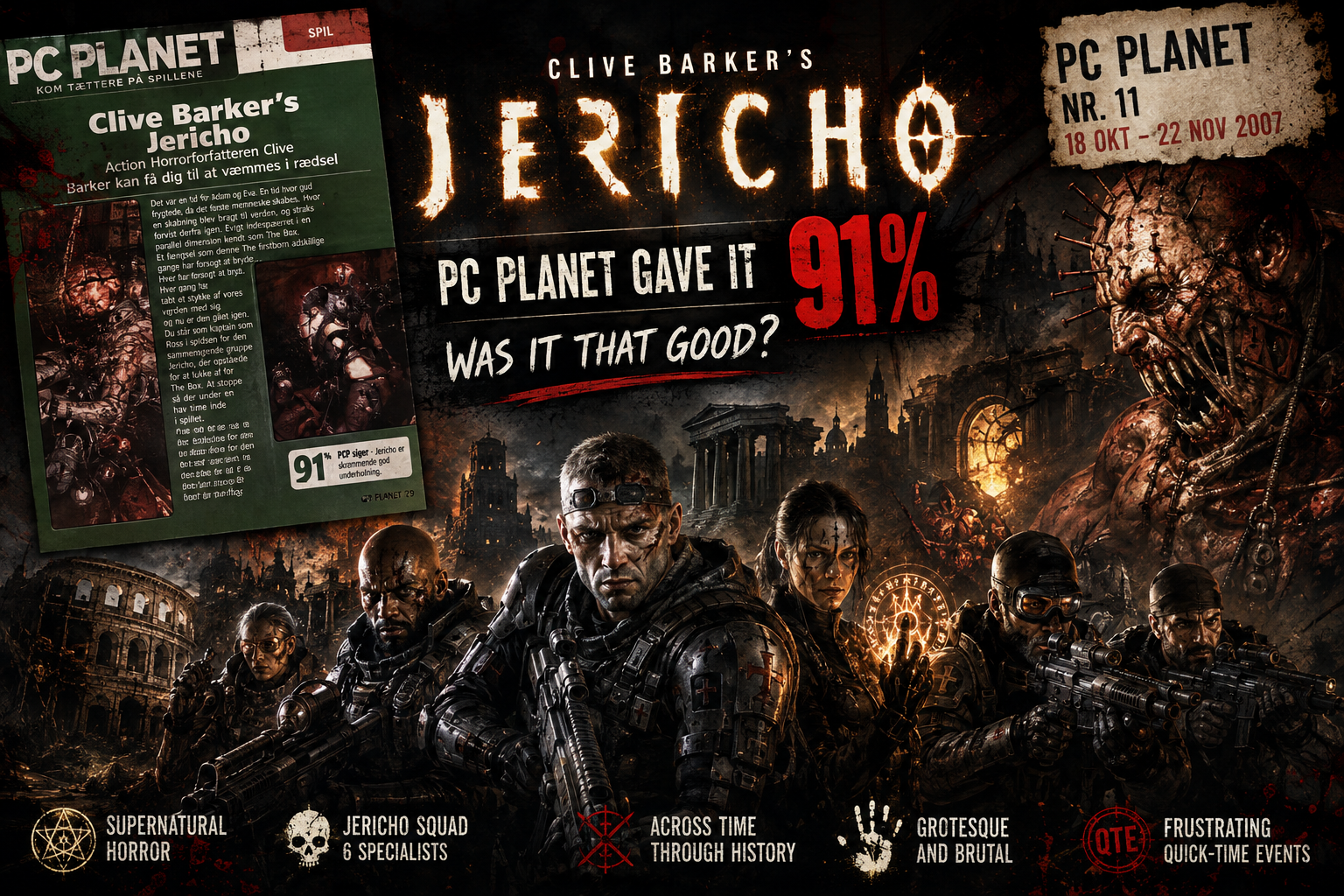
PC Planet gave Clive Barker’s Jericho 91% in 2007. I played it on Xbox 360 when it came out and returned to it once later. Reading that score now, I can recognise the game the reviewer describes, but I remember being frustrated far more often than I remember enjoying it.
The monsters, blood, ruined buildings and supernatural soldiers were memorable. So was the idea of fighting through different periods of history, switching between squad members with their own weapons and powers. There was plenty here that interested me. Then the game would interrupt it with another quick-time event, and my attention would move straight from the horror to a button prompt.
I hate QTEs. I hated them then, and I still hate them. Jericho gave me enough of them to spoil a game whose setting I wanted to explore.
The PC Planet review: 91% in October 2007
The review comes from PC Planet Denmark, issue 11, dated 18 October–22 November 2007. Its verdict was “Jericho er skræmmende god underholdning,” which translates roughly as “Jericho is frighteningly good entertainment.” That is a confident recommendation, especially with 91% printed beside it.
The magazine praised the horror atmosphere, graphics and entertainment, and discussed the squad’s paranormal abilities. Those are the parts I can still appreciate. Jericho had a recognisable visual identity during the early Xbox 360 and PlayStation 3 years, when developers were showing what the new hardware could do with lighting, more detailed characters and elaborate environments. Its soldiers looked battered, and its creatures looked mutilated. The ugliness was deliberate.

Other reviews were considerably less enthusiastic. Kevin VanOrd’s contemporary GameSpot review awarded 6.5/10 and described an uneven game whose strongest moments were undermined by its level design. That is much closer to my memory of playing it. The disagreement was already there in 2007; the game did not need nineteen years of hindsight to become divisive.
I enjoy finding that kind of disagreement in old magazines. A review written around release captures a reaction before years of retrospective articles have settled on a reputation. PC Planet’s reviewer saw a 91% game. I sat with an Xbox 360 controller and kept getting annoyed. The old page is interesting precisely because it preserves a verdict I would never have given Jericho myself.
Al-Khali and the history trapped inside it
Clive Barker’s Jericho was released for Windows, Xbox 360 and PlayStation 3 in October 2007. MercurySteam developed it, Codemasters published it, and Barker worked with Alchemic Productions on its horror concept and story. Barker was already known for horror fiction and Hellraiser, which made his name a large part of the game’s identity. His official Jericho archive describes the project and preserves interviews, promotional material and development commentary.
The Department of Occult Warfare sends the Jericho Squad to the fictional city of Al-Khali, where an ancient supernatural threat is breaking through. In the game’s mythology, the Firstborn is God’s abandoned first creation, imprisoned before humanity. Its attempts to escape have pulled pieces of the city into its realm, leaving different periods of history trapped together in a dimension known as the Box.
The squad moves deeper into those layers, through World War II, the Crusades, ancient Rome and Sumerian history. Each period brings its own soldiers, buildings and violence, corrupted by the same presence. People from earlier attempts to contain the Firstborn are still caught there. Some have become part of the nightmare they entered to stop.

I like that premise. Going further into the city also means going further into its past, with each era still physically present. It gives the developers room to use different kinds of architecture and enemies without making the journey feel like a collection of unrelated horror levels. The place has accumulated its own disasters, and the squad has to fight through them.

It also gives the Firstborn more potential than a monster waiting at the end of a corridor. This is an abandoned being whose imprisonment has damaged entire generations. There is room for questions about creation, rejection and the people sacrificed to keep it contained. I wanted the game to spend more time with those ideas. Too often it hurried me into another firefight before they had much room to develop.
The squad was the part I wanted to work
You begin as Captain Devin Ross, the squad’s leader and a psychic healer. After he is killed early in the campaign, his consciousness survives and can possess his teammates. That changes how the whole game works: choosing another soldier changes your weapons and supernatural abilities along with your position in the fight.
The six surviving specialists have distinct roles. The original Codemasters PC manual sets out their weapons and powers:
| Squad member | Weapons and abilities |
|---|---|
| Abigail Black | Sniper rifle, guided shots and telekinesis. |
| Frank Delgado | Minigun, a summoned fire spirit and a protective barrier. |
| Billie Church | Sword, machine pistol and blood magic that traps or burns enemies. |
| Simone Cole | Assault rifle, configurable grenades, slowed time and stronger squad firepower. |
| Xavier Jones | Rifle, astral projection and possession. |
| Father Paul Rawlings | Dual pistols, ranged revival and curses. |

That gives character switching a practical purpose. A distant target makes Black useful. Another situation calls for Delgado’s heavier weapon or Cole’s ability to slow things down. You can move between people instead of asking one character to carry every gun and perform every supernatural trick. When an encounter makes me choose a squad member because I see a useful opportunity, the system feels good.
It could also make the people in the squad matter more. Their bodies are how Ross continues, and their survival is part of keeping the unit functioning. Losing control of one wounded character does not necessarily end the encounter while others can still act and help. The idea suits a horror game in which death has already stopped behaving normally.
My problem was how often the game reduced those possibilities. Sometimes a particular power was simply the key required to get through the next obstruction. Elsewhere I had several characters available but little reason to change how I was fighting. Six people with different abilities should encourage me to experiment. Being told which person must perform the next action gives me much less to decide.

Too many people in too little space
Jericho’s corridors often worked against its squad system. Teammates, enemies, gunfire and supernatural effects crowded into the same narrow space. Movement became awkward, the screen became busy, and somebody would need reviving while the fight was still going on. I wanted to use the squad’s abilities; I kept having to deal with the squad being in trouble.

The AI made that worse. A teammate falling because I made a poor tactical decision is something I can learn from. A teammate repeatedly getting into trouble while the environment gives everyone little room to move becomes tiring. Reviving people can be part of a good combat system, but it loses its interest when it keeps pulling attention away from the rest of the fight.

The more open encounters showed why I kept finding the game frustrating. GameSpot singled out the Roman arena as one of its impressive set pieces. Give the characters space and the squad’s unusual abilities have a better chance to become useful. Those sections made the cramped ones harder to accept because the game had already demonstrated a more enjoyable way to use its own systems.
Enemy durability could drag things out as well. Spending longer shooting the same threat does not automatically make an encounter more demanding. When the space is restrictive and teammates keep going down, extending the fight can simply mean spending more time managing the same irritation. I wanted more situations that made me reconsider my approach, with enough room to carry out the decision.
The QTEs kept taking me out of it
Jericho calls these sequences Survival Events. The manual describes normal control being temporarily replaced by an interactive cinematic that requires a sequence of quick button presses. Whatever name is used, I am watching for prompts and trying to enter the requested inputs before the game decides I have failed.

That is where the scene stops working for me. During ordinary combat I am watching an enemy, choosing a character, aiming or moving. I know the controller well enough that most of those actions do not require me to think about the buttons themselves. A QTE moves the button back into the centre of my attention. The game can put an impressive monster in front of me, but I have to watch the interface to survive it.
Failing makes it worse. Once I have watched the same scripted movement and failed the same input, repeating the scene gives me less reason to care about the danger. I am waiting for the prompt I missed. Whatever tension the first attempt had is being worn away by repetition.
I would rather perform those actions through the controls the game has already taught me. Let me move, aim, attack or use a power. Let the danger happen while I am doing that. Jericho had an unusual squad system with enough possibilities to keep my attention, yet it repeatedly replaced those possibilities with a short sequence of prescribed inputs.
This was already a problem for me when I first played it. Returning later did not make the QTEs easier to enjoy. I still found them irritating, and they still interrupted the part of the game I wanted to be involved in.
The manual even advertised a paid QTE bypass
The US PC manual advertised paid bonus codes for features including unlimited ammunition and automatic success in Survival Events. Its telephone service cost US$2.99 per minute, approximately €2.08 or £1.46 per minute. An online route also charged a fee. The manual says some advertised features could also be unlocked by playing.
Automatic success in the very mechanic I hate was something being advertised through a paid code service. Reading that now does nothing to improve my view of the QTEs. I want a game whose normal controls let me enjoy those scenes. Selling a way around them leaves the underlying problem exactly where it was.
It also gives me little patience for pretending irritating monetisation began with modern games. Here it is in a 2007 manual. When I criticise publishers for selling gameplay shortcuts, an old release gets the same criticism if it deserves it. Collecting older games does not make me forget the things developers and publishers were already doing to annoy their customers.
The converted amounts use European Central Bank reference rates for 26 October 2007. They convert the advertised US telephone rate; they are not European or British service prices.
The horror artwork worked better than the fear
Jericho has plenty of imagery worth looking at. Flesh, metal and religious symbols are forced together in creatures that look damaged before anyone shoots them. Buildings can feel like part of the same corruption. The combination of historical settings and body horror gives the game a stronger identity than another ruined city full of ordinary enemies would have had.

But I remember feeling irritated much more often than frightened. The images could be disgusting or oppressive without making me afraid to continue. After enough gunfire, mutilated enemies and dark corridors, the game needed a change of pace. Constant ugliness becomes familiar. A quieter section, a little uncertainty or time to take in a place could have made the next encounter more effective.
The music was part of the effort to build that atmosphere. Cris Velasco composed the score, and Barker’s archive records his involvement in choosing the composer and pushing for music that suited the game. The sound and visuals received praise even in reviews that criticised the combat. That care is visible in the finished game, but an effective soundtrack cannot stop a prompt or an awkward encounter from pulling my attention away.
Why I respond differently to difficulty and frustration
I have been gaming since childhood, and preparation is a large part of how I enjoy games. In a strategy game I like building an economy, collecting resources, researching upgrades and putting an army together before committing it. In an RPG I want time to learn the systems and develop my character. I can spend a long time doing that without getting bored because I am making decisions that affect what happens next.
The same applies during action. If I choose the wrong position or fail to recognise what an enemy is doing, I have something useful to change on the next attempt. Jericho sometimes offered that through possession and the squad’s powers. Then a narrow encounter or another QTE would interrupt it, and I would be dealing with something I found much less satisfying.

Games also give me systems I can learn. If an Age of Mythology mission goes badly, I can reconsider how I built up or approached its objective. If an RPG battle defeats me, I can change equipment or tactics. Real life often gives you no comparable way to go back and try again. That is part of why having control inside a game matters to me. I want to understand what I can do and then be allowed to do it.
A long strategy mission can hold my attention because there are things to work through. A short button sequence can lose it because I am simply waiting to obey the next instruction. Jericho’s QTEs kept putting me into that second situation, even when its other mechanics had given me something far more interesting to think about.
Holbæk and places that carry older memories
The layers of history in Al-Khali are more interesting to me now than they were when I first played. Holbæk and the surrounding area are tied to several periods of my life: Orøstrand, Bjergmarkskolen, the library, technical-school programmes and the one-room apartment where I later lived alone. Returning to a familiar street can bring back a particular period even though the place has moved on.
A building can still be there while the people and routines I associate with it are gone. I recognise what is in front of me and remember something older at the same time. The library, for example, belongs to a real place in the present and to time I spent there years ago. Those associations do not disappear because another part of my life came afterwards.
Jericho gives that layering a physical form. Its earlier eras remain accessible, with people and events still trapped inside them. That is the part of its setting I keep thinking about: arriving somewhere and finding an older time still present beneath what exists now. The supernatural story exaggerates it into horror, but the connection between a place and its past is familiar.
Ross, possession and what remains after someone dies
Ross continuing through other people also gives the possession mechanic more to work with than character switching alone. His body is gone, but he remains part of the squad through his teammates. The game could have spent more time on what that means for him and for the people carrying him through the mission.
After my father died, the idea of a person remaining present through other people became more personal. Memories, familiar phrases, habits and things associated with him remain after the person himself is gone. There is no way to restore a conversation, but the influence of someone you lived with does not end as neatly as their physical presence does.
Ross’s situation turns continuing through other people into something literal. That connection interests me more now, though the game does relatively little with it. Possession mostly becomes the method for using another soldier’s weapons and powers. I would have liked more space for the characters to respond to what had happened, especially in a story already dealing with abandonment, death and people unable to leave the past behind.
A short campaign in a crowded year
Jericho arrived in the same year as BioShock, Halo 3, The Orange Box and Call of Duty 4: Modern Warfare. There were plenty of distinctive shooters competing for attention. Jericho had the setting and imagery to stand out, but its combat had to hold up once the first impression wore off.
GameSpot’s reviewer reported a campaign lasting roughly eight hours. A compact campaign can suit me very well, but Jericho’s frustrating sections still occupy a substantial part of the time spent with it. Its abrupt ending also gives the story less room to resolve the questions raised along the way.
There was no cooperative or competitive multiplayer. The official archive preserves Codemasters’ explanation that the story and abilities such as slowing time made multiplayer difficult to implement without losing important parts of the game. The decision was to concentrate on the campaign.
I still think cooperating with other players could have suited a squad of supernatural specialists. It would have needed careful work around those abilities, but taking some of the squad out of the AI’s hands is an appealing possibility. It also makes me wish the single-player encounters had done more with the characters already available.
Barker spoke about further Jericho adventures, and his archive records the sequel discussions. They did not produce a released sequel. The world had enough material for another game, but the original needed better pacing, more useful combat spaces and a more developed conclusion before I would have been enthusiastic about returning.
Finding Jericho now, and the problem with digital games
There is another frustration when looking at Jericho today. Its old Steam store address redirects to the storefront, while its Steam community hub remains online. The game is no longer available to buy through that store.
Valve’s published policy says retired games remain in existing owners’ libraries and can still be downloaded, installed and launched. New buyers lose the store route. Steam purchases also generally cannot be sold or transferred to another person under its Subscriber Agreement. A player with an unwanted copy cannot simply sell that individual Steam purchase to someone looking for the game.
This is one of the reasons I think we should stop buying digital games as consumers. Access to an older title should not depend so heavily on whether a publisher still wants it on a storefront. A game that somebody considers worth revisiting ought to be able to pass from one player to another. With the original Xbox 360 disc, there is still a second-hand route for that console.
I have eight Steam accounts. My main account, KibaAngelSnowpaw, showed 2,338 games on 12 October 2026. I have spent years buying games through Steam, and I want more control over what I paid for. Being able to resell a copy matters. Being able to find an old release after its publisher has stopped selling it matters too. Jericho does not have to be a game I love for its continued availability to be worth caring about.
Going back once did not change my mind
Returning to Jericho gave me another chance to enjoy the things that had caught my attention in 2007. The historical setting was still interesting, the horror imagery was still distinctive, and moving between supernatural soldiers was still a good idea. The same frustrations came back with them.
I would have liked larger and more varied combat spaces, better companion behaviour and actions performed through the normal controls in place of QTEs. I also wanted the story to spend more time with Ross, the squad and the Firstborn, and to give its ending enough space to follow through on what it had introduced. Those changes address the parts that kept stopping me from enjoying the game.
PC Planet’s 91% remains an interesting piece of gaming history. I can appreciate the imagination behind Jericho and still remember how much its mechanics annoyed me. Nearly nineteen years later, the QTEs are still among the first things I think about when somebody mentions it. That is a poor memory to leave behind when the world itself had so much more to offer.
Sources and image credits
Historical print source: PC Planet Denmark, issue 11, 18 October–22 November 2007. Game background, development commentary and promotional images: Clive Barker’s official Jericho archive. Squad abilities, Survival Events and the historical bonus-code service: Codemasters’ original US PC manual. Contemporary criticism and the 6.5/10 score: GameSpot, 29 October 2007. Promotional game imagery remains the property of its respective rights holders. Steam availability and policies were checked on 13 October 2026.
Additional in-game images: MobyGames’ Windows gameplay captures and GameSpot’s 2007 preview for the well-escape sequence.