
I owned Baldur’s Gate when I was a kid and played it back in the day. What I can remember now is the start. I do not think I played very much of it. The name stayed with me much more clearly than the adventure did.
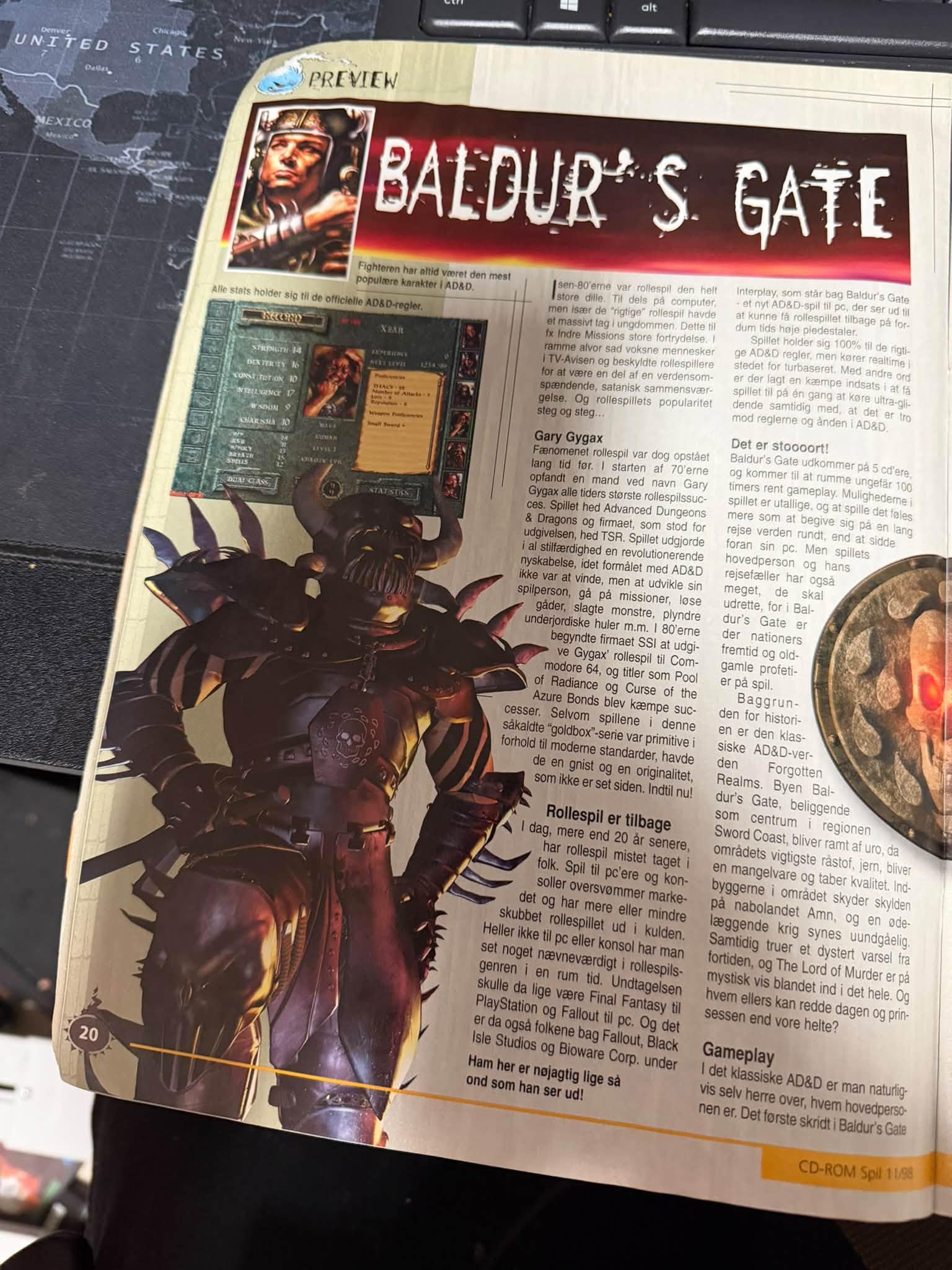
This preview comes from CD-ROM Spil, third year, issue 11, dated 15 October–11 November 1998. The cover calls it Denmark’s biggest games magazine. I was almost twelve when this issue appeared. Peter C. G. Jensen’s Baldur’s Gate preview occupies pages 20–21.
There is no review score here. The pages are marked PREVIEW, and the information box expects the game in December 1998. It is selling a game that readers are still waiting for, with promises about its rules, freedom, size and accessibility.
Roleplaying is back, apparently
The preview begins by looking back at the roleplaying craze of the late eighties. It remembers adults treating roleplayers as part of a satanic conspiracy, including accusations on television, while the hobby kept growing. From there it moves to Gary Gygax, TSR and the old Gold Box computer games, naming Pool of Radiance and Curse of the Azure Bonds.
Then comes the comeback story. According to the article, roleplaying has lost its grip on players, pushed aside by the flood of PC and console games. It makes exceptions for Final Fantasy on PlayStation and Fallout on PC. Baldur’s Gate is presented as the game that might put proper roleplaying back where it belongs.
That is quite a job to give one unreleased game. The writer is already talking about a spark and originality that have supposedly been missing, before arriving at this new project. It builds anticipation well, but the claim about an entire genre is much broader than what two preview pages can demonstrate.
The history also needs better credits. Original Dungeons & Dragons was published in 1974 and was created by Gary Gygax and Dave Arneson. The magazine’s account centres Gygax and calls the early game Advanced Dungeons & Dragons, compressing different stages of the rules into one story. Wizards of the Coast’s collection of the original documents identifies the 1974 game and the work of both men.
Five CDs, about a hundred hours and an iron crisis
The big numerical promise is five CDs and roughly 100 hours of gameplay. The preview also describes a story running over seven chapters and character development towards level seven. Those are the magazine’s advance claims, rather than a record of how long I spent with the game.
The setting is the Forgotten Realms and the Sword Coast. The preview introduces an iron crisis: the region’s important raw material is becoming scarce and losing its quality, neighbouring Amn is being blamed, and war seems close. Alongside that political trouble are old prophecies and the Lord of Murder. It wants both a troubled region and a much larger threat behind it.
Character creation gets a proper explanation. The article describes abilities, skills, classes, spells, races, alignment and appearance. It says I can make a brutal warrior or an elf woman, rather than simply being handed one fixed hero. That is a much clearer description of roleplaying freedom than announcing that the possibilities are endless.
There is a practical side to the scale as well. The writer describes a large cast with individual personalities and strange little lines of dialogue, side missions, a world map and a journal for important encounters, clues and information. The journal matters because a large adventure also gives the player more things to keep track of. Remembering what somebody asked for should not depend entirely on remembering a conversation from several sessions ago.
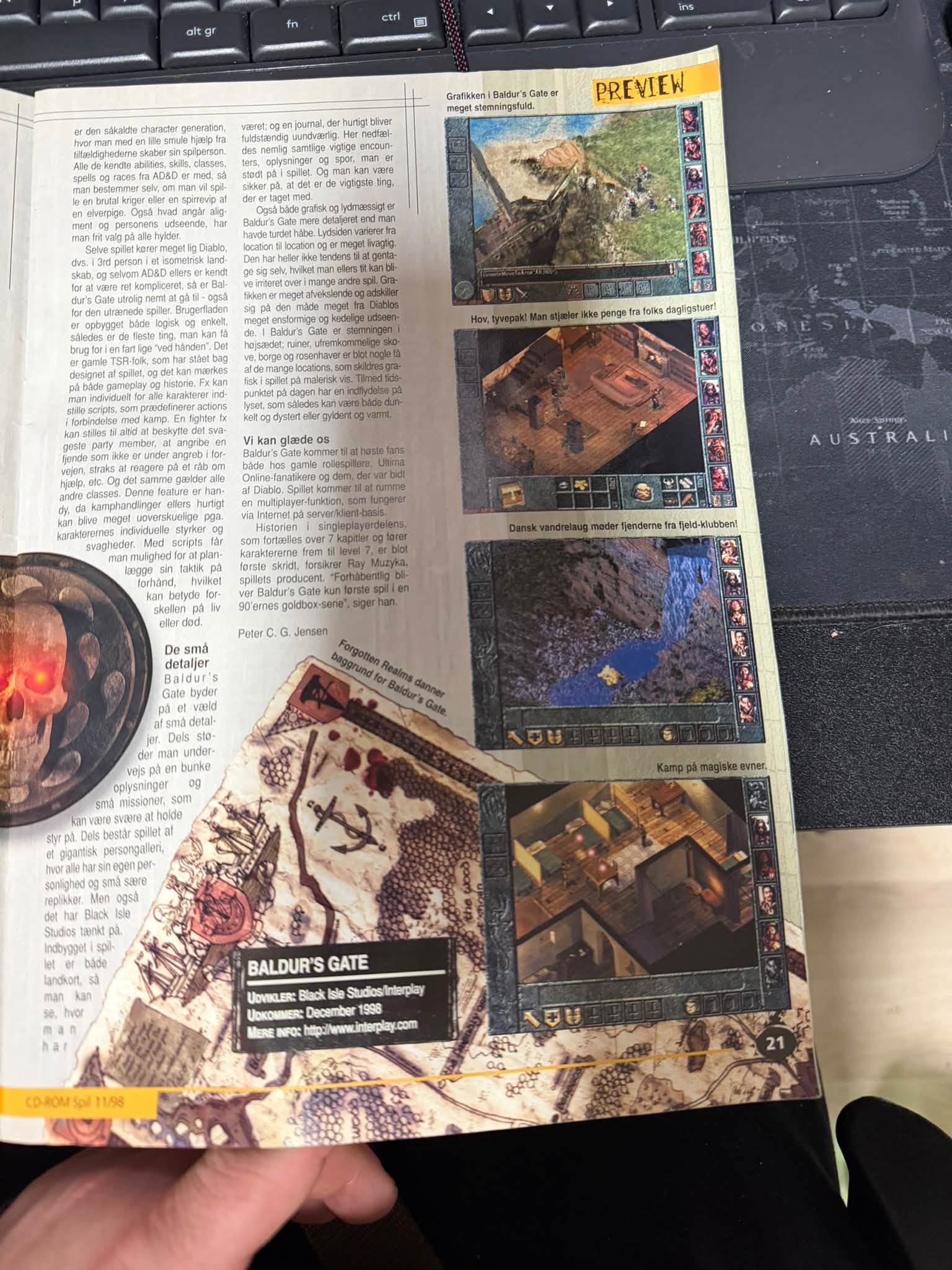
The preview praises varied locations, detailed sound and changing light through the day. Ruins, difficult woodland, castles and ocean are part of its picture of the game. Its screenshot captions are less grand: one warns thieves against taking money from people’s living rooms, while another jokes about a Danish hiking association meeting its enemies from the mountain club.
The information box gets the developer wrong
The box lists “Black Isle Studios/Interplay” under “Udvikler”, meaning developer. That is a muddled credit. Baldur’s Gate was developed by BioWare, with Interplay publishing it under the Black Isle label. The original game manual’s credits, p. 89 identify BioWare’s design, writing and programming team alongside Black Isle’s production and publishing-side staff.
Black Isle had an important role. That does not make leaving BioWare out of the developer field accurate. A magazine promoting a major roleplaying game ought to get the studio making it right.
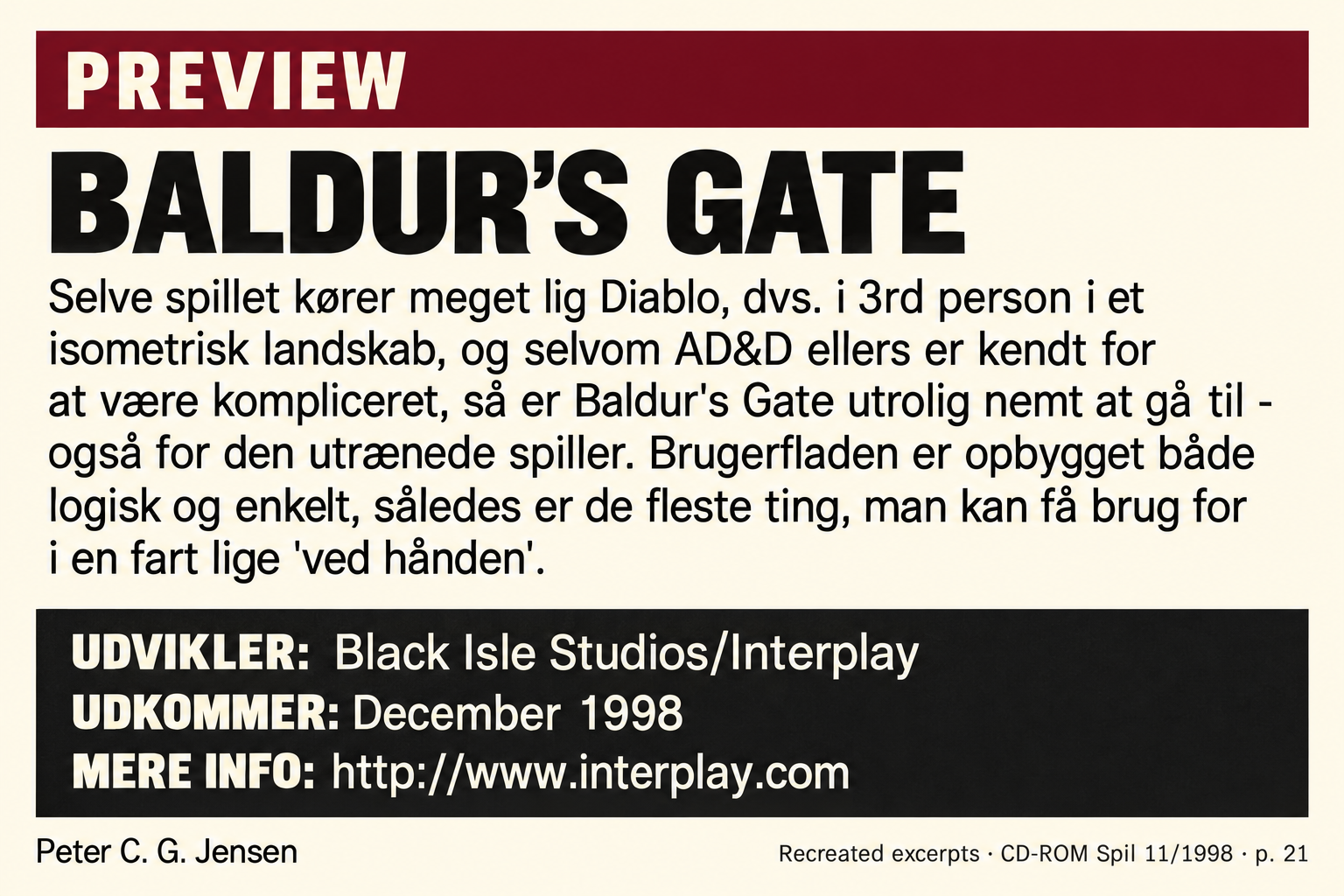
“100%” AD&D, with some rather important changes
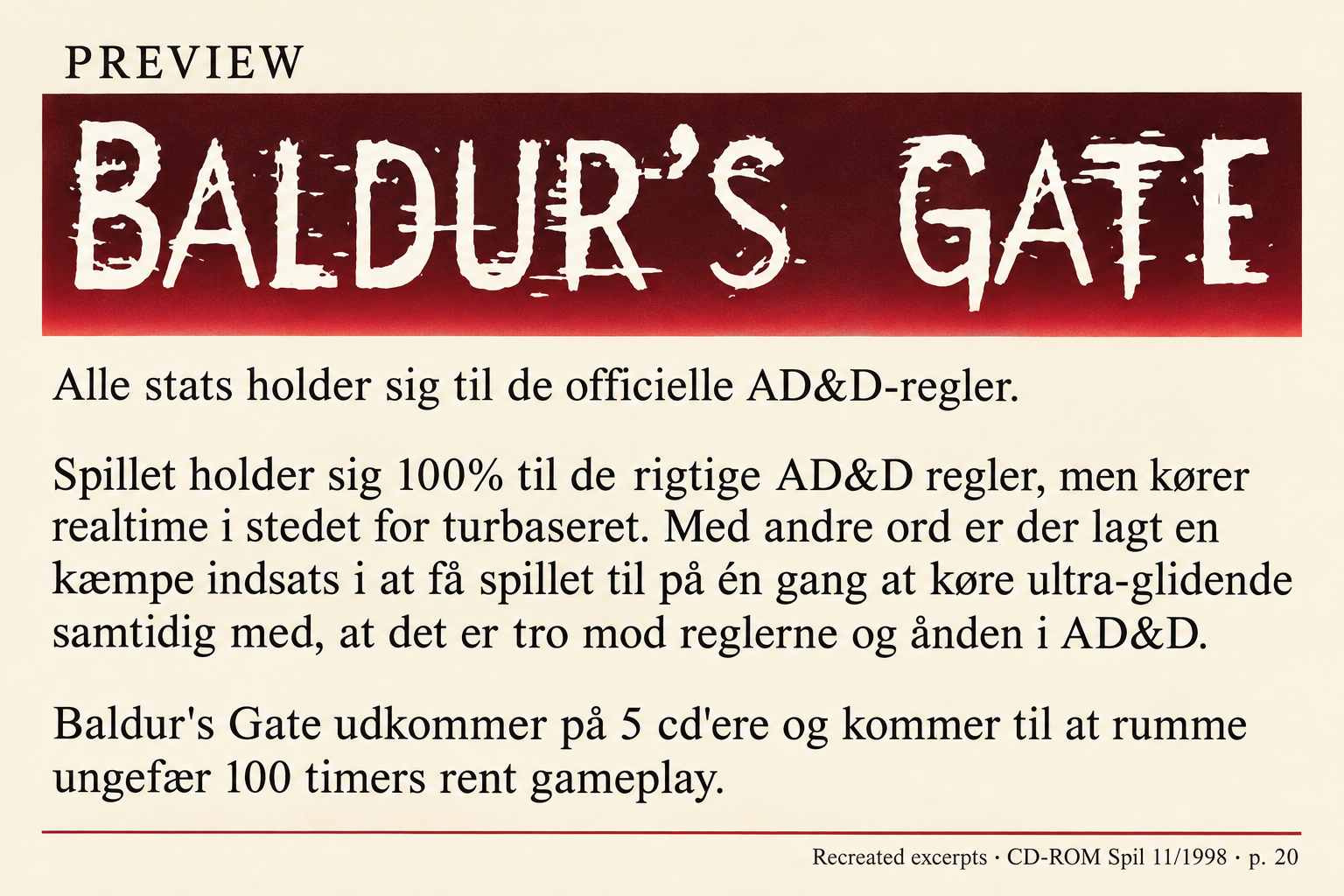
The preview says the game follows the real AD&D rules “100%”, then immediately explains that it runs in real time instead of being turn-based. It presents that combination as a major achievement: smooth action while staying faithful to the rules and spirit of AD&D.
The original manual is more precise. On pages 36–37 it explains that rules have been revised for the computer game. A round lasts six seconds in Baldur’s Gate instead of sixty seconds in AD&D, and characters use individual initiative rounds while the action continues. Those changes are stated in the manual itself.
That is an adaptation. Taking AD&D seriously and reproducing every rule unchanged are different claims. Printing “100%” oversells the exactness of a system that its own manual openly describes as modified.
The article also compares the isometric view with Diablo and calls Baldur’s Gate incredibly easy to approach, even for an inexperienced player. It praises a logical interface with the important controls close to hand. A clear interface helps, but it does not make the rules underneath simple. Knowing where the button is and understanding why an attack misses are separate problems.
The manual’s combat section explains that attacks still depend on dice rolls, with THAC0 and the target’s armour class determining the number needed to hit. A natural 1 misses and a natural 20 hits. The computer handles the calculation; it does not remove the chance from the result. That is especially relevant to what I dislike about the later game.
Real time does not mean I have to rush every order
The central control is pausing the action to give orders, then letting the party carry them out. That gives a player time to choose a spell, change a target or move somebody out of danger. The preview spends more space describing character scripts than explaining this pause-and-command structure.
Its script examples are interesting: a fighter protecting a vulnerable party member, helping somebody who is already under attack, or responding to a call for help. The article says these behaviours let the player plan tactics in advance, instead of trying to manage every reaction during a confused fight. That gives a much better idea of party management than its comparison with Diablo alone.
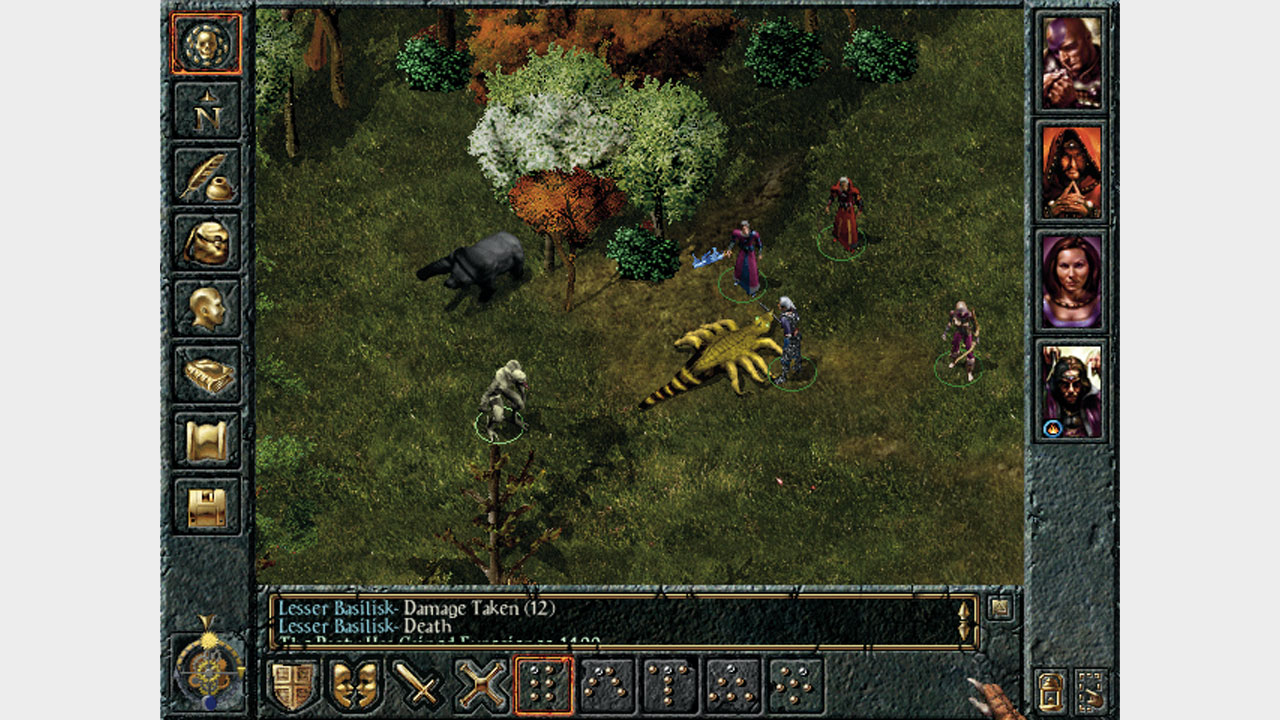
Those interviews explain how BioWare’s Battleground Infinity technology was redirected into a D&D roleplaying game. Black Isle producer Chris Parker describes combining real-time strategy with the depth of older party RPGs, with the ability to pause becoming central to making it work. That explains the design more clearly than claiming that real time and tabletop rules have somehow become a perfect match.
Baldur’s Gate 3 did not win me over
I also own Baldur’s Gate 3 on PSN. I have played it, but I have not completed it. I do not like the D&D mechanics, especially when success depends on luck and random rolls. Everybody seemed so hyped about it. Compared with other RPGs of this kind I have played, I honestly did not think it was even that good.
The praise had plenty of awards behind it. In its April 2024 community update, Larian celebrated five major Game of the Year trophies: the Golden Joysticks, The Game Awards, DICE, Game Developers Choice and BAFTA.
The two games use different editions of the rules. The original draws on AD&D second edition and runs in real time with pausing. Larian’s Baldur’s Gate 3 FAQ identifies fifth-edition D&D as the newer game’s basis. Its turn-based combat gives players a different rhythm, while the dice remain a central part of resolving actions.
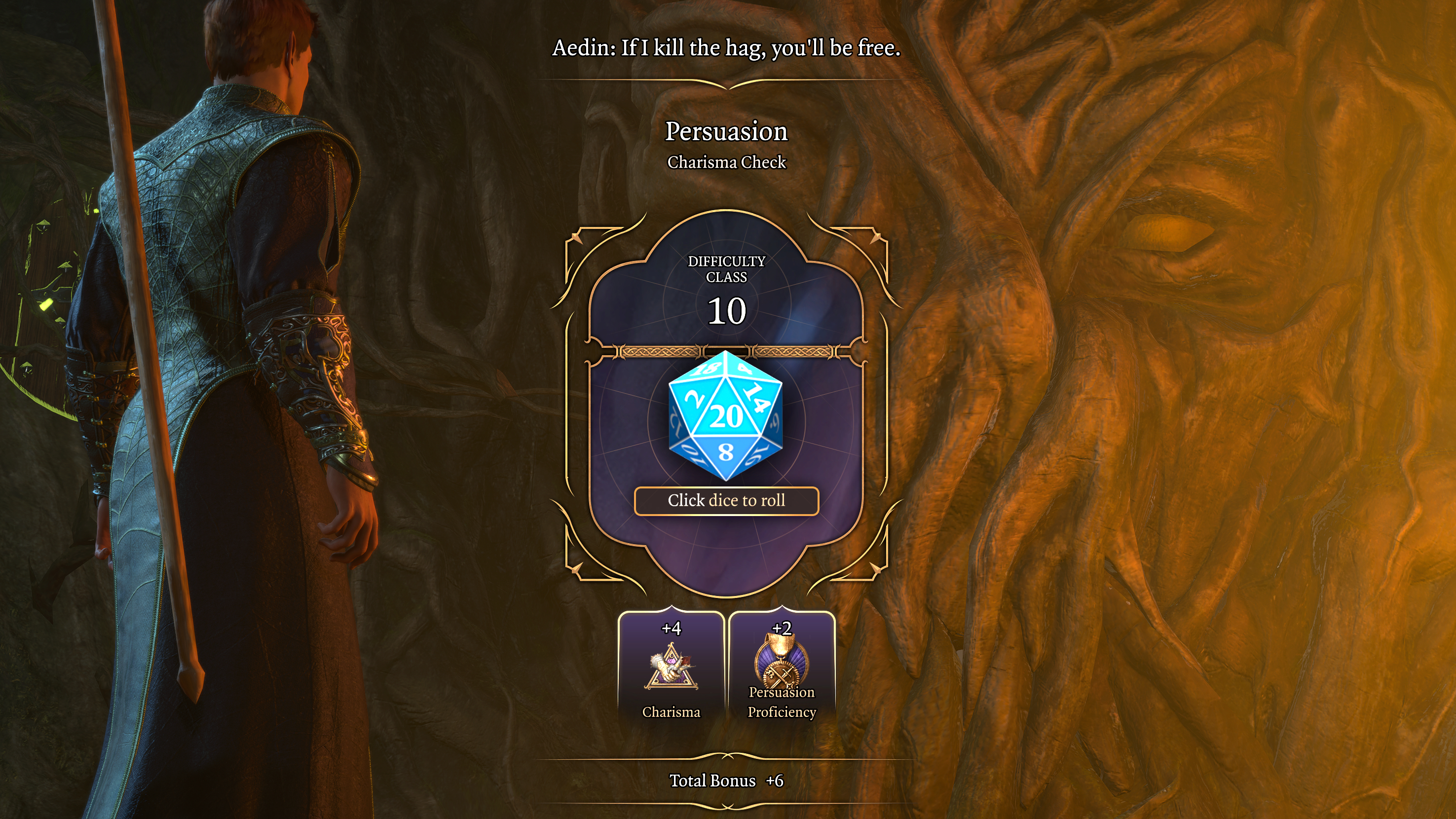
The bonuses matter. In the pictured check, the target is 10 and the character has +6. Using a fair twenty-sided die, rolls of 4–20 succeed: 17 out of 20 outcomes, or 85%. A strong character has improved the odds, but there are still three losing results. That arithmetic assumes an ordinary fair roll, without adjustments to the dice.
Larian’s explanation of Active Rolls describes using spells and party bonuses to influence those checks, including Guidance and advantage. I can understand how improving the odds is part of the design and still dislike leaving the outcome to a roll. Better odds do not turn it into the kind of gameplay I want.
Looking back at the 1998 preview, the selling point is almost the reverse of my problem. It wants to reassure D&D fans that the rules survived the move to a computer. Faithfulness to those rules is a large part of the attraction. For me, the newer game’s dependence on them is one of the things getting in the way.
My PSN copy and the PC alternatives are different purchases
My Baldur’s Gate 3 copy is a digital PlayStation purchase. Sony’s product page ties access to the account’s main PS5 and to signing into the same account on other consoles. Sony’s offline-play documentation allows downloaded games to work offline on the PS5 where Console Sharing and Offline Play is enabled, with one such PS5 active at a time.
That is still an account-linked purchase. Offline play gives me a way to use the downloaded game without a constant connection; it does not give me an independent installer or turn that purchase into a copy I can simply pass on. This is the control I dislike in digital game sales.
There are official alternatives on PC, checked on 14 October 2026:
| Game | Official release without compulsory account activation for single-player |
|---|---|
| Baldur’s Gate | GOG’s Enhanced Edition package includes the classic Baldur’s Gate: The Original Saga. The store offers DRM-free offline installation, with Galaxy optional. The classic game and Enhanced Edition are distinct versions. |
| Baldur’s Gate 3 | The GOG PC release offers an offline installer and single-player play without compulsory account activation or Galaxy. This is a separate PC purchase, not a conversion of my PSN licence. |
Larian describes its account services as providing features such as cross-save, cross-play and Twitch rewards. Those services should not be confused with a compulsory account for playing the GOG single-player game. Nor should a store account used to buy and download the files be confused with activation of the installed game.
I want us to stop rewarding account-locked digital releases. Here the purchasing choice is concrete: Sony’s account-linked console licence, or a PC edition whose installer can be kept and used offline. Buying the game again would still mean paying again. It would not return control over the copy I already bought.
We have power over the next purchase, even if we keep behaving as though we have forgotten it. A familiar name, a shelf full of awards or a crowd telling me that a game is brilliant does not entitle anybody to my next payment. I want games I enjoy and control over the copy I paid for.