
I have played two games from PC Gaming World’s military-strategy top ten in issue 7/2005: Company of Heroes and Joint Task Force. Company of Heroes felt weird to me, and I did not really like it. Joint Task Force came to me through my friend Shilka, who bought a multi-CD edition while he was in the United States. When he later got it on DVD, he gave me the CDs. I played it, but I do not have that copy anymore.
That is a fairly small amount of personal experience with a list full of tanks, soldiers and military operations. I spent plenty of time with Battlefield, Delta Force, Operation Flashpoint, Ghost Recon, Rainbow Six, Hidden & Dangerous, Conflict: Desert Storm, Medal of Honor and Call of Duty. Military games were hardly unfamiliar territory. Most of these particular strategy games simply never became games I played.
Looking through the magazine now, I am interested in what the editors expected, what eventually reached the shops and how little of it overlaps with my own memories. Some of the games are on my shelves today because I collect second-hand PC games. That happened much later.
The Magazine’s Military-Strategy Ranking
The heading is “Militær-strategispil”. This was an E3-era ranking of upcoming games, not a verdict on ten finished releases. The list includes projects close to release alongside others with a much longer road ahead. Here is the printed order, alongside what is actually in my physical catalogue dated 13 October 2026.
The magazine excerpts below use recreated layouts for clearer reading. Their Danish wording, dates and credits are preserved, including the original errors. Each caption links to my untouched photograph.
| Rank and game | My physical collection | Have I played it? |
|---|---|---|
| 1. Codename: Panzers – Phase Two | Two catalogued copies. | No. |
| 2. Company of Heroes | Not listed in this physical catalogue. | Yes. I did not really like it. |
| 3. Warfront | Not listed under this title or War Front: Turning Point. | No. |
| 4. War Leaders | Not listed under this title or Clash of Nations. | No. |
| 5. Shattered Union | Not listed. | No. |
| 6. Blitzkrieg 2 | A Blitzkrieg Collection is listed, but the catalogue does not establish that it contains this sequel. | No. |
| 7. Joint Task Force | Previously owned Shilka’s CD copy; no longer have it. | Yes. |
| 8. Full Spectrum Warrior 2: Ten Hammers | One copy, catalogued as Full Spectrum Warrior: Ten Hammers. | No. |
| 9. Rush for Berlin | Not listed. | No. |
| 10. Officers | Not listed. | No. |
The magazine’s introduction acknowledges how thoroughly the Second World War dominated the genre, while naming Shattered Union and Full Spectrum Warrior 2 as exceptions. Count the entries and seven of the ten use WWII or an alternative version of it. Even a list looking forward was spending most of its time looking back at the same war.
Four Pages for Age of Empires III, Two for Company of Heroes and a Shared Spread for JTF
Elsewhere in the issue, Age of Empires III received four pages beginning on page 16. The coverage went through water reflections, directional smoke, snow, physics, destructible objects, Native American alliances, the campaign and the Home City system. The magazine had plenty to say about it, and plenty of space in which to say it.
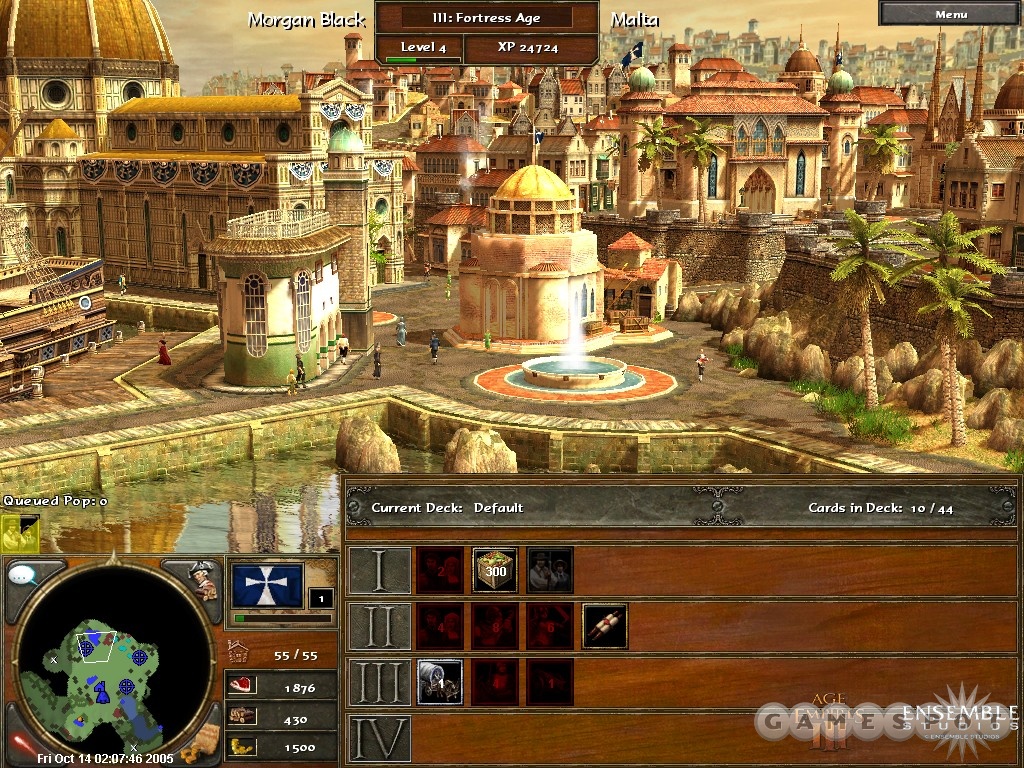
The original Age of Empires remains one of my favourite games. I do not think Age of Empires II is bad, but I never liked it as much. Its more defensive feel and the competitive way of approaching it do less for me than the first game. Age of Empires III was dog shit to me. Four pages of enthusiasm do not change that.
I own Age of Empires III on Steam and physically. The earlier physical copy I wrote about had Disc 1 missing and a broken expansion disc. The October catalogue has an Age of Empires III entry added on 11 October and marked “good”.
Company of Heroes had two dedicated pages, 22–23. Joint Task Force appeared across pages 24–25, but shared that spread with Ghost Wars. Calling both of them “two-page features” misses the difference: one had a feature to itself, while the other was being compared with a rival.
Page counts do not tell me how good a game is. They do show what occupied the magazine. Age of Empires III had room for a much fuller presentation, Company of Heroes was being discussed as a possible shake-up of the genre, and JTF had to share its introduction with another unfinished military game.
1. Codename: Panzers – Phase Two
The first-place entry expected Codename: Panzers – Phase Two near the end of June 2005. StormRegion’s sequel promised three campaigns taking troops through Africa, Italy and Yugoslavia, detailed military units, day-and-night changes, expanded multiplayer and an improved editor. The Yugoslav setting at least gave the description something beyond another familiar Normandy battlefield.
The finished game arrived in July 2005. Its Steam record lists 21 July and a Metascore of 80. That was a respectable result and a relatively small move from the magazine’s estimate. First place was not attached to a project that disappeared into years of development.
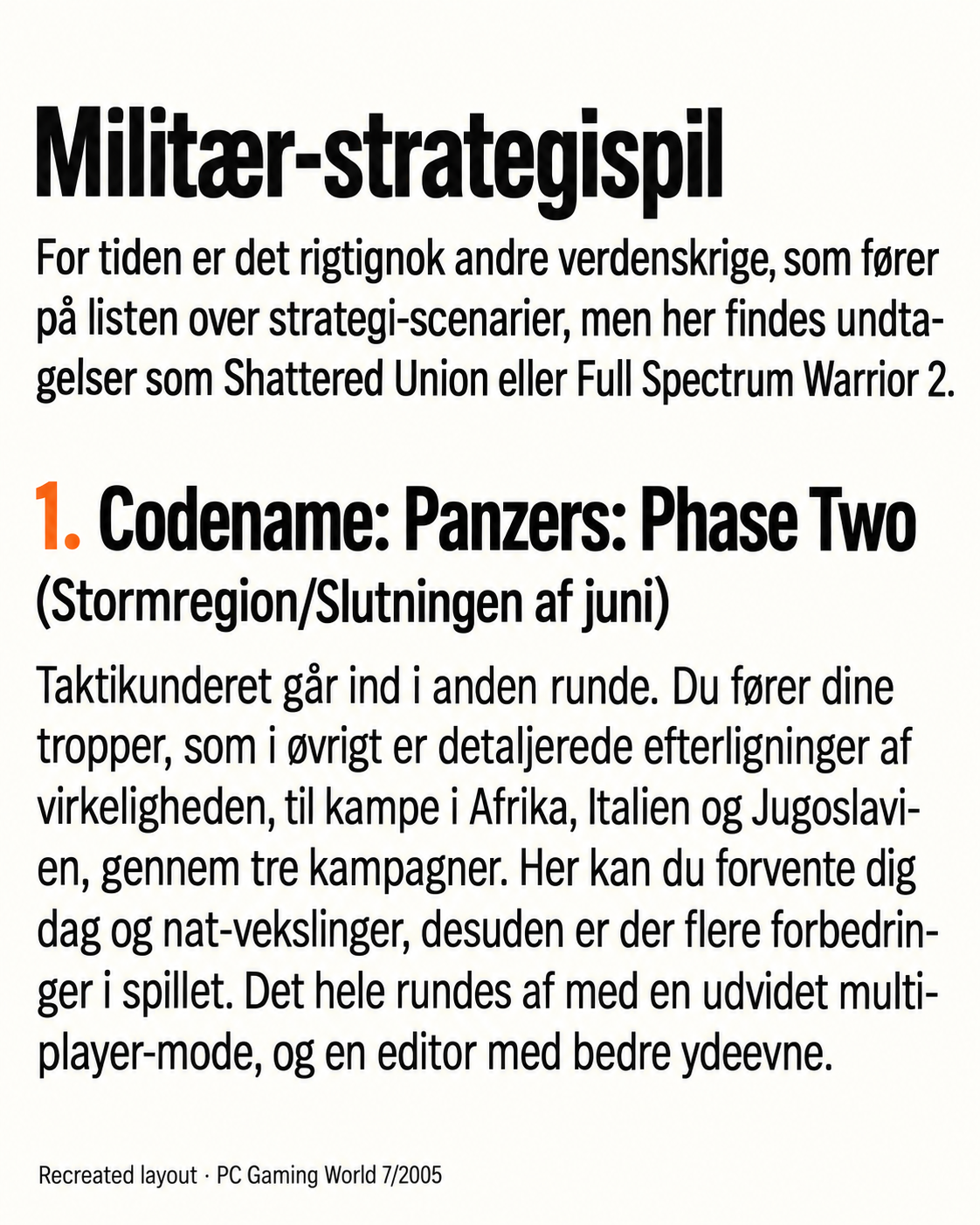

My catalogue contains two copies, added on 12 May and 15 July 2026. The later entry is marked “good”; the earlier one carries a note about a possibly missing manual. I have never played either copy.
The modern Steam release advertises remastered features. My copies are the older physical release.
2. Company of Heroes
Company of Heroes is where the magazine’s excitement and my own response pull furthest apart. I played it, found it weird and did not really like it. It never became one of the military games I wanted to keep returning to.
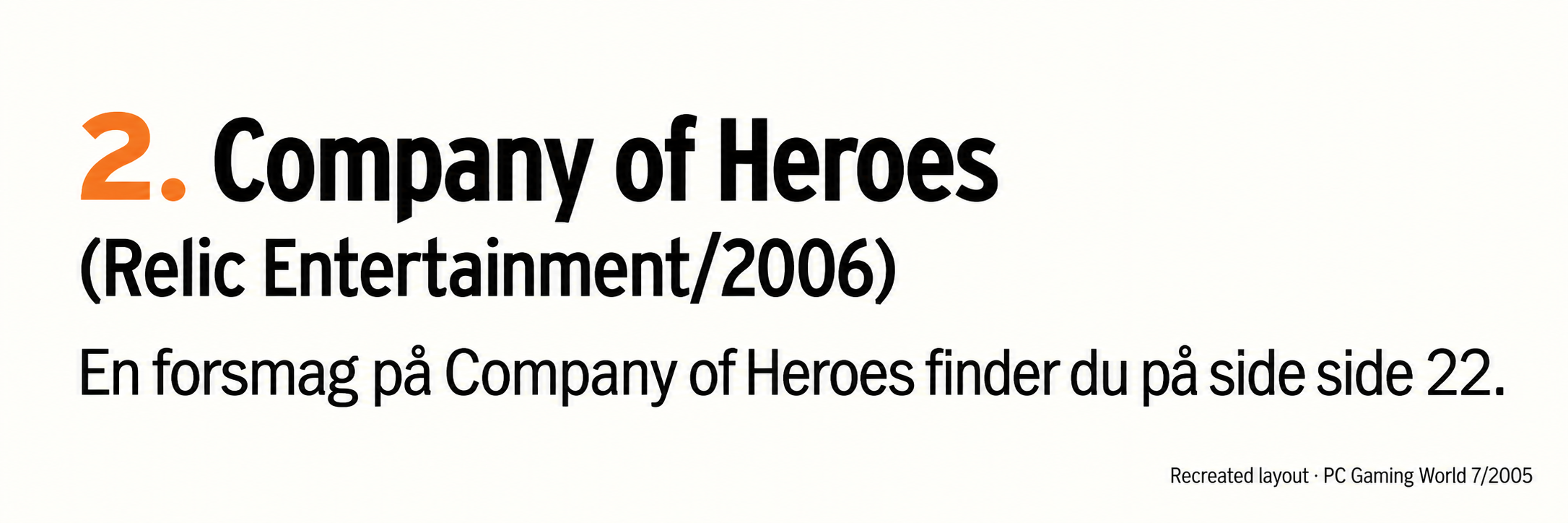

The preview had a much bigger ambition. Relic had already made Homeworld and Dawn of War, and the magazine argued that its move into WWII could do more than provide another set of uniforms. It acknowledged the tired setting, then concentrated on soldiers who looked and behaved more individually, more convincing physics and a battlefield that could be changed through fighting.
Its campaign introduction followed Able Company into Normandy on D-Day. Resource collection, construction and research remained part of the strategy framework, but control of strategic locations generated resources. The comparison was with Relic’s own Dawn of War, rather than workers gathering piles of material around a base.
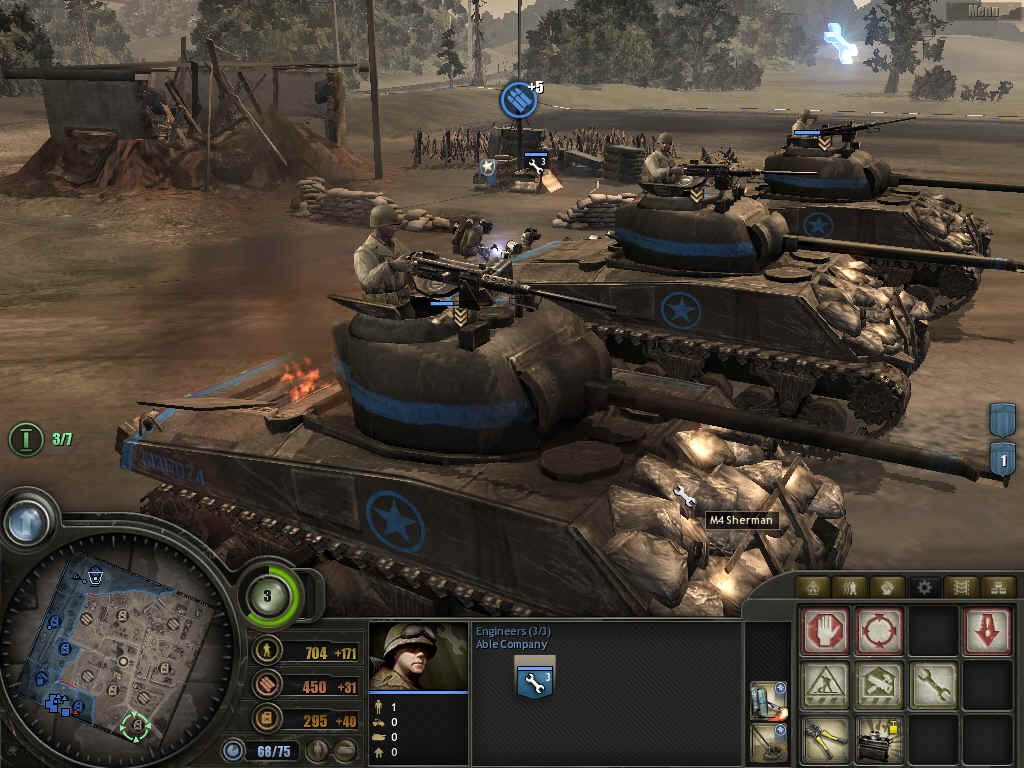
The preview discussed approximately 2,500 soldier animations, visually distinct troops, intelligent use of cover and units reorganising themselves. Its technical promises included the Essence engine, Shader Model 3.0 and Havok-driven destruction. Shells would leave craters, wooden structures would break under fire, tanks could push through walls, trees could snap and buildings could collapse.
That destruction had a tactical purpose in the pitch. A wall could stop being an obstacle. A building could stop being a safe firing position. A crater could become cover. The finished game’s official description likewise centres on squad behaviour, cover and reshaping the battlefield. These were systems the developers wanted players to use, not just effects to watch.
Released in September 2006, it received a PC Metascore of 93. The magazine’s confidence was borne out by the critical reception. That still leaves my reaction exactly where it was: I did not enjoy it much. I remember that more clearly than any particular mission.
3. Warfront
The magazine used the name Warfront; the released game became War Front: Turning Point. Its description promised an alternative outcome to WWII, graphics that would leave competitors behind and gameplay compared with Command & Conquer: Generals. There is a lot of confidence packed into that little paragraph.
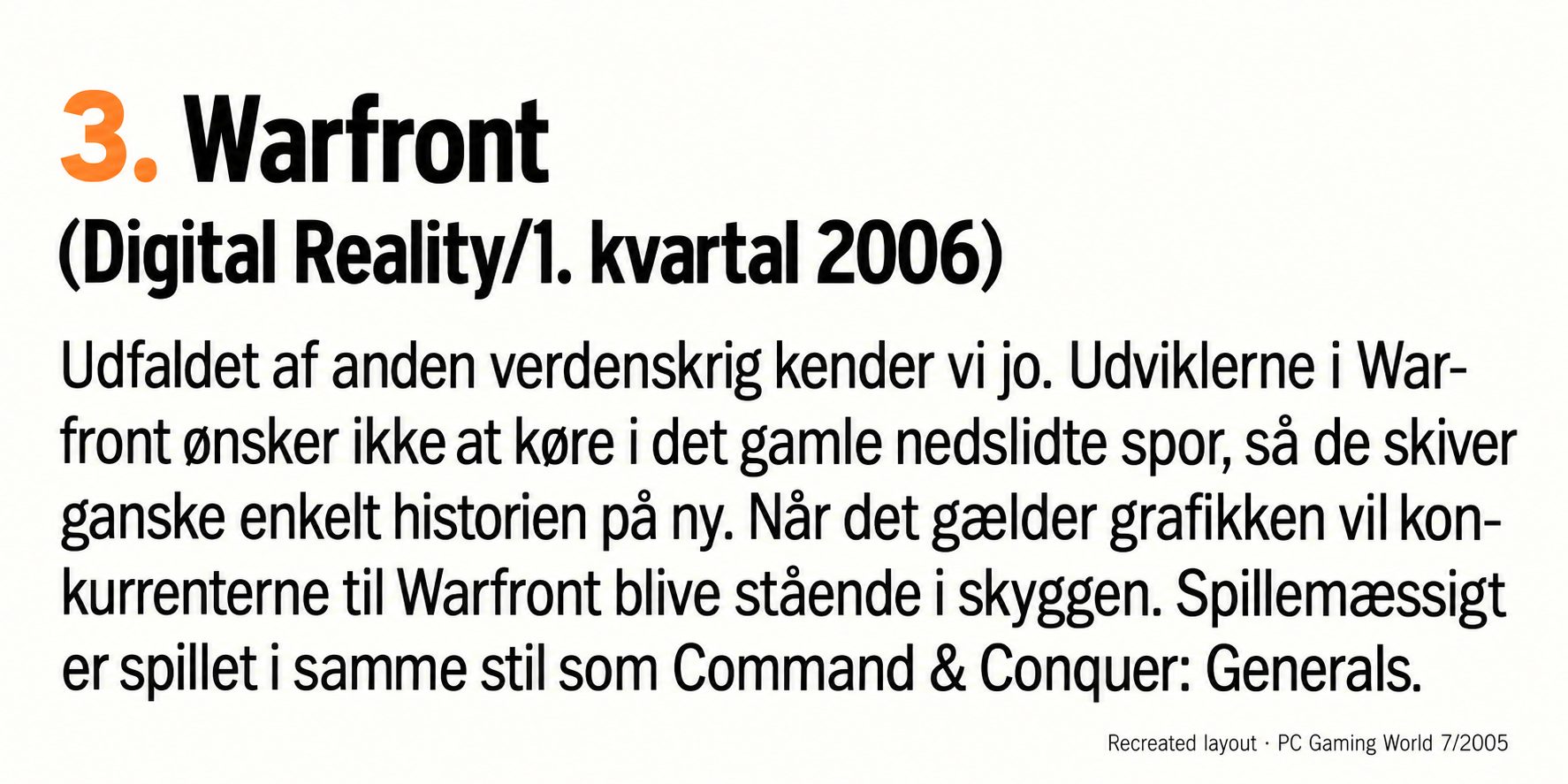
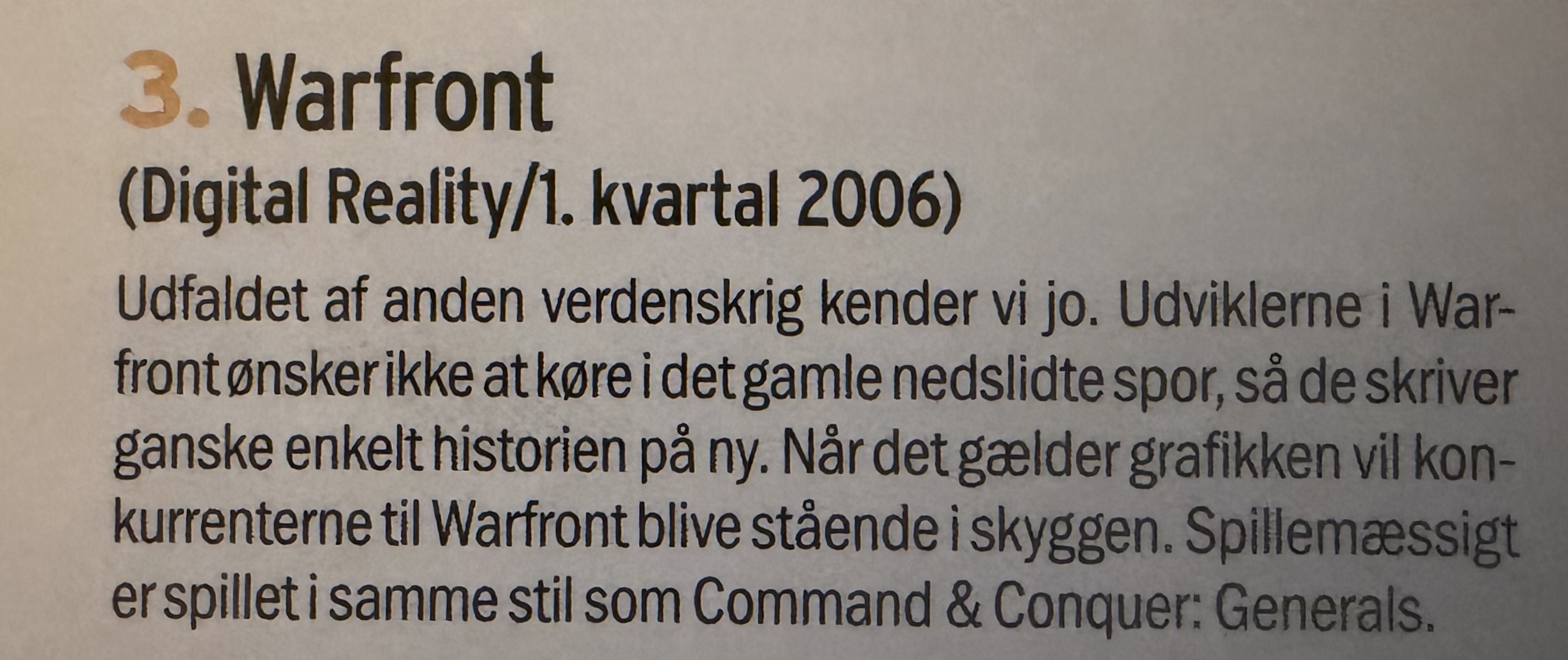
Instead of the predicted first quarter of 2006, it arrived in February 2007. Metacritic records a PC score of 73. Its alternative war and experimental weapons gave it a recognisable hook, but that reception is a long way from the preview’s suggestion that everyone else would be left standing in its shadow.
The name is vaguely familiar to me. I have encountered it over the years, although some of that recognition may belong to similarly named military games. I have not played it, and it is not listed in my October physical catalogue.
4. War Leaders
This entry contains a problem before the game has even been released. The credit says Digital Reality, while the paragraph describes Spanish developers. The finished War Leaders: Clash of Nations was developed by Enigma Software Productions, not Digital Reality.
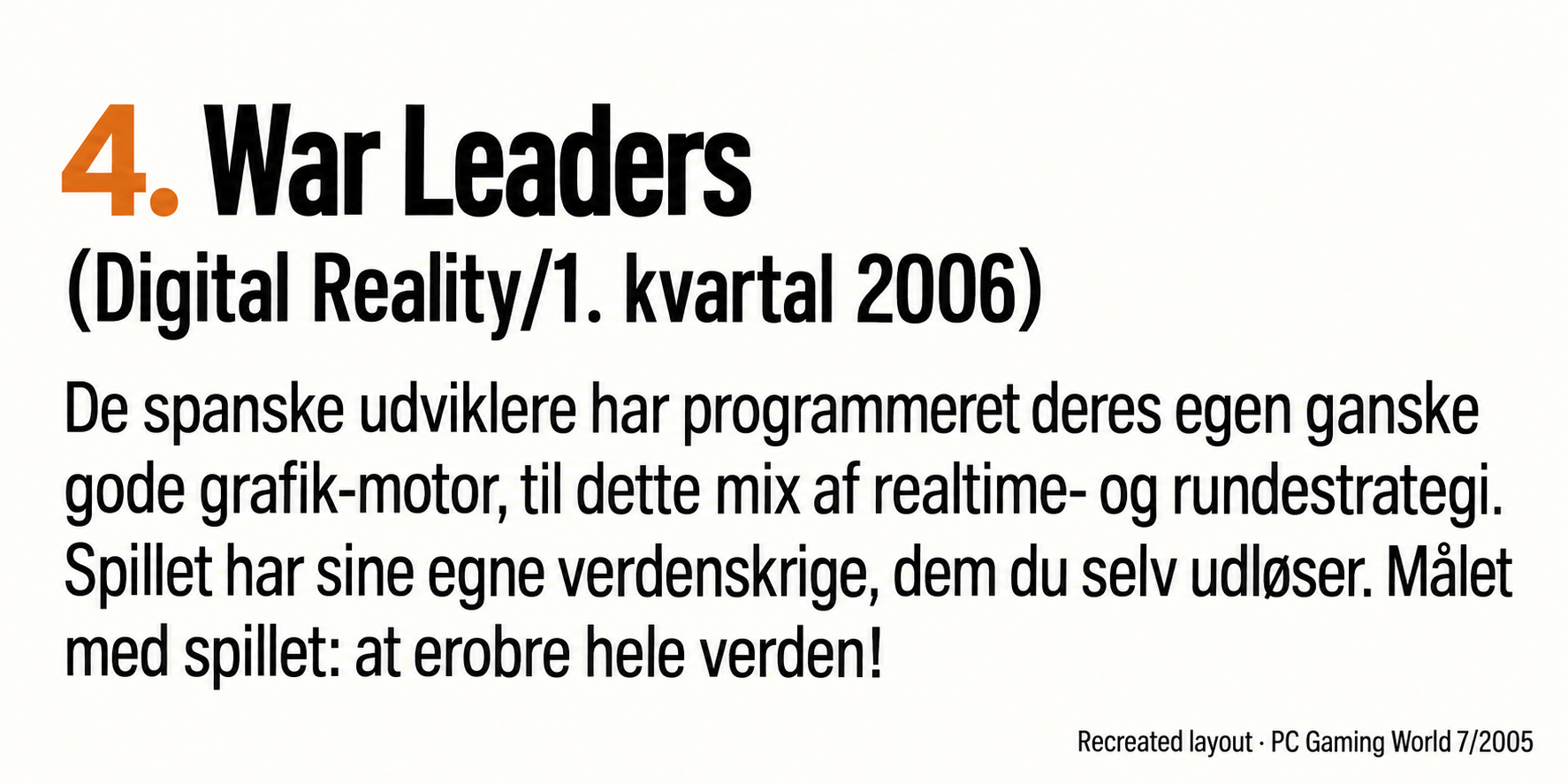

The proposal combined turn-based management with real-time battles and a campaign to conquer the world during an alternative WWII. A custom engine and that enormous scope made an impressive promise. Whether all those moving parts would work together was a much harder question than the ranking had room to answer.
The predicted first-quarter 2006 release did not happen. Release records place the European launch in 2008 and the North American release in 2009. The later critical record includes complaints about presentation, technical problems and the interface.
I do not remember this one from my own gaming life. I have not played it and have no entry for it in the physical catalogue. What catches my attention here is the magazine’s combination of a high position, a wrong credit and a release estimate that proved far too optimistic.
5. Shattered Union
Shattered Union at least left the Second World War behind. Its premise was a fictional American civil war, with the player trying to reunite a fractured United States. The magazine connected it with the developers of Tropico, although the name in the entry was given as “Top Software” rather than PopTop Software.
The finished game used turn-based tactical play rather than the continuous battlefield control found in most of its neighbours on this list. Its official store record identifies PopTop as developer, dates the release to October 2005 and displays a Metascore of 67. It reached players in the autumn window the magazine anticipated.
I have not played Shattered Union, do not remember following it at the time and have no physical catalogue entry for it.
6. Blitzkrieg 2
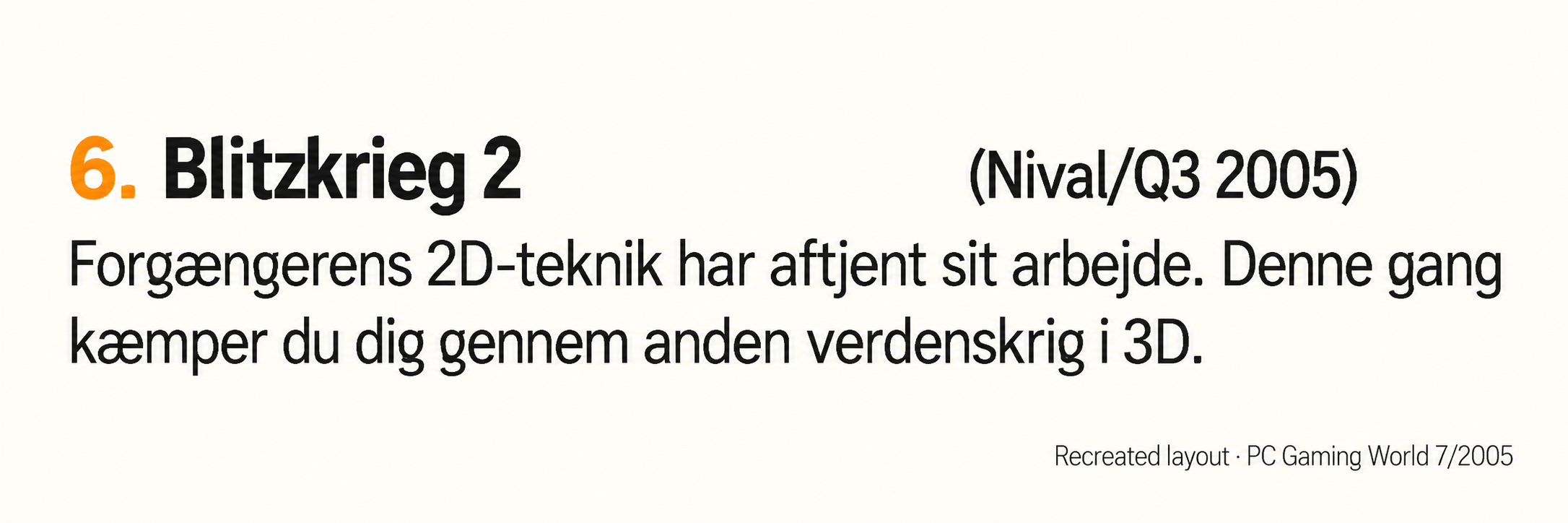
The magazine’s pitch for Blitzkrieg 2 was unusually straightforward: the first game’s 2D technology had done its job, and the sequel would take WWII into 3D. Nival was credited as developer, with a third-quarter 2005 estimate.

The official anthology listing dates the original game to 23 September 2005 and shows a Metascore of 75. Here, the broad release estimate held up. The result was a reasonably well-received tactical game, rather than the sort of delayed mystery attached to some of the other entries.
I own something catalogued as Blitzkrieg Collection, added on 15 July 2026 and marked “good”. That title alone does not establish that Blitzkrieg 2 is inside the box. I have not played the sequel, and I am not counting the compilation as a confirmed copy of it.
7. Joint Task Force
My clearest memory of Joint Task Force is how I got it. Shilka was in the USA and bought it on CDs. There were a lot of them. He later got the game on DVD and gave me his CD edition.
I played that copy, but I no longer own it. I cannot remember enough of the missions to write a proper retrospective review of how it played. The pile of CDs and the way the game came to me have stayed in my memory much more clearly.
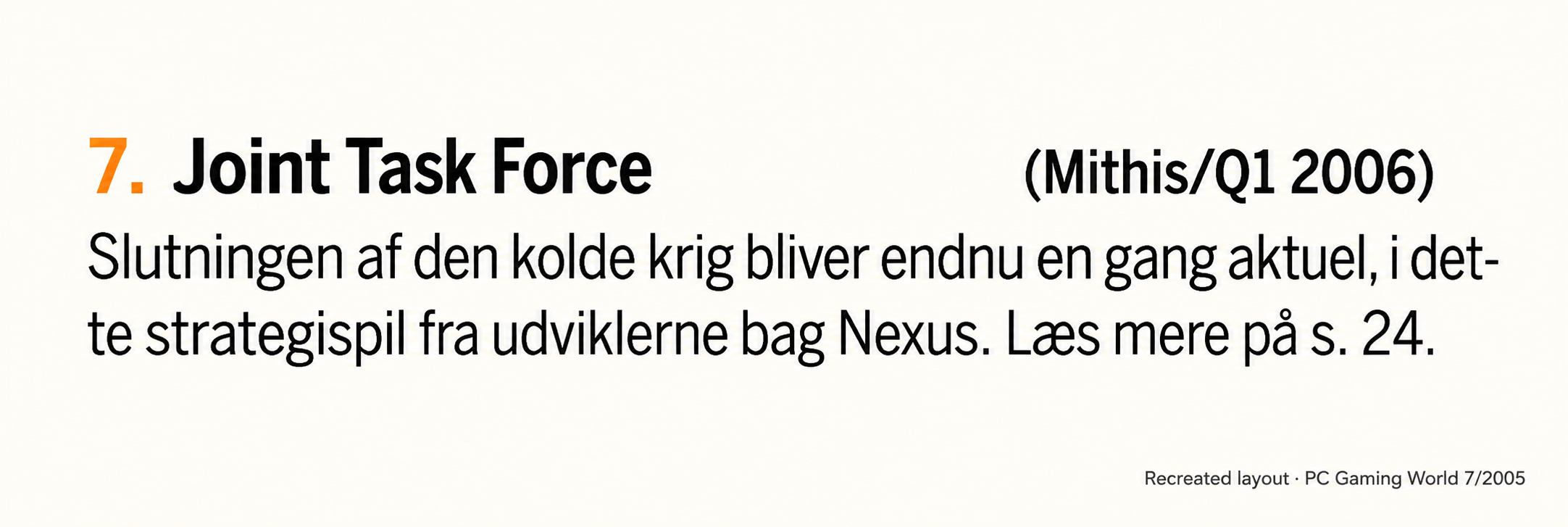

The magazine’s ranking paragraph mentioned the developers behind Nexus and directed readers to page 24. The comparison with Ghost Wars provided the detail: an internationally backed force operating in crisis regions, a restrained interface, access to reinforcements and air support, and more direct positioning of individual units. The emphasis was on commanding an operation rather than building a conventional RTS base.
One of the preview’s more interesting ideas was the expanding battlefield. Completing an objective would open another part of the map. That could introduce a settlement, an enemy position or a new threat near troops already committed elsewhere. The article also described smaller positions established while advancing, rather than a large base built up before the fighting started.
The comparison praised detailed surroundings, ragdoll effects, destructible scenery and building collapses calculated in real time. Weather was supposed to affect visibility. Its assessment of the AI was more qualified: units could seek cover, but reorganising after an attack had begun was less convincing. Both games were described as fairly linear, with JTF’s expanding map and Ghost Wars’ proposed random missions offering different ways to vary that structure.
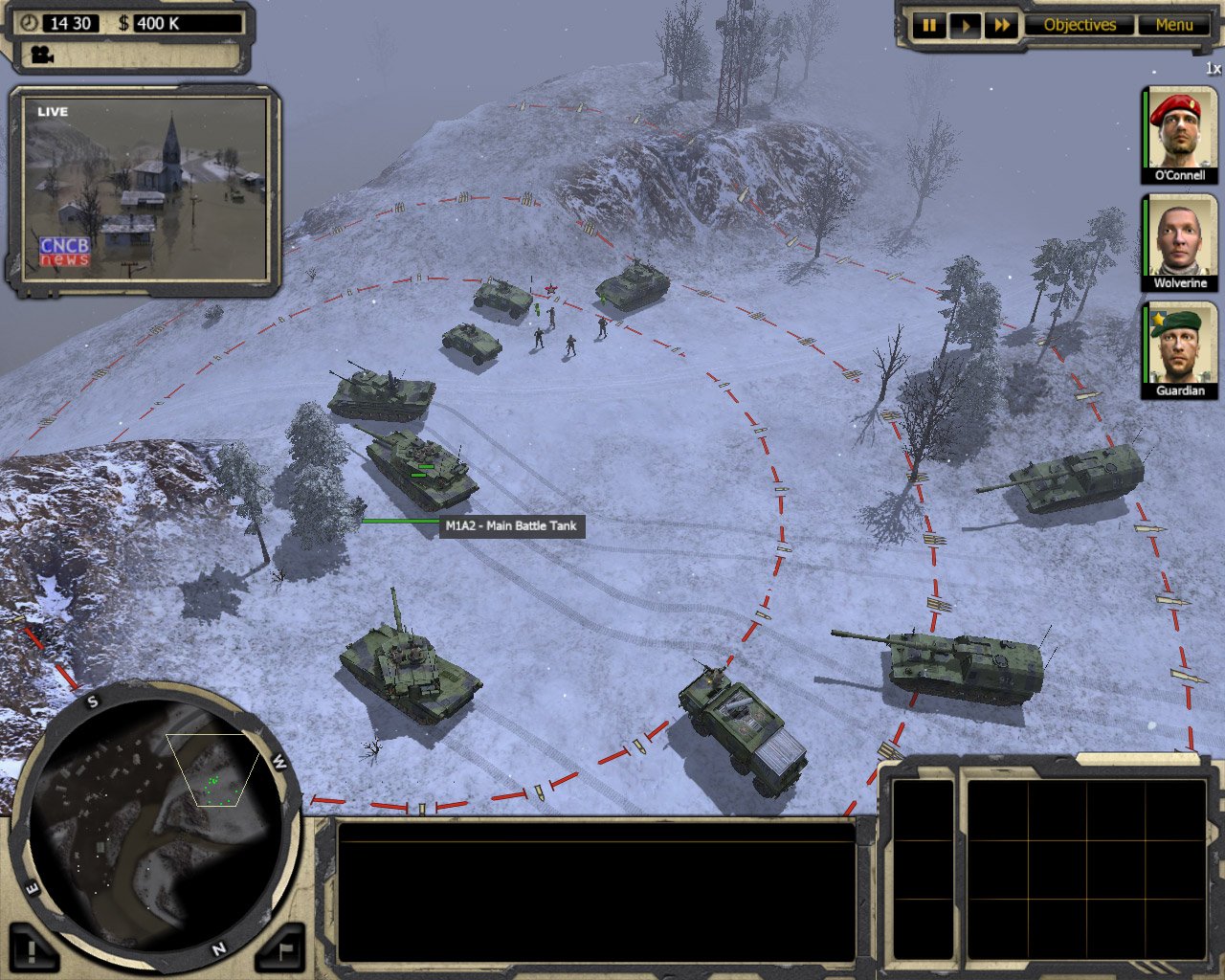
The released game credited Most Wanted Entertainment and arrived in September 2006. Its five campaigns and twenty missions used a mixture of infantry, armour, artillery, reconnaissance and air support. The store description also identifies persistent hero development and media coverage as parts of the game. Its Metascore was 68, considerably below Company of Heroes.
The competition was real enough that bit-tech’s contemporary review advised readers with money for only one RTS to wait and see how Company of Heroes turned out. That reviewer liked parts of JTF but criticised the voice acting and could not get its multiplayer working correctly. Those are the reviewer’s experiences, not things I remember testing myself.
Ghost Wars, meanwhile, became Field Ops during a troubled development history and was ultimately cancelled. Unseen64 documents that project’s changes. The rival occupying half the magazine spread never became the straightforward comparison between finished games that the preview suggested.
Shilka handing me his copy is also the kind of ownership I want when I buy games. Someone can finish with a copy and pass it to a friend. It is one reason I think we should stop buying digital games as consumers when what we actually want is something we can keep, lend or give away. A physical box still needs checking for account restrictions, but that old hand-me-down was how I got to play JTF.
8. Full Spectrum Warrior 2: Ten Hammers
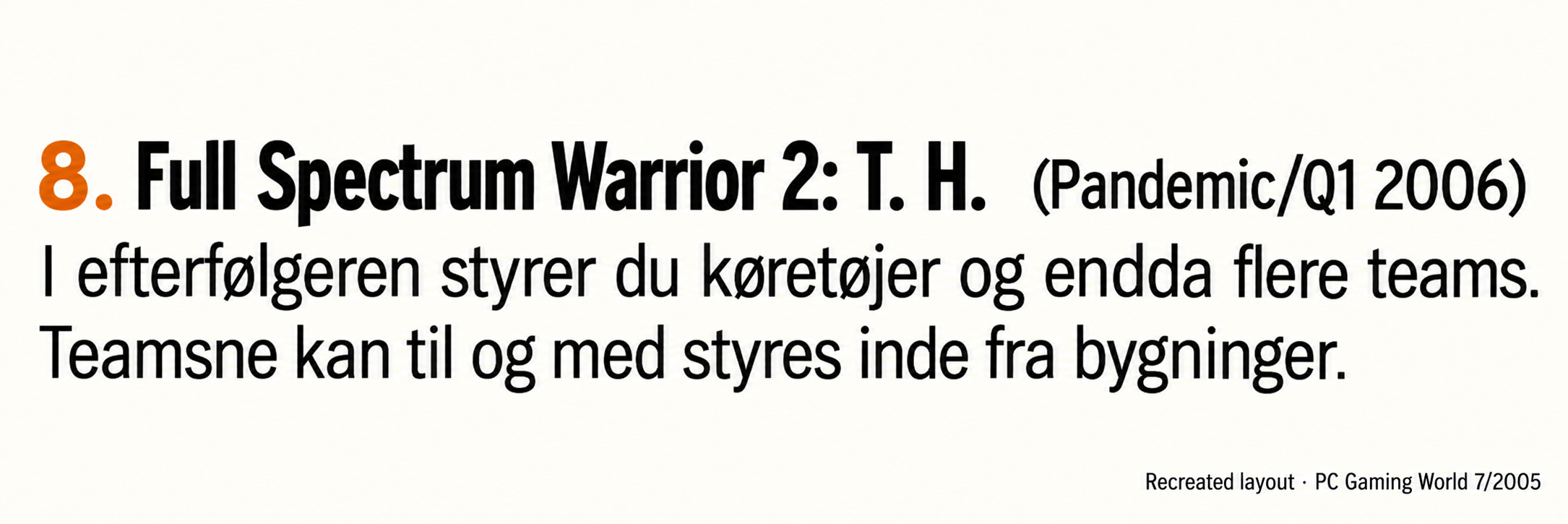
The magazine called this Full Spectrum Warrior 2: Ten Hammers. The released title, and the name in my catalogue, is Full Spectrum Warrior: Ten Hammers. Its first-quarter 2006 preview promised vehicles, additional teams and the ability to direct squads from inside buildings.

This was squad command rather than an overhead tank-and-base RTS. Pandemic’s official game description explains directing teams through hostile streets, coordinating fire and movement, using buildings and controlling mechanised units. The game arrived in spring 2006, and its PC Metascore is 70.
My physical copy was added on 26 July 2026 and is marked “good”. I have not played it.
9. Rush for Berlin
Rush for Berlin was another StormRegion game, which gave the magazine an obvious connection to its number-one choice, Codename: Panzers – Phase Two. The preview focused on the final advance towards Berlin and expected a release in the fourth quarter of 2005.
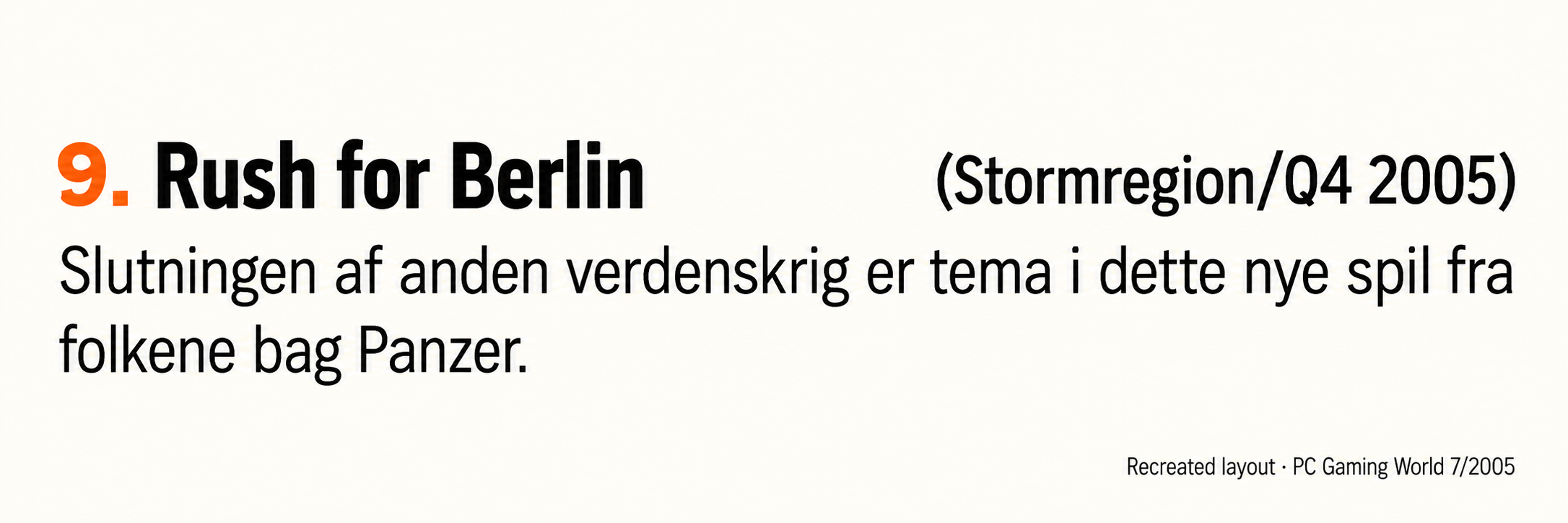

The original game instead reached release in May 2006. Its later Gold listing describes the 1944–45 setting, officers with special abilities and an alternative German campaign involving prototype weapons. It displays a Metascore of 76.
It was another entry that arrived later than expected without turning into a complete critical disaster. I have not played it, however, and it is not in my October physical catalogue. There is no personal run through StormRegion’s games for me to trace here.
10. Officers
The last entry was credited to Game Factory and expected in the fourth quarter of 2005. Its big promise was scale: a nonlinear strategy game with maps of up to 400 square kilometres. That is an enormous battlefield to promise in such a small piece of print.
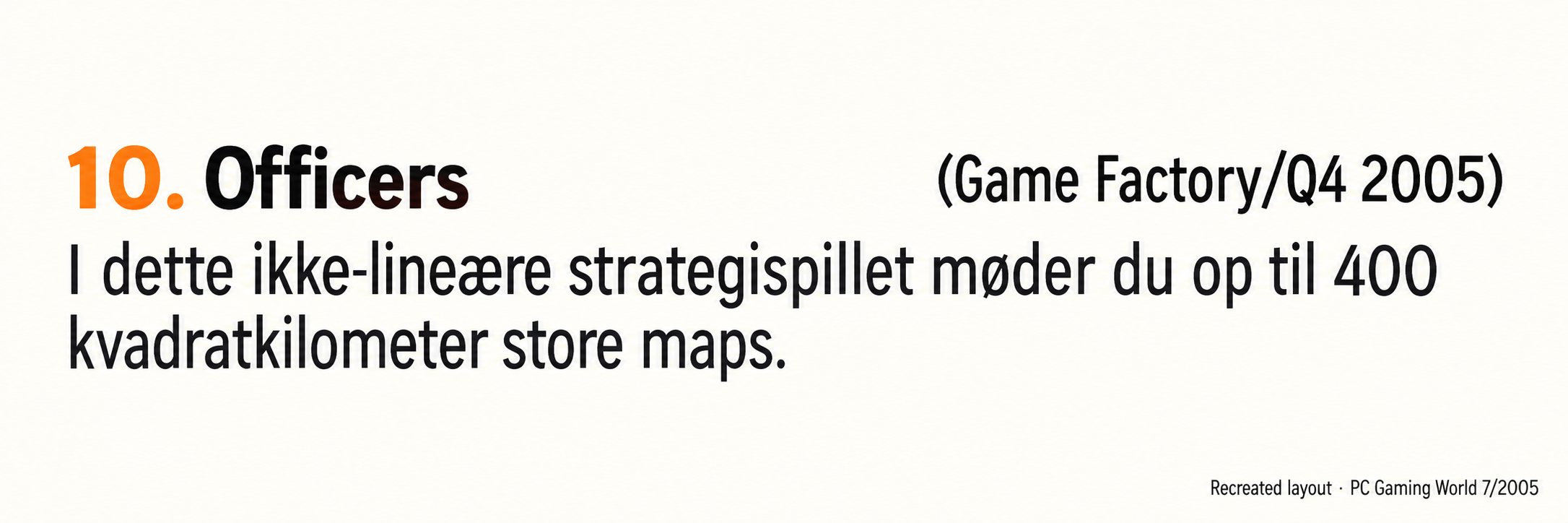

The development news became rather less expansive. A July 2006 Gameswelt report described a beta, maps of 25 square kilometres and up to 1,500 units. It also reported that the German and Soviet campaigns had been cut from the planned initial release, with the Western Allied campaign taking priority. That is a more concrete picture of development compromises than the ranking paragraph provided.
The German release followed in November 2008, while Metacritic’s North American record dates the game to July 2009 and gives it 64. This was a staggered release history: contemporary coverage also referred to an earlier Russian version. It would be misleading to treat the German date as the first moment any player could have encountered the game.
I have not played Officers, and it is not listed in my physical collection. What interests me is how much changed between the confident size claim, the revised development news and the later releases.
The Collection Behind These Old Names
Much of my present physical collection comes from second-hand shops, mixed with older possessions. An earlier snapshot recorded the following purchase groups. These are the earlier amounts, not a new total for the October catalogue.
| Earlier purchase group | Paid in DKK | Approx. USD | Approx. EUR | Approx. GBP |
|---|---|---|---|---|
| Main group: 279 games | 1,906 DKK | US$295.57 | €254.96 | £217.99 |
| Sixteen mint games | 129 DKK | US$20.00 | €17.26 | £14.75 |
| The Sims group | 382 DKK | US$59.24 | €51.10 | £43.69 |
| Total of these three groups | 2,417 DKK | US$374.82 | €323.31 | £276.43 |
Conversions use the 17 August 2026 rates published by evaluta.dk from Danmarks Nationalbank data: US$1 = 6.4485 DKK, €1 = 7.4758 DKK and £1 = 8.7436 DKK. They are approximate equivalents of what I paid, not retail prices in other countries.
The catalogue includes condition notes, incomplete copies and account-related restrictions. A box marked “good” is a condition entry, not a declaration that I have completed or tested the game. The Danish “Afsluttet” field records completion; “No” does not mean I have never played the title.
I have two Panzers – Phase Two entries, one Ten Hammers and a Blitzkrieg Collection whose title does not identify every included game. The JTF copy Shilka gave me is no longer mine.
The Games That Actually Stayed With Me
My military gaming memories are much more closely tied to Delta Force, Battlefield, Operation Flashpoint, Ghost Recon and Rainbow Six. Those were games I spent time with, rather than names I later encountered in a second-hand shop or an old ranking.
Strategy was part of my gaming life too. The first Age of Empires mattered to me, as did Black & White and especially Black & White 2. I still think it is a shame Lionhead’s series never grew into everything it could have been. The creatures, morality and different ways of influencing the world interested me much more than another announcement about detailed WWII tanks.
Black & White 2 appeared elsewhere in the magazine’s rankings, but did not receive anything like the four-page treatment given to Age of Empires III. Looking back through the issue, I keep finding that mismatch between the space devoted to a game and the amount it eventually meant to me.
The military list has some good predictions, some ordinary delays and some wildly optimistic promises. It is interesting to read with the release history beside it. But my own part of it is much simpler: I tried Company of Heroes and did not really like it, and I played Joint Task Force because Shilka gave me a pile of CDs.
Sources and Image Credits
Magazine source: PC Gaming World, Danish edition, issue 7/2005, military-strategy ranking; Age of Empires III coverage beginning on page 16; Company of Heroes, pages 22–23; JTF and Ghost Wars, pages 24–25. The ranking excerpts are recreated text layouts based on my photographs of the magazine. The originals are linked beside them. The October ownership details come from my physical-game catalogue exported on 13 October 2026.
Release, developer and reception references are linked beside the relevant games. Metascores are PC critic aggregates, not my ratings. The external gameplay images are credited to Sector.sk for Company of Heroes, bit-tech for JTF, and Ensemble Studios/Microsoft with the retained GameSpot watermark for Age of Empires III. They are not captures from my playthroughs. Magazine and game artwork remain the property of their respective rights holders.