
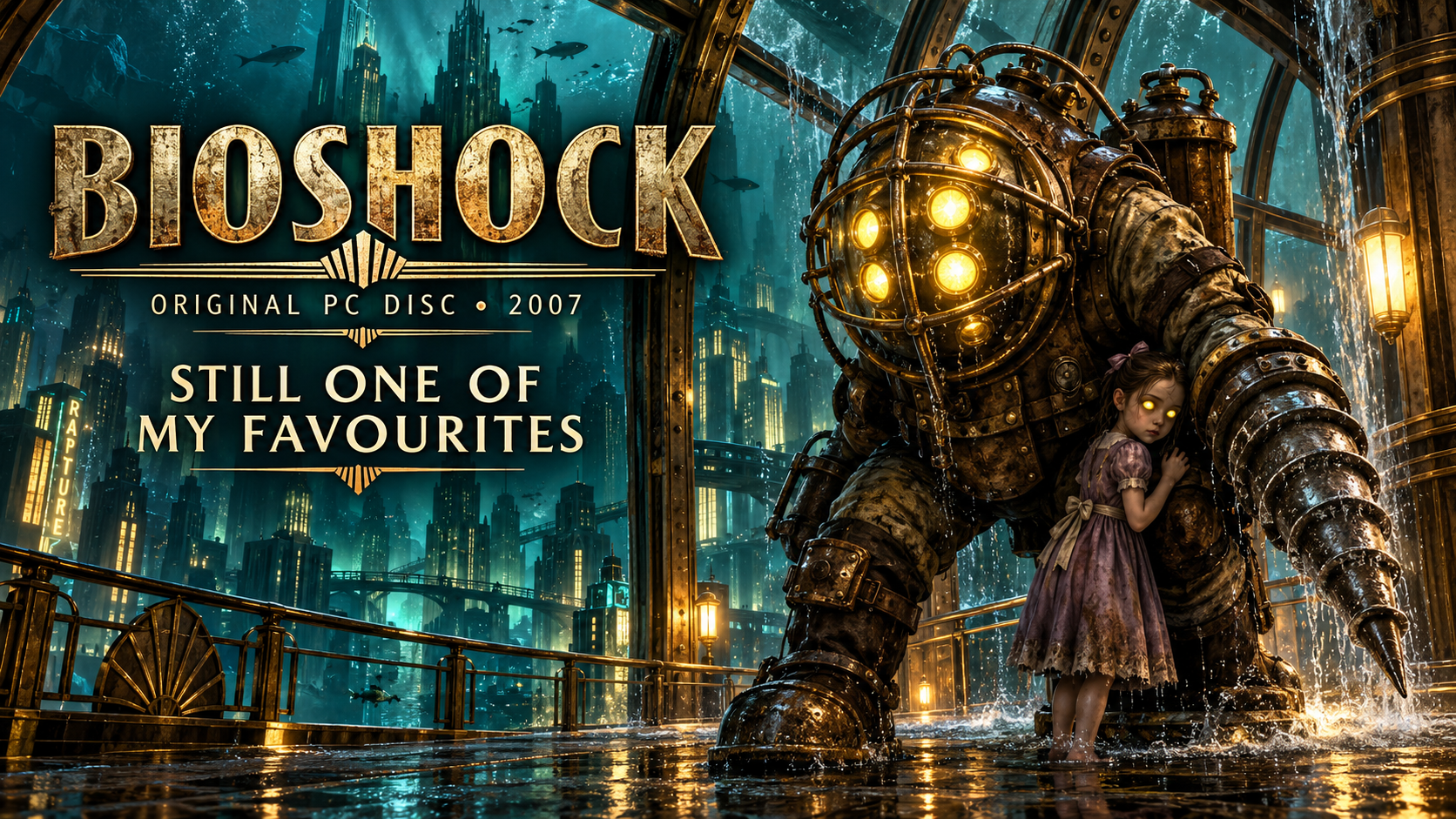
I love BioShock. It is easily one of my favourite games. The horror, the action and the lore work together, and it makes you feel as though you understand what is happening while you have no idea how much you are missing.
I have completed both the original and BioShock Remastered multiple times, and I own both on Steam. This time I returned to the original PC DVD. I finished this disc playthrough on 30 August 2026, after getting the retail installation working through Wine and Lutris.
There are two things I particularly dislike: the research camera and the final boss. Getting the DVD installed also took far more work than it should have. Once I was playing, though, the game ran smoothly for me, and Rapture was still a place I loved being in.
My disc copy
| Detail | Recorded information |
|---|---|
| Edition played | Original PC retail DVD, updated with the Worldwide Retail 1.1 patch |
| Bought | 23 August 2026, at Kirppu in Denmark |
| Paid | DKK 10.00 — approximately US$1.51 / €1.34 / £1.13 |
| Condition / CLZ index | Good / #468 |
| Completed | 30 August 2026 |
| CLZ value estimate | DKK 450.73 — approximately US$67.86 / €60.30 / £50.88, as recorded on 18 October 2026 |
The valuation is CLZ’s recorded estimate. Currency conversions use ECB reference rates dated 16 October 2026, rounded to two decimals.
My original-disc gameplay
The playlist contains three recordings from the disc version. My installation was patched to 1.1, with ReShade and BioshockGraphicalUpgrade installed.
Watch my BioShock disc playthrough — all three recordings
- Recording 1 — 3:51:58. Play here · Open on YouTube
- Recording 2 — 1:33:55. Play here · Open on YouTube
- Recording 3 — 42:54. Play here · Open on YouTube
Rapture makes the journey matter
The glass passages are one of the things I remember most fondly. You can be running from one place to another, then look outside and see the city around you. The bathyspheres, those little submarine lifts, make travelling between its areas feel like part of the place too.
Rapture has a strong identity. Andrew Ryan built his underwater city around his belief in individual achievement, free enterprise and freedom from outside authority. By the time Jack arrives in 1960, that dream has collapsed into violence, genetic modification and people trying to control what remains.
I like how the game lets you work out that history while you are moving through it. Atlas gives you directions, the audio diaries fill in the lives of people who were there, and the advertisements show what the city was selling to itself. You have enough information to keep going, but understanding your next objective and understanding the whole situation are very different things.
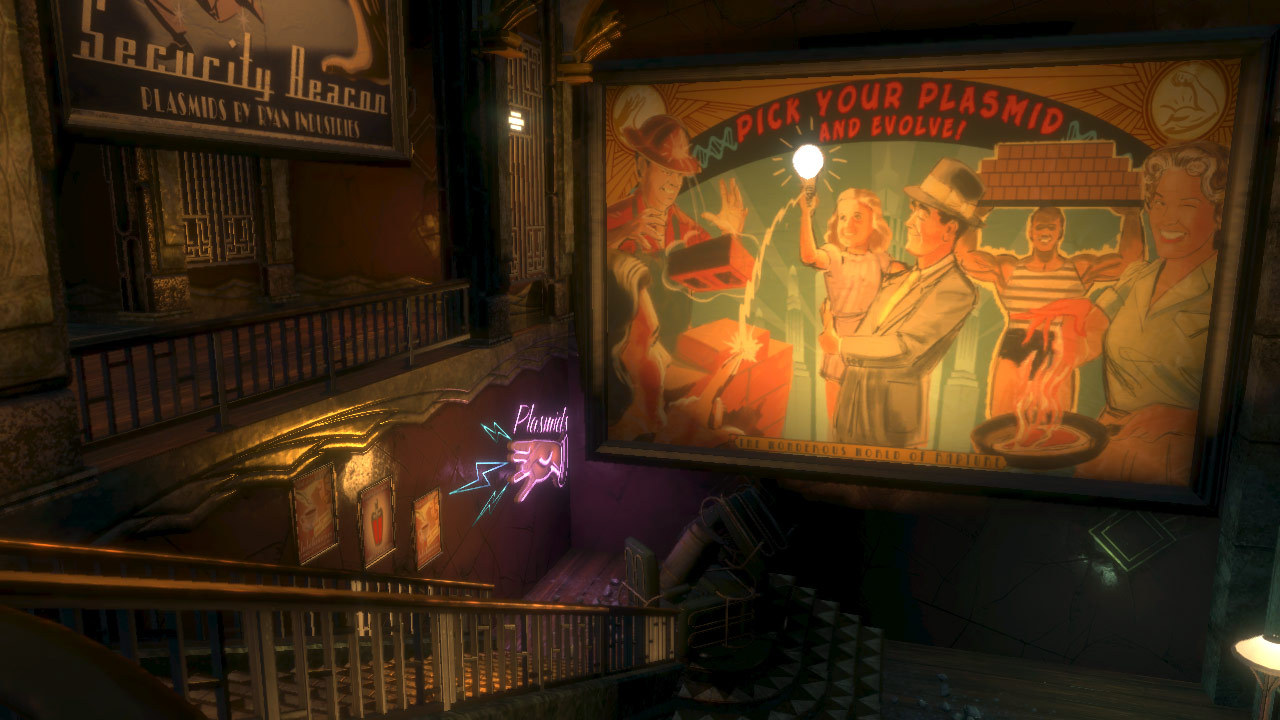
The first shotgun is another moment I like. It sits there under a spotlight, making sure you notice it. You take it, the lights go out, and suddenly you are being attacked by enemies you can barely see. It gives you a new weapon and immediately makes you use it.
That is the sort of thing I mean when I say I can feel the work a studio has put into a game. The weapon, the lighting and the encounter all belong to the same moment.
How BioShock became this game
BioShock grew out of Irrational Games’ experience with System Shock 2. The first public details appeared in 2004, with an emphasis on interacting with an environment and finding different solutions to encounters. Earlier concepts were very different: Ken Levine described discarded stories involving genetic experiments on an isolated island and a cult deprogrammer. The gameplay ideas survived substantial changes to the fiction.
Take-Two announced its acquisition of Irrational on 9 January 2006, bringing BioShock under 2K. At release, its developers were credited as 2K Boston and 2K Australia. Valve’s own Steam launch announcement dates the North American release to 21 August 2007, with Europe following on 24 August. The original launch platforms were PC and Xbox 360.
Project lead Alyssa Finley’s November 2007 postmortem, pages 20–26, records a three-year production and a peak of 93 in-house developers. The goal was to build on the studio’s earlier work and reach a much larger audience. The technology included a modified Unreal engine, Havok physics and FMOD audio.
Finley describes a difficult first external playtest. Players found the opening confusing, missed important information and did not understand how to use the powers or develop their characters. The team rebuilt the first two levels around a slower introduction. Medical Pavilion became a series of problems designed to teach key plasmids.
The Big Daddy encounters also changed during development. Work on a demonstration helped establish them as roaming boss fights that players could choose when and where to begin. Finley also describes a long, hard final crunch, with people expecting six more weeks of work suddenly facing three months.
Levine’s 2008 discussion of the narrative shows how closely the writing developed alongside the environments. Posters, arrangements of objects and artists’ ideas fed back into the story. The mystery was built around what the player understood and what the game withheld. That is a large part of why the lore works so well for me.
Powers that belong in the world
I like the way BioShock gives you something that works like magic and makes it fit the game. Plasmids are sold as genetic modifications. ADAM is the resource behind those changes, while EVE fuels the active powers. ADAM originates in a sea slug, and the Little Sisters have been altered to produce and reclaim it. The same technology is part of what has ruined the people around you.
The powers also help you get through Rapture. Electro Bolt can activate a shorted door control. Fire can melt obstructing ice. Telekinesis lets you move objects and return explosives. These abilities have uses beyond giving enemies another kind of damage. The original manual explains the powers, equipment and character systems.
That connection is what I like. The game gives me a power, gives it a place in the story, and gives it things to do in the environment. It makes sense within the world I am playing in.
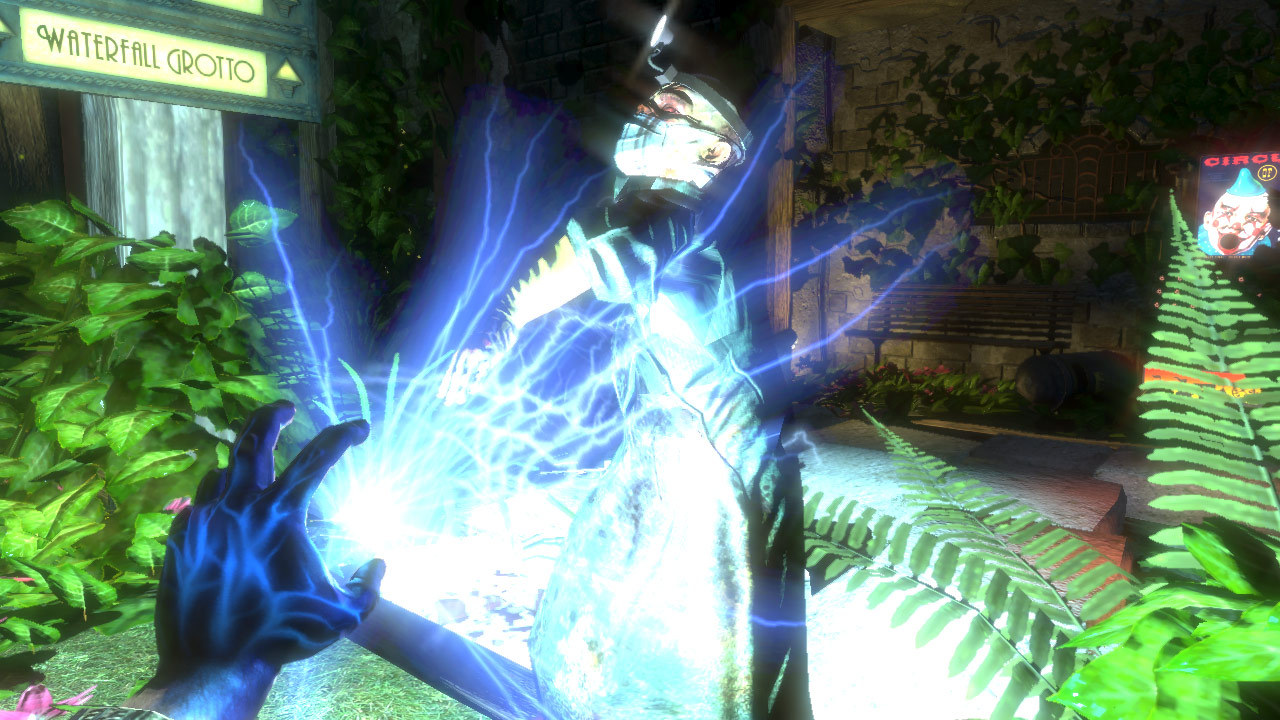
In a pre-release interview, Levine said the team wanted character growth to have immediate, understandable effects, with fire, water and other systems behaving predictably enough for players to improvise. That is a design aim I can recognize in the finished game.
I keep saving the Little Sisters
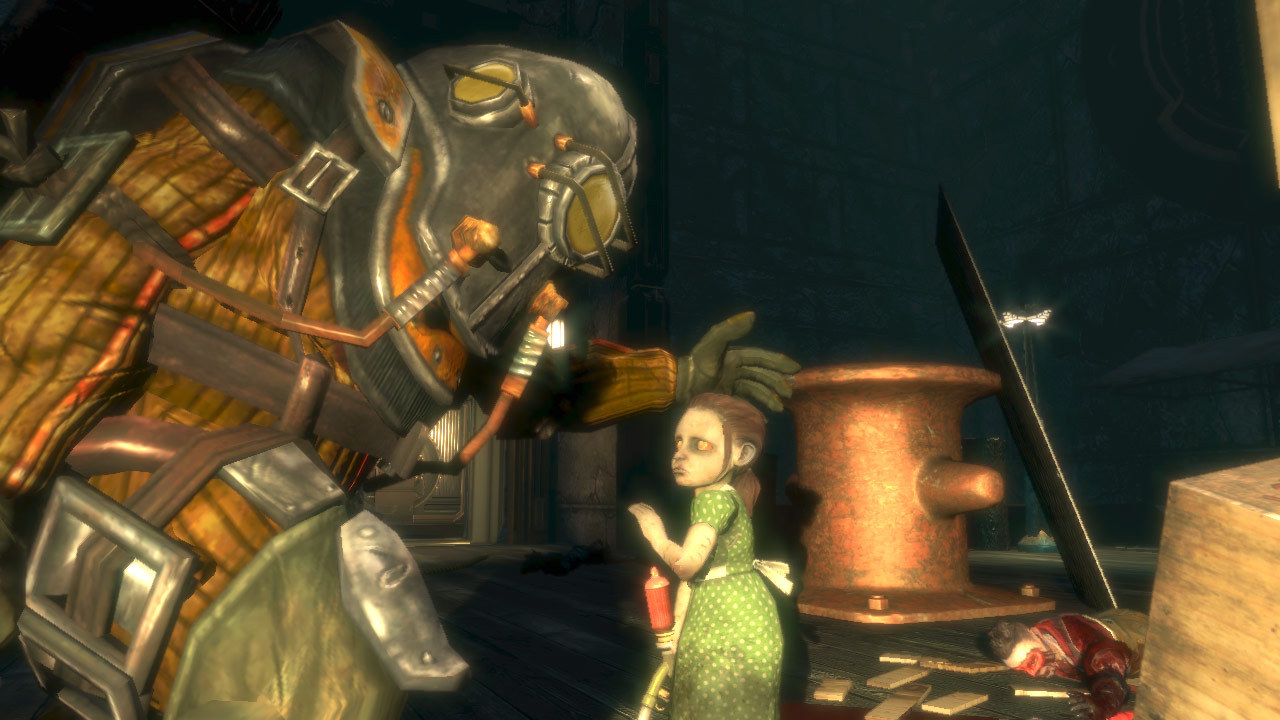
I like having the choice to rescue or harvest the Little Sisters, even though I keep choosing to save them. As far as I can remember, I have always rescued them. I may have harvested one in an older playthrough, but I cannot remember doing it.
Saving them also gives me enough ADAM for the way I play. Rescuing provides less immediately, then Tenenbaum sends gifts after groups of three rescues. Those gifts include more ADAM and other useful items. The original game’s rescue and harvest rewards are 80 and 160 ADAM respectively.
| Choice | Immediate ADAM | Rescue gift | Total after collecting the gift |
|---|---|---|---|
| Rescue all three | 3 × 80 = 240 | 200 ADAM | 440 ADAM |
| Harvest all three | 3 × 160 = 480 | — | 480 ADAM |
The 200-ADAM gift is also documented in GameSpot’s walkthrough. There is still a difference, but rescuing does not leave you with only half the ADAM over that group of three.
On Easy, I already feel very powerful. Between the ADAM I collect and the gifts, I have almost everything I need. I like that I can save the children and still build a strong character.
The research camera feels like extra work
The research camera is the system I could most easily do without. There is a required task in Neptune’s Bounty where Peach Wilkins wants photographs of three Spider Splicers. Beyond that, the continuing research gives you damage bonuses, Gene Tonics and other upgrades for photographing different subjects.
I can see why those bonuses would matter more on Hard. On Easy, I already feel overpowered, so the camera becomes another way of collecting things I do not particularly need.
I still use it. There is enough film, and hacking the vending machines makes buying supplies cheaper. I remember running short near the beginning, but after that it was not really a problem. I kept taking photographs because I could, rather than because the game was making me need the rewards.
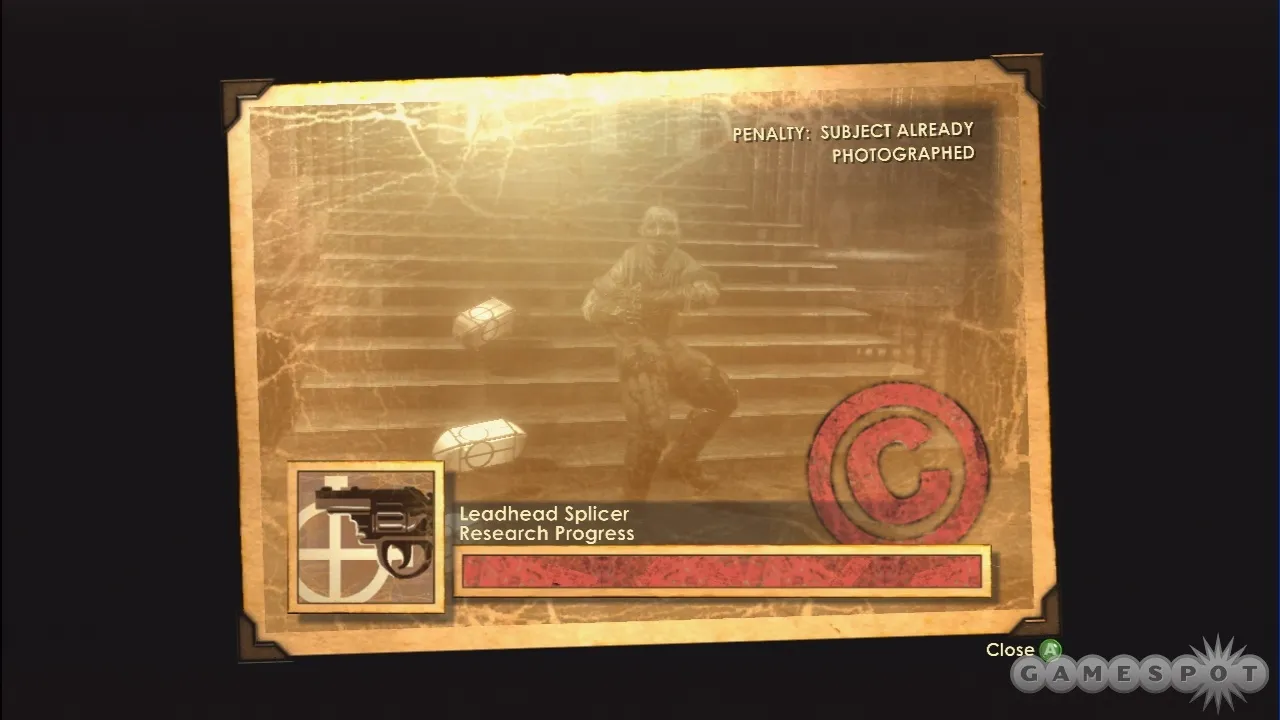
The camera has a purpose in the progression system, but it often feels unnecessary in my playthroughs. I would rather get on with exploring and fighting than keep stopping for another research photograph.
The sound belongs to Rapture
The sound effects and background music fit the game extremely well. They support the horror and the atmosphere without feeling separate from the place I am walking through. This is one of the things I love about BioShock.
Garry Schyman composed the original score, while audio director Emily Ridgway led the sound and music implementation. In her Game Audio Network Guild interview, Ridgway explained that individual music cues were linear, but their exact alignment with a player’s actions could vary. The priority was the emotional effect of a room, rather than making every musical hit match an action. The score sits alongside the licensed period recordings heard around the city.
For me, it all works together. The game sounds like the world it is showing me.
Becoming a Big Daddy, and the ending
Major story and ending spoilers follow.
I like the late section where the game turns you into a fake Big Daddy. You collect the equipment, change your voice and use pheromones so a Little Sister will accept you as one. You have spent the game dealing with that relationship from the outside, and now you have to take on the protector’s role yourself.
The larger story also makes you reconsider the directions you have been following. The “would you kindly” reveal brings the player’s obedience into the plot. It is a good example of BioShock making you feel informed while keeping something important out of sight.
The final fight with Fontaine is much less satisfying to me. He has filled himself with ADAM, and you wear him down before draining it from him between combat phases. After everything I have been through, those short extraction moments feel anticlimactic.
I understand the idea: he wanted all that power for himself, and now it is being taken away. The idea fits his character. The fight itself does not give me the ending I wanted after that journey.
Levine later expressed his own dissatisfaction. In a PC Gamer interview, he said, “I would never have had the boss battle at the end of Bioshock.” He described realizing it was the wrong approach too late to change it.
The original PC game had bugs and interface problems
My patched installation ran smoothly once it was working. The original release still had a substantial list of problems addressed after launch. Patch 1.1 arrived on 4 December 2007, adding content and fixing input, interface, display and audio issues.
| Area | Recorded changes |
|---|---|
| Mouse and controls | Mouse acceleration fixes, key-rebinding fixes and a walk-toggle binding |
| Interface and hacking | Fixes for long hitches or hangs when opening certain screens, machines and the hacking minigame |
| Display | Horizontal FOV Lock option; DirectX 10 refresh-rate and VSync fixes |
| Audio and subtitles | Vista audio-stuttering fixes, subtitle timing and queuing improvements |
| Content and difficulty | Additional plasmids and tonics, plus an option to disable Vita-Chambers |
The published patch notes also include a progression fix for a photograph of Cobb becoming impossible when his body fell behind a pillar.
The 2016 remaster needed updates of its own. 2K’s October 2016 PC patch notes document mouse and sensitivity changes, adjustable FOV, 21:9 support, audio fixes and a fix for settings resetting after an improper shutdown.
I had to run a web server to finish installing the DVD
My Linux troubleshooting took place on 27 August 2026. The DVD installer reached its Auto Patcher stage and stopped with Download server not responding. I had the disc, but installation still depended on getting a file from somewhere else.
This was part of the original installer. 2K’s own FAQ describes the executable being downloaded during setup and the failure message when the download server cannot be reached.
The workaround that got me past it was to serve the expected payload locally. I placed bioshock_patch.gz in a temporary folder, inside a subdirectory named bioshock, and named the served copy installer, with no extension. The file therefore answered the path /bioshock/installer.
I temporarily added this mapping to Linux’s /etc/hosts:
127.0.0.1 www.2kgames.comThen, from the temporary folder containing the bioshock subdirectory, I ran:
sudo python3 -m http.server 80 --bind 127.0.0.1The installer’s request went to my own computer, and the local server supplied the file. That let the installation continue. I had to run a small web server to finish installing a game from a DVD.
After this installation step, stop the server and remove the temporary hosts entry. The mapping belongs to the workaround. Python’s documentation explains how the server serves its working directory, and the hosts manual covers the local hostname mapping.
I then successfully applied Bioshock Version 1.1 Patch Worldwide Retail.exe. Earlier patch attempts had crashed too, including an attempt with that updater. Getting through the installer’s download stage came first; the successful standalone update followed.
The runners used during troubleshooting included Wine 11.2 Staging and Wine-GE 8-26. After installation and patching, I added ReShade and copied BioshockGraphicalUpgrade.addon32 and its GraphicalUpgrade folder beside Bioshock.exe in BioShock/Builds/Release. ReShade’s interface worked afterward.
The graphical add-on comes from garamond13’s ReShade-shaders project. It changes the presentation of the original game. My disc recordings come from that installation.
The restrictions around a game I love
The DVD’s installation problem is why preserving a disc can involve more than keeping the disc itself. In this case, the installer payload, the correct retail patch and the method of supplying that missing download were all useful parts of getting my copy working again.
The original retail release also used SecuROM activation. At launch, the simultaneous-machine limit was increased from two to five after complaints. In June 2008, 2K removed the installation limits. Community manager Elizabeth Tobey clarified at the time that activation and the disc check remained. Removing the limit was a change to the restriction, rather than a complete removal of the protection.
The later Steam release is different again: SecuROM’s own BioShock support page says the Steam version no longer uses SecuROM. My Steam copies are part of my Steam library; that is separate from the DVD I bought at Kirppu.
I object to having an external installation requirement stand between me and a single-player game on a disc I own. I wanted to make this copy work, and I did. I also want to be able to rebuild that installation later.
The free remaster was the right way to treat existing owners
The free upgrade deserves credit. 2K’s 2016 PC upgrade announcement said existing Steam owners would receive the corresponding remaster free, as a separate library entry. The original remained available alongside it. The Steam rollout began on 15 September 2016.
That is how I think companies should handle this. People who already supported the game got the updated version without having to buy it again. To me, that shows consideration for the community over trying to get another payment out of the same players. I would like more companies to do it.
The remaster also included the Imagining BioShock director’s commentary, the Museum of Orphaned Concepts and Challenge Rooms. The Remastered product page lists its additions. The campaign is the same BioShock story I have completed multiple times.
The publisher’s later launcher history is less impressive. A 2022 update added the 2K Launcher to the remaster. 2K then removed it in November 2024, with a further Steam cleanup update on 25 November. BioShock Remastered now launches directly from the platform’s Play button again.
There is also an official account-independent installation option: GOG’s BioShock Remastered package includes BioShock Classic, with DRM-free offline installers and optional GOG Galaxy. An account is used to obtain the installers; the installed games do not require online activation. That is a useful option for keeping a working offline copy.
Still one of my favourites
The research camera feels unnecessary for much of the way I play, and Fontaine’s fight is an underwhelming finish. I still love BioShock.
It gives its powers a place in the world, makes travelling through that world interesting, and surrounds it with sound and lore that fit. When a studio puts real energy into making a game, I can often feel it in how the game plays. BioShock is one of those games for me.
Featured image: original BioShock media from 2K’s publisher gallery. BioShock © 2K / Take-Two Interactive.