
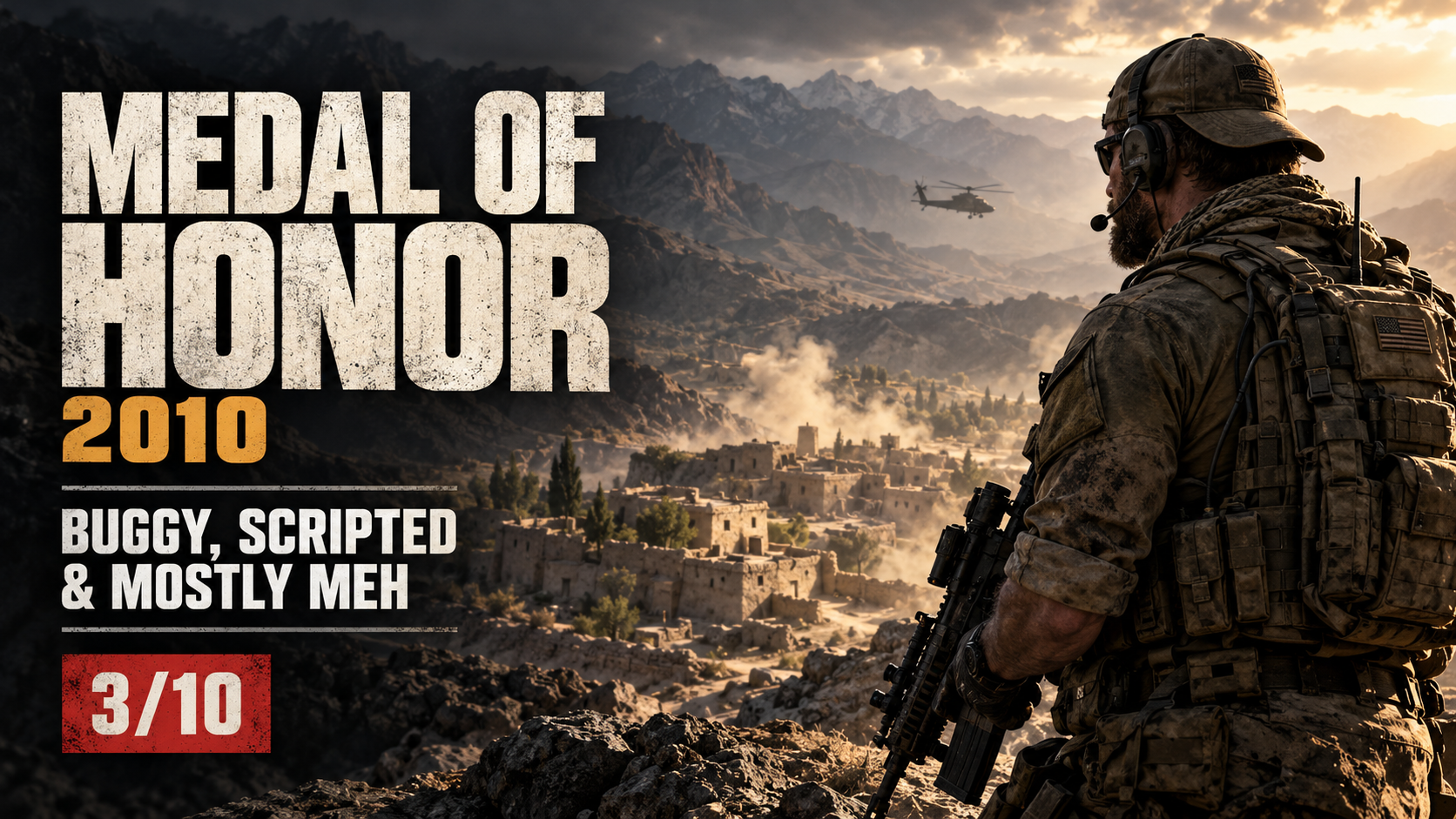
I had to watch my own gameplay again to remember much of Medal of Honor, and I only played it about three months ago. I finished the campaign in July 2026, playing the original PC DVD through Wine on Linux. I am not a fan of this one. The sniping, helicopter sections and ordinary shooting all left me with much the same reaction: meh.
What I remember much more clearly is getting stuck because the game wanted me to look at a particular place, replaying parts of the airfield, and having the game crash. It felt scripted as hell. Getting through an area was not always enough; I also had to satisfy whatever little trigger the game was waiting for.
My rating: 3/10.
The reboot that took Medal of Honor to Afghanistan
The original Medal of Honor began on PlayStation in 1999, developed by DreamWorks Interactive with Steven Spielberg involved in its creation. The series spent its first decade in the Second World War. EA announced this reboot on 2 December 2009, moving it to Afghanistan and building its identity around American special operations soldiers. [1] [2] [4]
There was a commercial reason for starting again. In a May 2010 interview, EA Games president Frank Gibeau said he had been dissatisfied with Airborne’s sales and wanted EA to lead the shooter market. Executive producer Greg Goodrich described the creative starting point differently: the soldiers the team met had stories from Afghanistan that they wanted to tell. [2]
EA Los Angeles, which took the Danger Close name during the project, made the campaign. DICE in Stockholm made multiplayer. They even used different engines: a heavily modified Unreal Engine 3 for the campaign and DICE’s Frostbite for the online game. Goodrich said they chose to develop the two experiences around their different strengths rather than spend their time trying to make them identical. [3] [4]
The campaign was already playable from beginning to end in a rough form by December 2009, according to Goodrich. That let the team assess the whole game before finishing its presentation and polish. The PC multiplayer open beta ran from 4–7 October 2010, followed by the full release on 12 October in North America and 15 October in Europe, for PC, PlayStation 3 and Xbox 360. [4] [5]
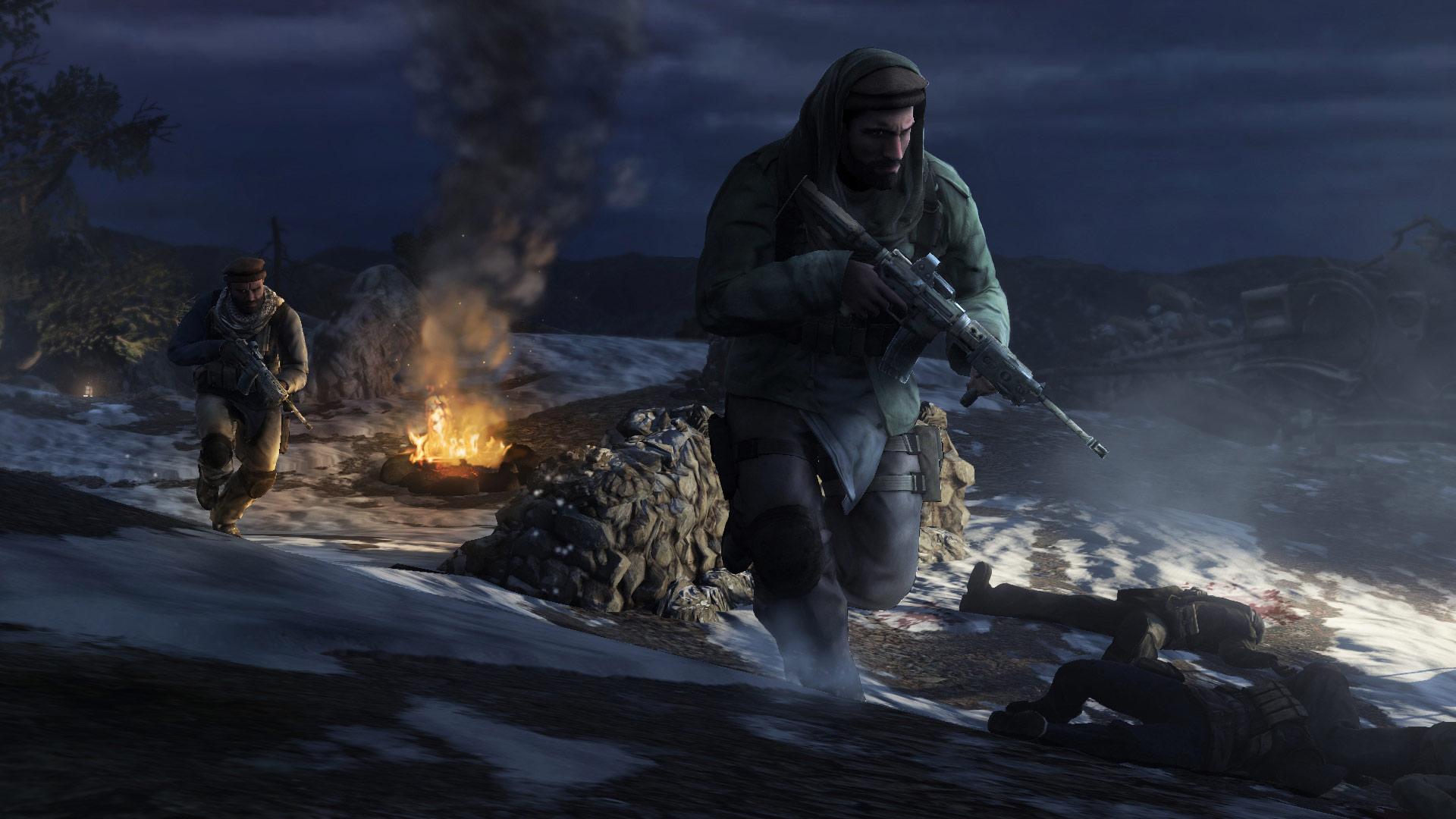
The campaign moves between Rabbit’s SEAL team, Deuce and Dusty’s reconnaissance work, Army Rangers and an Apache gunner. An early search for the informant Tariq leads into airfield fighting, operations around the Shahikot Valley and a rescue effort in the mountains. Radio traffic connects the teams while headquarters argues about what should happen next.
Goodrich called it historical fiction. The characters draw on real people and the setting draws on real events, but he explicitly said it was not a literal recreation. The consultants influenced the equipment, locations, dialogue and missions. [6]
The contemporary setting also brought a controversy before release. On 1 October 2010, Goodrich announced that the multiplayer faction called the Taliban would be renamed “Opposing Force,” following objections from military families and others. His statement said the change did not fundamentally alter the gameplay. The campaign still depicts fighting in Afghanistan. [26]
The compound: I needed to look at a corner
The part that really held me up is in Running With Wolves…, near the start of my second recording. After leaving the ATVs, I followed Dusty to the position overlooking the compound. The instruction was to get eyes on Panther and Vegas near the compound wall.
I misunderstood Panther. I thought they were talking about a tank, something like a panzer, rather than one of my teammates. Once I realised Panther and Vegas were people, I still had to work out where they were. I was looking around, checking the objective and trying to understand what the game expected. The objective I read out was about securing the perimeter of the outpost and avoiding detection. That did not answer the question I actually had: where am I supposed to look?
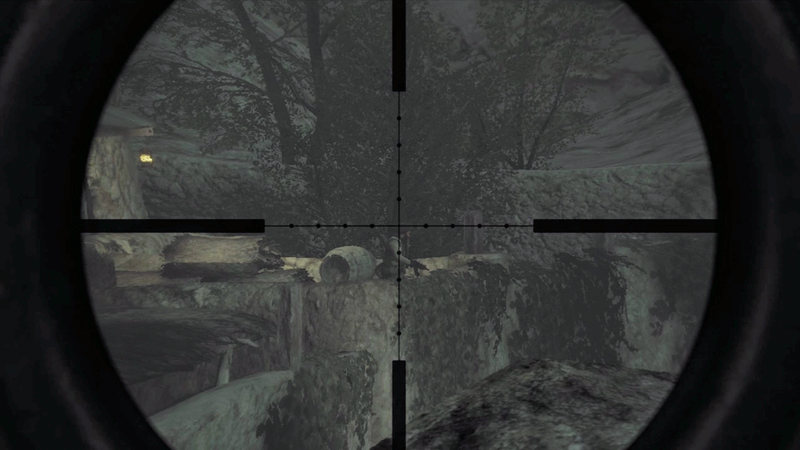
I reloaded the checkpoint because I thought I had missed something in the spoken instruction. It put me back into the same confusion. I also looked online without finding an explanation that helped me at the time. Eventually I looked at the right corner of the wall by accident, found where the others were coming around, and the sequence moved on.
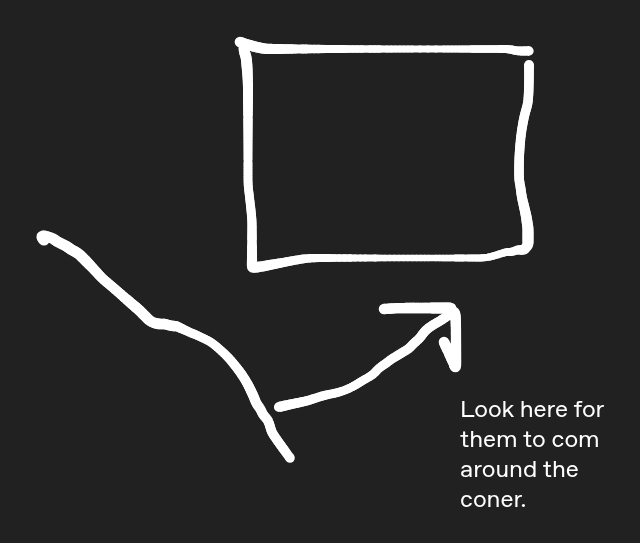
This takes roughly fifteen minutes in the recording, from the approach around 4:05 to getting moving again around 19:25. That is a long time to spend trying to understand one instruction in an action game. Why do I have to look at them before the game will let me continue?
The official guide describes that exact order: watch Panther and Vegas reach the other side of the village, shoot the tower guard, then follow Dusty onwards. It is an overwatch sequence, with progress tied to those steps. From my side of the screen, it was a mission that would not get on with itself until I found the required sightline. [8]
There is a navigation aid: the PC manual assigns the Dynamic HUD to H, and the guide explains that it can reveal objective direction, distance and teammate icons. The game deliberately keeps much of that information off screen until it is needed or requested. At this compound, the spoken callsigns and the objective text I was checking did a poor job of getting me through the next few seconds. [7] [9]
Following the script through every fight
That compound was the worst example, but the same feeling ran through the game. Follow the teammate, wait for him to get into position, clear the enemies, stack at the door, wait for the next action. There are places where you need a boost or someone else needs to open the way. I kept feeling the boundary between what I was doing and the sequence the game wanted to play.
The campaign gives you useful shooting controls. You can crouch or go prone, lean and peek around cover, and slide into cover from a sprint. You can also request ammunition from squadmates with compatible weapons. Their supply is limited, and they will not hand it over while pinned down. Those rules account for the repeated ammunition responses you hear from the characters in my recordings. [7]
Moving between reconnaissance, close fighting, vehicle sections and air support gives the campaign variety on paper. The problem for me was how little excitement I got out of that variety. I still felt like I was following instructions through a series of prepared scenes.
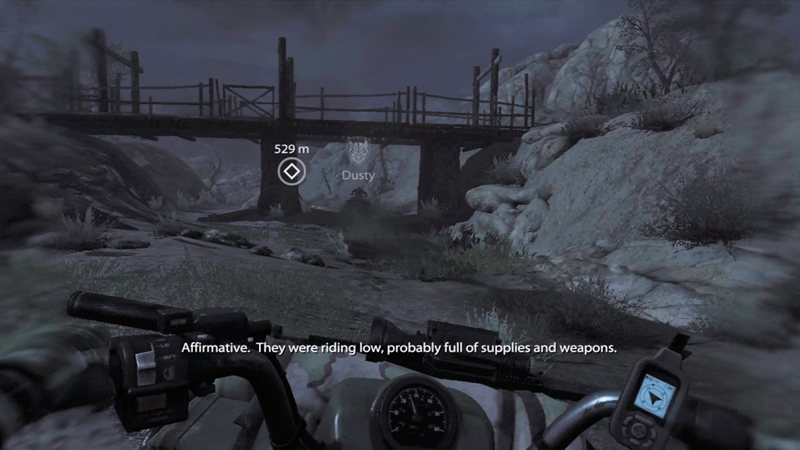
The ATV sections have you follow Dusty through the terrain, slow down near enemies and turn the lights off when told. In the second recording, I also got caught up trying to get moving again. Later, in the Ranger section, I spent time asking whether the others were coming while trying to keep the machine gun position suppressed. Waiting for the team to perform its part kept drawing my attention away from the fight.
Sniping and helicopters felt watered down
The sniping should have been a chance to make that slower pace interesting. In Friends From Afar, you work with Dusty from positions overlooking distant camps and ridgelines. The M82 has a powerful scope, breath control and thermal imaging to help pick out targets. Dusty calls out where to look and what to shoot. Later you cover Neptune’s withdrawal, identifying the friendlies by their infrared beacons. [10]
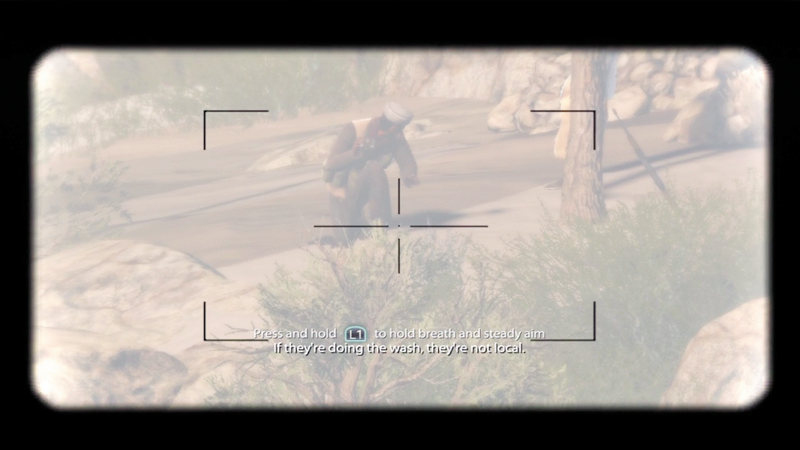
There is a revealing detail in Goodrich’s interview: the team simplified sniping so it was less about doing calculations and more about firing the weapon. They also added dialogue where the real operators would have stayed silent and made the ATV riding faster. These were deliberate concessions to make an action game. [6]
For me, the sniping felt filtered down too far. I did not get that feeling of “wow, this is what being a sniper is like.” It became another sequence of finding the target the game was calling out and taking the shot. Missing shots with my cheap mouse did not help, but I was not excited by the role itself either.
Gunfighters puts you in the Apache’s gunner seat. The pilot handles the flying while you use the 30 mm cannon, Hydra rockets and Hellfire missiles. The targeting display lets you acquire designated positions and lock missiles onto them. You move from spotting and destroying mortar teams to attacking a village and further positions in the mountains. [11]
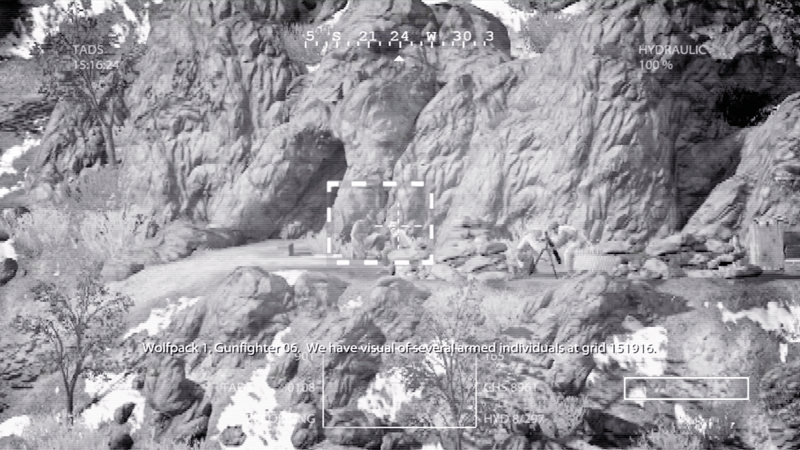
Again, it should have been an exciting change of pace. I came away with the same meh feeling. The weapons and the view changed, but the helicopter section did not give me that sense of doing something especially cool. It felt like another contained shooting sequence.
Crashes, retries and the airfield
The first recording has a particularly clear interruption around 51:03. I read out a “general protection” failure as I reached the airfield tower section. After getting back in, the close air support sequence caused more trouble. I struggled with the target-designating and weapon selection, failed the section, stopped to look for a patch, and returned to it.
I eventually replayed the airfield mission and got past the counterattack. That whole stretch fills a substantial part of the first stream. By about 1:32, I was calling the game buggy as hell. By the end of the second recording, I was fed up again and stopped for a break.
The exact cause of those crashes on my Wine setup is not established. There were problems on other platforms too: Chris Kohler’s launch-day Xbox 360 review for WIRED reported AI mishaps and bugs requiring checkpoint restarts or a console reboot. A Windows XP player posted a single-player General Protection Fault report on Microsoft’s support community on 15 October 2010, just after launch. [12] [13]
EA’s 14 October 2010 PC multiplayer patch notes covered a DirectX 9 crash when changing kits or weapons, PunkBuster joining problems and server-browser faults. No single-player changes were included in that update. [14]
My PC, Linux setup and cheap mouse
I used my original PC DVD with Wine on Linux. My recordings are from July 2026; the system details below are my current snapshot from October 2026.
| Component | Current system snapshot |
|---|---|
| Motherboard | Gigabyte X99-Ultra Gaming-CF |
| Processor | Intel Core i7-6850K; 6 cores / 12 threads; reported clock 4,000 MHz |
| Graphics | NVIDIA GeForce RTX 2070 SUPER, 8 GB VRAM |
| Memory | 15,305 MB RAM reported |
| Current OS | Ubuntu 26.04.1 LTS, 64 bit; Linux kernel 7.0; KWin |
| Current graphics driver | NVIDIA 595.99.02; OpenGL 4.6 |
| Display | 1920 × 1080; reported monitor refresh rate 279 Hz |
| Input and audio | Logitech K540 keyboard, cheap gaming mouse, USB mixer |
The mouse was one of those cheap gaming mice that cost next to nothing. My aim in the recordings is not as good as I know I can manage. I complained about the mouse flying all over the place right near the beginning of the first stream. It felt too sensitive, and that made some of the shooting more awkward for me.
Other players’ experiences
There are players who get much more out of this campaign. A detailed positive Steam review by Bravo-One-Six from November 2015 praised the Afghan scenery, weapon details, dialogue and the way the teams’ radio traffic makes their missions feel connected. A more recent positive review by MAVEN, dated 4 October 2026, praised the sound, scenery and story while accepting that the campaign can be finished quickly. [15]
That production work was intentional. Goodrich described a weapon-recording session at Fort Irwin using more than 100 microphones, placed at different distances, to capture the weapons from numerous perspectives. The team put substantial effort into the equipment and sound. [6]
The negative reviews contain familiar complaints too. A September 2013 Steam review by offline criticised the restricted routes and dependence on instructions. winfryd’s May 2024 review described waiting for NPCs to get into position and finding the short campaign predictable. Sierra’s April 2026 review liked the old campaign but still reported progression problems, restarts and the need to adjust PC settings. Other recent negative reviews are about being unable to launch or activate the game at all. [15]
The waiting and progression complaints are the ones that most closely match what bothered me. I wanted an action game that kept me involved, and too much of this one had me trying to make the next scene happen.
What remains playable, and what EA shut down
At launch, DICE’s multiplayer had its own classes, maps and support systems. The PC open beta alone offered 12-versus-12 Sector Control and Combat Mission play. More online content followed in November 2010: Clean Sweep used elimination rules, while Hot Zone centred the fighting on holding one objective. [5] [17]
The original package also included Tier 1, a timed replay mode for the nine on-foot missions. It removed checkpoints and teammate ammunition resupply, increased the challenge and rewarded skill kills with pauses to the timer. Although played alone, it used online services and leaderboards. The Apache mission was excluded. [27]
EA retired the official online services in February 2023. The Steam page now states “Single-Player only,” even though a multiplayer feature badge and old online wording remain elsewhere on the page. The Project Neptune community advertises replacement services for PC and PS3, including multiplayer and Tier 1. That is an unofficial continuation run by the community. [16] [19] [24]
There is an unpleasant detail here: EA’s Hot Zone product page still presented the multiplayer add-on with a purchase button when checked on 20 October 2026. Its own service-retirement page lists the official shutdown. That purchase page should clearly explain the loss of the official service before asking for money. [18] [16]
For the original PC release, EA’s manual describes installation from disc and identifies SecuROM protection. Online features require an EA account and a single-use code. Its five-computer authorisation limit is specified for the digital version. [7]
Buying through Steam requires a Steam account, and players continue to report registration-code problems. My original-disc campaign ran after the official online shutdown, with the problems described above. GOG’s Allied Assault War Chest and Pacific Assault are older Second World War games; neither is an edition of this Afghanistan reboot. [15] [23] [24]
There were edition bonuses in 2010 as well. EA’s Limited Edition announcement advertised an exclusive multiplayer MP7 and early shotgun unlocks. The PlayStation 3 release included the HD version of Medal of Honor: Frontline on Blu-ray. [25]
Where the series went afterwards
EA announced sales of more than 1.5 million copies in the reboot’s first five days. Danger Close followed it with Medal of Honor: Warfighter in October 2012, bringing campaign and multiplayer together on Frostbite 2. After that sequel’s disappointing reception, EA put the series on hold in early 2013. An EA spokesperson told GamesBeat that it was giving the series a rest while planning its return. [20] [21] [28]
The name eventually returned with Respawn’s Medal of Honor: Above and Beyond, released on 11 December 2020 as a Second World War VR game. [22]
I can see the effort that went into this reboot, but playing it left me bored and frustrated more often than excited. The sniper and helicopter sections did not lift it above that, and the crashes and progression problems made the experience worse. My rating stays at 3/10.
My gameplay recordings
These are my three recordings, in order, from the original PC disc through Wine on Linux. The first contains the airfield crash and retries; the second contains the long compound delay. The third continues through the mountain missions and the ending.
Sources and image credits
Gameplay recordings and the compound sketch are mine. The four interface captures come from Prima’s official guide; the mountain scene is an EA promotional screenshot. Game imagery © Electronic Arts.
- EA’s reboot announcement, 2 December 2009.
- Game Developer: Rebooting Medal of Honor, interviews with Gibeau, Goodrich and Farrelly, 4 May 2010.
- Capsule Computers: Greg Goodrich interview, 11 May 2010; engine and production details.
- Game Developer: The Meaning of Medal of Honor, Goodrich interview, 1 October 2010.
- EA’s September 2010 beta and release announcement.
- Prima: developer interview with Greg Goodrich; fiction, consultants, sound recording and design concessions.
- EA’s original PC manual; controls, ammunition and edition-specific access wording.
- Prima: Running With Wolves…; outpost sequence and the compound/ATV captures reproduced here.
- Prima: Dynamic HUD.
- Prima: Friends From Afar; sniper mechanics and scope capture.
- Prima: Gunfighters; Apache gunner mechanics and TADS capture.
- Chris Kohler’s WIRED launch review, 12 October 2010; Xbox 360 bug reports.
- Microsoft Support Community: original Windows player report, 15 October 2010.
- Planet Medal of Honor’s archive of EA’s 14 October 2010 multiplayer patch notes.
- Steam player reviews: Bravo-One-Six, 29 November 2015; offline, 14 September 2013; winfryd, 9 May 2024; Sierra, 26 April 2026; MAVEN, 4 October 2026; Hellaflush36 シ, 5 September 2026. These are individual accounts.
- EA’s online-service retirement list.
- PlayStation Blog: November 2010 multiplayer additions.
- EA’s Hot Zone product page, checked 20 October 2026.
- Project Neptune and its Medal of Honor community description; unofficial replacement online services.
- EA’s Warfighter announcement, 6 March 2012.
- GamesBeat: EA’s decision to rest the series, 30 January 2013, including EA’s direct response.
- EA’s Above and Beyond release announcement, 11 December 2020.
- GOG listings for Allied Assault War Chest and Pacific Assault.
- Current Steam product page, including the single-player notice and official promotional gallery.
- EA’s Limited Edition announcement and EA’s PS3 launch post.
- WIRED’s report of Goodrich’s multiplayer faction statement, 1 October 2010.
- Prima: Tier 1 Mode.
- EA’s initial sales and Clean Sweep announcement, 19 October 2010.