
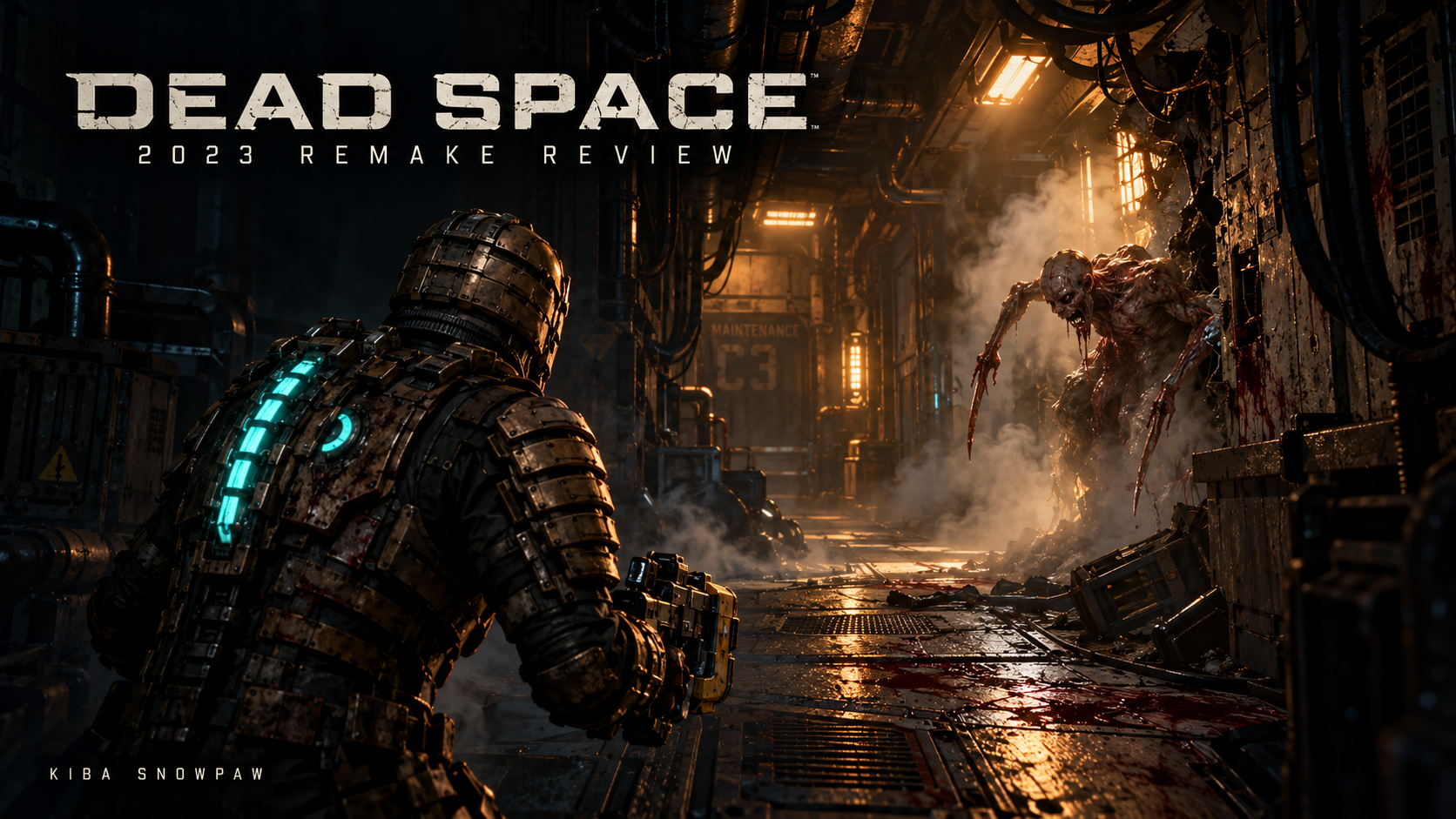
Dead Space is one of the best remakes I have played. I played and completed the Steam version on 4 March 2024, and I loved it. It may even be better than the BioShock remasters as a return to a game I already loved. BioShock still did one thing better: I did not have to pay again for the corresponding remastered games I already owned on Steam.
I usually dislike remasters and remakes because too many of them change the things that made me love the game in the first place. Better graphics do very little for me if I am left with a different experience. With this one, I still felt like I was playing Dead Space. The ship, the horror, the story and the fighting kept that familiar feeling, while everything looked much better.
This is Motive’s 2023 remake, released on 27 January 2023 for PC, PlayStation 5 and Xbox Series X|S. My Steam copy is recorded in my collection as the PC Standard Edition, completed on 4 March 2024, with my rating of 8/10. My review of the original Dead Space from 2008 covers why that game remains one of my all-time favourites.

The remake kept the game I loved
The first game already had a strong idea of what it wanted to be. Isaac Clarke is an engineer arriving at a huge mining ship that has stopped answering its communications. His girlfriend, Nicole Brennan, works aboard it. What begins as a job becomes a struggle to survive among the remains of the crew and the things their bodies have become.
You still move through a ruined industrial workplace, looking for supplies, repairing equipment and dealing with creatures that make ordinary shooting habits a bad idea. The Plasma Cutter still belongs in Isaac’s hands. The health display still runs down his back. The Ishimura still looks as though people were supposed to work and live there before everything went wrong.
That is what I mean when I say they kept what I loved. The remake changes plenty of individual details, including parts of the layout, character conversations and movement. Those changes did not take away the identity of the game for me. I could recognise why I loved Dead Space while enjoying how much more detail there was to look at.


How Motive approached a game that already worked
The original was developed by EA Redwood Shores, later known as Visceral Games. Motive took on the remake years later. In the studio’s account of the project’s beginnings, Philippe Ducharme described the team looking for its next project as Star Wars: Squadrons was wrapping up. Art director Mike Yazijian, who had worked on the Montreal contribution to Dead Space 2, wanted to return to the series.
EA announced the remake at EA Play Live on 22 July 2021. It was being rebuilt in Frostbite, rather than given a new coat of paint in the original engine. The January 2023 release date was announced in May 2022. New assets, animation, lighting and sound were part of that work.
Motive also involved a community council during development. In its September 2022 explanation of the remake, the team described consulting dedicated fans roughly every six weeks and using their feedback alongside responses to the development streams. That is a useful approach when the job involves a game people already care about.
Creative director Roman Campos-Oriola later described wanting to capture the “glorified memory” of the original. That description comes close to my own reaction. It felt as good as the old game did to me, while looking much better. The aim was not simply to reproduce every old limitation.
The Ishimura looks better because there is more to see
The visual upgrade suits this particular game. Dead Space spends so much time in corridors, maintenance spaces, medical rooms and machinery that improvements to materials and lighting are visible everywhere. Suit plates, pipes, wall panels, blood and the mess left around a room all give those spaces more physical detail.
The screenshots show how much the lighting changes from one area to another. Medical has pale, uncomfortable light around beds and equipment. Engineering has hot orange light, smoke and heavy machinery. Outside the ship, the suit is exposed against the hull and the darkness beyond it. Those are different spaces with different jobs, while still belonging to the same ship.


I like that the remake still looks like Dead Space. Adding detail to a familiar place is much more interesting to me than replacing its appearance with another art style. The metal suit, the cyan equipment lights and the damaged ship still belong together.
A connected ship changes exploration
Motive rebuilt the Ishimura as an interconnected environment. Its November 2022 account of the ship’s redesign explains how the team recovered usable layout data from the original, then adjusted spaces and added connections so the areas would fit together. The new zero-gravity movement also required changes to some rooms.
The result lets you return to previously visited areas as more of the ship becomes accessible. Security clearance gives another reason to remember a locked door or container and come back later. The tram remains useful for crossing between the larger sections. You have the main repair jobs to follow, but there is more room to investigate along the way.


The additional exploration works alongside the mission log and locator. When you want to get back to the current job, the game provides a route. Side objectives can draw you away from it without making you memorise every corridor before you can continue.

Cutting limbs is still the point of the fighting
The central combat rule survives. You look at a creature, choose a limb and try to stop it before it reaches you. Removing a leg can slow an advance. Taking off a cutting arm changes another part of the threat. A body falling down does not automatically make the space around it safe.
The Plasma Cutter makes that idea easy to understand. Its cutting line rotates, so you can line up a shot with the part you want to remove. The tool has a clear shape, an obvious purpose and enough room for upgrades to remain useful. It is one of the things I would have hated to see replaced just because this was a newer version.


The remake adds a layered damage system. As Motive’s Necromorph breakdown explains, the creatures have skin, flesh and bone that become exposed as they are damaged. It gives you a visible indication of where an enemy has been weakened. The gore is also information you can use during the next shot.
The same developer account describes using kinesis to throw a severed Slasher claw back at an enemy, or using objects to knock something away long enough to reload. That fits the practical side of the combat: the room and the remains of the fight can give Isaac another tool.


The wider arsenal still gives you different ways to handle distance, groups and pressure. The Pulse Rifle, Ripper, Flamethrower, Contact Beam, Line Gun and Force Gun sit beside the Plasma Cutter. Their jobs and attacks vary, and the remake revises parts of that arsenal. The important continuity is the need to control a fight while managing what you have available.
Stasis, kinesis and the repair jobs still belong together
Isaac’s abilities make sense in the workplace around him. Stasis slows a mechanism so he can deal with it, or slows a creature so he can get a clearer shot. Kinesis lets him handle objects without standing directly beside them. Both are useful during the work and the fighting.
The remake’s circuit breakers add decisions to that work. You redirect the available power between systems. In some places, getting the equipment you need working means losing lighting or another useful service. You can see the practical result of the choice in the room around you.


Much of the campaign still sends Isaac to fix another failure. The tram, medical facilities, engines and other systems keep giving him work. That repeated structure is part of the game, and the remake does not make it disappear. It carries the story through places with a purpose, and gives the creatures something to interrupt.

Zero gravity is one of the clearest changes
The original uses jumps between suitable surfaces. In the remake, Isaac can lift off and move freely through designated zero-gravity areas using his suit’s thrusters. You can turn, rise, descend and approach machinery from another direction. It is a substantial change in how those spaces are crossed.
The hangar and engineering sections show why rooms had to be reconsidered for that movement. You are no longer choosing only which surface to jump towards. There is a volume of space to navigate, with structures, openings and hazards around it.


Vacuum still puts a limit on how long Isaac can remain exposed. Greater movement freedom does not remove the need to find the route, deal with the equipment and watch the air supply. The industrial setting still determines the problem.

Isaac speaks, and the characters have more room
Isaac has spoken dialogue in the remake, performed by Gunner Wright, who voiced him in Dead Space 2 and Dead Space 3. Motive’s Story Matters article explains the intention: let the engineer take part in conversations and work out solutions, while avoiding a character who constantly talks over the player’s experience.
Nicole also has more of a role in showing what happened aboard the ship. Other characters receive additional scenes and context, including Elizabeth Cross and Jacob Temple. Side investigations let the story look back at the outbreak instead of relying entirely on the next emergency Isaac has to solve.


The main situation is still the one I loved: a ruined ship, missing people, the Marker, Unitology and Isaac trying to understand what has happened while surviving it. The extra conversations and investigations sit around that story. For me, they did not turn it into a different kind of game.
There are changes around individual characters and the way some events unfold, so someone returning from 2008 will not see every scene reproduced exactly. My overall reaction stayed the same. I still loved the story and the horror around it.
The sound and the uncertainty matter as much as the monsters
The ship gives the creatures places you cannot see. A corridor can put machinery, a vent and an opening behind Isaac close together. You have to decide what to watch while the sound suggests something moving elsewhere. Better visual detail gives those spaces more to look at, but the part outside the view remains useful to the horror.
Motive also introduced the Intensity Director, a system that varies events such as enemy appearances, sounds, lighting, fog and steam. The developers described managing periods of pressure and relief, with more than 1,200 possible events depending on how they counted them. A noise or broken vent does not have to lead to the same result every time.
That is especially relevant in a remake of a game people know. Recognising a room does not have to tell you everything that will happen there. Returning through the connected ship can still put something new in your way.
This is part of why the remake worked for me. Keeping the atmosphere matters much more than having every old surprise happen at precisely the same moment. I wanted to enjoy being back in Dead Space, and I did.
The interface and upgrades remain part of Isaac’s world
The suit’s spine carries the health display. The weapon shows its ammunition. Inventory screens and communications appear as holographic projections. The remake keeps that visual language, so information still looks like equipment Isaac is using aboard the ship.
At stores you buy supplies and suit upgrades, sell items and manage storage. In the inventory, ammunition and other resources compete for space. The bench turns power nodes into improvements. Those systems give searching a room a practical purpose: what you recover can affect the next fight or the next upgrade.


The weapon upgrade paths can also expand when you find the relevant parts. The screenshots show an early Plasma Cutter grid and the later message opening another section of that grid. Suit and weapon improvements give a reason to keep looking through the ship beyond the next objective.


Controls and accessibility give players useful options
The controls screen includes customisation, a keyboard-and-mouse layout page, presets and sensitivity settings. Those are useful things to have readily available in a game built around choosing a limb while an enemy moves towards you. The archived recording includes a visit to that screen rather than leaving the input settings entirely out of view.

EA’s accessibility overview documents remappable inputs, toggle options for actions such as aiming and sprinting, single-press alternatives for quick-time events, adjustable subtitles, menu narration, colour adjustments and a camera-shake setting. It also describes optional warnings and visual obscuring for selected disturbing scenes. Those content options are off by default; they do not remove Necromorph combat from the game.
The useful part is having choices over how the existing game is presented and controlled. A player can change a subtitle size or an input action without requiring the underlying horror game to be redesigned around that choice.
PC and Linux play: the technical problems still need space
My completed copy is the Steam PC release. The supplied recordings are labelled Ubuntu, and their on-screen overlay identifies VKD3D and GE-Proton9-4. It also identifies a GeForce RTX 2070 SUPER and a 1920 × 1080 rendering resolution in the inspected captures. The recorded graphics screen shows NVIDIA DLSS with its mode and graphics quality set to Auto.
Those are the settings and compatibility details visible in that archive. The PC requirements on Steam’s store page are for Windows and include DirectX 12 and an SSD. The remake is not a native Linux release. Its Steam listing also declares Denuvo DRM.

The PC version’s stuttering complaints deserve attention alongside the praise. An EA forum report dated 28 February 2023 describes repeated hitches at loading boundaries. More recent Steam reviews still discuss that issue. A brief interruption can be particularly noticeable in a game that relies on moving continuously through a convincing place.
There were also progression problems in the launch period. The official EA community update from February 2023 listed fixes involving the Crew Quarters key card, a security-station door, asteroid-launch progression and Dr. Kyne failing to appear. It also mentioned Steam Deck improvements and added the ability to use earlier acquired suit appearances without losing upgrade benefits.
I completed the game and loved it. The technical problems reported by other PC players are still part of its history, including complaints made after those early patches.
What other Steam players praise and criticise
The useful comparison is in the detail of the reviews. micron’s July 2026 recommendation praises the remake while also noting performance and stuttering. Fl4v1en’s negative review makes stuttering the reason to reject a remake of an original they love. Those are different verdicts on an important shared concern.
A longer negative review by Holocene praises the appearance and sound but describes repeatable hitches when crossing between areas, opening doors and using elevators. The reviewer distinguishes those interruptions from an otherwise high frame rate. That is a more specific complaint than simply saying the graphics settings are too demanding.
In the Steam review feed checked in October 2026, positive reviews also praise the atmosphere, lighting, story and combat. Odoxon’s recommendation combines that praise with complaints about loading interruptions and weak supporting characters. Hrizalida praises the overall story while finding the late quarantine encounters and final stretch repetitive. Enjoying the game clearly does not require every player to agree about its pacing or cast.
My own enthusiasm is closest to the praise for bringing back the original’s atmosphere and combat. I went in with a game I loved already, and the remake kept that feeling. Its technical complaints are still useful to someone deciding whether to play on a particular PC.
BioShock’s free upgrade policy is still the example I want followed
I had to pay for Dead Space again. I still think BioShock handled existing PC owners better. The relevant 2K announcement from September 2016 said owners of BioShock, BioShock 2 or Minerva’s Den on Steam would receive the corresponding remastered version free. The remasters appeared as separate library entries, leaving the original versions available too.
That is the approach I want publishers to use. If somebody already owns the original when you release the new version, give them the upgrade. People who do not own it can buy it. You are recognising the people who played and loved the game before there was another edition to sell.
BioShock’s PC remasters were different in scope from a full rebuild such as Dead Space. The ownership policy is still the part I want copied. I can appreciate the work Motive did and still prefer a better deal for existing owners.
I also think it could be good publicity. Give existing owners a reason to return and more of them may install it, play it and talk about it. Some may write reviews or introduce other people to the game. That could bring in new buyers while showing the older players that supporting the game counted for something.
I would much rather see that than another sales pitch about how much a company values its fans. Put the new version in their library and let them play it. BioShock gave PC owners a real example of that approach.
Finishing it leaves more to return for
Dead Space has a New Game Plus mode with additional equipment and enemy variants, as well as an alternate ending to uncover. EA confirmed those additions before launch, as recorded in the January 2023 announcement coverage. They give returning players something beyond the same campaign with a fresh save.
Motive’s later studio direction also belongs to the history of this release. On 9 April 2024, Patrick Klaus announced a Motive team joining the Battlefield projects, led by the remake’s directors Philippe Ducharme and Roman Campos-Oriola, while the studio continued its separate Iron Man project.
One of the best remakes I have played
I love this remake because I could still enjoy the things I loved in the original. The Ishimura, the horror, the story and the fighting were still there for me, with much better visuals. The changes gave me more to explore without taking away the game I wanted to return to.
It may even be a better remake experience for me than the BioShock remasters. BioShock keeps my preference for how the upgrade was offered to existing owners. I want the quality of this return to Dead Space and the treatment BioShock gave people who already owned the corresponding PC games.
My rating: 8/10. Completed on Steam on 4 March 2024.
My Dead Space remake recordings
These are my four supplied recordings of the remake, in their original order. They show the early campaign and are separate from the recordings linked in my 2008 review.
Part 1
Part 2
Part 3
Part 4
Sources and screenshot credits
Screenshots are from my supplied Dead Space remake recordings. Each caption identifies the part and timestamp. Game imagery © Electronic Arts and its respective creators.
The linked Motive development articles cover the remake’s origins, ship, creatures, story and Intensity Director. EA’s accessibility article and official community update document options and patch changes. Steam comments are attributed player reports, rather than measurements of my own playthrough. Store and collection details were checked on 27 October 2026.