
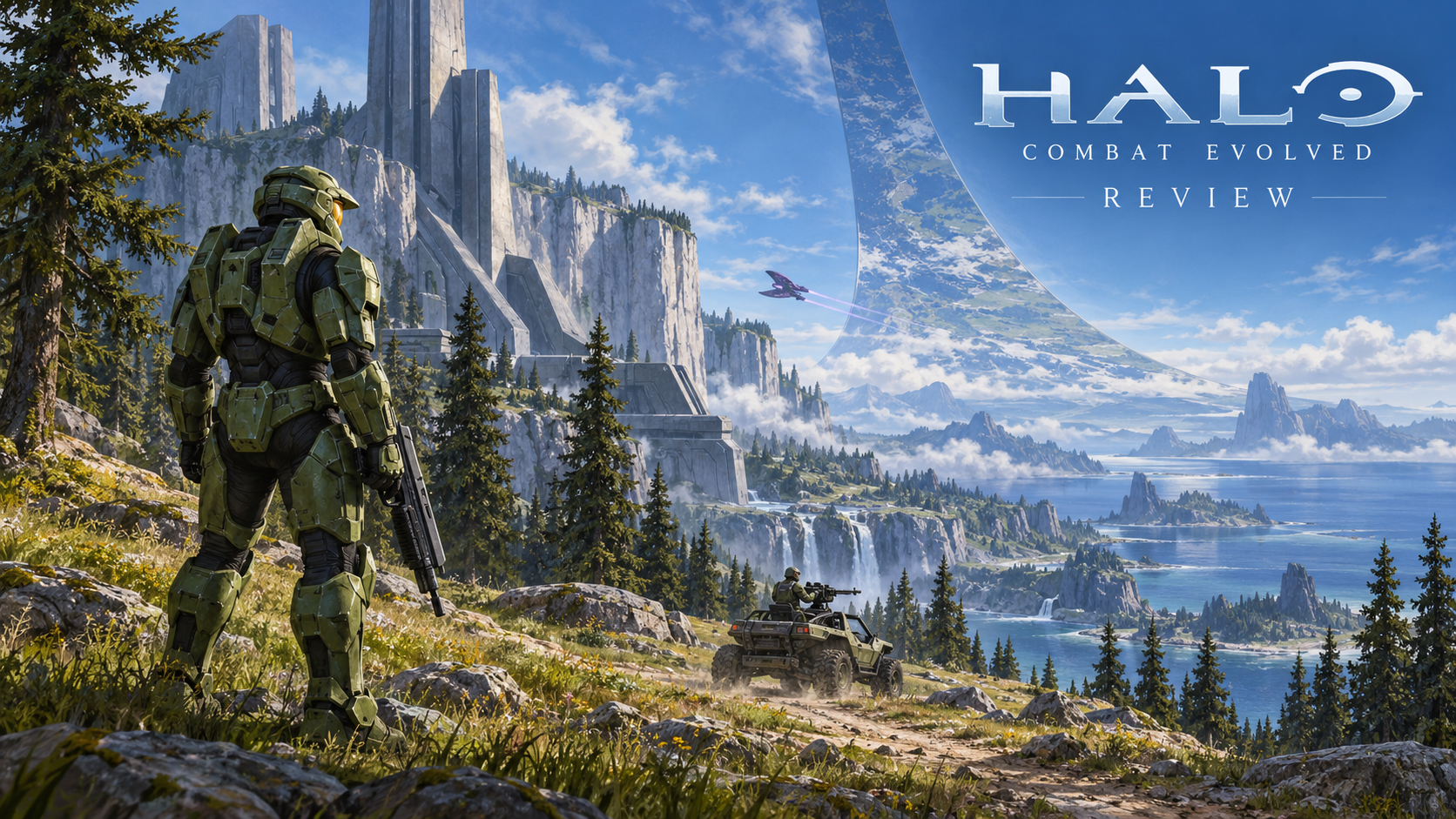
I have played Halo: Combat Evolved so many times that parts of it are almost mechanical for me. I know where I am going, what is waiting behind the next door, and which weapon I want before I get there. I still enjoy playing it. That says more about the game than another argument about how old its graphics are.
I got the original Xbox when it came out, and Halo belongs to that part of my gaming history. For this review I returned to Combat Evolved through The Master Chief Collection, finished the campaign again, compared my older Xbox and Xbox 360 recordings, and went back to my original PC disc on Linux. The PC revisit covered the early missions through the Flood introduction; I stopped that comparison run once I had the material I wanted.
My rating: 8/10. This is a review of Combat Evolved, with the original Xbox release as my reference and the PC port, Xbox 360 Anniversary and MCC versions compared along the way. The newer Halo: Campaign Evolved is a separate remake and is not reviewed here.
Campaign spoilers follow, including the Flood, Keyes and the ending.
The Xbox game I keep coming back to
I liked the feel of the old Xbox controller. People complained about how heavy it was, but I liked having that weight in my hands. The Xbox 360 controller felt good too. The first time I held a PS3 controller, it felt like cheap plastic made out of air. I have become more used to PlayStation controllers after years of playing with them, but back then I preferred the Xbox controllers.
That physical memory is part of how I remember Halo. Its movement, the way the weapons feel and driving around the ring belong together. Putting the same campaign on another machine does not automatically make the whole experience feel identical.
I play on Easy. My philosophy is simple: if a game is not fun on Easy, it is not fun. I am playing because I enjoy it. Halo still gives me the weapons, movement, vehicles and alien fights I came back for.
How Halo became Halo
Halo did not begin as the first-person Xbox shooter we know. Bungie experimented with a real-time strategy game built from its Myth technology, then moved toward a third-person action game. The version Steve Jobs introduced at Macworld in 1999 already had the ring, vehicles and an unmistakably Halo atmosphere, but it was a different game. The official Cutting Room Lore retrospective traces that transformation and the material left behind.
Microsoft announced its acquisition of Bungie on 19 June 2000. Combat Evolved became an Xbox launch game, releasing in North America on 15 November 2001. Gearbox handled the Windows port, which reached US shops on 30 September 2003. The Mac version followed later that year.
The PC conversion involved more than moving the files across. In Bungie’s September 2003 discussion with producer Michel Bastien, he described a new networking architecture and the challenge of supporting different hardware. He specifically mentioned active camouflage, night vision and the light bridge as difficult rendering work. Those are exactly the kinds of effects that can change how familiar scenes look across releases.
| Release | What it means in this review |
|---|---|
| Halo: Combat Evolved — Xbox, 2001 | Bungie’s original game. My reference for its appearance and feel; some footage was recorded while playing it on Xbox 360. |
| Halo: Combat Evolved — Windows, 2003 | Gearbox’s original PC port, installed from my physical disc and revisited on Linux. |
| Halo: Combat Evolved Anniversary — Xbox 360, 2011 | The remastered campaign, with classic and Anniversary graphics, plus a separate multiplayer offering based on Halo: Reach. |
| Halo: The Master Chief Collection — Xbox One, 2014; CE on PC, 2020 | The version used for my recent full campaign replay. CE Anniversary joined MCC on PC on 3 March 2020. |
Anniversary was developed by 343 Industries with Saber Interactive and Certain Affinity. Its 2011 fact sheet advertised the remastered campaign and Xbox Live co-op. The later MCC PC release added modern PC options such as adjustable field of view and ultrawide support. These releases should not all be treated as one unchanged build.
The campaign still has a good reason to move
The opening gets you moving through a ship that is already losing its fight. Chief is brought out of cryosleep, the crew checks that he works, and Keyes gives him a pistol. The tutorial makes you try the normal and inverted look settings. The original PC version does it too, even when I already know which setting I want.
Once you reach the ring, the change in space is immediate. You leave the ship’s corridors for hills, trees, cliffs and a sky that curves up over your head. Rescuing scattered survivors gives you a reason to drive around instead of putting every encounter in another straight corridor. The Truth and Reconciliation then changes the mood again: a night approach, the sniper rifle, the gravity lift and the purple interior of a Covenant ship.

The Silent Cartographer gives you an island to move around, a beach landing, a Warthog and an installation that goes deep underground. Assault on the Control Room brings snow, large outdoor fights, bridges, a tank and opportunities to take a Banshee. There is a good spread of spaces and vehicles before the game changes direction with the Flood.
The campaign also repeats itself. The Library is built around successive floors, corridors, doors and Flood waves. Two Betrayals returns to the control-room region, Keyes takes you back into the Covenant ship, and The Maw returns to the Pillar of Autumn. Fighting different enemies through familiar spaces changes the encounters, but it does not make the reused geometry disappear. Halo’s strongest variety is in the fights and the shifts between environments, rather than a completely new architectural idea behind every door.
Two weapons, grenades and a reason to keep moving
Chief carries two weapons, so picking something up means giving something else up. That matters when the enemy changes. A weapon I want for distant Covenant targets is not automatically the one I want when Flood are coming through a door beside me. Grenades and melee stay available without replacing the weapon in my hands, which makes them part of the fight rather than items I have to dig through an inventory to use.
The shield lets me recover after breaking contact, while damage to the health underneath it sends me looking for a health pack. There is a difference between ducking out for a shield recharge and continuing with barely any health. The HUD keeps that information visible alongside ammunition, grenades and the motion tracker. It gives me useful information without covering the fight in menus.
The enemies also ask for different responses. A Jackal can make a direct frontal shot awkward with its shield. An Elite can keep a fight moving while its shield protects it. Grunts add noise, movement and targets around those stronger enemies. Hunters look like something that should require an enormous amount of ammunition, until I get the angle I want on their exposed back.
During The Silent Cartographer I put a Hunter down with two pistol shots into its back. That pistol earns the hand-cannon description. Moving from it to the sniper rifle can feel like replacing my hand cannon with an actual cannon.

I also have an aiming habit that I have used for years. With automatic weapons I move the aim around more; with single shots I often pull up toward the head as I fire and bring the mouse back down. I do not know whether that actually improves my aim. It is simply how I have always played.
Taking the Warthog where it probably should not fit
I remember taking vehicles farther into Halo’s installations than the obvious route suggests. Returning to the old PC release brought that back. On The Silent Cartographer I could get the Warthog through the narrow approach and down into the security installation. I could not get it farther through the doorway where the two Hunters came out, but the security control was only a few steps away anyway.
In my MCC run, the Warthog was pushed back at the narrow passage as though it had hit an invisible barrier. I had to leave it and continue on foot. In the original PC run I got much farther, and my older Xbox footage also shows the Warthog inside the installation.

I also took the Warthog back through another narrow interior section after using the Cartographer. Being able to squeeze it into these spaces is part of the amusement. I am not going to claim it makes me a good driver. When I played with Shilka, I was still the one ending up behind the wheel.

On Assault on the Control Room, I could take a Banshee all the way into the approach to the control room before the cutscene. There is something very practical about dealing with the remaining corridor from an aircraft rather than walking it again.

Small differences in how enemies and Marines reacted
At the gravity lift in the original PC game, the Hunter I was watching could not land a hit on me. Covenant plasma shots also appeared to track me. Those stood out while moving between versions, alongside a difference in the Marines’ response to an invisible Elite.
After the lift, I encountered an invisible Elite with an energy sword. In MCC, my Marines ignored him even after I shot at him. In the PC run, they all started firing as soon as I did. That made the allies feel more responsive in that encounter. Later, I also encountered an invisible Elite firing a rapid-firing Plasma Rifle.
The Flood changes the game, but one sequence still bothers me
343 Guilty Spark changes the campaign from fighting an alien army into finding out what has gone wrong underground. The swamp, abandoned areas, bodies and frightened Marine build toward Jenkins’ helmet recording. The recording then turns the people you have been following into the victims of something they did not understand.
There is a continuity detail I have never found convincing. On the way down after Keyes, you can see and hear fighting ahead. It feels as though his group is working its way through the place and I am following them. Then the helmet recording presents their descent without that same fighting along the route. If the Flood had already escaped when Keyes arrived, I would also expect more signs of them on the approach.
The helmet footage has fast-forwarded sections, so it is not a continuous record of every step. Even so, the route and the staging leave that impression with me. Holding back the full Flood reveal makes sense for the horror sequence, but I still notice the join between the chase suggested by the gameplay and the events presented in the recording.

Once the Flood arrive, the pressure changes. They close distance, crowd spaces and bring familiar weapons back against me. The shotgun becomes something I want to keep nearby. Guilty Spark questioning the effectiveness of my weapons is funny when those same weapons feel more useful against the Flood than the Sentinels’ lasers.
The worst thing you can give a Flood combat form is a rocket launcher. I have died to that more times than I care to count. It does not need an elaborate attack when it can fire one rocket down the corridor I happen to be using.
Chief, Cortana and the ending
Chief works with relatively little dialogue. Cortana does much of the explaining and gives him someone to react to, while Keyes connects the opening military situation to the campaign’s later consequences. Guilty Spark initially looks like a helpful guide and then becomes a problem because his idea of solving the outbreak is disastrous for everyone else.
The control-room confrontation is where the ring stops being an interesting place to explore and becomes something that has to be stopped. Going back for Keyes then gives that task a particularly unpleasant personal cost. By The Maw, returning to the Pillar of Autumn is about destroying the ship I began by trying to escape.

The final escape puts me back in a Warthog, gives me a countdown and makes getting out the immediate priority. My recent MCC run reached the ending again. Familiarity has removed the surprise, but I still enjoy getting through the campaign and reaching that escape.

More detailed does not automatically look better to me
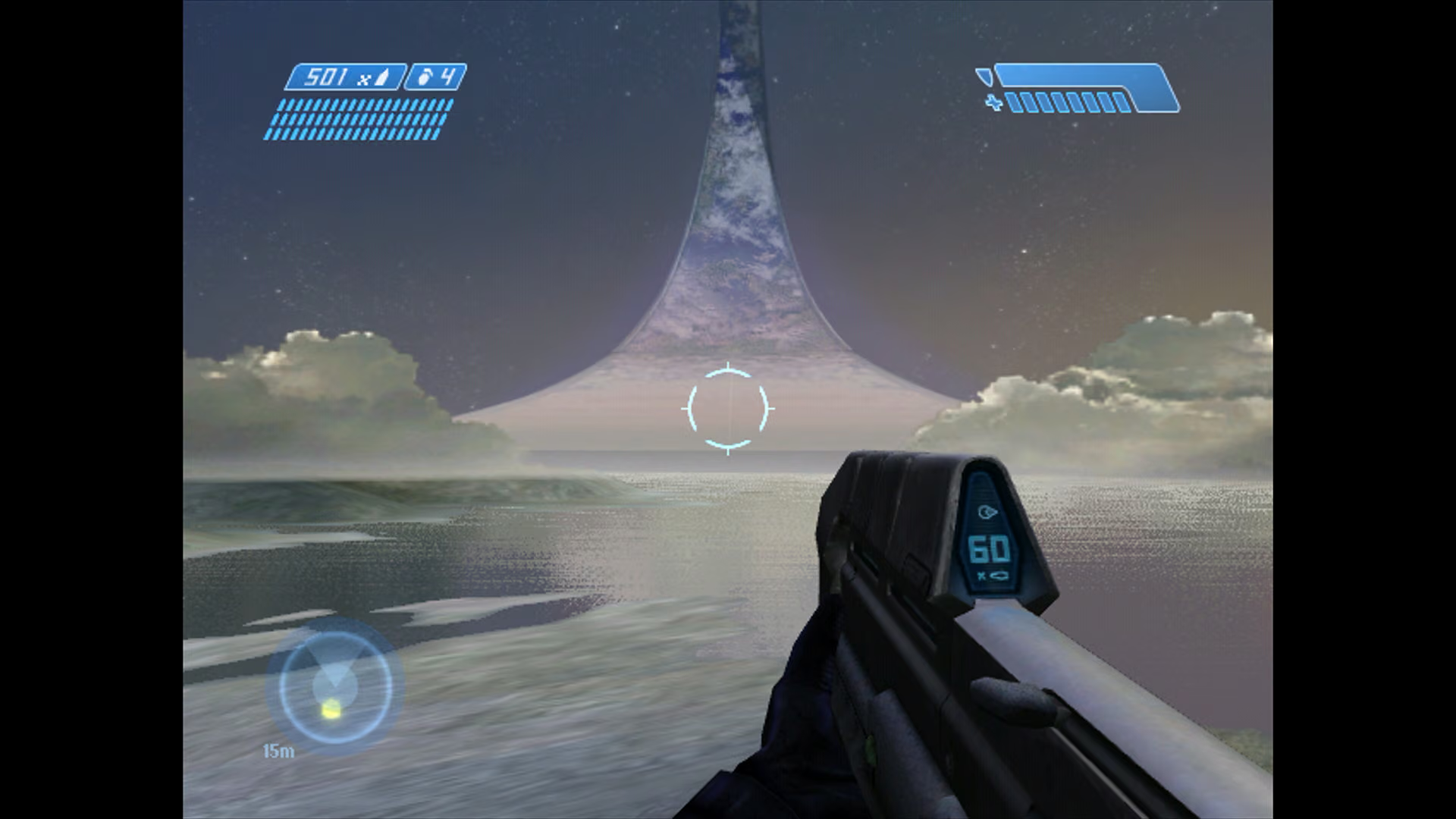
I prefer the original Xbox presentation. The original PC port and MCC do not feel completely identical to it, even when I am looking at a familiar room. Anniversary adds far more surface detail, changes lighting and replaces character models. I can appreciate the extra work without preferring the result.
The original’s large grey Forerunner structures, purple Covenant interiors and simpler surfaces give the spaces a clear identity. Anniversary often fills those surfaces with more patterns, panels, lights and colour. It can look attractive, but I do not always want the busier version of a place I already liked.


The original PC game was noticeably darker in my setup, to the point that I raised gamma to make it easier to see. That adjustment helped visibility. Darkness can support atmosphere, especially around the Flood introduction, but struggling to see what I am doing is still a practical problem.
My PC configuration also stretched the 4:3 image across the widescreen display. Everything looked wider and felt closer than in MCC’s supported widescreen presentation. Stretching a 4:3 picture does not reveal extra scenery at the sides; it changes the proportions. Old television Wide or Zoom settings and capture-card settings can also affect the image that ends up in a recording.
Some screenshots here come from my older YouTube gameplay videos. They can look softer or more compressed than the games did on the console. The newer original-Xbox-edition frames captured directly on Xbox 360 come from unedited capture-card footage that was never uploaded to YouTube. The PC and MCC screenshots are separate sources, and I have labelled the images accordingly.
Classic mode has its own restoration history
MCC’s classic presentation has received substantial fixes. The June 2021 patch notes list changes to active camouflage, bump mapping, fog, Jackal shields, reflections, Cortana’s colour effects and Captain Keyes’ original Xbox model. That is a significant list of details for something presented as the classic game.
The April 2021 update also removed the 30 FPS cap on cinematic character animations and addressed vibrating models in classic cutscenes. Its audio fixes included Warthog engine volume, turret firing sounds and the Needler’s weapon-switch sound. Later restoration work matters, so an old complaint about a missing effect should not automatically be presented as the state of today’s build.
The sound side also has different versions. The original music was composed by Martin O’Donnell and Michael Salvatori; Anniversary re-orchestrated and re-recorded that score. Weapon reports, plasma fire, shield feedback and enemy voices are a large part of how these encounters communicate what is happening. Changing those sounds changes familiar cues as well as their recording quality.
The original PC disc on Linux: getting it running was several jobs
I still have an original Halo: Combat Evolved PC disc copy. Installing it on Linux turned into several separate problems, especially once I wanted Steam’s overlay and recording.
I first installed Halo in a shared Wine prefix already used for other games. Installation worked, but launching it produced a DirectX 9 requirement. Trying the disc’s DirectX installer then told me a newer version was already installed. A fresh prefix or installation through Steam brought up “Cannot load PidGen.dll.” Troubleshooting involved mfc42 and older DirectX components, and I eventually had the game working in Lutris.
Steam integration was another job. A Lutris-created shortcut opened Halo, but Steam did not keep tracking it properly, so I did not get the overlay and recording setup I wanted. Adding halo.exe directly produced an invalid licence-key message, despite that installation working through Lutris. Starting from the disc offered to install again, which brought back the dependency problem.
I ultimately used a cracked executable with my disc installation. That let me launch directly through Steam with the overlay and recording working. The important practical difference was the launch route: the game was already playable in Lutris while Steam was still producing errors.
My Steam system report supplied on 21 October 2026 lists an Intel Core i7-6850K with an NVIDIA GeForce RTX 2070 SUPER on Ubuntu 26.04.1 LTS. The PC screenshots show the Windows game running through Proton Experimental. MCC also ran through Proton for my recent campaign. Neither is a native Linux release.
Hundreds of frames did not make every movement smooth
With the original PC game’s frame limit off, I saw readings ranging from roughly 200 to 1,000 FPS. That did not make every part of the image look smooth. Hit reactions looked as though frames were being skipped, and running produced a ghosting-like effect. In that configuration the game’s refresh option showed 60 Hz.
Limiting the game to 30 FPS cleared up the visual problem I was seeing, but added a small amount of mouse-response delay. It was not enormous, although I could feel it. That was the compromise I ended up with for this old PC installation. The frame counter alone was not a useful description of how it felt to play.
The original PC campaign also moves straight on to the next mission instead of giving me MCC’s postgame time and score presentation. MCC made it easier to keep track of individual runs.
Steam recording added its own confusion
I used Steam’s built-in recording for the comparison work. At one point I thought the original PC footage had no sound. I could hear the game while playing, and my MCC recordings had sound, but the original Halo footage was silent in Steam’s own player. Checking the Linux audio routing showed Halo and Steam’s recording source matched.
Exporting the footage revealed that the sound was there. The problem was playback inside Steam’s player, while the exported recording had usable audio. I also changed the displayed 120-minute background-recording limit to unlimited. Later, one recording did not save as expected, and I left automatic recording running rather than spending the whole playthrough troubleshooting it. I suspected a change around the gameplay display or frame-rate settings, but never established the cause.
The Microsoft account was the worst interruption
The part that annoyed me most about MCC was needing a Microsoft account to get into a game I wanted to play through Steam. The Steam listing explicitly requires an Xbox Live account. That requirement became a real obstruction when the account I had used for Halo was suspended for “suspicious activity” within about a day.
I had used it for Halo and had not been doing anything else with it. The sign-in process kept giving me a 404 error, and I submitted an appeal. Instead of continuing the campaign, I was dealing with an account problem. I later got back in with another account and chose to restart so I could record the run again.
I hate this kind of dependency. A problem with a Microsoft login should not be standing between me and an old single-player campaign. Keeping the original disc gave me another route, although making that version work with modern software was hardly effortless either. Buying access and keeping access are very different things when another account system can get in the way.
Co-op, multiplayer and keeping an old game alive
Playing Halo with Shilka is part of why I keep returning to it. Sharing the campaign, fighting through encounters and dealing with the Warthog together are part of my history with the game. My recent comparison work was focused on the campaign rather than a new assessment of competitive multiplayer.
The editions differ here too. Original Xbox Halo has local campaign co-op and competitive split-screen and system-link play. The 2003 PC release added internet multiplayer and extra maps and equipment, but omitted campaign co-op. Xbox 360 Anniversary added online campaign co-op, while its competitive component used Halo: Reach. MCC brings CE’s competitive multiplayer and online campaign co-op into the collection; the PC edition does not provide native campaign split-screen.
There is also a preservation example worth remembering. When GameSpy’s shutdown threatened the original PC server browser in 2014, Bungie released patch 1.0.10 with community help. Roger Wolfson credited btcc22’s replacement browser and help from Technut and kornman00. The update also addressed security and newer hardware, including refractive active camouflage on NVIDIA cards. That is a concrete case of keeping an old game useful rather than leaving its network dependency to die.
My verdict: 8/10
Combat Evolved is still a game I enjoy playing after knowing it this well. The pistol, shotgun, grenades, shield recovery, vehicles and different enemy factions give me plenty to work with. The campaign moves from a military escape to exploring the ring and then into a Flood outbreak without losing its identity.
Its repeated corridors and returning locations are obvious, and the different releases bring their own compromises. I prefer the original Xbox presentation to Anniversary’s busier art. The old PC version needed work on Linux and a frame-rate compromise in my setup. MCC was more convenient once I was playing, but the Microsoft account suspension was an interruption I should never have needed to deal with.
8/10. I still want to play Halo. I would like getting into it to involve rather less fighting with everything around the game.
My intro comparison and gameplay recordings
The intro comparison below is my own comparison video. The other links collect the original-edition and Xbox 360 Anniversary recordings used alongside the newer direct captures and PC screenshots in this review.
Open my original Halo and Anniversary gameplay recordings
Original Halo: Combat Evolved playlist · Halo: Combat Evolved Anniversary playlist
Original recordings: Part 1 · Part 2 · Part 3 · Mission 1 recording · Mission 2 recording · Xbox 360 Part 1 · Xbox 360 Part 2.
Anniversary recordings: Mission 1 recording · Part 1 · Part 2 · Part 3 · Part 4 · Part 5.