
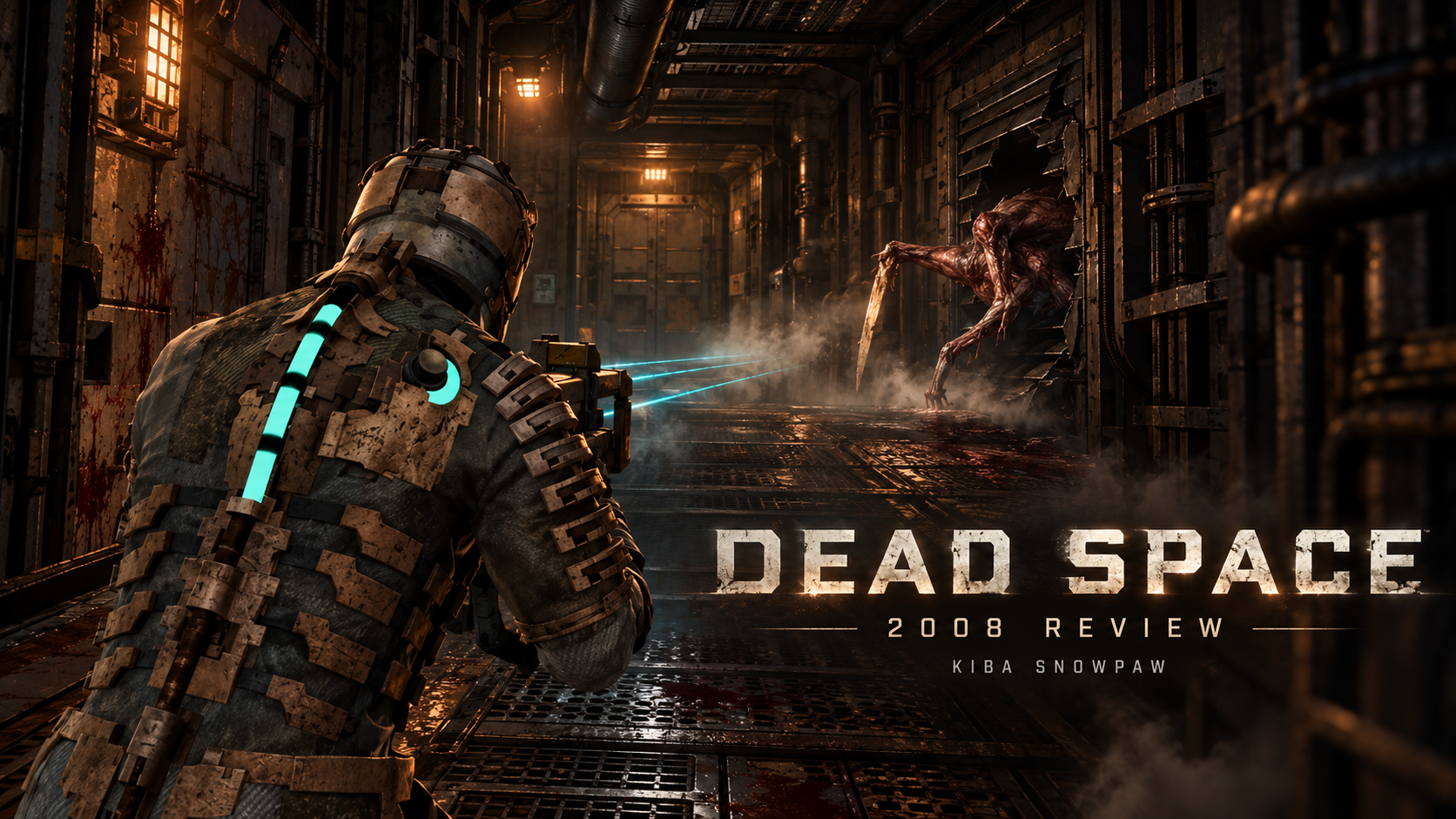
Dead Space is one of my favourite games of all time. I have completed it many times on Steam and have also played it on PS3. This review is about the original 2008 game and my physical PC DVD copy. I love its horror, and I love its story. Returning to the Ishimura still gives me plenty of reasons to love both.
Knowing the game changes how I play. I recognise rooms, anticipate some encounters and get through objectives faster. Then something moves, a noise comes from the wrong direction, or an enemy gets closer than expected, and I am reacting again. In the final session of this playthrough, I could be talking about what would happen next and still get caught by something a few minutes later.
There are sections that annoy me, especially the regenerating enemy chases and some slow cargo handling. The original PC version also carries technical problems worth discussing. Those belong in the review alongside the things that keep bringing me back: the ship, the creatures, the combat, the isolation and the story underneath it all.

A repair job on a ship that has already fallen apart
Isaac Clarke arrives aboard the USG Kellion with a maintenance team sent to investigate the USG Ishimura’s communications blackout. The Ishimura is a huge mining vessel, a planet cracker, operating above Aegis VII. Isaac also has a personal reason to want to get aboard: his girlfriend, Nicole Brennan, works there.
The opening gives the disaster time to become believable. The team tries to contact the ship. There is no proper answer. Docking goes wrong. Inside, luggage and equipment suggest people left in a hurry, while the ship’s welcoming announcements continue as though its employees are about to start another ordinary working day.
Then the quarantine begins, the first attack tears through the team, and Isaac has to run. The game establishes his vulnerability before giving him the tools to fight back. You have already seen how quickly a room can become a slaughterhouse by the time you find the Plasma Cutter.
That sequence introduces a pattern running through the whole campaign. A practical problem needs solving, the solution takes Isaac deeper into the ship, and what he finds makes the situation worse. Fix the tram. Reach medical. Restore the engines. Deal with the failing defences. Clean the air. Get a message out. Each job has an understandable purpose, and each brings another part of the catastrophe into view.
Isaac being an engineer holds that structure together. His equipment, his movement through machinery and the work he is asked to do belong to the same character. People keep handing him another broken system because he is the person who can do something about it. The ship would kill its remaining survivors through mechanical failure even if the Necromorphs stopped helping it along.

How the original took shape
EA Redwood Shores, the studio later known as Visceral Games, developed the original for Windows, PlayStation 3 and Xbox 360. It arrived in October 2008; the PC release is dated 20 October on Steam’s listing.
In his 2020 retrospective interview with Ars Technica, creator and executive producer Glen Schofield recalled thinking about Dead Space around 2005–2006. He described wanting to make an especially frightening game, and identified Resident Evil 4 as a major influence. You can recognise the over-the-shoulder perspective and the pressure of aiming while something advances towards you.
Schofield’s later career retrospective gives another useful part of that history. He wanted a small team protected from being pulled onto other projects, and that team built a frightening corridor demonstration around dismemberment. Early artwork and posters helped sell the idea inside EA, but the playable demonstration convinced people to support it.
The science-fiction horror influences were deliberate too. In a contemporary interview, Schofield discussed films including Alien and Event Horizon, and his desire for a dirty, believable setting. That influence fits the finished ship: cramped passages, heavy equipment and an environment that seems increasingly hostile to the people supposed to work there.
Dead Space developed a strong identity around that combination. An industrial cutter becomes a weapon. A safety display becomes the health meter. A maintenance task becomes a dangerous trip through a ruined workplace. The game keeps finding ways to make its science-fiction setting useful to its horror.
The Ishimura is a place worth being frightened of
The Ishimura has a layout and a purpose. There are areas for medical treatment, engineering, hydroponics, mining, communications and the crew’s everyday lives. The tram gives those places a relationship to one another. Even when a chapter keeps you on a particular route, you have a sense of moving through different parts of a very large vessel.
That matters to the environmental storytelling. A treatment room means something different from a cargo bay. Beds, waiting areas, workstations and personal messages show how people used these spaces before the outbreak. Blood, barricades and abandoned supplies show what happened afterwards. The remains of ordinary life give the violence its context.
The different decks also let the visual design change without losing the ship’s identity. Engineering is dominated by large machinery and narrow routes around it. Medical turns familiar equipment into something unpleasant to stand beside. Hydroponics introduces greenery, growing systems and contaminated air. The bridge opens onto the huge operation outside the windows, giving a momentary sense of scale before another corridor closes around Isaac.


The original’s art direction still does a lot of work. Worn metal, repeated structural ribs, dim practical lights and the cyan glow of Isaac’s equipment create a recognisable look. The brown and grey industrial surfaces have clear shapes and functions. Sudden warmer light, a bright medical room or a view outside can change the mood without making the location feel disconnected.
It has the visible age of a 2008 game in faces, textures and some animations. Its spaces remain effective because their lighting, composition and contents work together. Looking down a passage, you can see where the light ends, where the next door is and how little you can see around the corner. Those relationships survive an increase in polygon counts elsewhere.

Horror that keeps working after the surprise is familiar
Dead Space uses jump scares freely. Enemies burst into rooms, bodies move, vents break and doors open onto something horrible. After several playthroughs, some of those moments become predictable. A suspicious body stays suspicious, and a useful-looking room can make you expect an attack before you have stepped inside.
The atmosphere survives that familiarity because there are several things putting pressure on you at once. You are listening for movement, watching your ammunition, checking where you can retreat and looking for the next place an enemy could enter. A room can remain tense while nothing is attacking. You still have to decide when to cross it.
Vents are especially effective. They make the ship’s structure part of the threat. An enemy can leave one route and reappear elsewhere, and the walls stop feeling like reliable boundaries. A sound behind Isaac demands attention even when there is something directly in front of him.
The camera contributes to that pressure. Isaac occupies a substantial part of the view, particularly while aiming. You can see his body and equipment clearly, while the area around him remains limited. Turning towards one threat means exposing another direction. Retreating into a corner can simplify an encounter, but first you have to reach it.
His deaths are brutal, which reinforces how vulnerable that body is. The suit looks heavy enough for dangerous work, yet the creatures can still tear through it. The game gives you effective weapons and repeatedly shows what happens when you fail to use them in time.
In my later recording, I was still stopping to listen, reacting to noises and getting startled despite knowing the overall route. That is a large part of why I keep enjoying this game. The first playthrough has its surprises; returning gives me another chance to experience the place and the pressure of moving through it.
Sound makes the empty spaces uncomfortable
The Ishimura is full of machinery, ventilation, alarms and metal under strain. Something rattling nearby might be part of the ship, part of an attack or the start of a scare that never develops. Dead Space gets a great deal out of that uncertainty.
The distinction between a warning and a harmless noise becomes valuable during combat. You want to hear an enemy approaching, but there is already a whole damaged ship making noise around you. Distance and direction matter. A creature you can hear without seeing takes some of your attention away from the one already in the room.
Vacuum sections change the soundscape and make Isaac’s breathing and equipment more prominent. Crossing from the busy interior into that reduced, muffled space creates a different kind of isolation. Then returning to a pressurised area brings the ship’s noise back around him.
The production work behind this is worth recognising. Audio director Don Veca discussed recording much of the raw source material rather than relying heavily on existing libraries. He also explained how Jason Graves’s score used texture and mood within the larger soundscape. Designing Sound’s contemporary collection of developer material preserves that account.
The music’s reputation has a concrete historical basis: BAFTA lists Dead Space as its 2009 Original Score winner, crediting Jason Graves and Don Veca. The achievement fits a game where sound has such a large role in making a corridor uncomfortable before anything appears in it.
Dismemberment gives the fighting its own rules
The Necromorphs make you change your aim. Shooting at the centre of a body is often a poor use of ammunition. Removing limbs damages an enemy and changes what it can do. Taking off a leg can turn a fast approach into a crawling threat, buying time while leaving something dangerous on the floor.
That creates useful decisions during a fight. You can keep concentrating on one enemy until it dies, slow it by taking out a leg, or switch targets because another creature has reached a more dangerous position. You have to aim accurately while deciding which problem needs solving first.
The Plasma Cutter is an excellent introduction to that system. Its cutting line rotates between horizontal and vertical orientations, so the shape of the shot has an immediate relationship to the limb you want to remove. The three blue aiming beams make the tool readable. Later upgrades let it remain a useful weapon throughout the campaign.

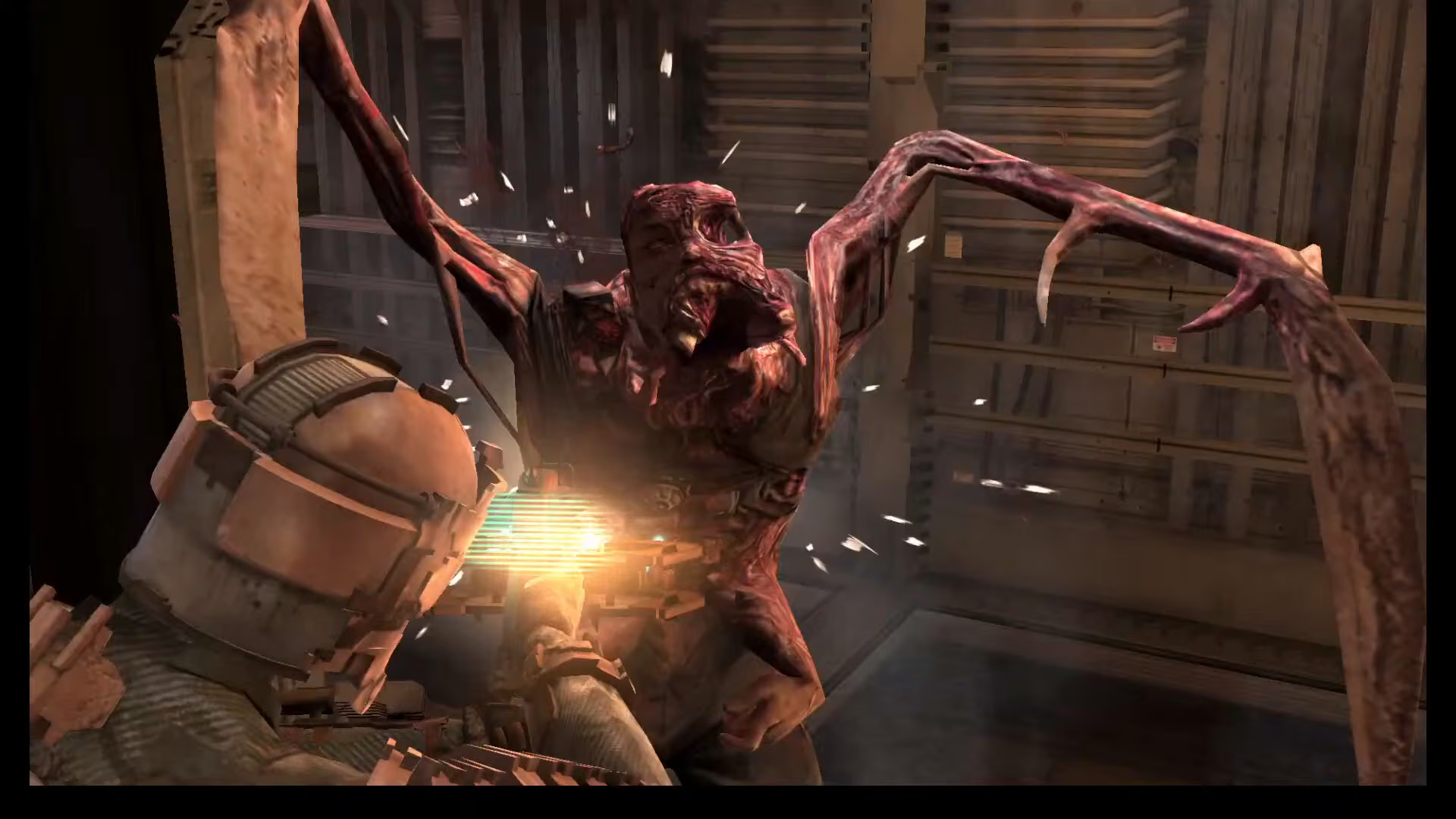
The enemy designs make those decisions more interesting. Slashers advance with long cutting limbs. Lurkers expose tentacles that become obvious targets once they unfold. Pregnants punish careless shots into the stomach by releasing smaller creatures. Infectors make intact corpses in a room an additional concern. You are looking at bodies for information about how to fight them.
Creative director Bret Robbins described the extra design and animation work this required in an August 2008 interview. The team had to account for creatures losing different limbs and continuing to behave coherently. His explanation of the Pregnant shows the intended connection between anatomy and player decisions. The finished combat benefits from having enemies whose shapes communicate consequences.
The stomp gives close encounters a particularly physical ending. It can break containers, finish a threat on the floor and help deal with bodies that could otherwise become a problem. It also puts Isaac close to things. The heavy motion has force, but standing over something is a commitment when another enemy may be moving nearby.
Weapons that belong aboard a mining ship
Much of the arsenal extends the industrial setting. The Line Gun offers a broad cutting shot. The Ripper holds a spinning blade in front of Isaac. The Contact Beam delivers a powerful charged attack, while the Force Gun helps deal with close-range pressure. The Flamethrower and the more conventional Pulse Rifle give the collection further variety.
The weapons feel different enough to change how you approach a space. A weapon that needs time to charge asks for a different opening from one used to keep something away at close range. A cutting line encourages you to consider how enemies are positioned. A short-range tool makes the distance between Isaac and a creature especially important.
Alternative fire adds another choice, and the original’s versions deserve to be judged as their own designs. They are not interchangeable with the remake’s revised arsenal. The PC manual documents primary and secondary actions separately, alongside aiming, reloading, melee and the suit modules. There are several useful actions available without turning the combat into a complicated sequence of abilities.
I like how this fits Isaac. His equipment looks as though it could have a job when there are no monsters around. The fighting still has plenty of force and gore, while the tools keep the character connected to the place he is trying to survive.

Stasis, kinesis and the work between encounters
Stasis slows a target, giving Isaac time to get through a dangerous mechanism or deal with an advancing creature. The opening tram repair teaches a practical use for the ability, and combat gives it another use. A limited charge creates a decision about when to spend it and when to rely on ordinary movement and shooting.
Kinesis lets Isaac manipulate objects at a distance. It supports the engineering work, allows objects to be moved into position and gives him ways to use parts of the environment. The radioactive material aboard the Valor is a good example of a problem built around handling dangerous objects rather than finding a conventional key.


The puzzles are usually understandable from the equipment in front of you. You can see a damaged system, a missing component or a mechanism that will not stay where you need it. Working out the required action gives a break from shooting while keeping Isaac occupied inside the same dangerous environment.
This is one of the reasons the repair-job structure works so well. It gives the player something specific to do in each location. You learn where the controls are, how the machinery operates and what route you need to take through it. An attack can then interrupt work you already understand.
The game also leaves room for small diversions, including the Valor’s shooting range and the zero-gravity basketball activity. They are optional changes of pace within a campaign that mostly keeps its attention on survival and repair.
The suit tells you what you need to know
The health meter runs up Isaac’s spine. His stasis charge sits beside it. The weapon shows its ammunition, and oxygen information appears when it is needed. Menus and communications are projected into the space around him. The presentation keeps essential information close to the character you are already watching.


Producer Chuck Beaver explained the thinking behind the RIG in a 2008 developer article: the back-mounted health display made sense as something miners could monitor on one another. The team then extended that approach to the rest of the interface.
The inventory and map continue in real time. That makes checking supplies a decision about where to stand, especially after a fight when the room may still contain a threat. The actual pause menu remains available; the tension comes from particular in-world actions remaining exposed.
The locator is another strong piece of practical design. It projects a route to the current objective, making it easy to get moving again after exploring or being interrupted. The game can preserve its winding industrial spaces without constantly making navigation the obstacle. The original PC manual also documents subtitles, control remapping, separate management screens and the locator’s default controls.
This interface is one of the original’s clearest strengths. Its visual language is consistent across the suit, weapons, doors, terminals and communications. It helps the technology feel like something used throughout this world.
Supplies and upgrades give exploration a purpose
Inventory space is limited, and the things competing for it are useful. Ammunition, healing supplies and other resources have to be carried or put into storage. Finding something valuable can mean deciding what to use, what to leave and what to keep for later.
Stores turn credits and recovered schematics into equipment and supplies. The bench uses power nodes to upgrade weapons, the RIG and stasis. Its connected paths make planning useful: reaching a desirable improvement can require spending nodes on the route towards it. Putting resources into a small set of tools also feels different from spreading them across an expanding arsenal.

There is a further temptation in the doors opened with a power node. A node can become a permanent improvement at the bench, or it can buy access to whatever is behind that door. Searching side rooms therefore feeds back into future decisions rather than existing only to fill a completion counter.
The amount of pressure changes with difficulty, equipment and familiarity. During the later part of my run, I could complain about being low on ammunition and, elsewhere, remark on having a lot of money. Those are different resources, and the game asks you to manage the relationship between them. A healthy credit balance does little during an encounter if the weapon in your hands is nearly empty.
Zero gravity makes familiar rooms unfamiliar
The original uses directed zero-gravity jumps between suitable surfaces. Landing on a wall or ceiling changes your orientation and forces you to read the room again. A doorway or piece of machinery can look very different when it is no longer where your instincts expect it to be.
This system is more restrictive than the free movement associated with later entries and the remake. The jumps have a particular rhythm: choose a destination, commit to it and reorient after landing. That restriction can make the environment feel awkward and dangerous in a way that fits the original.
Vacuum adds an oxygen limit, placing a clear time pressure on finding the next route or completing the next task. The huge structures outside the Ishimura contrast with the limited supply keeping Isaac alive. You can have an enormous view and very little freedom to admire it.


The communications array, the centrifuge and exterior work vary the way you move and solve problems. They help keep the ship interesting across its twelve chapters. The campaign can return to corridors and combat while giving those spaces a different shape around the next task.
The story gives the disaster a human reason to matter
I love the story because the mystery has several connected layers. There is the immediate question of what happened to the crew, the larger question of the Marker and the outbreak, and Isaac’s personal search for Nicole. Progress in one part of that mystery changes how the others look.
Hammond and Kendra keep Isaac connected to the remaining maintenance team, but communication provides limited comfort. They have their own locations, their own information and their own arguments. Isaac still has to walk through the next door himself. Their transmissions can make him feel responsible for other people without removing his isolation.

The logs work best alongside what is already visible in a room. A recording of the medical staff struggling to cope lands differently when you are standing among the results. Messages about deteriorating conditions, strange behaviour and the Marker give names and decisions to a disaster that could otherwise be reduced to anonymous bodies.
Unitology adds another disturbing element. Its promises about death and transformation let the story put horrific events beside characters who interpret those events as something desirable. Mercer is particularly effective because his conviction keeps colliding with the suffering directly in front of him. There is a human willingness to enable the catastrophe as well as an alien cause.
Isaac’s silence also belongs to the original’s particular mood. He breathes, struggles and reacts physically, while other people fill the communications with instructions and conflicting explanations. The lack of spoken replies can make him seem passive in some conversations. It also leaves long stretches where his situation is carried by movement, sound and the work in front of him.
The major revelations deserve their own space. They are a substantial part of why I love the story, and the discussion below includes the ending.
Major story and ending spoilers — Nicole, the Marker and Aegis VII
Nicole changes the meaning of the journey
The reveal that Nicole has been dead throughout the journey changes Isaac’s search into something much more painful. The recording he has been returning to has an ending he has not faced. His desire to find her has also made the appearances of Nicole horribly persuasive.
On a replay, that knowledge changes the earlier scenes. A familiar face stops being a reliable source of reassurance. Messages and appearances acquire another meaning, and Isaac’s determination becomes easier to understand while looking increasingly dangerous.

The Marker’s influence makes his perception part of the threat. He can repair machinery, survive attacks and complete the tasks in front of him while still misunderstanding what is happening to him. Competence at one kind of problem gives him no protection from the other.
Human intentions make the situation worse
Kendra’s betrayal exposes another purpose behind the mission and the search for the Marker. Her account identifies the red Marker as a human-made reproduction of an alien artefact and places the Aegis VII disaster within an older government experiment. What Isaac has been surviving also has a history of people trying to control something they do not safely understand.
Kyne, Mercer and Kendra approach the crisis differently, and Isaac is caught between people who want him to act on their explanations. Mercer’s religious certainty is particularly ugly beside his treatment of other people. Kyne sees returning the Marker as a chance to contain the disaster. Kendra wants to take possession of it. Each gives Isaac another reason to keep moving it.

The result is an effective extension of the game’s central routine. Isaac keeps carrying out practical jobs, and the story keeps asking whose purpose those jobs are serving. Repairing a shuttle and transporting cargo become much less reassuring once the cargo is the source of the disaster.

Surviving the final creature leaves another problem behind
The Hive Mind gives the ending a physical confrontation on a huge scale. Its exposed targets still connect the fight to the game’s emphasis on aiming at particular parts of a creature. The setting opens out, but Isaac remains small beside what he is fighting.

Escaping Aegis VII gives him a moment without the helmet, and the exhaustion in his face matters after so much time spent watching the armoured back of his head. The final appearance of Nicole denies him an easy sense of safety. The ship and the planet can fall away behind him while what happened to his mind remains unresolved.
That ending fits the horror I love here. The physical escape happens, and the story leaves Isaac carrying something his engineering tools cannot repair.

The parts that still get on my nerves
The Hunter is my clearest complaint. An enemy that regenerates after you cut it apart changes the rules of the fight: dismemberment buys time, while the actual solution involves escape, containment or the environment. I understand the pressure that creates. I still dislike having the unkillable enemy chasing me while I am trying to complete another task.
That irritation is especially clear in my final session around the crew quarters. I knew the sort of encounter I was heading towards and was already unhappy about having to deal with it. A strong horror game can use a mechanic effectively and still make that mechanic one of the parts I least enjoy playing.

Some of the cargo movement also drags. Guiding the Marker along its route, getting it into position and moving between controls can take longer than the activity remains interesting. In the hangar section of this run, I repeatedly wanted the thing to move faster. Familiarity makes those stretches stand out because I already know where it needs to go.
The chapter structure can become predictable too. Another system fails, Isaac gets sent to deal with it, and the repair leads to another attack. The locations, revelations and changing encounters carry much of that repetition, although repeated quarantine fights and returns through familiar passages are still recognisable parts of the formula.
The original ADS cannon is a very different sort of interruption. It takes you out of ordinary movement and into shooting incoming debris from a fixed position. It provides variety, but it also places extra importance on the aiming behaviour of the PC version.

The original PC port needs to be discussed separately
The original has longstanding mouse-input problems. Methanhydrat’s own explanation of the Dead Space Mouse Fix describes frame-time-dependent input transformations and the effects of VSync, then explains the raw-input approach used by the community fix. That is useful technical work for a game where choosing a limb quickly is central to the combat.
There are also player reports of progression and high-frame-rate problems. The negative Steam reviews include accounts of blocked early doorways, aiming faults and difficulty getting the PC version into a usable state.
The original is a Windows game. Linux play relies on compatibility software such as Wine or Proton, and the setup for a disc installation can differ from a Steam installation. Valve describes Proton as a tool based on Wine that lets Windows games run on Linux through Steam.
The physical edition also belongs to the history of PC activation restrictions. The 2008 PC manual states an internet connection and online authentication requirement. Having the DVD does not make that original requirement disappear.
For preservation and offline installation, there is a separate official alternative: GOG’s version of the original is sold DRM-free and offers an offline installer, with Galaxy optional. That is relevant to keeping the game accessible, even though my copy discussed here is the physical PC edition.
Why so many players still love it
The original remains Very Positive in Steam’s English review summary at the time of checking on 27 October 2026. The more useful part is what players actually praise. Austin96’s 2025 review highlights the environmental detail, atmosphere and interface. The Horror Network’s 2017 review describes the isolation while also observing that some scares become predictable.
Those reactions fit the combination of strengths in the game. The combat asks you to look closely at the creatures. The interface lets you keep looking at Isaac and the ship. The ship gives the creatures somewhere believable to move through. The sound suggests movement beyond the part you can see. The story makes the people and the bodies in that place worth understanding.
These systems keep supporting one another. Removing the fear of a particular scripted surprise still leaves a room to cross, supplies to manage and a creature whose movement you need to control. Learning the story adds another way to read the messages and appearances on the next visit.
In a 2023 discussion with the remake’s creative director, Bret Robbins identified immersion and dismemberment as pillars of the original. He also explained that a more continuous, freely revisitable Ishimura was something the original team had wanted but could not fully achieve within its time and budget. That gives useful context to the original’s more linear structure.
Motive’s remake arrived on 27 January 2023. It has its own changes to discuss in a separate review. The 2008 game already contains the atmosphere, systems and story that made returning to this setting worthwhile.
Why it remains one of my favourites
I can return to Dead Space knowing its story and still enjoy the journey through the Ishimura. The horror has more to offer than waiting to find out what the next monster looks like. The layout, sound, industrial equipment and physical combat keep giving me things to pay attention to.
I love that Isaac has useful tools and remains vulnerable. I love how the story starts with a missing person and a repair job, then gradually exposes what has happened to the ship and to the people trying to understand it. The final revelations reach back into the beginning instead of feeling detached from the hours spent getting there.
The game also gives a completed run somewhere to go. The completion screen unlocks the military suit, additional backstory logs and Impossible mode, alongside credits and power nodes. A further playthrough can put familiar encounters beside different equipment, upgrades or difficulty.

Some sections still make me complain. Then I am back in another corridor, hearing something move through the ship and checking what is left in the Plasma Cutter. I have finished this game many times, and it can still get a reaction out of me. That is why the original Dead Space stays among my all-time favourites.
Watch my Dead Space (2008) playthrough
Open all four gameplay sessions
All four recordings from this playthrough are collected in my Dead Space – S1 playlist. You can also open each part directly using the links below.
Part 1 — S01P01 (1:21:46) · Part 2 — S01P02 (1:44:01) · Part 3 — S01P03 (2:18:23) · Part 4 — S01P04 (2:41:14)
Sources and screenshot credits
Screenshots are from my four Dead Space (2008) recording sessions. Captions identify the session and recording timestamp. Game imagery © Electronic Arts and its respective creators.
Development background comes from the linked Schofield, Robbins and Beaver interviews and articles. Interface and control details were checked against the original PC manual; audio background comes from the linked developer material and BAFTA record. Steam reviews are attributed player experiences. Store and collection information was checked on 27 October 2026.