
A cancelled trip to Sofia became five days based in Aalborg, with Shilka, a heavy camera bag, animals, secondhand shops, a ridiculous fish burger and enough walking to make my knees complain. I came home with a lot of photos and the feeling that I had actually used the days.
In this post
- Aalborg instead of Sofia
- Day 1: stations, a simple room and Restaurant Sanya
- Day 2: Aalborg Zoo and a city determined to give me stairs
- Day 3: Randers Regnskov, then a much longer walk than expected
- Day 4: Frederikshavn finds and a fish burger on the train
- Skagen: the sea, small finds and a museum missed by 22 minutes
- Day 5: a lighter bag and a quieter Aalborg day
- Packing up and heading home
- The money I actually recorded
- What stayed with me

This is the trip from my side. We travelled together, but we often split up during the day and met again later. Shilka could happily spend hours looking through Blu-rays. I wanted animals, water, old things, photos and whatever interesting detour appeared on the map. Having separate plans worked better than making either of us follow the other around.
Aalborg instead of Sofia
Sofia had been the original plan. It was cancelled for reasons I do not need to go into here, and Aalborg became the replacement. I had seven days of vacation and used five for the trip, leaving a day beforehand to get ready and a day afterward to land again before work. Coming home late and going straight back to normal life the next morning does not feel like a break to me.
Shilka handled the train tickets and hotel booking. We had our own rooms and paid for them when we arrived. I like travelling with someone while still having a door I can close at the end of the day. After hours outside, I want my own space to unpack, charge batteries, look at photos and stop talking for a while.
My hotel stay, including breakfast, cost 3,518.20 DKK. I had set aside 9,066 DKK, leaving 5,547.80 DKK after the hotel. Across five days that gave me an allowance of 1,109.56 DKK per day for food, transport, drinks and finds. That was a planning figure, rather than what I actually spent each day.
There was no schedule locked down to the hour. We had ideas and talked each morning about what made sense. Weather, energy and mood matter more to me than following a plan just because I wrote it earlier. We had split up on our Zagreb trip too, although we did it more often this time.
I also use Google Maps as a collection of places for future trips. I save somewhere interesting when I come across it, even if I have no immediate plan to go there. That is how places around Rebild, Rold Skov, Himmelbjerget, Ry and Blåvand end up waiting on my map. The trouble starts when I am nearby and think I might as well see just one more.
Day 1: stations, a simple room and Restaurant Sanya
Copenhagen Central, much too early
Our train left Copenhagen Central Station at 13:44. I got there around 10:00. Shilka was not due until roughly 12:40, so I had managed to turn the departure into several hours of waiting.
I was hungry and did not have much at home. Going into town with all my bags, buying food and then taking the bus sounded more awkward than taking the bus straight away and eating at the station. That was how I ended up at Joe & The Juice with a Pick Me Up juice, a Spicy Tuna sandwich and a muffin.
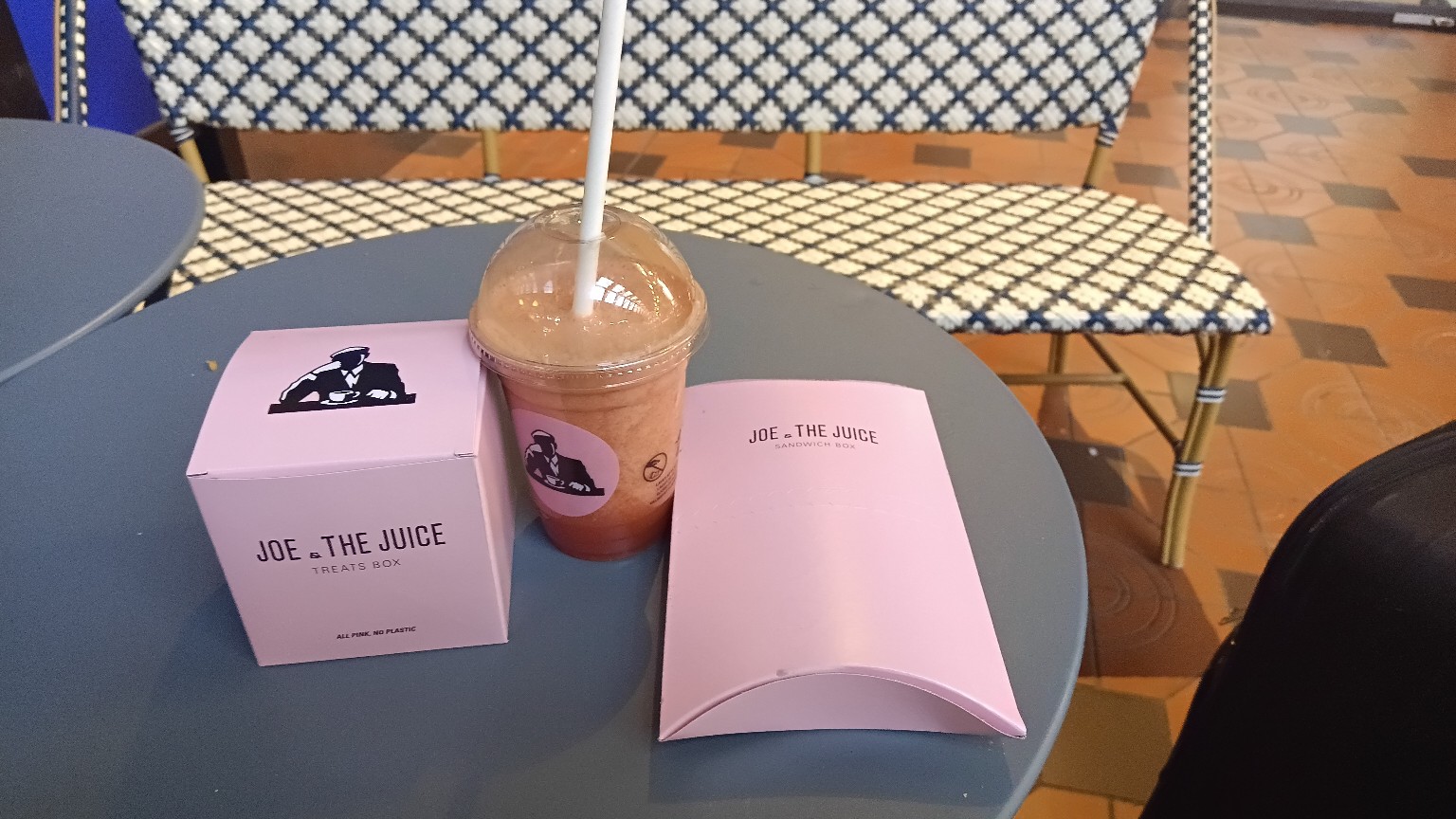

The total was 180 DKK. It tasted fine, but I definitely noticed the station price. The juice was the apple, strawberry and banana combination with ice and olive oil. The sandwich had tuna mousse, tomato, jalapeños, Tabasco and vegan pesto in Joe’s Classic Bread. I wanted something with a little bite, and it did the job. Whether the convenience was worth 180 DKK is another question.
I keep a close eye on money when travelling. Debit cards and keeping the trip money separate work well for me because I can see what I have left. The train to Aalborg had already been paid for, but the hotel was still going to take a large part of the budget when we arrived.
Once Shilka arrived, we went into 7-Eleven for food and drinks for the train. There was also a chicken wrap I had bought for the journey. I forgot I had it, and by the time I remembered at the hotel it had gone bad. It went in the bin. A small, stupid waste of money caused by forgetting what I had packed.
The change in Aarhus
The journey involved changing trains in Aarhus. I do not particularly enjoy changes: get off, find the track, check the time and hope nothing has moved since you last looked. This one was easier because the DSB app showed the departure times and platforms. We knew where to go before getting off the first train.
That was a useful app moment. I still have my usual complaints about travel apps using phone battery, GPS and data. During this trip I was complaining about Rejsekort-style tracking and joking that at least the DSB points made me feel I might eventually get a soda back for the inconvenience. But having the platform information ready helped with the change.
The rest was normal travel-day waiting and sitting. I took a train selfie, looked out, checked the time and finally felt that we were on the way rather than still preparing to leave.


Our base at the B&B Hotel
The hotel was about 500 metres from Aalborg Station, from what I remember. That was exactly the kind of location I wanted after hours on trains: pick up the bags and walk there, without working out another bus or paying for a taxi.
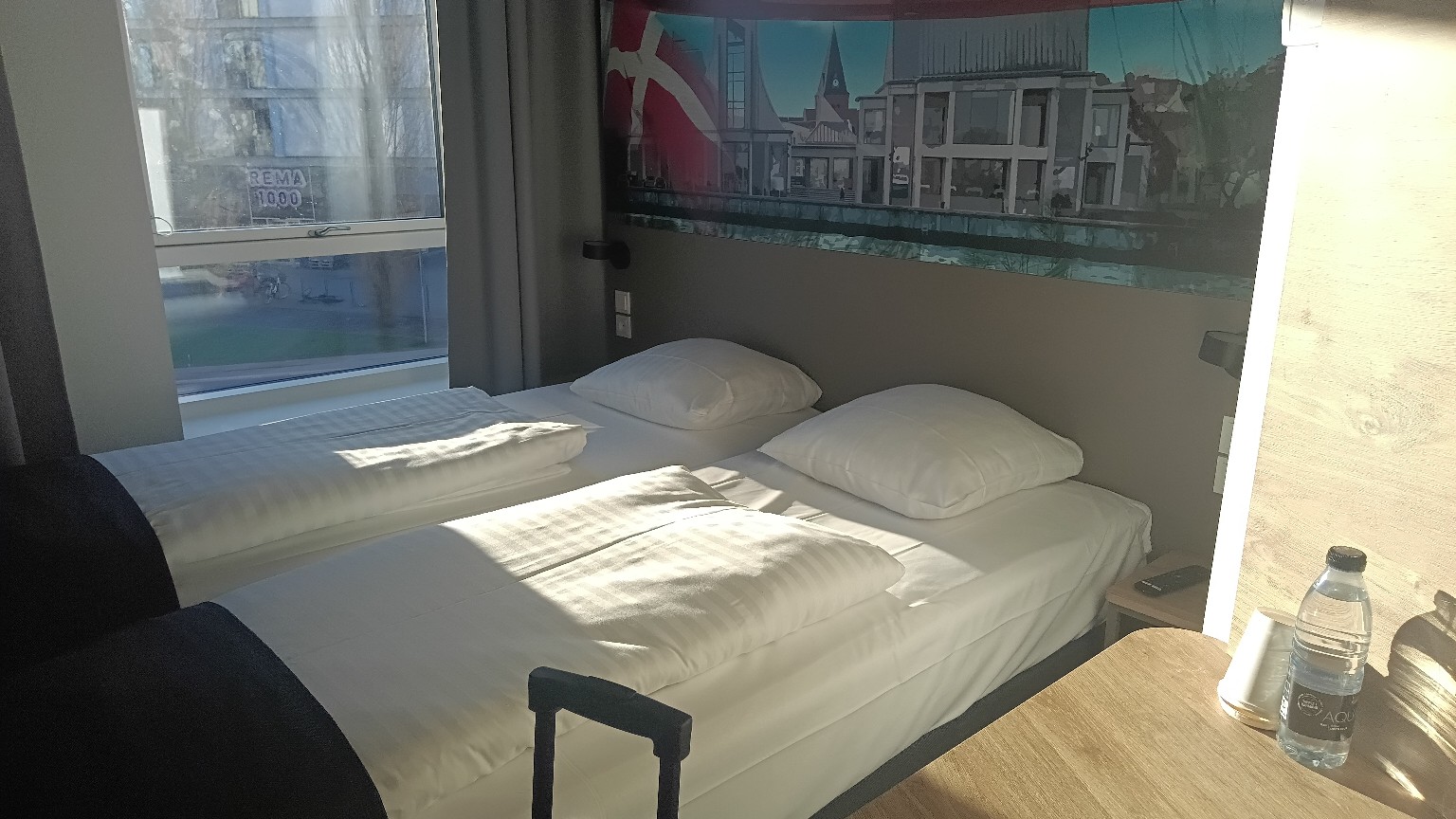
My room was basic: bed, desk, TV, space for the bags and a bathroom. There was a bottle of water too. The bathroom had a sink, mirror, toilet and shower, and it was fine for what I needed. I do not need hotel luxury when I intend to spend most of the trip outside.
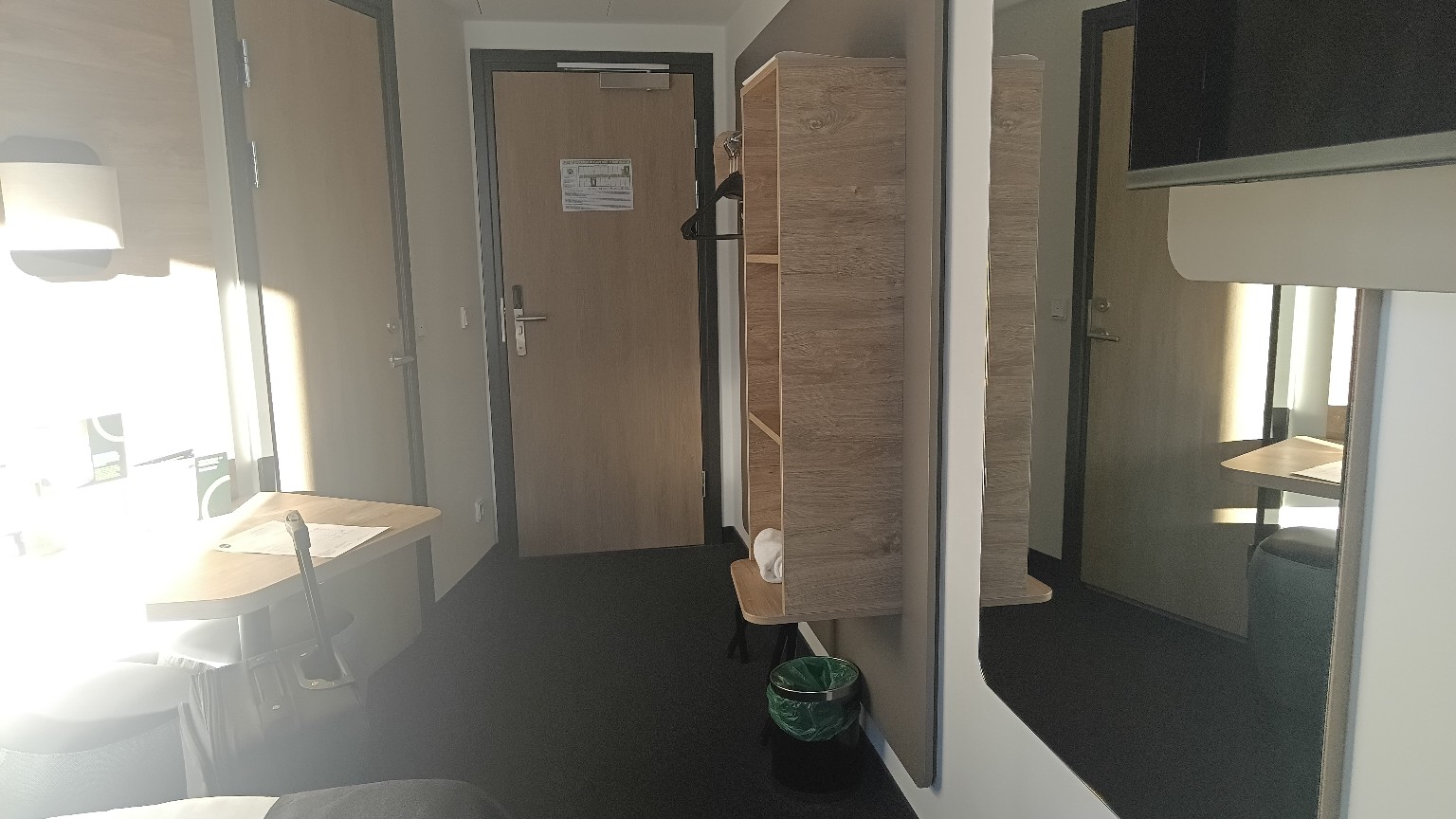

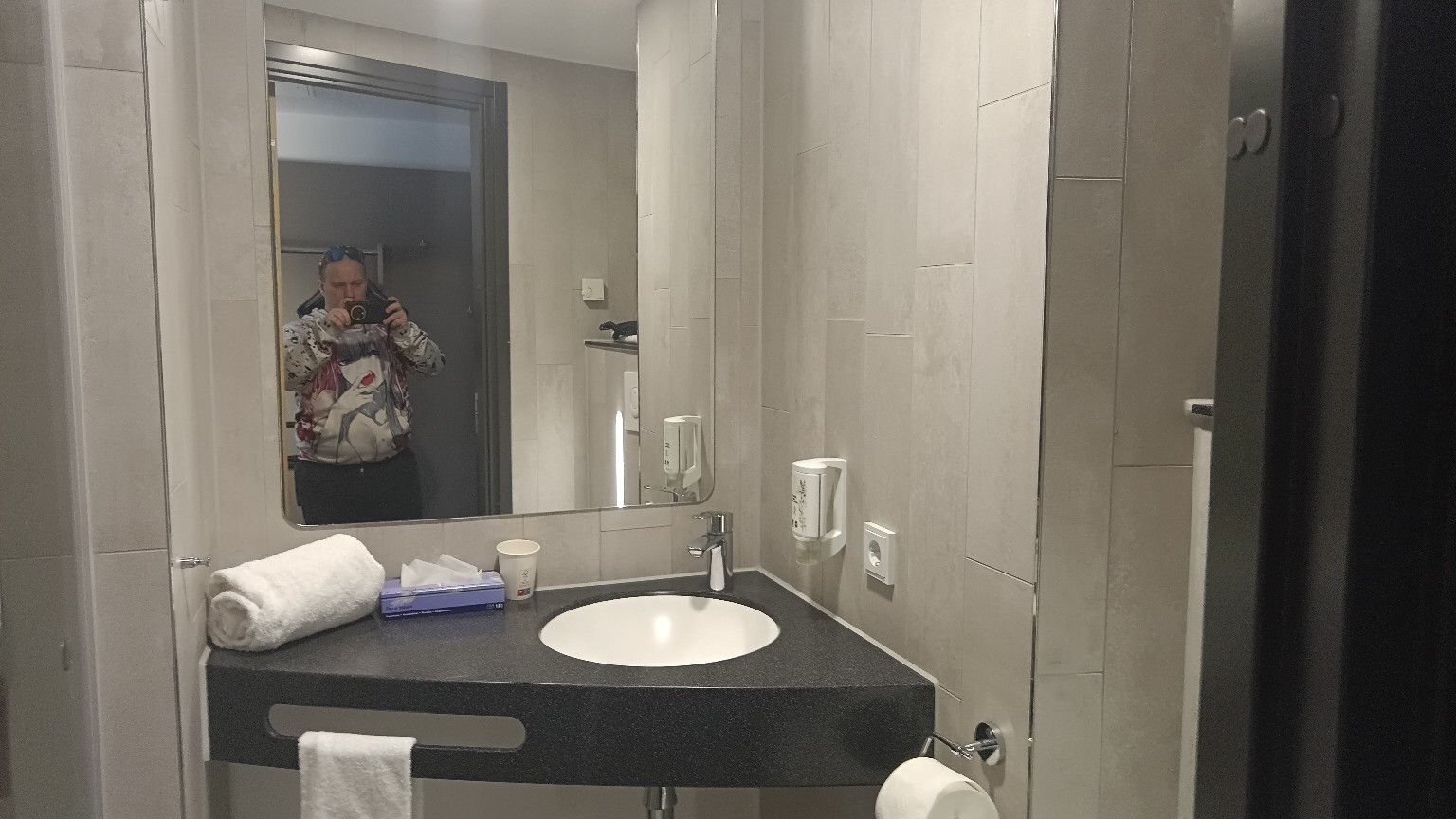
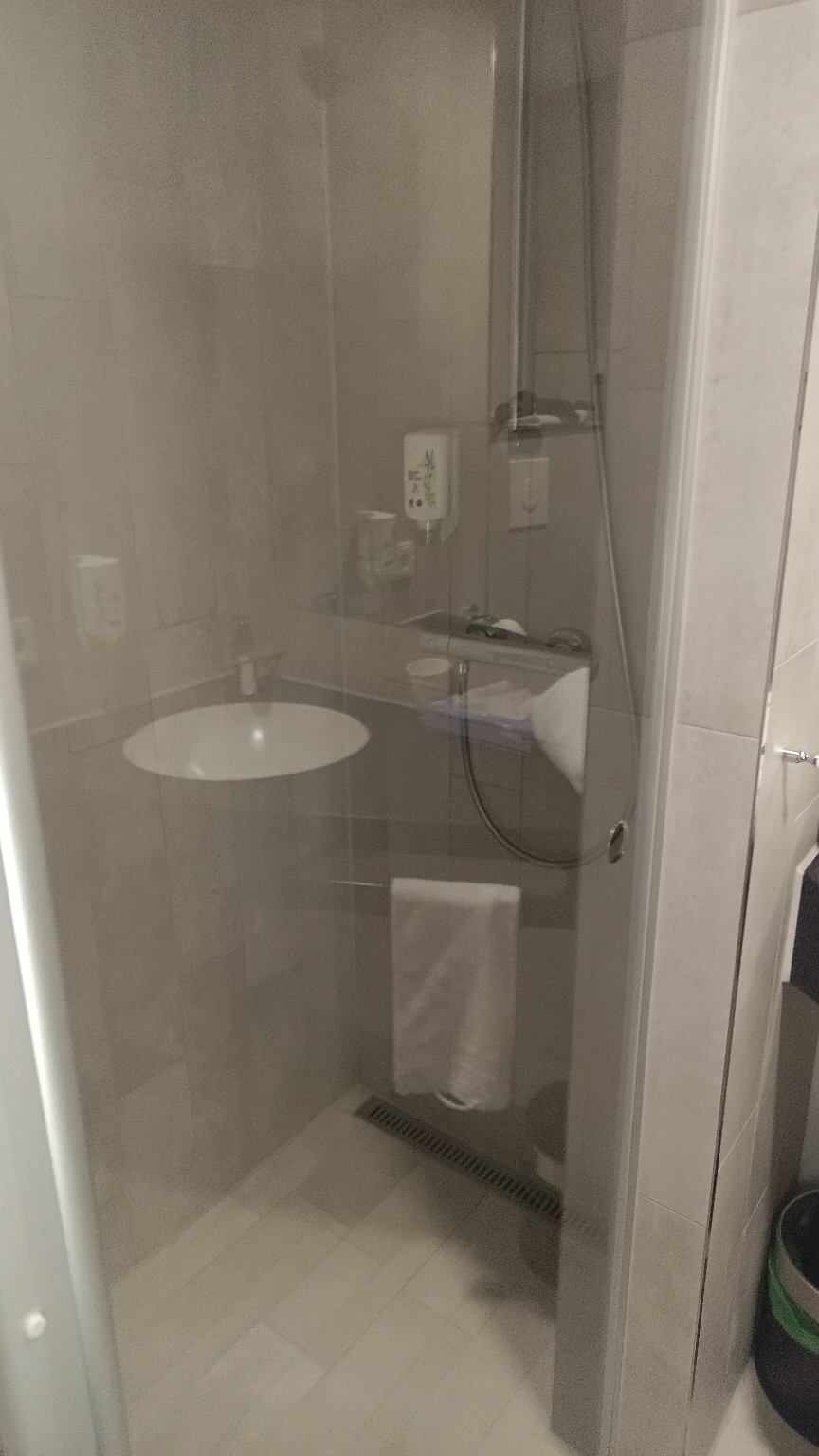
The room became a place to sleep, shower, repack and charge everything. Reviewing photos was less successful. I had brought a laptop, but it was so slow and laggy that I gave up trying to inspect the files properly during the trip. Much of the close reviewing happened afterward.
The first buffet
After unpacking, we went out for dinner at Restaurant Sanya. There were not many people there when we arrived, but it looked fine, so we tried the buffet. We ended up visiting Sanya twice during the trip.

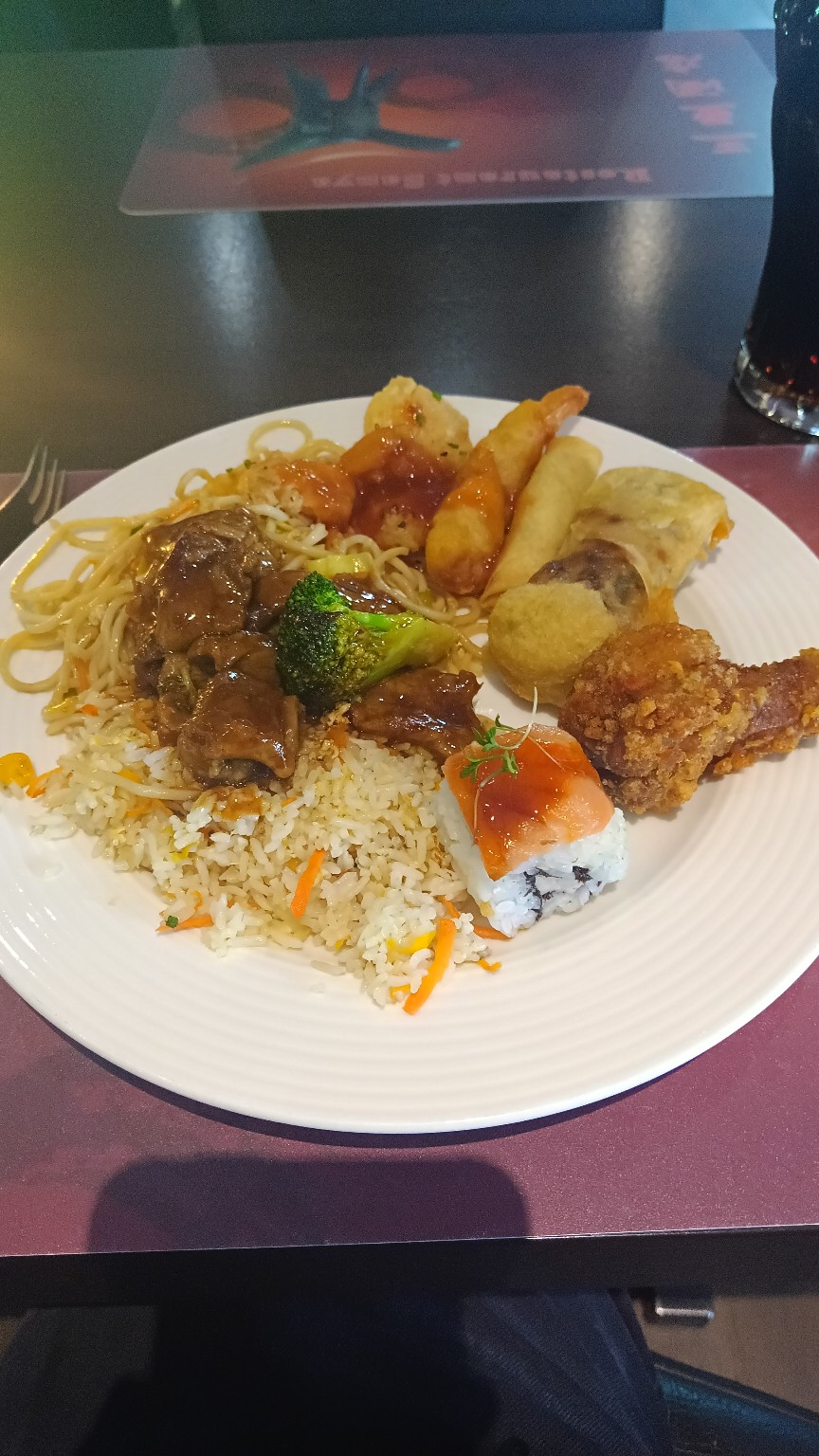
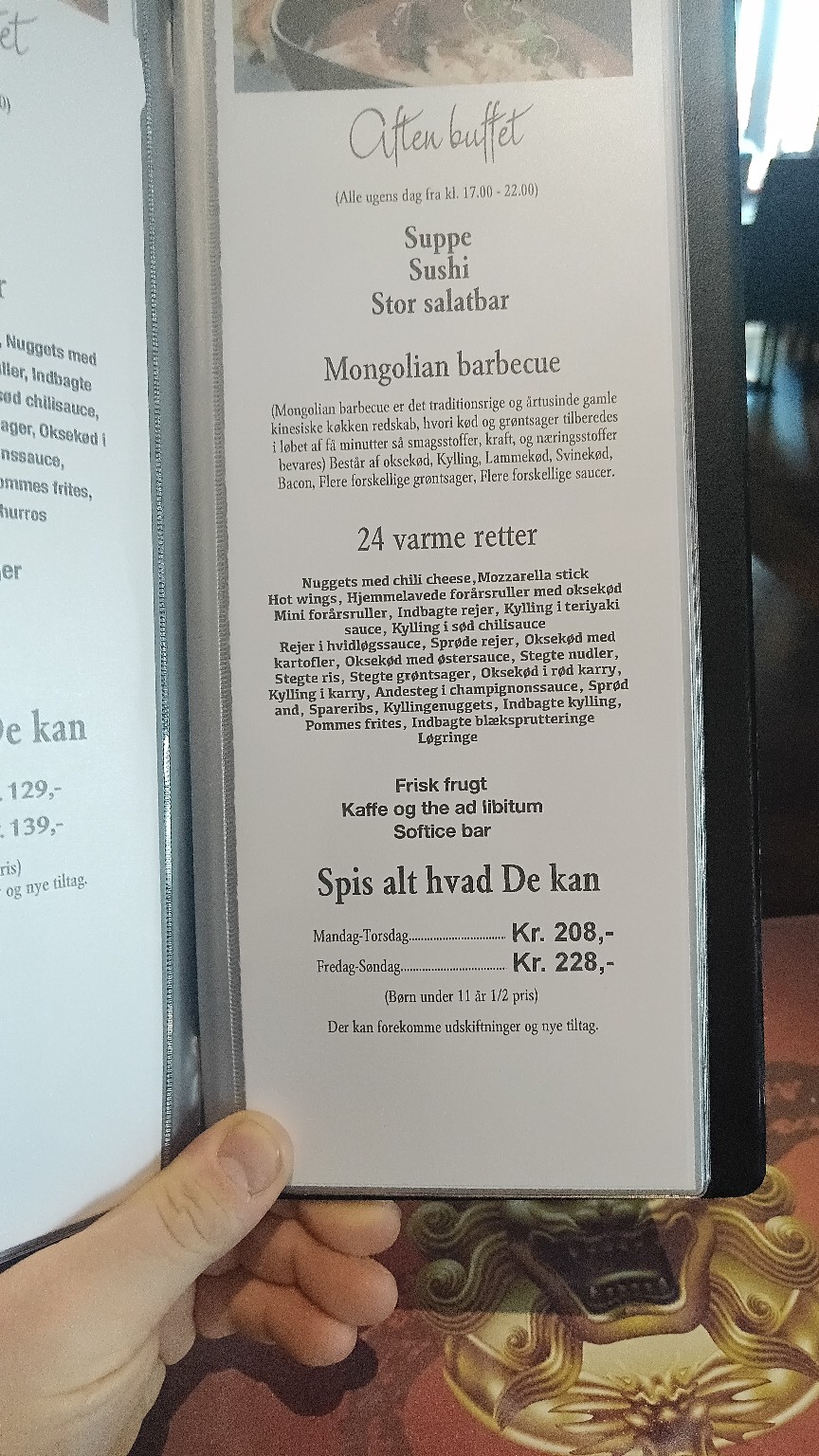
The menu I photographed listed the evening buffet at 208 DKK Monday–Thursday and 228 DKK Friday–Sunday. It included soup, sushi, salad, Mongolian barbecue, warm dishes, fruit, coffee, tea and soft serve. Those were the prices on that visit, rather than a current price guide.
I had a mixture of rice, noodles, chicken, spring rolls, sushi, meat, vegetables and prawns, with a large 75 cl cola. My buffet and drink came to around 270 DKK. The salmon and fried chicken were not dry, and the sushi was fine. For a buffet, that already put it ahead of a lot of places I have tried.
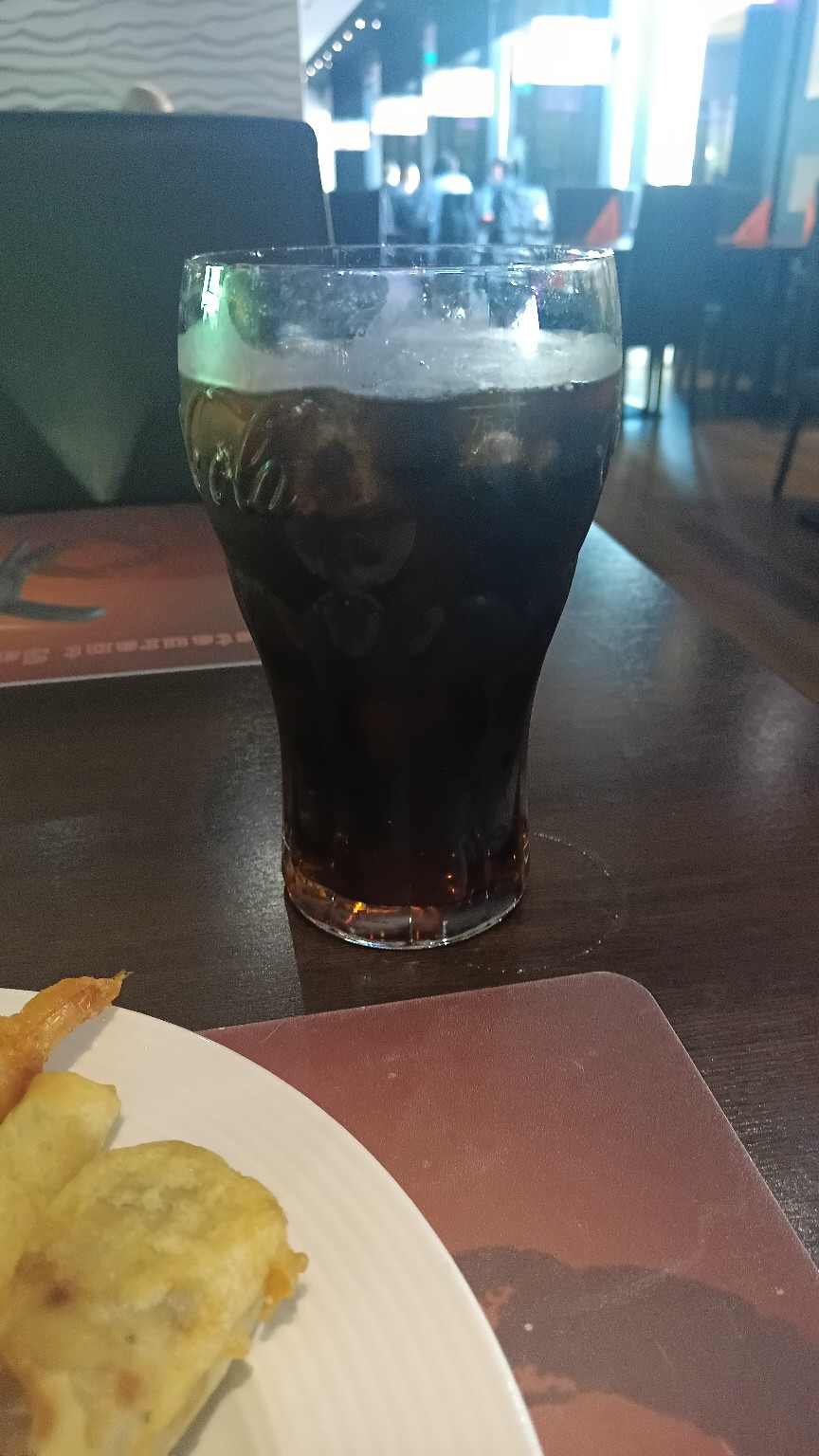
It was one of the better Chinese buffets I remember visiting. I am not pretending it was a luxury meal; it was solid food at the end of a long travel day. Then we went back to the hotel. Getting there, checking in and eating was enough for day one.
Day 2: Aalborg Zoo and a city determined to give me stairs
Breakfast, then an early walk
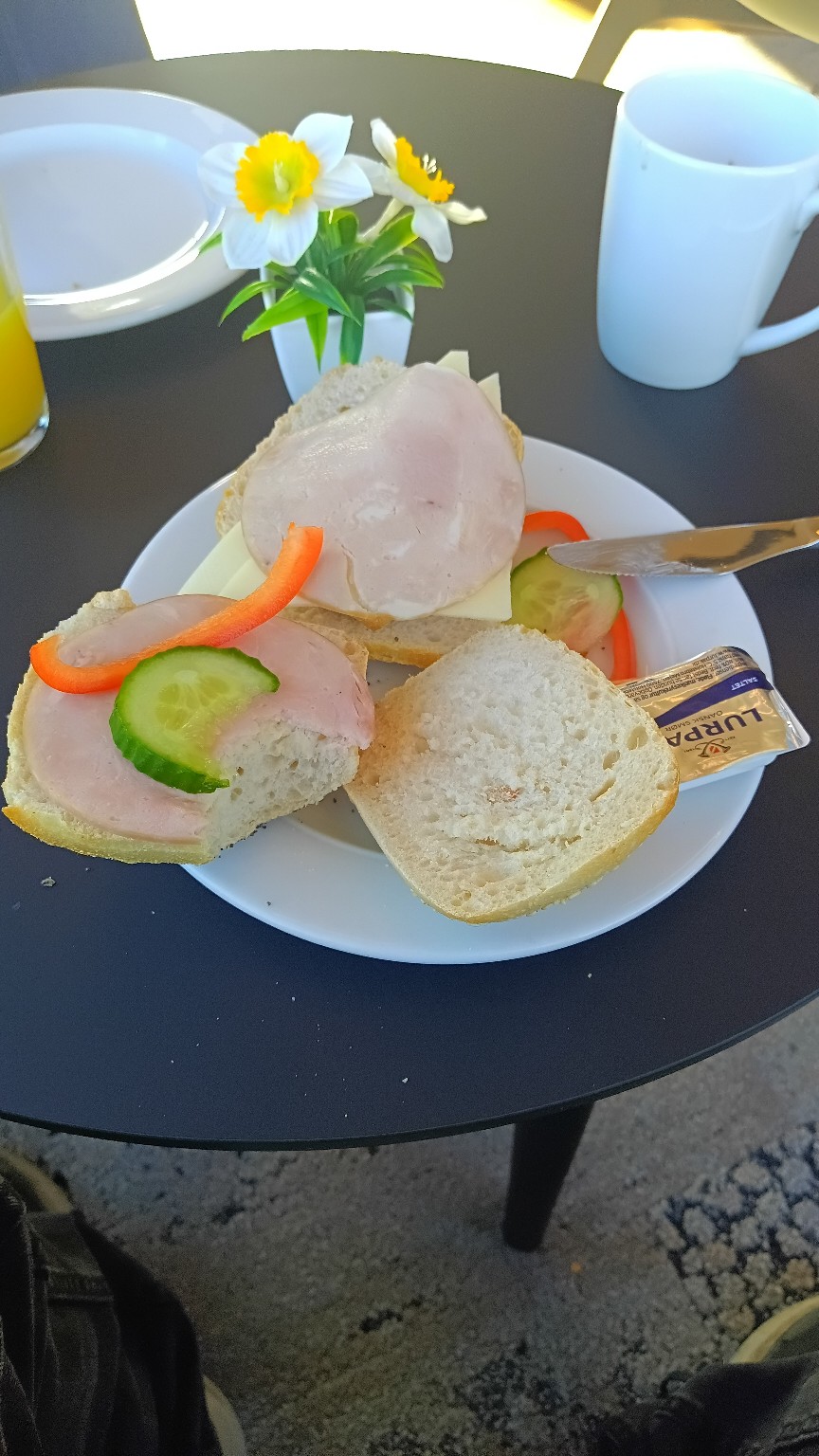
Breakfast at the hotel was simple but useful: eggs, yogurt, cake, juice, coffee and cacao. We talked about the day, and I decided to go to Aalborg Zoo while Shilka did his own thing. Spending hours with animals and a camera is easier when I can stop as long as I want without worrying that someone else is bored.
The zoo opened at 10:00 on my visit, and the walk from the station area was around 1.9 km, or roughly half an hour. The morning was cold, around 6°C, with a forecast of about 16°C later. I walked part of the way with Shilka before continuing alone. At one bridge I had to look twice because the path appeared to be for bicycles, but there was a pedestrian crossing as well.
I was early enough to explore nearby before going in. That turned into a walk through Skovdalen and the Skovrock area, photographing the empty outdoor stage and stepped seating. Morning sun and tree shadows were cutting across the stone. I tried different exposures, climbed up for a view back down toward the stage, and photographed a cartoon-dog graffiti detail that reminded me of Goofy.
I continued up to Aalborgtårnet and took both a tight upward view of the tower and a wider version with the neighbouring building. One showed the structure more dramatically; the other helped me remember the place around it.
Nearby, I photographed a statue from several angles and also photographed its plaque. My notes recorded Hunner med kineserpige, Carl Johan Bonnesen, 1935. Taking the plaque photo was the useful part for later sorting. I should do that more often with animal signs too, instead of coming home with hundreds of photos and trying to remember every name.
What I was carrying
The main camera was my Nikon D7500. I had the 200–500mm f/5.6, 70–200mm f/2.8 and 18–55mm kit lens, GPS, three batteries, the charger, two power banks and the usual smaller things in the bag.
I estimated the bag at around 6–8 kg, depending on what was in it. That was an estimate, not a weigh-in. The old iron tripod added its own contribution. I had bought it used for around 400 DKK, and the head was a little loose where it attached, even though the locks worked. I would like to improve that part eventually.
I carry the tripod along the bag, secured with the straps so it hangs near my leg. I am used to carrying gear, but that does not make it weightless. Most of my normal photography is walking, seeing something, taking a shot and moving on. I sometimes wonder why I bring the tripod when I use it so little. This day it did get some use, particularly around the birds and pond with the long lens.
Back at Aalborg Zoo after many years
The zoo visit was on 21 April 2026. I had not been there since around 2008 or earlier, as far as I could remember. It felt smaller than the place in my head. That might say more about my memory, or about spending much more time at Copenhagen Zoo since then, than about Aalborg Zoo itself.
I started the animal photos with the 200–500mm. The pond and flamingos took a lot of my attention. I tried resting poses, head details, curved necks, feeding birds and reflections. I took many variations, probably spending longer there than I expected.
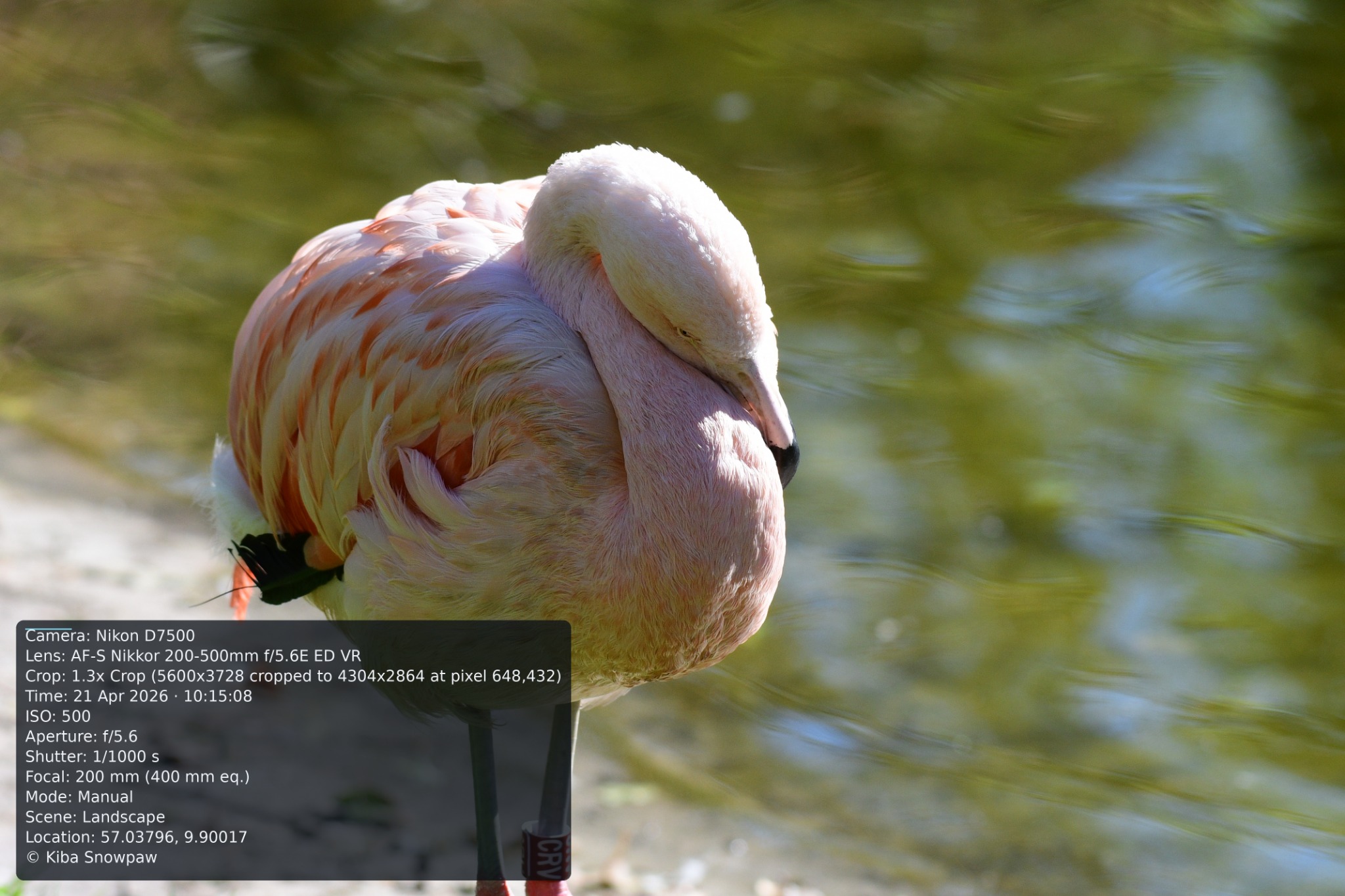

The light kept fighting me. Pale flamingo feathers were bright in the sun, while the ducks on the same water were much darker. A setting that looked sensible for one could look wrong for the other. The same problem returned with black fur, pale animals, black-and-white markings, reflective water and deep enclosure shadows.
I shoot in manual mode and, on this trip, was choosing ISO myself. My usual method is a quick look at the camera screen, an adjustment if needed, another shot and then moving on. I have the histogram turned on, but I am still not comfortable reading it. I mostly judge the result by eye. That is a description of how I worked, not a claim that my method is the best one.
Some pictures still looked soft to me even with a fast shutter speed. That was frustrating because I felt I had already dealt with movement. I could not tell for every frame whether it was focus, a narrow sharp area, the enclosure barrier, movement, camera shake or just my expectations when looking closely afterward. I am keeping that uncertainty rather than pretending I found one explanation for the whole set.
Even on the tripod, I could see a little movement through the viewfinder when the shutter fired. Between that, the loose head and the long lens, it gave me plenty to think about. Animals also have their own timing: turn the head, blink, disappear behind a branch, or move just when I press the button.
Ducklings and their security team
The ducklings were especially difficult. Tiny, fuzzy, fast, low to the water and changing direction constantly. Cute does not mean easy to photograph. One moment they were running around, then they were swimming, and the bright water or ground kept making their little faces harder to see.


When the mother and father noticed me, they came rushing down and started complaining. At least that was how it felt from my side of the camera. I was trying to take a duckling photo while the parents acted like security guards. It was funny, but it did not make the job easier.
Faces, feathers and a little lemur
I worked my way through much more than the pond: a monkey occupied with a pine cone, tapirs, resting pigs and goats, long-eared animals on the grass, dark birds, a hippo-like animal eating, ostriches, zebras, giraffes and pale horned animals. Some gave me a clearer eye or a useful moment of behaviour; others stayed awkward behind fencing, shadows or a messy background.
The black monkey was a good example of the exposure problem. I wanted enough light to show the face, hands and fur without losing everything bright around it. The pine cone gave the photos something to be about beyond a straight portrait.


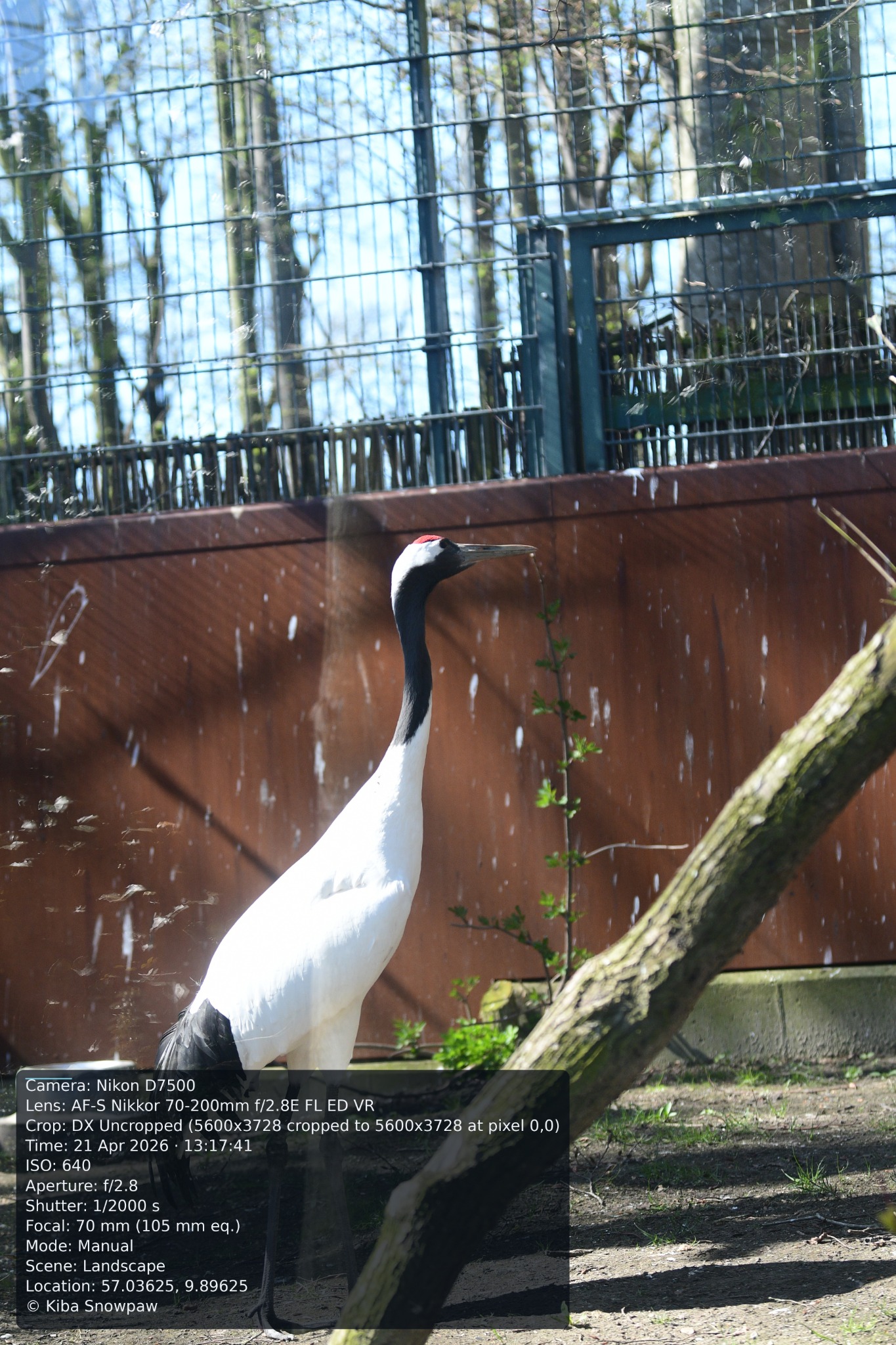
I liked the clearer giraffe view much more than the one with a barrier dominating the foreground. The ostrich had that rush of black-and-white feathers, the meerkat stood upright on its rock, and later there was a tiny lemur clinging behind an adult. Those were the kinds of details I wanted to bring home.


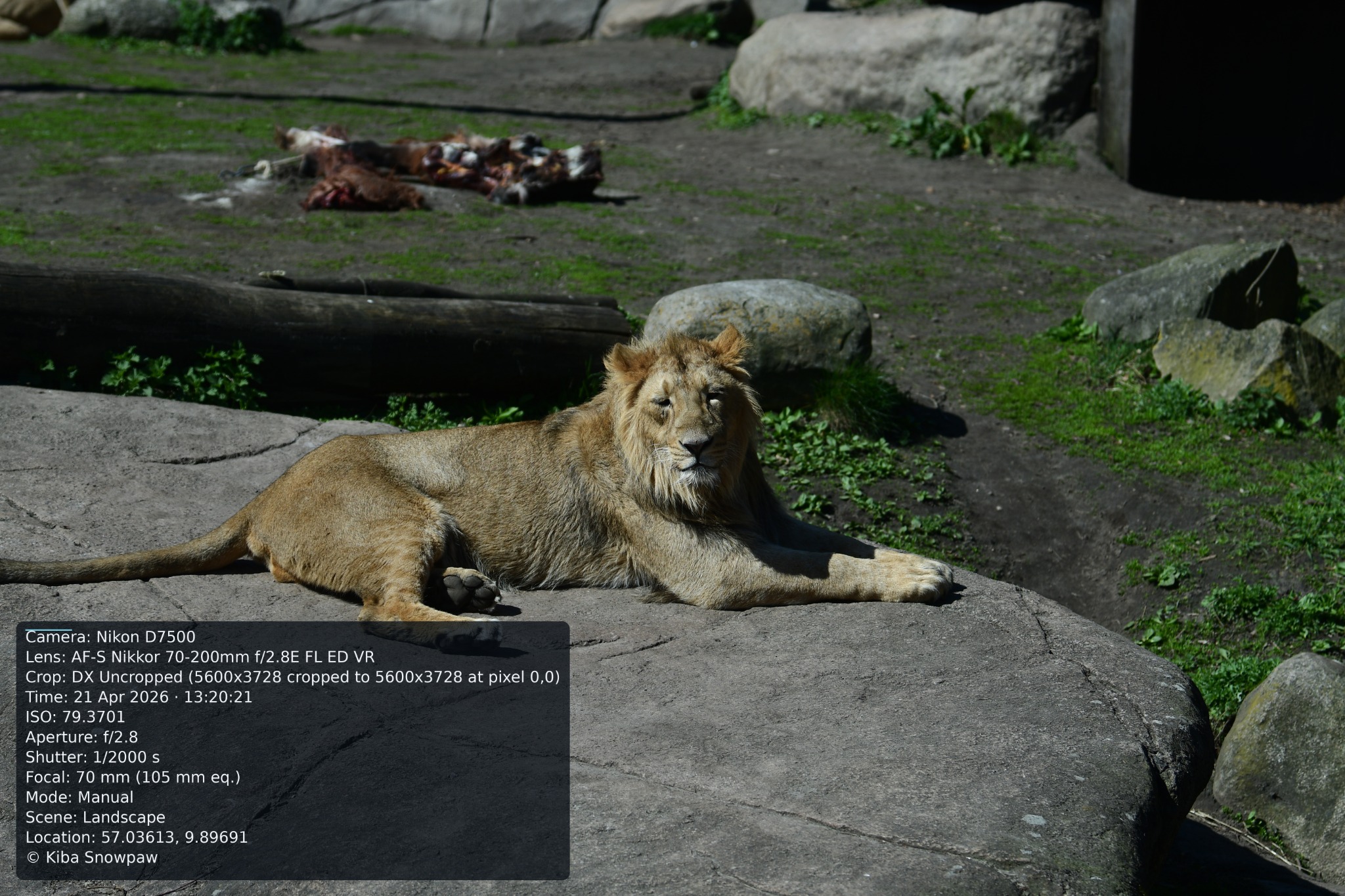
I also photographed the polar bear in the pool, the resting lion shown at the start of this post, and indoor skeleton and skull displays. Those darker displays were another change of conditions: glass, reflections and very different light from outside.


Then there were things that only looked alive. I photographed artificial flowers convincing enough to make me look twice, and the zoo’s dinosaur models supplied the obvious joke.

Yes, I was almost eaten by a dinosaur. Fortunately, this one was a model. I had enough to carry without becoming lunch myself.
Between the bigger animals, I kept noticing smaller things too: a bird spreading a wing on the ground, or an insect on a yellow flower. Those little pauses belong to the day just as much as the lion and the giraffes.


Later I switched to the 70–200mm and handheld shooting. The big lens is useful, but after hours of carrying it I felt the weight. The shorter lens was easier to react with as I moved around. The metadata in the photos records both lenses during the zoo visit, with the kit lens appearing later too.
Battery anxiety, a burger and brain freeze
For a while I thought I had forgotten the camera charger. I had three batteries, so it would not have ended the trip immediately, but it was still an annoying thought. In Zagreb I had made one battery last almost four days. I normally switch the camera off between shooting and use live view mainly for video. This time, watching a battery fall toward 25% and then 10% made me pay more attention.
After around two and a half hours inside, I needed food and a sit-down. The weather had warmed up and I was tired enough that I could almost have fallen asleep during the break. I bought a burger menu with fries and soda, plus a large slush ice. The total was 174 DKK.
The fries had grill seasoning, which I liked. The slush ice was good too, until I drank it too quickly and gave myself brain freeze. Apparently enthusiasm does not make my head immune to ice.
Before leaving, I bought a cup and a fridge magnet for 104 DKK together. From memory the split was around 64 for the cup and 40 for the magnet, but the combined amount is the useful figure. Entry had cost 211 DKK with a 15% discount. Entry, food and souvenirs therefore came to 489 DKK, before the rest of the day’s purchases.
Mølleparken, Noah’s Ark and Kridtgraven
I could have gone straight back to the hotel. Instead, I checked the places saved on my map and continued toward Mølleparken, then Noah’s Ark, then Kridtgraven. That was where the zoo day became a much longer Aalborg walk.
There were stairs. Then more stairs. By a certain point I was convinced Aalborg had decided to test every part of my knees. The bag strap was also making my arms complain. Walking with camera gear, hills, stairs and constant stops for photos feels very different from walking the same distance empty-handed at home.
I liked the green areas and the smaller things between attractions. A city made only of shops, traffic and roads gets dull for me much faster than a route with trees, water and odd little corners. At one point something sent my mind off toward the Japanese AE86 Trueno and anime, which had almost nothing to do with Aalborg. That is also how my walks go: the route stays in one city while my head wanders somewhere else.
Kridtgraven was one of the peaceful parts. There were ducks and coots, clear water in places, and people sitting by the lake. Some girls were feeding the birds. A couple on a bench were quietly reading and looking over the water, one leaning against the other. It was an ordinary scene, but it felt almost like a calm moment from a film.
Then a big fish appeared near the edge. In clearer water it seemed to have a blue-purple sheen and some red near the tail. I thought it might be a carp, but I did not have a certain identification. The coots were bothering it and seemed to nip at its tail. I had the 200–500mm on again and tried for a better view from the other side.
That was a different animal memory from the zoo: something happened in front of me, and I had to respond without knowing it would be there.
Counting down to the hotel
The tracker said 12.5 km that day. I thought it had missed some of the zoo walking, but I cannot turn that feeling into an exact extra distance. Whatever the number, the weight and stairs made it feel long.
I started counting down the route back: 2.8 km, 2.5 km, around two, then 1.1 km, then 550 metres. There was some side stitch too. Seeing the hotel finally felt like reaching a checkpoint after a long game mission.
I had taken a roughly 500-metre detour to Rema 1000 for something to drink and hand cream because my hands felt dry. I remember the cream being around 5 DKK. Later, iced tea gave me an excuse to use the zoo cup. I washed it with the bathroom soap I had available, poured the tea and finally stopped moving.
That evening we ate at Fumo Pizzeria. The pizza was good and had a decent amount of pepper. After a day like that, food and a seat were enough.
The newer 20,000 mAh power bank had also earned its place in the bag. With the phone busy running Maps, ChatGPT and, when I used it, Spotify, it still gained charge while plugged in. My older power bank struggles with that now. I estimated I had used about a quarter of the newer one’s capacity that day; that was my impression, not a battery benchmark.
Day 3: Randers Regnskov, then a much longer walk than expected
Humidity, glass and noise
The visit to Randers Regnskov was on 22 April 2026. It felt very different from the open-air zoo: plants close around me, humidity, water, indoor light and animals appearing between branches or behind glass. There was something to look at in almost every direction.
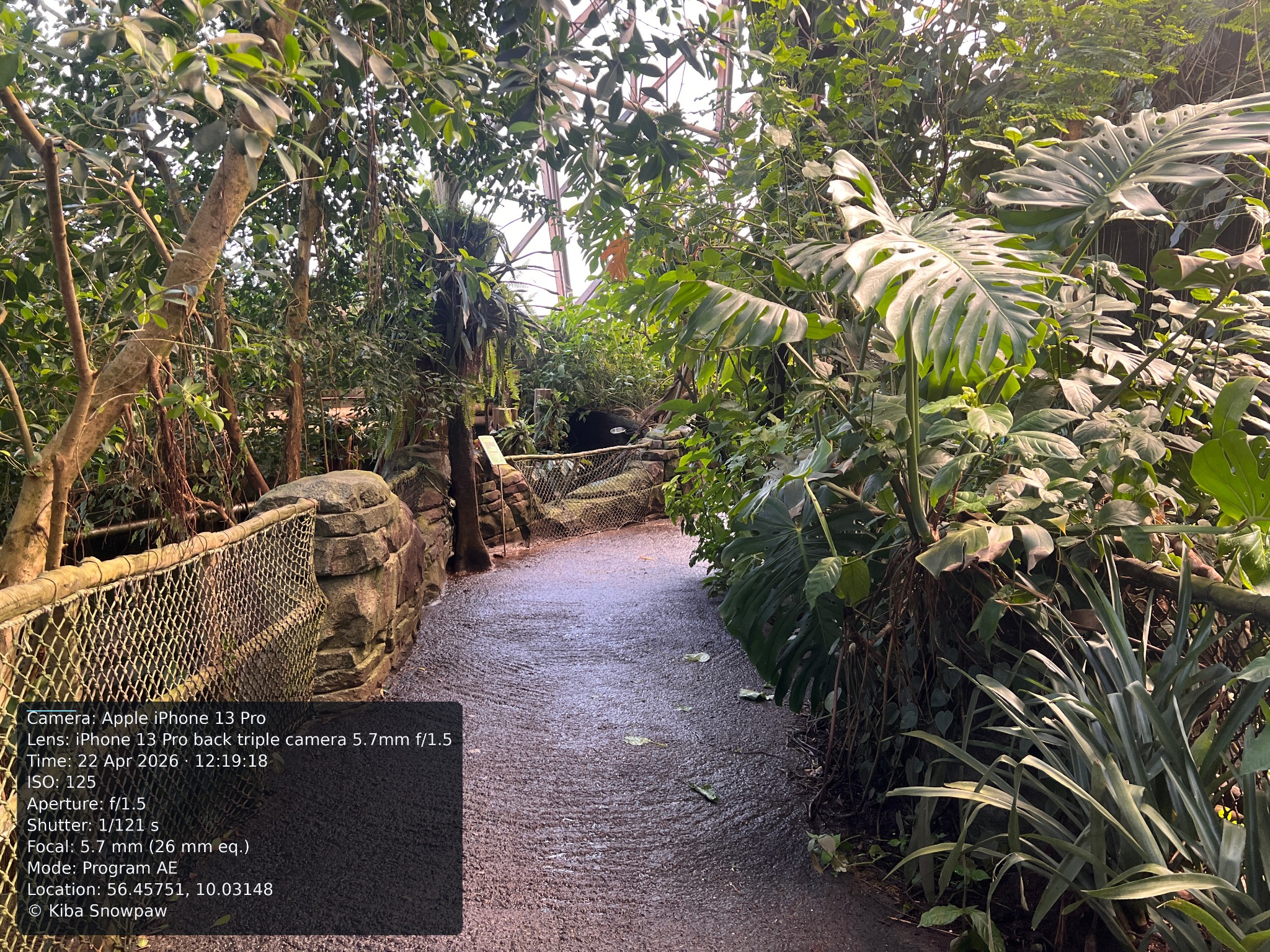
It was also difficult photography. Low light in one place, reflections in another, then water, movement, foliage and people passing through the angle I wanted. A place can look wonderful to my eyes and still be awkward for the camera.
I used both a dedicated camera and my phone during the trip. The Randers Regnskov photos selected here are from my iPhone 13 Pro. I also have separate camera photos, including an angle I worked on behind a waterfall, trying to keep the bird visible and show where the water hit the pool. These phone pictures are their own part of the day.


The aquarium gave me colours and faces to work with, and I photographed signs as well as animals. The sign photos are useful later, but a sign alone is not proof that I photographed the animal described on it. Some reptile identities were uncertain in my notes, and I would rather leave them uncertain than attach the wrong name.


The noise was the difficult part of the visit. There was a group of children, possibly a kindergarten or school group, and an adult talking loudly over them. Another adult was trying to quiet the children. To me, the loud adult voice made it worse. After a couple of hours I had a headache and wanted a quieter environment.
I still enjoyed looking around and got photos I wanted to keep. After the indoor parts, I also explored the outdoor displays and photographed the Tidsrejsen information boards. Those displays and reconstructions were interesting in their own right, separate from the live animals.


The lunch receipt


Lunch was a crispy chicken burger with fries, extra cheese and a hot drink. The receipt makes this one clearer than my remembered prices: 109 DKK for the burger and fries, 5 DKK for cheese and 20 DKK for the drink, making 134 DKK. Another burger had joined what was slowly becoming a burger tour.
Storkeengen and the train I watched go past
After Randers Regnskov, I had a look in a souvenir shop without finding anything I wanted, then started exploring near the water. That brought me to Storkeengen, with its paths, bridges, reed beds, boardwalk and information signs.
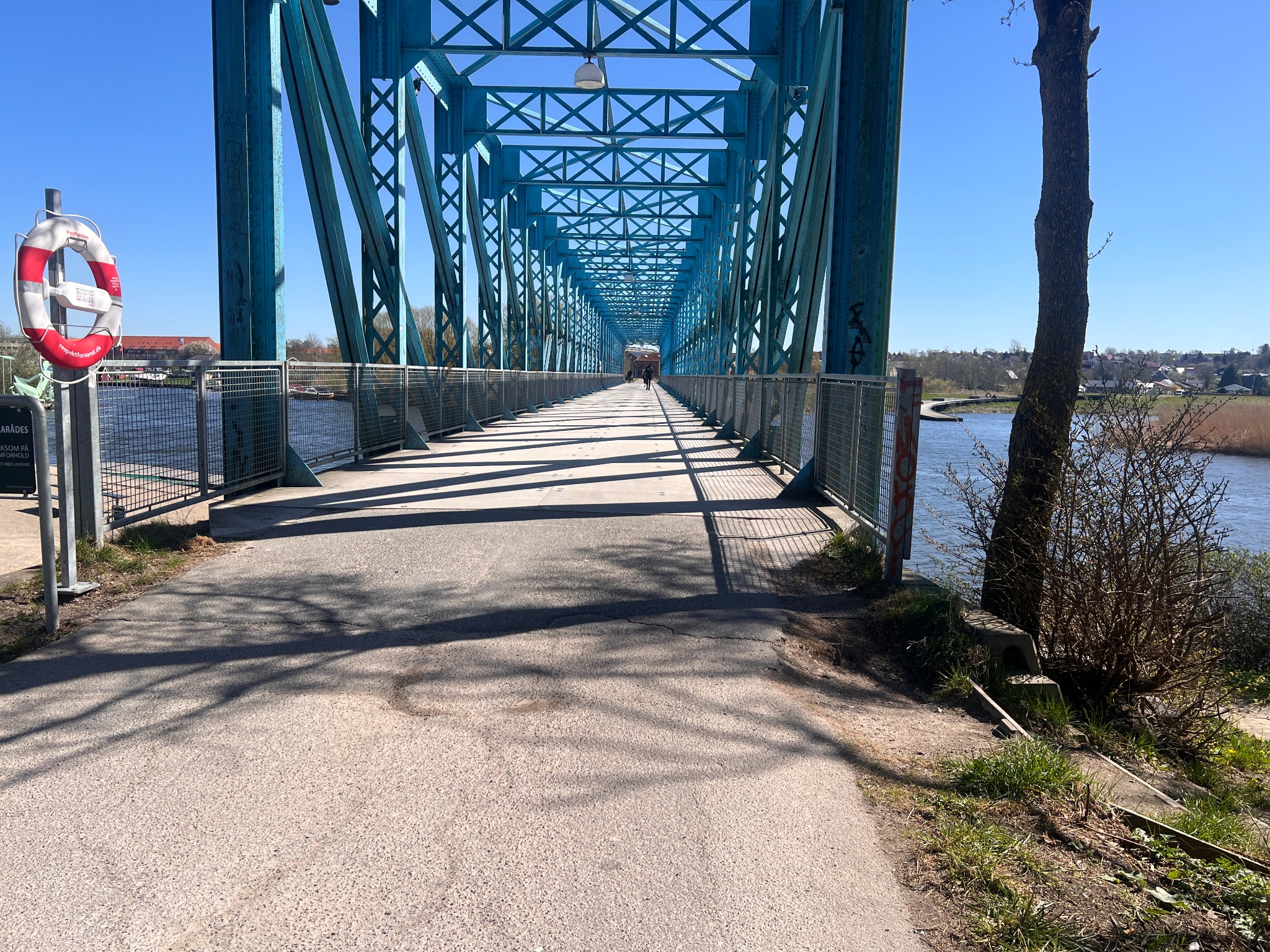
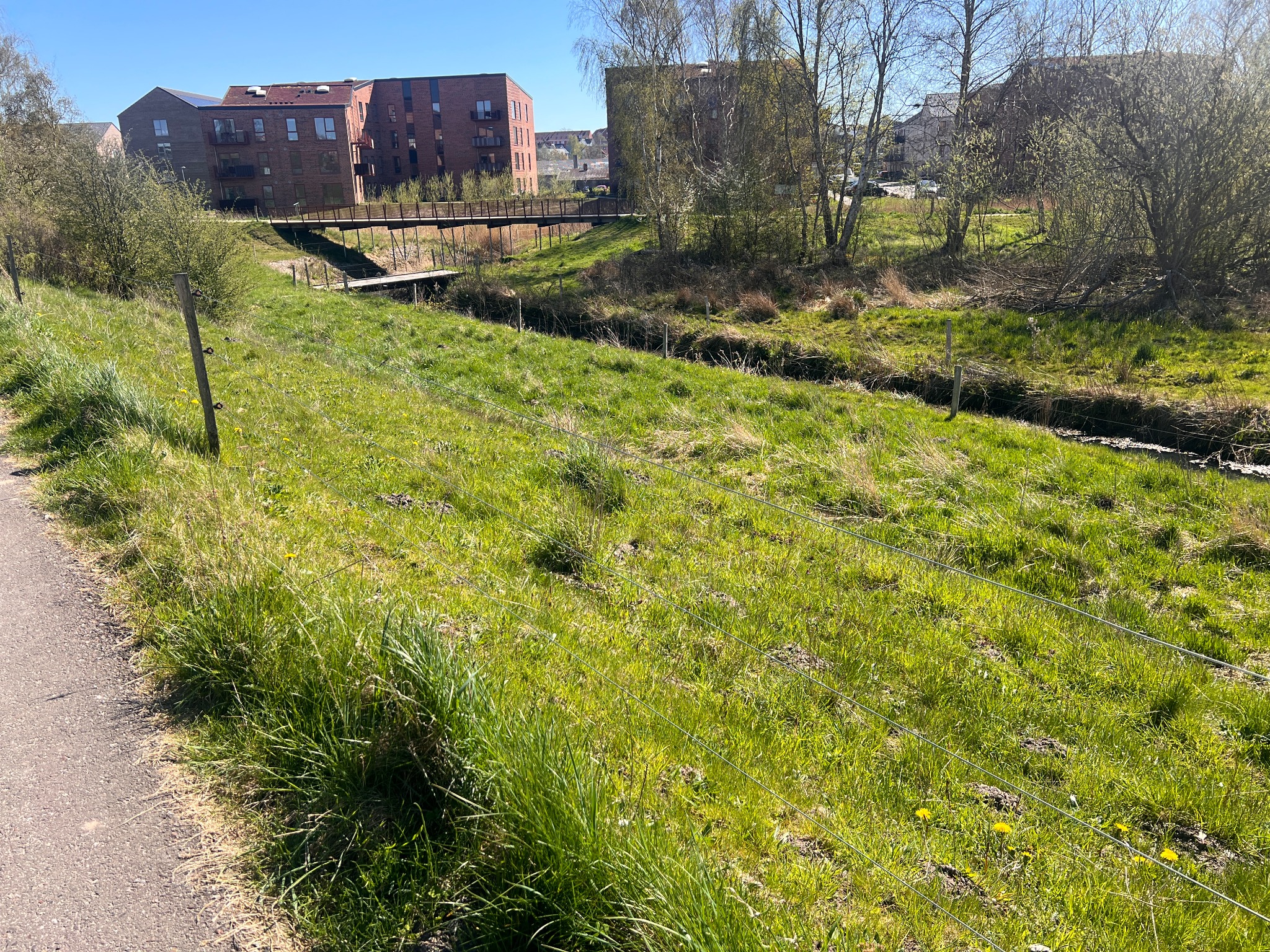

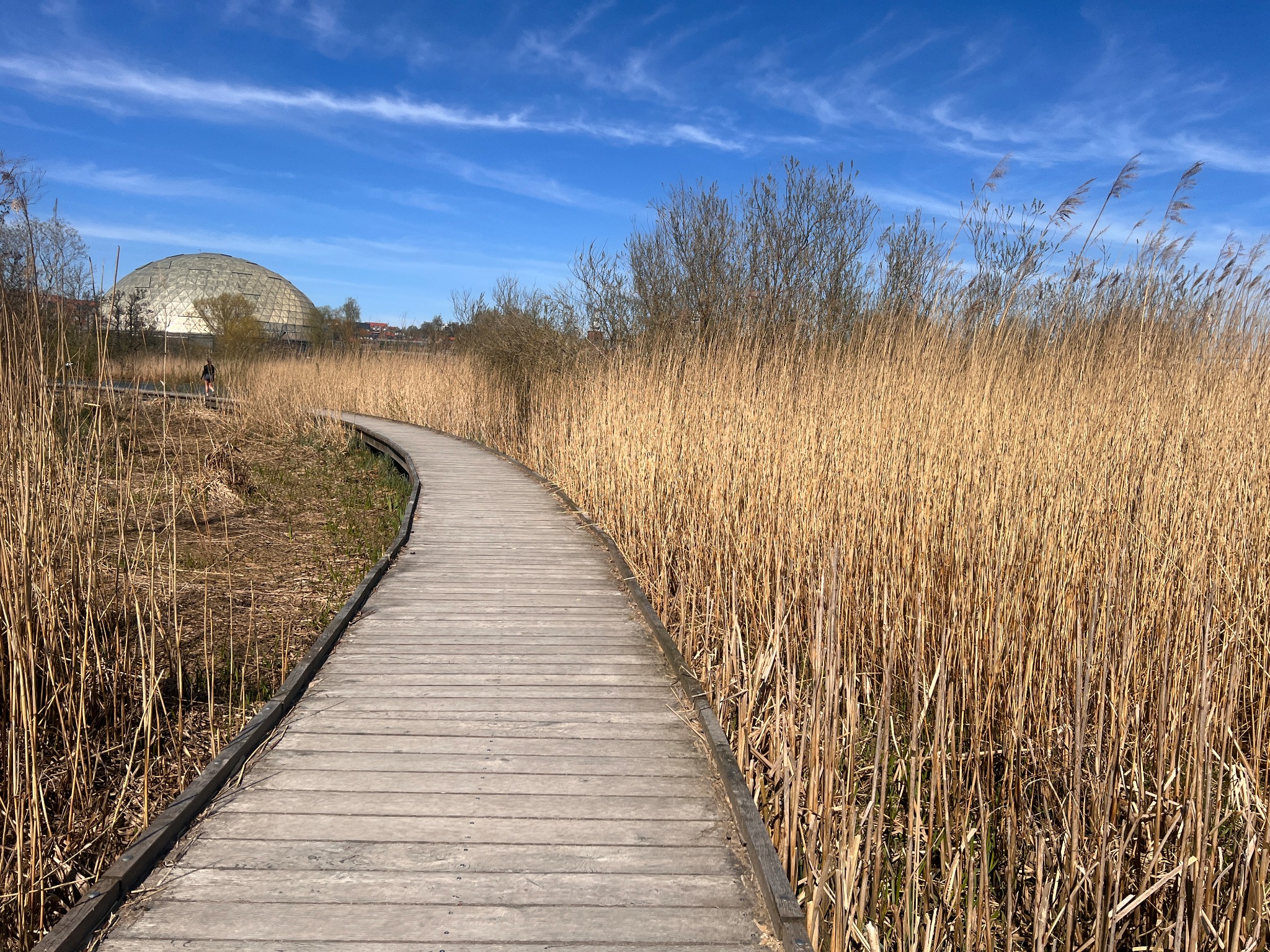
The signs described the wetland and its connection with water management, nature care and grazing animals. Some parts were fenced or closed. I kept looking for another way in rather than immediately giving up, thinking I could always turn around if it failed. Eventually I found an entrance that let me continue around.
I crossed the blue bridge, followed gravel paths and boardwalks through the reeds, and ended up at the other side of the area I had first found blocked. There were views back toward the city and the rainforest domes. It was the sort of walk where every small turn adds a little more distance.
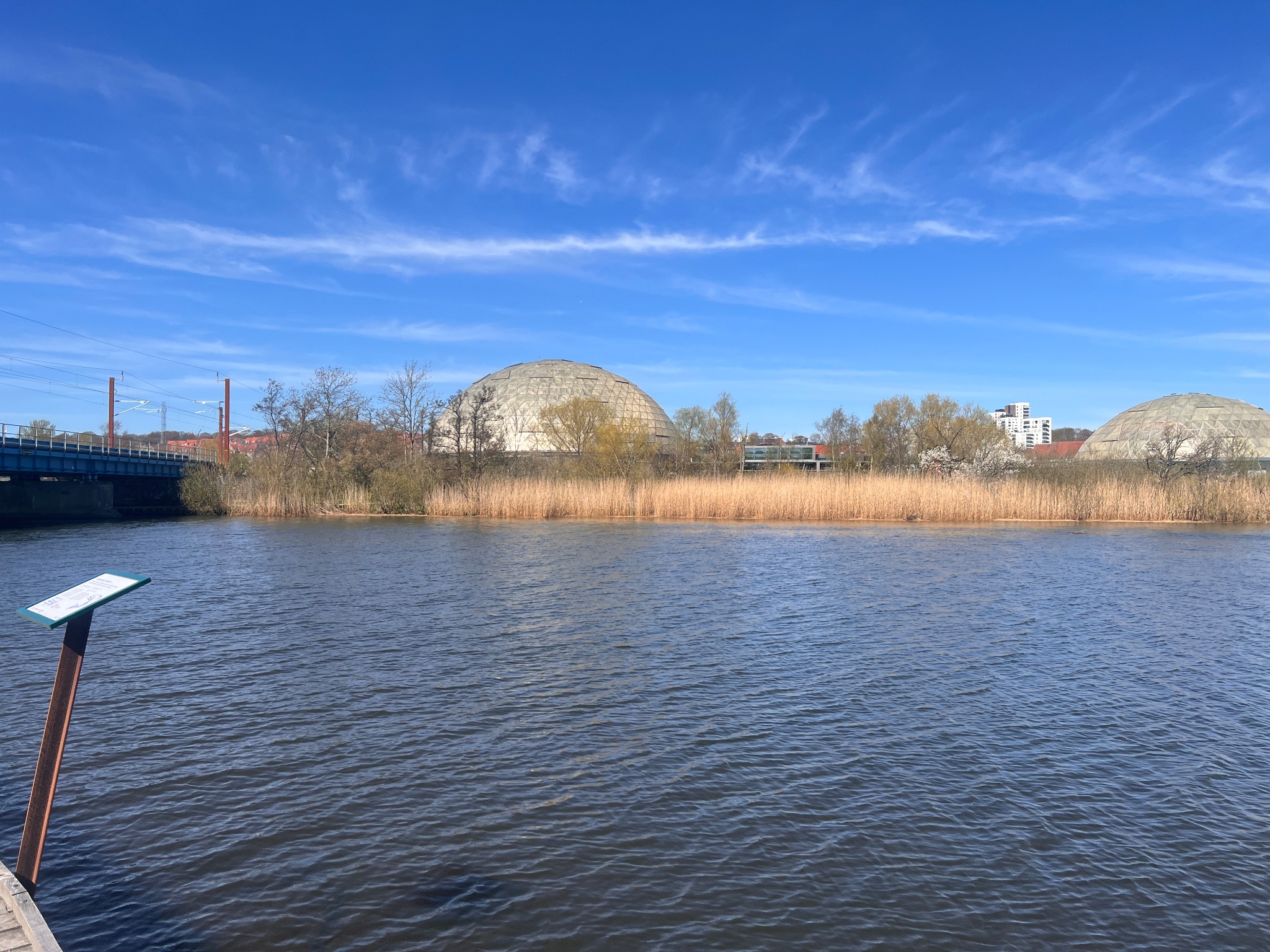
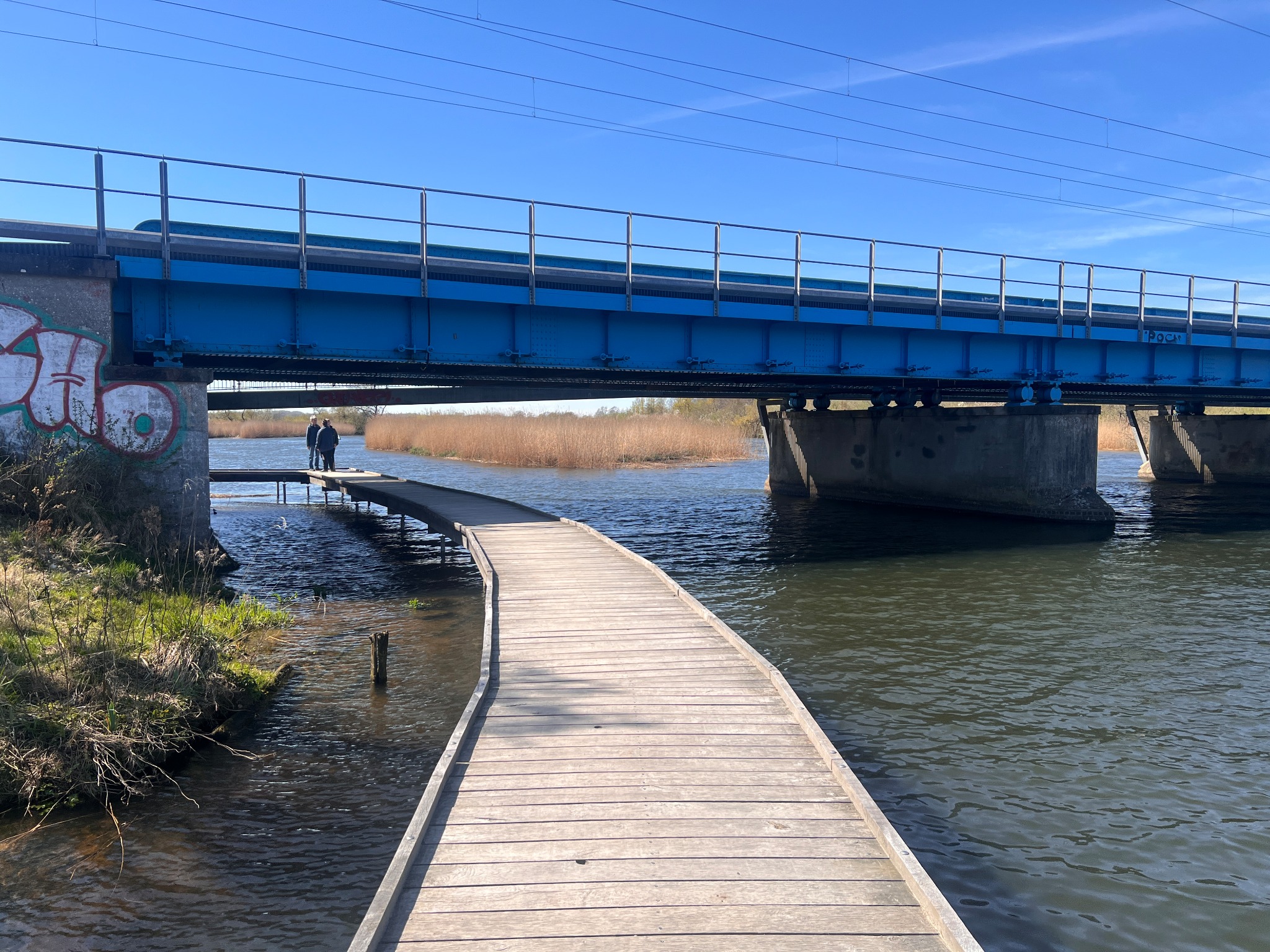
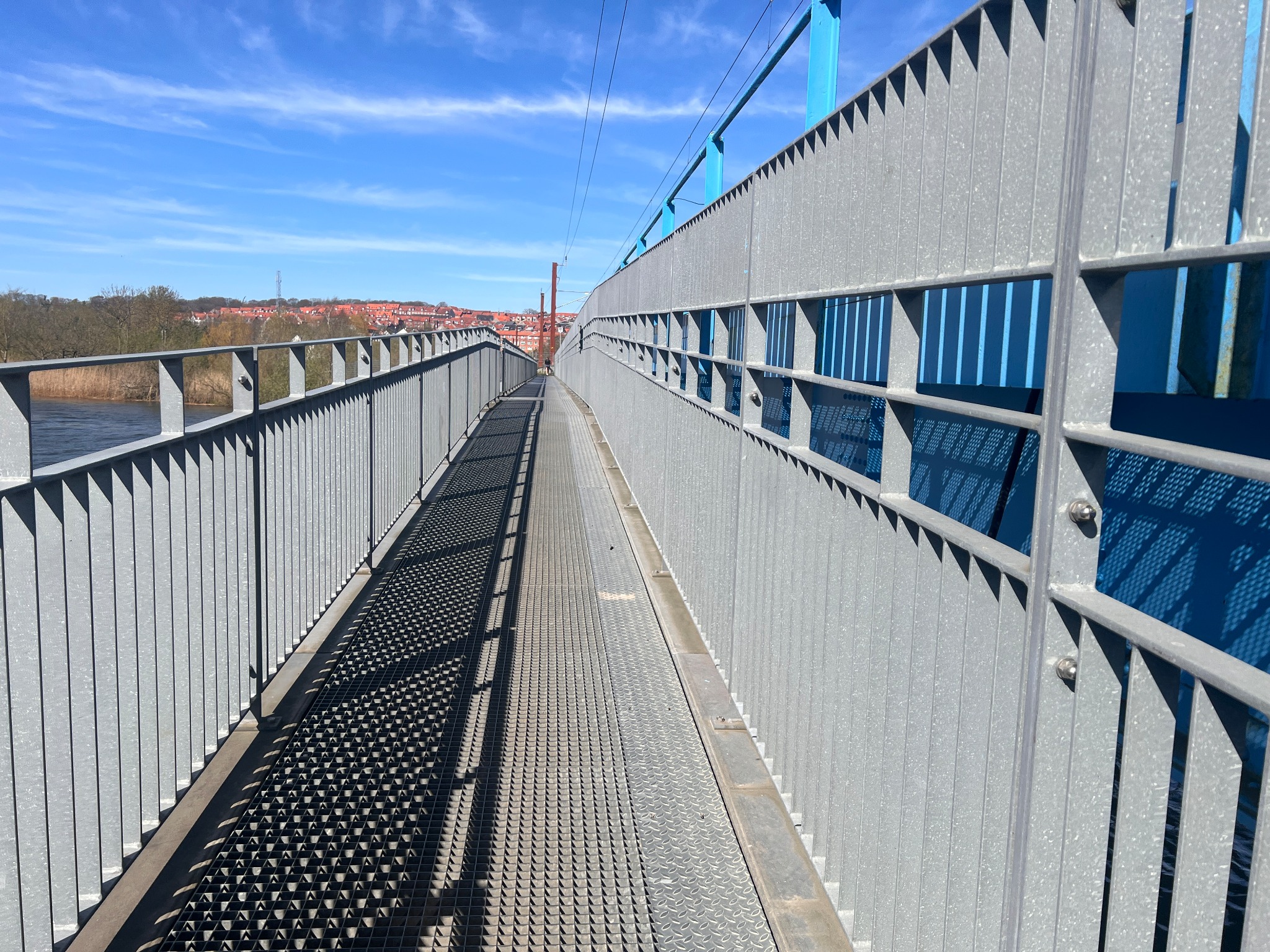
Google Maps suggested a way across from that side, which sounded better than retracing everything. I followed it under and around bridges and railway structures toward the station. Then it wanted me to use stairs again. Apparently Aalborg had shared the idea with Randers.
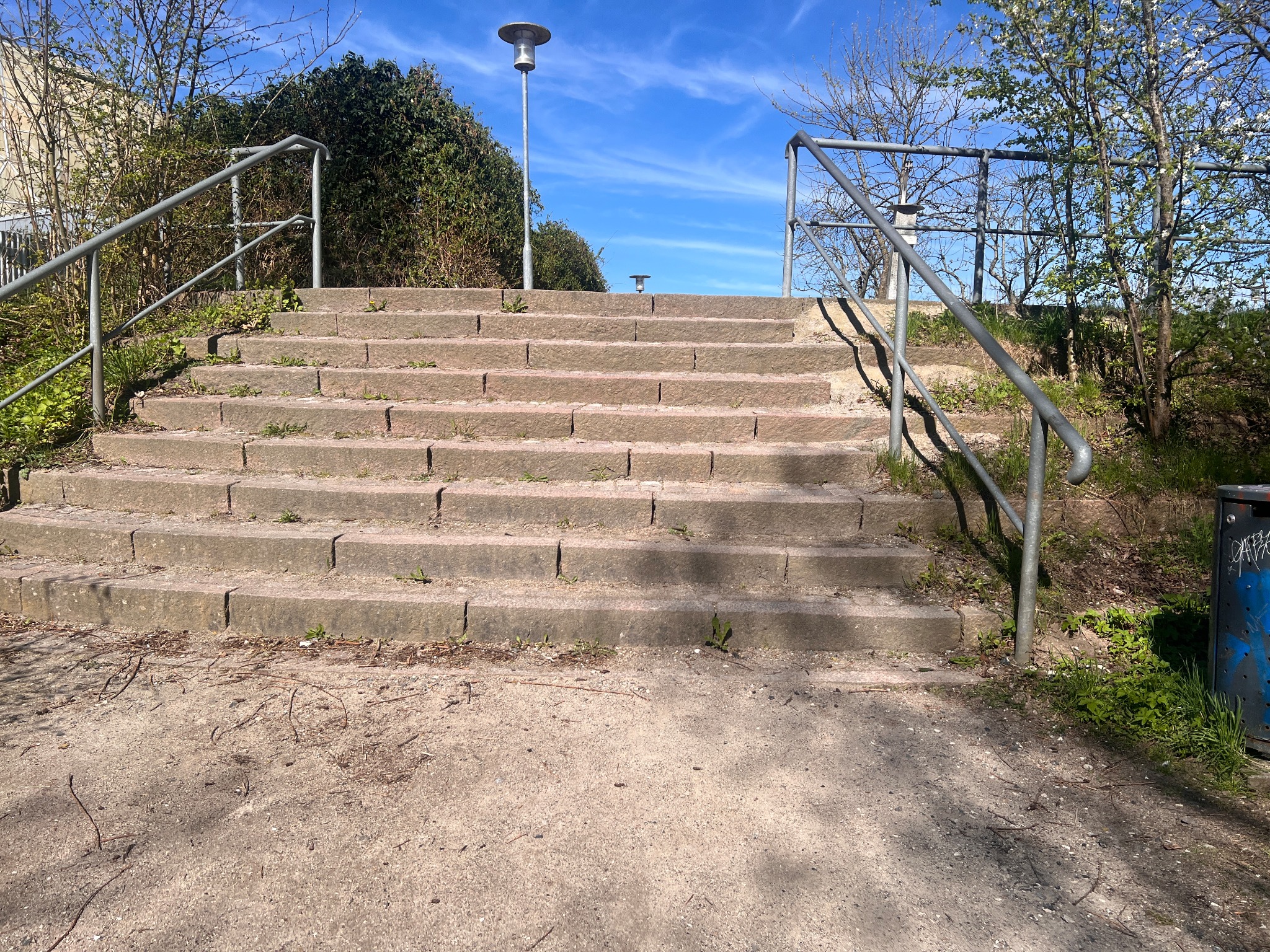
I was close enough to the railway to watch the train I wanted pass while I was still walking. That is a particularly annoying way to miss a train: I could see it, but seeing it did not help me get on it.
There were around 19 minutes until the next one. I found a toilet at the station, took a mirror photo and finally got onto the next service. The walk was worth doing, but it had become another much longer outing than “a quick look behind the rainforest.”
Route maths and green curry
While we were doing separate things, Shilka also had a transport route that annoyed me. From Viborg, I would have looked at travelling via Langå and changing onto the Aalborg train. His choice involved buses and a very tight change, and took a little over two hours. I found an option of around one hour forty in a couple of minutes, but by then he was already on his way.
That is usually why I become the route planner when we travel together. I compare the waiting time and the connections; he sometimes takes the first thing moving. He got a look at more of outlying Jutland than he had probably intended. It was a travel-style difference, rather than a reason to spend the trip arguing.
Another food stop was Esaan | A Thai in Randers. I had expected more of a restaurant from the Maps listing, but to me it felt like a takeaway with a few seats. The surroundings disappointed me; the food did not.
I ordered number 5, green curry with rice, at medium heat. That was right for me: enough spice to notice while still tasting the coconut milk, meat and vegetables. It was not visibly very green, but I liked the flavour much more than the watered-down curry I have had at some other places.
The small drink was the complaint. Around 28–29 DKK for a 33 cl can felt expensive, especially in a place with such basic seating. My view was fairly simple: good curry, disappointing setting and a drink price I did not like.
The Netto review
I also had an irritating experience at a Netto during the trip. I had picked up a bit of plastic or tape and tried to hand it to an employee through a slightly opened staff-area door. From my point of view, I was getting someone’s attention, rather than trying to enter the back room.
I did not like the way the person I understood to be in charge spoke to me. Having worked at Netto for more than eight years, I could not help comparing it with how I would respond to a customer trying to hand something over.
I wrote a Google Maps review. It was initially removed or flagged, but my appeal was accepted about two days later and I was told it could be posted again. I was pleased that the appeal had been considered. It was one more small annoyance alongside the walking and transport, rather than the main memory I wanted from Randers.
Day 4: Frederikshavn finds and a fish burger on the train
Eighteen little cookbooks
We took the train to Frederikshavn and went through secondhand shops, or genbrug. That is something I like doing in another town. I do not know whether I will find nothing, something useful, or an old thing I never realised I wanted.
This time it was little Lotte Haveman “Bogen om …” cookbooks. I found six first, then another twelve, making 18 books. They covered potatoes, vegetables, red beef, lamb, cakes, salads, grilling and campfire food, herring, winter food and other topics. I already owned some at home and thought the full series might be around 25, although I had not confirmed that number.
At 2 DKK each, they were hard to leave behind. Later, the duplicate checking began. Potatoes and vegetables were repeats, and the lamb books were more confusing because the covers looked different. Comparing titles, page layouts, years and ISBNs showed that some were the same book despite the different look. I had managed to collect multiple copies of lamb.
It was a typical secondhand-shopping mistake, but not an expensive one. Eighteen books at two kroner each made 36 DKK before any other finds.
The surprising part was how they changed the bag. It was already heavy with camera gear. I put twelve books flat in the bottom and it felt more stable against my back. Heavier, yes, but less awkward because the contents had a firmer base and shifted less.
Shilka had his own successful hunt: Blu-rays. At one point it sounded as though he had been swallowed by a shop full of them. He bought enough that going back to the hotel made more sense than carrying on, and he was too tired for the war museum he had considered. I still wanted to reach Skagen, so we went our separate ways again.
Fisk & Grill exceeded the brief
Before continuing, I wanted food I could take onto the train. Fisk & Grill was practical, and the Fish Burger Deluxe caught my attention. It was 99 DKK alone or 119 DKK as a menu with fries and a half-litre cola. I ordered the menu.
There were about four people before me and I waited roughly twenty minutes. That did not feel unreasonable. What arrived was much larger than I expected: a big burger, a generous portion of fries and three little packets of mayonnaise.
At first I thought it was fish fillet, shrimp and salad. Then I found the salmon. There was also red onion, tomato, cucumber, green asparagus, plenty of white asparagus and cocktail dressing. It was a fish meal that had somehow been squeezed between bread.
The burger came in a foam box inside a thermal bag like the ones used for roast chicken. The fries were separate. I initially thought the little cardboard holder had two mayo packets, then discovered the third. Finally, a place that had not decided one tiny packet should last through a whole meal.
I ate some fries first and nearly filled myself up before starting the burger. I meant to save more of it until Skagen, but ended up eating most on the train. There was no tidy way to hold and bite it. I used my fingers and made a project of it, although a knife and fork would probably have been the sensible approach.
I got through around ninety percent of the burger and still had fries left. It stayed with me for hours. For 119 DKK, with the fish, salmon, shrimp, fries, cola and mayo, it felt like good value. It was easily the most memorable meal of the trip and one of the biggest burgers I have had.
Skagen: the sea, small finds and a museum missed by 22 minutes
Distances look shorter from the beach
Once in Skagen, I walked down to the water and followed the beach toward the lighthouse and bunker area. Wide sand, clear water, blue sky, dunes, ships on the horizon and the lighthouse far ahead: it was the part of the day that felt properly open after stations and shops.
The lighthouse looked as if it was just over there. Walking through sand while stopping for pictures turns “just over there” into a much longer journey. I think that stretch took around an hour and a half, including all the stops.
I liked the wind, the water and the space. A wave crashing over an algae-covered rock gave me one of the water photos I particularly liked afterward. Catching the splash made it more interesting to me than simply pointing at a calm sea.
A beach treasure hunt
The walk became a search for little things as much as a route to somewhere. I found cuttlefish bones, pieces of razor-clam shell, other broken ribbed shells, oyster shells and eventually a more complete razor-clam shell. After smaller or broken cuttlefish bones, finding a larger whole one was satisfying.
There were also transparent, capsule-like remains that I could not confidently identify, and long dark fuzzy things that looked like marine worms. I left the uncertain identifications uncertain. Not everything unusual on the beach needs a confident name for it to be interesting.
Every stop for a shell, a pattern in the sand or a photo of the water quietly added time. That was why the walk mattered, but also why I was later than I expected.
At a stream outlet, brownish water cut across the sand into the sea. A sign discouraged bathing there. The surface could look calm, but I did not feel like trusting it or testing it. I could not judge the current from a photograph; I just saw the warning and kept walking.
The lighthouse, slush ice and the limit of my legs
By the lighthouse area I was already tired. I thought about continuing to Grenen, but I did not make it to the point where the two seas meet. I had walked enough that my body was starting to disagree with the next idea.
I bought a slush ice near the lighthouse, blue at the top and red below. Cold, sugary beach-kiosk fuel. It fit the moment very well.
The closed museum and the bunkers that were still there
I wanted to visit Skagen Bunkermuseum. From where I was, it was about another 900 metres. When I arrived at around 15:22, the posted April–May hours said 11:00–15:00. The adult price on the sign was 60 DKK, but I did not pay it because the museum was closed.
Missing it by about twenty-two minutes was more irritating than being hours late. I had nearly made it, and all those stops along the beach had added up. For a moment I thought I should just head back. Then I decided that, since I was there, I might as well explore the bunkers outside.
I spent about another hour looking around and taking photos. Big concrete structures stood beside the water or half-buried in the dunes. Inside some were sand-covered floors, rusty door frames, dark spaces, graffiti, old paint and small openings in the walls.
The Skagen Batteri information board explained the wartime coastal-defence background and how changes to the coast had exposed structures that were once farther inland. Seeing that alongside the sand-filled rooms made the place more interesting than just finding random concrete on a beach.
It reminded me of Blåvand: sea, dunes, wind and old bunkers. These were heavy, ugly structures, but they had a strong presence in the landscape. I liked photographing them more than I expected when I first realised the museum was closed.
I also found the Oscar Reutersvärd chain monument. My notes recorded the line “Vor forankring til jorden sprænges, når himlen kalder os hjem” — about our anchoring to the earth breaking when heaven calls us home. A chain and that thought were memorable details in a place full of heavy things being surrounded by moving sand and water.
A sign about the old Skagen Airport landing strip added another piece of the area’s past. It was strange to imagine aircraft arriving near a place I was now experiencing as beach, dunes and walking paths.
There was also the less poetic matter of finding a toilet. Near Sønderstrand and Vippefyret, the regular toilets seemed closed and the accessible one had an ÅBEN sign. I used the one that was open. That was an uncomplicated decision.
The long route back
Around 16:00 I started back toward the station. There were about 3.3 km left and no useful bus for that stretch. The return was along the road, which was much less interesting than the beach. By then I mostly wanted to reach the train.
I made the 17:00 train from Skagen toward Frederikshavn. From there I changed onto bus 973X toward Aalborg. My notes had the bus leaving at around 17:47 instead of 17:45 and reaching Aalborg Station, at John F. Kennedys Plads, around 18:55. Those are the timings from my journey, not a timetable for planning another one.
The tracker showed 25,200 steps and 16.67 km, along with 312 active minutes. I treat those as tracker readings rather than exact measurements, but they explained why I felt finished.
On the bus I had a slight headache and some neck tension, and I was much thirstier than hungry. The enormous fish burger was still doing its work. Shilka wanted to meet for food at Sunset Boulevard or somewhere similar; I was thinking more about a cold drink, perhaps refills, and getting back to the hotel. I did not want to force down another meal just because it was dinner time.
Several days of walking had caught up with me. Most days felt somewhere around 13–17 km, although I did not have equally reliable records for all of them. Add camera gear, sand, stairs and constantly figuring out the next route, and it feels like more than a familiar walk at home.
Day 5: a lighter bag and a quieter Aalborg day
Rebild could wait
I had considered Rebild, Rold Skov and the Skørping area. My map had enough marked places around there, Gravlev, Rold and Arden to turn another casual idea into a walk of thirteen to twenty kilometres.
After Skagen, I dropped it. I wanted to use the trip, but I had reached the point where another big walking day would mostly be stubbornness. Rebild would still be there for another visit.
I emptied out the bag and made the final Aalborg day lighter, using my phone for photos if I needed it. I visited some of the secondhand shops Shilka had found, but did not come away with another pile of finds.
Bogø and the price of a spoonful of mayo
Around 13:50 I stopped at Bogø in Aalborg Storcenter for a Deluxe Crispy Chicken menu. It was a chilli-cheese bagel-style burger with crispy chicken, salad and dressing, plus fries and a half-litre Pepsi.
The receipt showed 109 DKK for the menu and 4 DKK for mayonnaise, making 113 DKK. It was decent shopping-centre food. More manageable than the fish burger, although much less memorable.
The mayo packet was 17 grams. Four kroner does not look like much until I calculate it as around 235 DKK per kilo. I know tiny portions come with a markup, but after the three packets in Frederikshavn it still felt stingy. Apparently mayonnaise had become a serious category in my holiday reviews.
A game, an audiobook and the usual book tangent
One of the secondhand finds from the trip was a PC DVD copy of Of Orcs and Men for 50 DKK. The box said an internet connection was required for activation, so whether the old disc and key worked was something to check at home. If it did not, it was still a physical item for the collection.
I already knew the Styx games and did not like them much, but this looked interesting enough to try. That is part of why I like used shops: I sometimes buy something I would not have gone searching for.
I also came across The Host and bought it on Audible. It was outside my usual LitRPG and fantasy habits, which made it a slightly odd choice for me. The trip was full of those small things that appeared in front of me and sent my interests in another direction.
During the trip conversations I also ended up talking about my own books, Whispers of the Frostbound and Alpha’s Rise: Kiba Snowpaw and the Battle for the Pack. One moment I was discussing trains and food; the next it was Kiba, HowlStrom, ice magic and old published versions.
The free online versions can keep changing, while a paid edition stays at the version uploaded at that time. That is why I often prefer the online versions of my own work. My Goodreads reading challenge showed 50 of 100 books at that point, but I had listened to very little during the trip itself.
Normally I walk with headphones and an audiobook. This time I mostly left the headset at the hotel and did not miss it. Routes, animals, shops, food, trains and the places themselves gave me enough to think about. That surprised me more than buying another audiobook.
Packing up and heading home
When it was time to leave, I woke around seven and packed early. There were no drawers or fridge full of things to check, so getting the room ready was straightforward. I still had some time before we needed to leave.
I took the bedding off, folded the duvet, sheet and little decorative blanket, and gathered everything with the pillow. Housekeeping would have changed it anyway. It was probably unnecessary, but it made the room feel finished and let me check that nothing was hidden in the bedding.
The plan was to sit in the lobby for a little while, walk slowly to the station and perhaps stop at Meny for train food. I already had two half-litre iced teas from Rema. I did not particularly want another lesson in station prices.
The journey toward Copenhagen was expected to take around six hours, with a change in Aarhus. After Copenhagen I was weighing the two ends of the route home to Skibby: via Frederikssund, or via Roskilde.
My rough comparison was about 45 minutes on the C-train to Frederikssund and another 38 on the bus, against about 28 minutes to Roskilde and 40 on the bus. The bus connection was the awkward part either way: miss it and I could face a long wait. Those were my planning estimates, not verified current service times.
I leaned toward Frederikssund because the frequent C-trains gave me more flexibility and time to say goodbye to Shilka. At the end of a trip, reducing one more connection worry can matter more than saving a few theoretical minutes.
The money I actually recorded
I kept checking spending as we went. A few small costs can disappear into a trip surprisingly quickly: another drink, another fare, a souvenir, a sauce packet. The amounts below are my records from this visit in April 2026, including estimates where I only remembered an approximate price.
The plan before spending
| Budget item | DKK |
|---|---|
| Money set aside | 9,066.00 |
| My hotel stay, including breakfast | 3,518.20 |
| Left after the hotel | 5,547.80 |
| Allowance per day across five days | 1,109.56 |
Meals, entry and finds
| Item | DKK | What the figure means |
|---|---|---|
| Joe & The Juice | 180 | Juice, sandwich and muffin |
| Sanya buffet and 75 cl cola | About 270 | A remembered meal total; we visited twice |
| Aalborg Zoo entry | 211 | With the 15% discount I used |
| Zoo food and slush ice | 174 | Burger menu and large slush ice |
| Zoo cup and magnet | 104 | Combined purchase |
| Zoo subtotal | 489 | Those three zoo purchases, not the whole day |
| Randers Regnskov entry | 235 | From my spending notes |
| Randers Regnskov lunch | 134 | 109 food + 5 cheese + 20 hot drink |
| 18 cookbooks | 36 | At 2 DKK each |
| Fish Burger Deluxe menu | 119 | Fries and half-litre cola included |
| Of Orcs and Men | 50 | Secondhand PC DVD |
| Bogø menu and mayo | 113 | 109 menu + 4 mayo |
The detailed Randers-day bank notes
My bank notes for the Randers day listed the following entries. I am keeping the separate transport lines as they appeared, because I cannot confidently turn every one into a particular leg or fare afterward.
| Recorded entry | Outgoing DKK |
|---|---|
| Rema 1000 | 19.50 |
| DSB | 140.00 |
| DSB | 5.00 |
| Taxi | 178.00 |
| DSB | 23.00 |
| Randers Regnskov entry | 235.00 |
| Randers Regnskov lunch | 134.00 |
| DSB return | 140.00 |
| Netto | 85.45 |
| Food entry in my notes | 154.00 |
| Outgoing total | 1,113.95 |
There was also an 80 DKK transfer in toward the taxi. Subtracting that from the listed outgoing entries gives 1,033.95 DKK. That is the total of these recorded entries after the contribution, not a complete trip budget. My earlier 700–800 DKK estimate had been made before everything was counted.
I do not have a clean final total for every purchase across the whole trip, so I am not inventing one by adding partial lists together. Once home, I wanted to start building the savings back up. The trip had been planned for, but I still notice the money afterward.
What stayed with me
I complained about plenty: stairs, awkward route choices, noise, expensive cans of soda, tiny mayo portions, a heavy bag, blurry-looking photos and a museum closed twenty-two minutes before I reached it. There was even the usual irritation with aggressive woodland ants along the way. All of that was part of the trip, but it did not outweigh what I got from it.
The body side was real. My knees felt the walking, especially in the mornings. After the first night, though, I slept better than I often do. I was simply worn out by the evening. By Skagen I could feel the days adding up, and choosing a lighter final day was the right call for me.
I also wore the same anime hoodie for much of the trip, around four days. I bought it on Amazon in 2021 for 27 euros and still like it. Most of my clothes are just practical things I own; only a few feel like me. That hoodie, a wolf-themed top and a thick winter item my little brother once gave my father, which I now wear after my father died, are different. I would rather have more clothes I actually like than a wardrobe full of “bleh.”
The trip conversations wandered too. There were books and Goodreads, future places on the map, how awkward a Blåvand trip could be without a car, and even a later discussion about the military-ship photos taken from public pavement outside the naval base in Frederikshavn. I compared those with older harbour photos from Langelinie. That question about what to share is a separate subject from this travel diary.
What I remember most clearly is more ordinary: the big fish with coots bothering it at Kridtgraven, the duck parents objecting to my camera, a little lemur’s face, a boardwalk through reeds, eighteen cheap cookbooks making the bag sit better, and a fish burger that was too large to behave like a burger.
Skagen gave me the sea, beach finds, old concrete and a long walk back. Missing the museum did not make the visit a failure; it changed what I did with the hour afterward. I would still like to return for the museum and Grenen when I have more energy and better timing.
Aalborg worked well as our base. From there I could spend a day at the zoo, travel to Randers, go through Frederikshavn and continue to Skagen. I had wanted a break from everyday life and enough freedom to follow what interested me. That is what the trip gave me.
I came home tired, with photos to sort, books to check and a few plans left for another time. The holiday did not go perfectly, but it felt like mine. I had gone out, looked closely, walked too much and come back with things I would remember.