
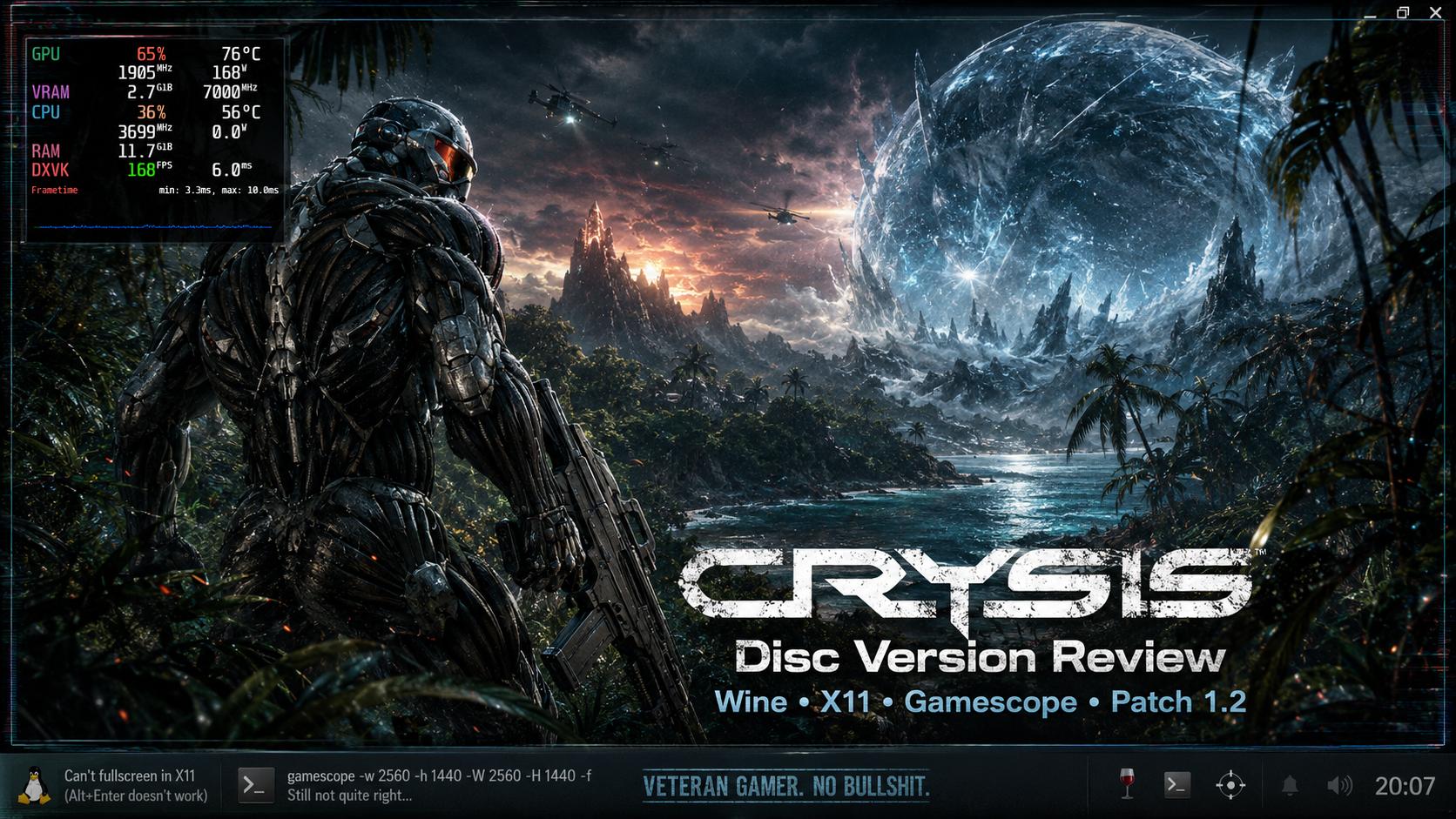
Crysis is one of those games I do not just review. I survive it.
The original PC disc. A Linux desktop. A nanosuit that never has enough battery. And an old graphics legend that still knows how to make a computer fight back.
And yes, this is Crysis. The old beast. The game that became a meme before memes were even what they are today. “Can it run Crysis?” was not just a joke. Back then, it was a warning label.
Crysis is not a bad game. It is not a great game either. It is a love-hate relationship burned into PC gaming history.
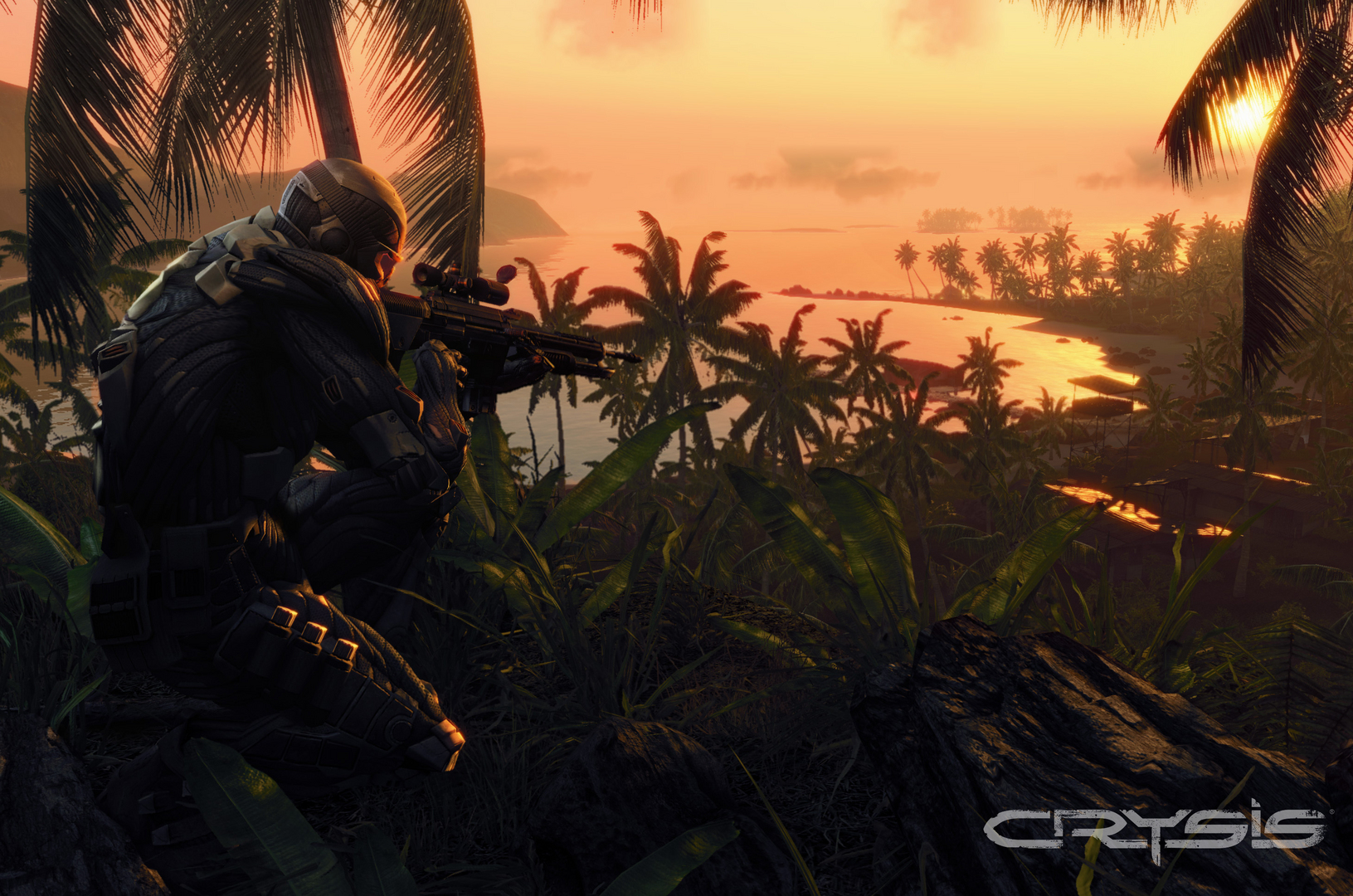
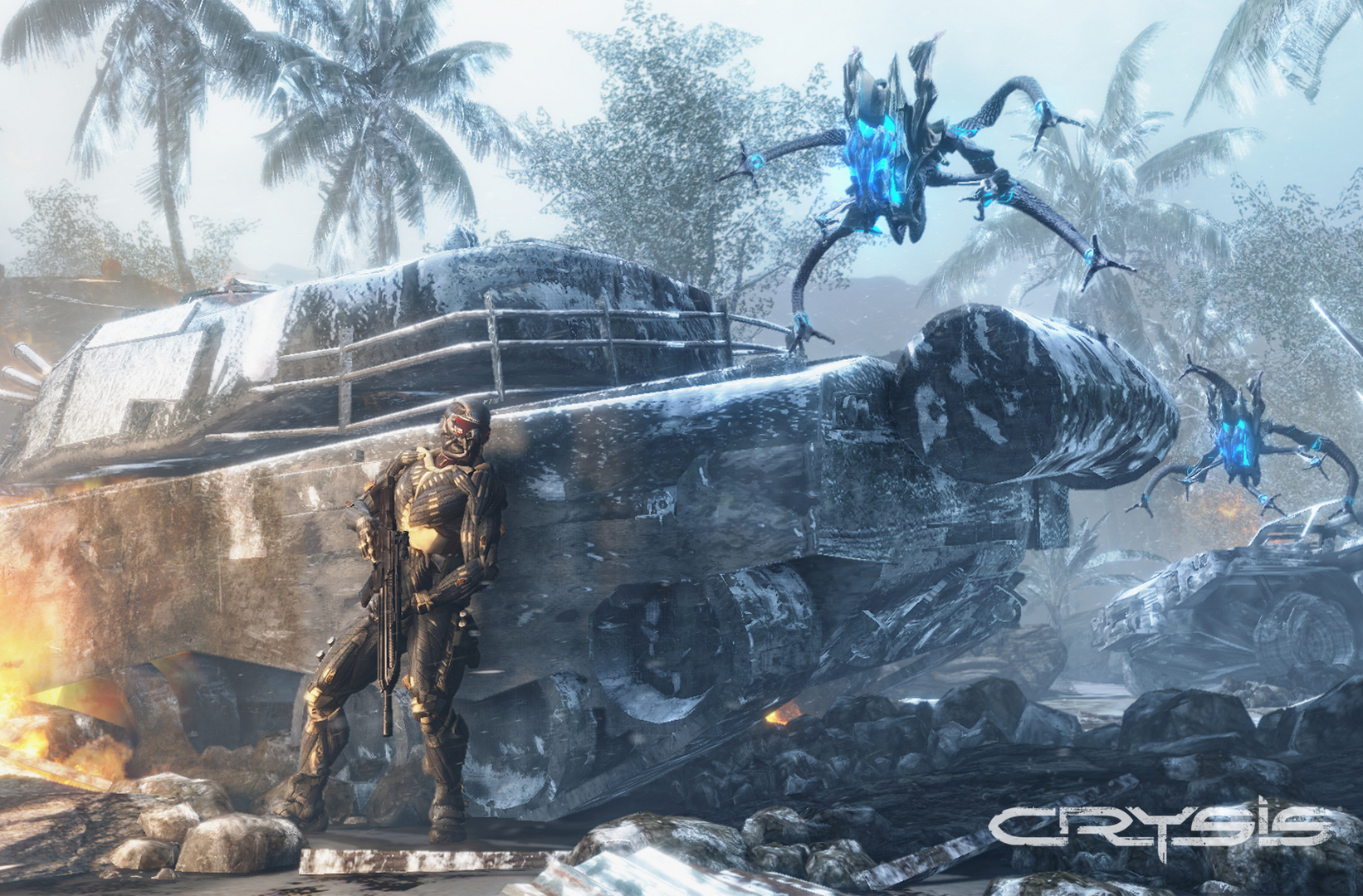
The images in this article are publisher promotional images from the original Crysis Steam gallery. They illustrate the game; my Linux experience is described in the review and the supplied playthrough video.
The Playthrough
Watch the playthrough on YouTube.
Which Crysis I Played
This is the original Crysis, the 2007 PC disc version from Crytek and Electronic Arts, patched to Crysis Patch 1.2 using Crysis_Patch_1_2.exe. I played it on Linux through Wine, using Wine-GE 8-26 x86_64 and DXVK. The game itself supports 64-bit, but I ran it in a 32-bit Wine setup because that was the setup that worked best for this disc install.
| Edition | Original 2007 PC disc version |
|---|---|
| Patch | Crysis Patch 1.2 — Crysis_Patch_1_2.exe |
| Runner | Wine-GE 8-26 x86_64 |
| Graphics translation | DXVK |
| Wine setup | 32-bit prefix used for this disc install |
| Graphics card | NVIDIA GeForce RTX 2070 Super |
| Desktop/display session | Linux, X11 |
| Display mode that worked better for me | Crysis in windowed mode, launched without Gamescope |
2007: Invisible Soldiers and a Dying GPU
My first meeting with Crysis was almost comedy. I bought the game back when it came out, put the disc in, installed it, launched it, and my GPU basically said: no. The card I had at the time did not properly support the game. The ground and a few parts of the world showed up, but almost everything else was invisible. Enemies, objects, parts of the scene — gone. That was my introduction to one of the most famous PC games ever made: a tropical island haunted by invisible soldiers and a dying graphics card.
Years later, I came back to it with far better hardware, far more experience, and decades of gaming behind me. I have played since the 80s. I have seen the Magnavox Odyssey 2 era, NES, old PC games, broken ports, console classics, shovelware, masterpieces, failed experiments, and more than 8,000 games across my life. So when I say Crysis feels strange, I do not mean that lightly.
A Tropical Island with an Alien Problem
The official setup is simple on paper. Crysis is a first-person shooter released in 2007, developed by Crytek and published by Electronic Arts. It runs on CryEngine 2 and was built as a high-end PC showcase for Windows XP and Windows Vista, using DirectX 9.0c and DirectX 10. The story is set in 2019, where a team of U.S. scientists makes a frightening discovery on an island in the South China Sea. North Korea seals off the area, the United States sends in a team of nanosuit-equipped Delta Force soldiers, and everything escalates from military conflict into alien disaster.
That premise still works. The opening has a strong mood. The jungle, the Korean soldiers, the nanosuit, the mystery, the alien threat under the island — all of it sounds like the perfect PC shooter. But when I actually sit down and play it, Crysis feels less like a finished action game and more like a giant technical experiment that turned into a full product because the engine was too impressive to ignore.
Graphics That Made PCs Cry
The graphics are still the reason people remember it. In 2007, this game looked insane. The jungle, the lighting, the vegetation, the water, the physics, the destruction, the suit effects, the draw distance — it was built to make PCs cry. It was one of those games where screenshots alone sold the dream.
But in 2026, playing the original disc version on Linux through Wine, the truth is more complicated. Even with everything on max, the game can still look rough if the resolution or display mode breaks. That is exactly what happened to me.
The Linux Battle: Fullscreen, Panels and Gamescope
The biggest technical problem I had was not only Crysis itself. It was Linux X11 fullscreen behavior.
On my setup, many older Windows games under Wine do not behave properly in true fullscreen on X11. Crysis was one of them. The game would hit the Linux panel/taskbar border, or the desktop environment would interfere with how the game handled the screen. If the panel was visible, the fullscreen space was wrong. If I enabled auto-hide for the panel, the game could stretch from border to border, but then it could stop updating properly unless I alt-tabbed. Sometimes the game looked like it was frozen, but after tabbing out it was actually still running in the background.
So I used Gamescope to force the game into a controlled window/display environment. That let me get the game running and helped me reach the point where I could set Crysis to windowed mode. But Gamescope also broke the resolution behavior. I could not get proper 1080p the way I wanted. It forced a weird lower or wrong resolution, and even with the graphics set to maximum, the image looked bad because the presentation was wrong. Crysis with max settings but broken resolution is like putting a racing engine inside a shopping cart. The power is there, but the result still feels wrong.
After I managed to set the game to windowed mode, I could launch it without Gamescope. That was the better solution. Windowed mode avoided the border/fullscreen problem, and because it did not slam into the Linux desktop panel in the same broken way, the game finally behaved better.
This is important because my review of the graphics is not only about the engine. It is about the actual experience of playing the old disc version today on Linux. Crysis can still look impressive, but if fullscreen breaks, if resolution scaling is wrong, or if Gamescope forces a bad mode, the whole visual legend falls apart fast.
The better solution on my setup: windowed mode.
Gamescope helped me reach the settings. Switching Crysis to windowed mode and then launching it without Gamescope gave me the better result. That is the sequence that worked for this installation, rather than a promise that every Linux desktop needs the same workaround.
Gamescope can present the game with its own virtual screen and has separate settings for the game resolution and output resolution. My results tell me that the configuration I used had a presentation problem; they do not mean Gamescope inevitably prevents proper 1080p. I would need to test the relevant settings before claiming one confirmed cause.
High FPS Does Not Tell the Whole Story
Performance was better than the old days, of course, but the game still had that heavy Crysis feeling. Even with my RTX 2070 Super, it did not feel as smooth and light as I expected from a 2007 game. My MangoHud overlay showed around 168 FPS at points, but that number was a moment in the playthrough, not a benchmark average.
High FPS and smooth movement are not quite the same thing. Frame pacing, the engine, the display setup and the translation layers are possible places to investigate. I did not record a frame-time analysis or isolate those variables, so I cannot identify one measured cause. What I can say is that the game sometimes felt heavier than the counter suggested.
Patch 1.2 and the Old Chaos
I played with Patch 1.2 installed. EA’s contemporary announcement describes multiplayer improvements, mod support, and changes involving weapons, AI and vehicles. The patch is part of the version I reviewed, rather than proof that every rough edge had disappeared.
I did not hit many of the old wild bugs during this playthrough. The older game could have that chaotic physics feeling, as if one bad collision might open a portal to another dimension. This run was less of a constant bug parade. I did not compare the unpatched game and 1.2 on the same setup, so I cannot credit the difference entirely to the patch.
That is part of the legend, but it is also part of the problem.
The Nanosuit: Maximum Power, Minimum Battery
The nanosuit is the heart of the game. In theory, it is a great idea. You have armor, strength, speed, and cloak. You can punch harder, run faster, hide for a short time, or survive more damage. It should make you feel like the ultimate hunter. The problem is the energy system. The suit energy runs out so fast that it often kills the fun before the fun gets started.
Cloak often feels like a battery warning.
Cloak should make you feel like a predator. Instead, it often feels like a battery warning. Speed should make you feel powerful. Instead, it drains so quickly that I barely want to use it. Strength is useful in small moments, but it does not transform the whole game the way the concept suggests. Armor is probably the most practical mode, because at least it helps keep you alive.
I understand why Crytek limited the suit. They probably did not want players to sneak through every camp forever or sprint across the whole island like a superhero. But for me, the balance goes too far. The suit becomes a great mechanic that I do not use enough because it feels too restricted. That makes it feel wasted.
Freedom Is Where It Works
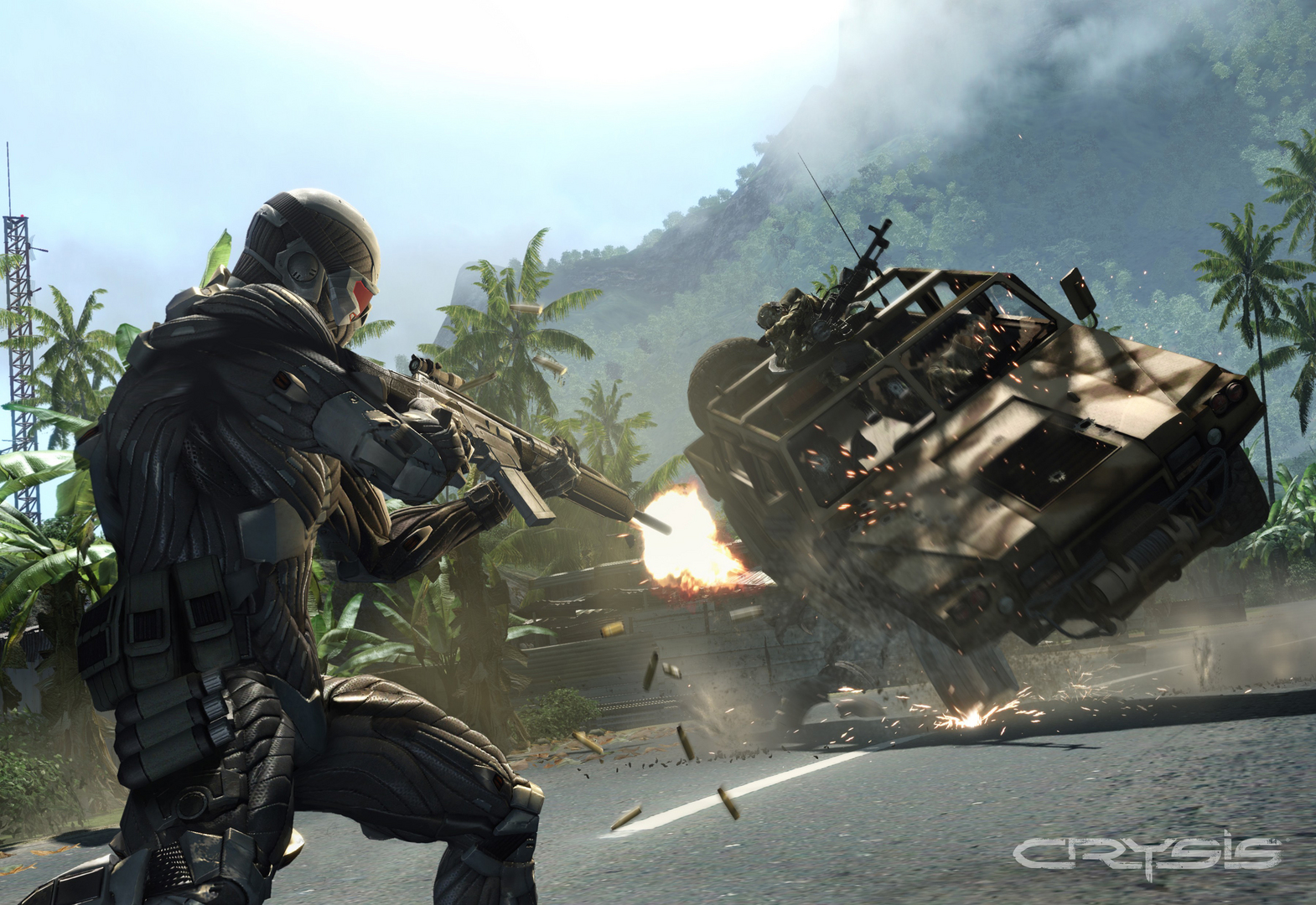
The map and tactical systems are better. Spotting enemies and seeing where they are looking is useful. It gives the game a more open tactical feeling, and it helps you plan attacks. This is one of the stronger parts of Crysis. The game gives you room to approach combat in different ways. You can sneak, shoot, flank, swim, drive, hide, or attack from range. When it works, it feels good.
Night vision, however, feels almost pointless. It exists, but I rarely felt like the game truly needed it. It is more of a feature on a list than a core part of the design.
The AI and Shooting Never Quite Settle
The enemy AI is one of the strangest parts of the game. Crysis was often talked about as having advanced AI, and in some ways you can see what they were trying to do. Enemies search, shout, move around, react to danger, and try to fight in a more open environment than many shooters from that era.
But in real gameplay, they can be unbelievably dumb.
If you are far enough away, enemies often struggle to understand what is happening. If you use a silencer, it can feel like you are doing almost no damage, while the enemies run around confused like headless chickens. They lose track of you quickly, they sometimes react badly, and they can go from laser-accurate threat to confused island tourist within seconds.
So the AI is both ambitious and broken. That is very Crysis. Big idea. Strange result.
The shooting itself is fine, but not amazing. Weapons work, but they do not always feel satisfying. Suppressed weapons can feel weak. Enemy reactions can feel inconsistent. The hit feedback is not always strong enough. The game is playable, but when I compare it to the best shooters I have played over decades, Crysis is not carried by its gunplay. It is carried by its engine, its atmosphere, and its reputation.
Sound That Stays, Animations That Feel Their Age
The voice acting is actually good. The soldiers, radio chatter, nanosuit voice, and main story delivery help the game feel bigger than it really is. The sound design does a lot of work. The nanosuit voice alone is iconic. “Maximum Armor,” “Maximum Speed,” “Cloak Engaged” — that stuff burned itself into PC gaming history.
The animations are more mixed. Some of them feel stiff or slightly unnatural today, with a mechanical quality that does not always match the visual ambition around them. The world looks expensive, but the bodies do not always move like they belong in it.
A Strong Opening, a Weaker Alien Finish
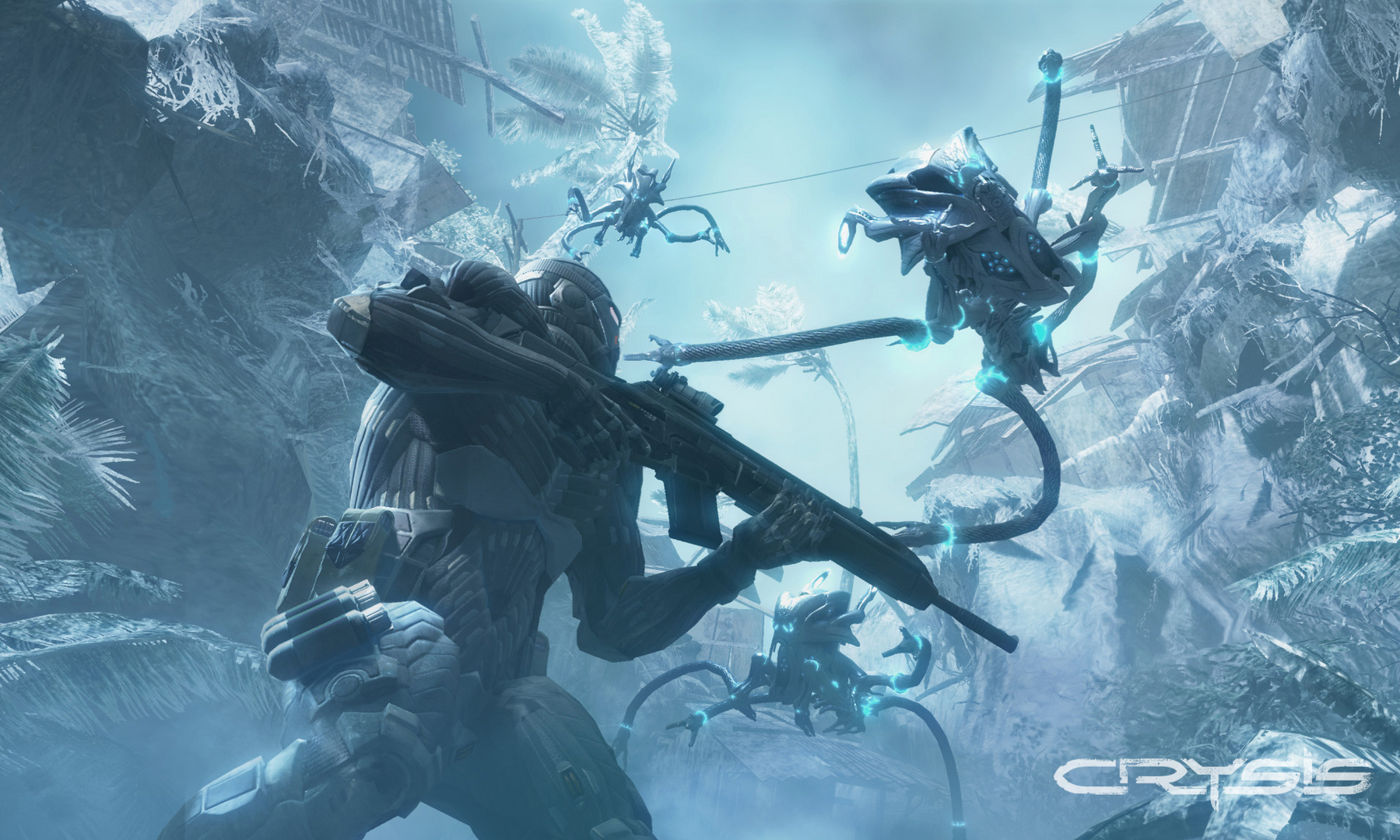
The story is okay. Not terrible, not mind-blowing. It starts stronger than it ends. The military island setup is better than the later alien-heavy parts. The early game has tension, freedom, jungle warfare, and mystery. Later, when the alien side becomes more dominant, the game becomes more linear and less interesting to me. The zero-gravity alien section is memorable, but memorable does not always mean fun.
That is one of the core problems with Crysis. It often wants to impress more than it wants to be enjoyable.
A Landmark I Respect More Than I Love
As a technical product, Crysis is historic. As a game, it is uneven. It is a showcase, a benchmark, a myth, a warning, and a half-finished-feeling shooter all at once. It pushed PC graphics so hard that it became larger than itself. But when you strip away the legend and just play it, you can feel how much of it was built around possibility rather than polish.
The original disc version in 2026 is even more interesting because it is not just a game anymore. It is a preservation project. You are not just installing Crysis. You are fighting old Windows assumptions, old patching, old fullscreen modes, Wine prefixes, DXVK translation, X11 problems, Gamescope workarounds, and the ancient curse of PC gaming: one wrong display mode and the whole thing becomes stupid.
But I respect it.
I do not love Crysis the way some people do. I do not hate it either. I respect it like an old alpha beast with broken teeth. It bit the industry, scared hardware makers, humbled PC gamers, and made an entire generation ask whether their machine was worthy.
For me, Crysis is not a masterpiece. It is a legendary experiment that got lucky enough, ambitious enough, and broken enough to become immortal.
My Verdict
Crysis is a technical landmark, a flawed shooter, and a brutal piece of PC gaming history. The graphics were revolutionary in 2007, the nanosuit idea is still cool, the atmosphere is strong, and the voice work holds up. But the suit energy is too limited, the AI is wildly inconsistent, the story is only decent, the animations feel stiff today, and the game still feels heavy even on modern hardware.
Playing the original disc version on Linux through Wine in 2026 made the experience even more dramatic. I used Patch 1.2, Wine-GE and DXVK for the playable setup, while the X11 fullscreen behaviour and the resolution trouble I had with Gamescope made getting the presentation right part of the battle.
It was about surviving the machine that tried to run it.
And somehow, that feels right. Because this is Crysis. It was never just about playing the game.
7 / 10
Historical PC gaming landmark
A game whose technical ambition earned its place in PC history.
6 / 10
As a pure shooter today
Strong atmosphere and freedom, with uneven AI, suit balance and pacing.
10 / 10
“What the hell is my computer doing?” simulator
The joke score for the technical battle around the game.
Game and promotional images © their respective rights holders, including Crytek and Electronic Arts. Image source: the original Crysis publisher gallery on Steam. Personal review © Kiba Snowpaw.
References: Crytek’s original Crysis page, EA Polska’s Patch 1.2 announcement, reproduced by GRYOnline, Gamescope documentation, and the Wine-GE 8-26 release. My setup details, scores and judgments describe my own playthrough.