
Spoiler warning: This review discusses the opening heist, Jackie, the Relic, the structure of the main story and how the endings work.
I started playing Cyberpunk 2077 when the discussion was full of console problems, PC bugs and arguments about whether the game was even playable. I own it on Steam and have played it on both Windows and Linux. Even back then, my biggest concern was the game underneath all those technical problems. I said that they could fix every bug and still be left with a broken game, because so much of what bothered me was built into the design.
I have returned to it over the years, often out of boredom and to see whether the latest round of praise actually matches what has changed. Every time people start talking about how much better it is, I want to see whether it finally feels like the game its separate parts suggest it could be. I keep coming away with the same basic frustration. There are plenty of systems, plenty of things to collect and plenty of ways to approach a job, but too little of it makes me stop and think.
Night City can look excellent. The music and voices are among the strongest parts of the game. Neither of those things solves the problem I have when I start playing. My overall rating is 2 out of 5.
The parts never quite feel like one game
Cyberpunk often feels as though somebody picked ideas from GTA, Deus Ex, Mad Max and Fortnite, then tried to fit all of them into the same game. Driving, police, shooting, stealth, hacking, crafting, coloured loot and layers of character progression are all there. I can recognise what each part is supposed to contribute. Playing through them rarely gives me the feeling that they were built around the same priorities.
The closest comparison I can make is buying a finished component to put into a game you are making. You connect it, get it working and move on, but it still feels like something inserted into the project. Cyberpunk gives me that feeling repeatedly. It is like ten people made ten different parts and somebody got them running together without making the whole thing feel consistent. That is how the result comes across to me, especially when I move between an elaborate conversation, a routine fight, a crafting menu and the behaviour of the city outside.
A large development team will naturally divide its work. The result still needs a clear idea of how the systems support each other. If crafting is meant to be important, finding another better gun should not keep making it feel unnecessary. If character development is meant to shape how I solve problems, the encounters should give those choices some weight. If the city is meant to convince me that people live there, its reactions need to hold up when I do something the script was not waiting for.
There is an interesting connection to Paweł Sasko’s GDC 2023 quest design talk, reported by Game Developer. He discussed removing unnecessary complexity, making consequences visible and coordinating different disciplines so their work supports the same experience. Those are exactly the qualities I kept missing while playing. A feature needs to earn its place through what it adds to the game.
A backstory, a Jackie section, the main game and an ending
Story: 1 out of 5. I experience the campaign in four chunks. First comes the backstory. Then comes the early section with Jackie, which feels like training or a demonstration of the game. After the heist, the main game starts. Eventually I reach the point of no return, and the ending becomes another separate section.

Nomad, Streetkid and Corpo give V different beginnings. They establish where this person comes from, with lifepath dialogue and a specific side job later, but those beginnings quickly feed into the same mercenary story. I wanted that background to have more influence over the journey. Selecting a different introduction does not give me the feeling of living a substantially different life in Night City.
The early Jackie section introduces the work, the people and the systems. You get a feel for being a mercenary, meet fixers and prepare for the Konpeki Plaza heist. Dexter DeShawn hires V and Jackie to steal the Relic biochip. During the job, they witness Yorinobu Arasaka kill his father, Saburo, and the hotel goes into lockdown. Their escape leaves Jackie fatally wounded and the chip’s protective case damaged. Jackie initially carries it in his neural slot, then passes it to V before he dies. Dexter subsequently shoots V, and the story moves into a different situation.
Takemura kills Dexter and brings V back from the aftermath, but V’s survival creates another problem. The Relic contains a digital copy of Johnny Silverhand’s personality, and it is progressively overwriting V’s brain. Much of the main story concerns finding someone who understands the technology well enough to stop that process. Takemura has his own objective: exposing Yorinobu’s role in Saburo’s death. His loyalty to Saburo draws V deeper into Arasaka’s internal struggle.
It feels like being made to start again after the game has already spent time establishing itself. The lifepath has its own setup, the Jackie section has another, and then the Relic story takes over. I still feel the joins while playing.
The ending adds another boundary. Nocturne Op55N1 is the point of no return, after which the campaign moves into its final route. Completing particular character questlines can open additional approaches, and the final decisions determine which route you take. After the credits, the option to continue playing takes you back before that boundary. You do not carry on exploring a city that has permanently moved into your chosen ending.
I find that structure restrictive. There is a large city in front of me, but the main journey keeps moving me through enclosed stages. By the time I am choosing how the story ends, I want the life I have been building across the game to have changed more of the journey already.
Choices exist, but too much of the journey stays familiar
There are consequences beyond romances and the final fate of V. The early Maelstrom job is a useful example. Decisions around Royce and Brick can change who is running the gang when you return to Totentanz during Second Conflict, which changes how that visit plays out. Some characters can survive or die, jobs can develop differently, and relationships can open or close content.
What I kept wanting was a stronger effect on the overall experience. A changed conversation, a different person in the room or another way through a particular job can be worthwhile. Across the main campaign, I still feel pushed through much of the same story. The changes that stand out most to me gather around who survives, who V becomes involved with and which ending becomes available. I wanted more of the game between the opening and the ending to feel shaped by what I had done.
Sasko addressed a similar disagreement in a 2023 stream, covered by Game World Observer. He described developers counting many kinds of variation as nonlinearity, while players often mean choices that lead to substantially different content. He acknowledged that expectations concerned larger branches and that the team could have done better.
That difference is easy to feel while playing. I am interested in where a choice takes me and what I encounter because of it. The amount of work needed to support a branch does not automatically make the result feel substantial from my side of the screen. I can spend time choosing dialogue and developing a character, then still feel as though the campaign has already decided most of the important steps.
Having several endings does not solve that by itself. The ending is the last part of the game. I want the decisions before it to create a stronger sense that I am steering the experience as I go.
Easy means I rarely have to think
When I call Cyberpunk easy, I mean that the solution too often feels obvious. Turning up the difficulty can make enemies more dangerous and make mistakes more costly. My frustration starts earlier, when I look at an encounter and already know roughly how I can get through it.
This is also a problem I had with the last Deus Ex game. I start expecting the available entrances. There will be a route for one kind of character, another for a different ability and an accessible way through regardless. After a while, I am reading a familiar arrangement of options instead of working out a difficult situation. Finding a route should sometimes require more observation, preparation or adaptation than recognising which opening the designers have provided.
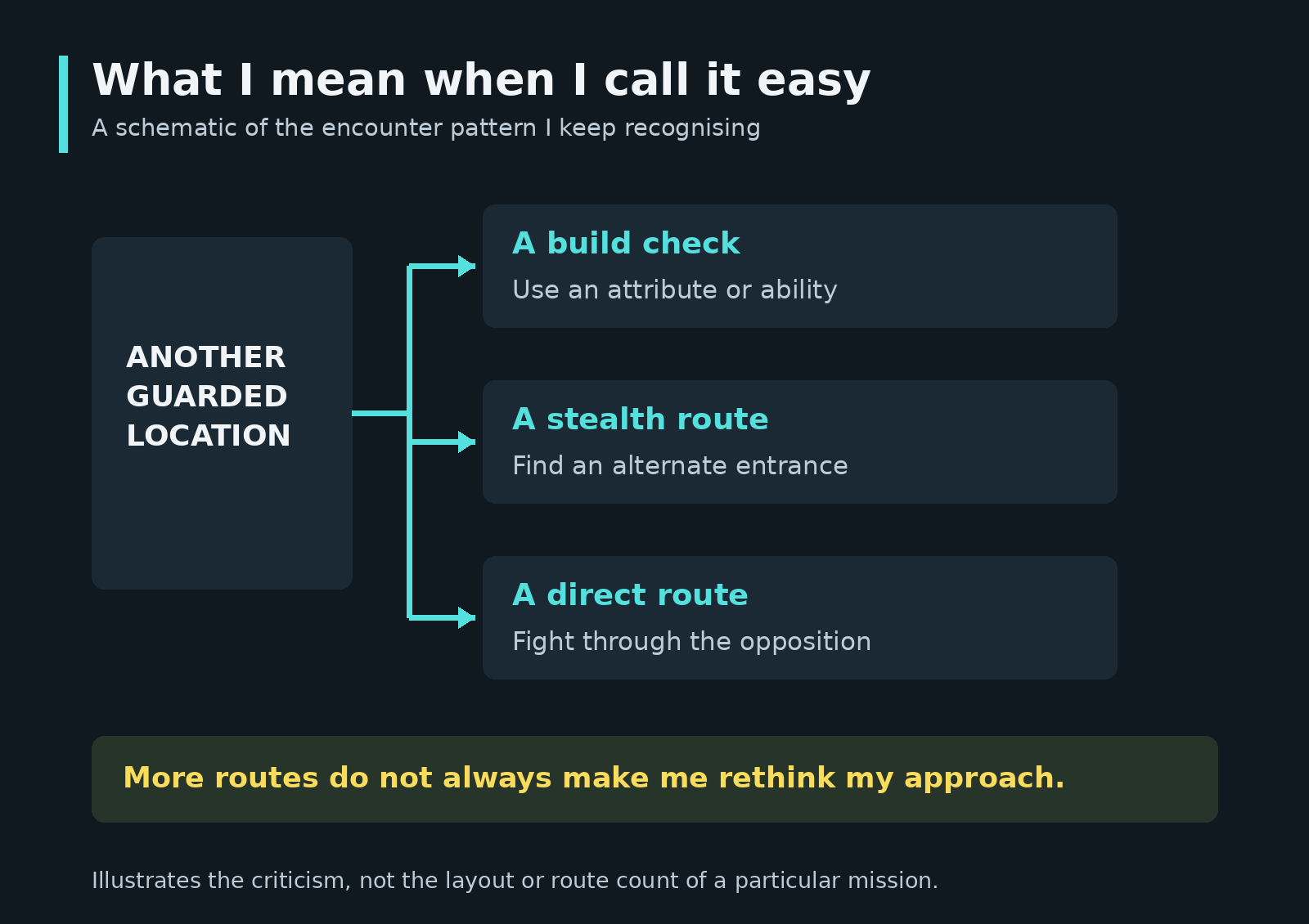
I do not need every mission to lock me out because I spent my points differently. I want my build to change the problems I face. A weakness should occasionally force me to improvise. If I can keep falling back on the same straightforward approach, the other systems start feeling like extra ways to perform something I could already do.
CDPR level designer Miles Tost discussed the difficulty of making alternate routes feel rewarding in his GDC 2023 talk, Benefits of Missing Out. The team had not always achieved the response it intended. GameSpot’s account of the presentation describes a generic route intended to keep players from being blocked by their character build. Players could then take the easiest route instead of engaging with more interesting alternatives.
That comes very close to the problem I am describing. I can see the variety on offer. I rarely feel enough pressure to explore it. A mission might support several playstyles, but I want choosing between them to involve more than deciding which method I feel like using today.
Skill trees, hacking and the reliable option of a gun
The original progression system gave me too many things to advance without enough reason to care about all of them. Character level, attributes, perks, skills, Street Cred, weapon quality and cyberware added up to a lot of menus and numbers. I was spending points, but I kept questioning how much of that development I actually needed.

The skill trees felt useless to me because investing in guns already gave me such a reliable answer. Get better at shooting, get a better weapon and keep moving. Hacking is available, stealth is available and more specialised builds are available. I rarely felt that ignoring them created an interesting problem I then had to solve.
Hacking should be a particularly strong part of a setting like this. It can affect people, cameras and devices, giving the player ways to interfere with an encounter before or during a fight. I rarely felt pushed to engage with it when a gun kept doing the job. A large set of abilities loses its appeal when I am comfortable leaving most of it alone.

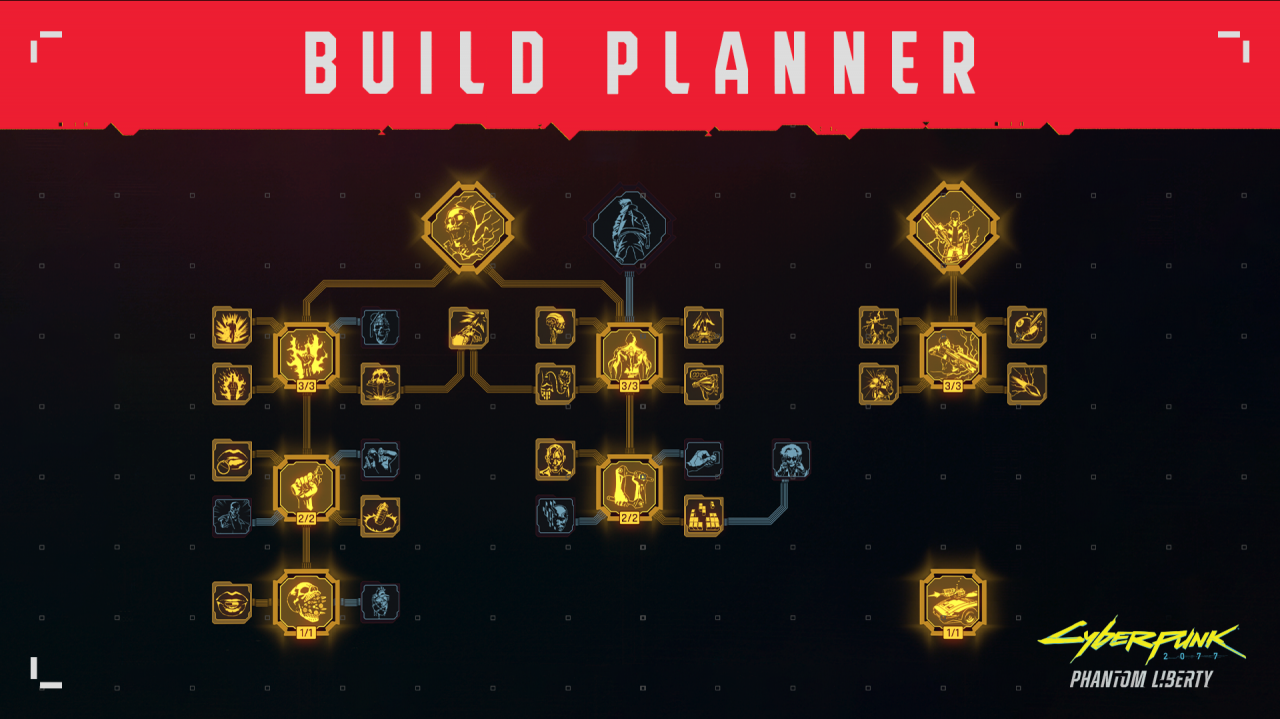
There has been a real redesign since launch. In CDPR’s August 2023 REDstreams recap, the team explained that the perk overhaul would rearrange the trees and reset perk points. The newer trees put more emphasis on abilities that alter what V can do. Update 2.0 also introduced quickhack queues and Overclock, which lets a netrunner use health to support quickhacking when RAM is insufficient.
Cyberware received a clearer role too. CDPR explained that it wanted implants to support particular builds, moved most armour protection from clothing to cyberware, and introduced a capacity limit. That connects equipment, protection and character development more directly. Choosing clothes mainly for their appearance also makes more sense than treating every outfit as a collection of defensive statistics.
Those changes address actual weaknesses in how the systems were arranged. The question I keep returning to while playing is what the encounters ask of me. A more interesting skill tree needs situations that make its possibilities worth exploring. I want to make decisions because the game has given me a problem to work through, rather than because I have decided to entertain myself by avoiding the easiest answer.
Crafting and loot keep getting in each other’s way
Crafting was one of the clearest examples of a system that struggled to justify its place in my play. I could open the menu, collect components and make equipment, then find another weapon that made the effort feel wasted. It often seemed as though crafting only started making sense near the end of character development, when replacements were less likely to arrive immediately.
That is a pacing problem. If I can keep finding something better, the game has already supplied an easier way to improve my equipment. The crafting menu becomes another thing to manage while the rewards for ordinary play undermine it. I want crafting to give me a useful reason to make something, maintain something I value or solve a shortage. Its presence alone does not make the equipment system deeper.
I also dislike how casually games use the word legendary. A legendary item should feel unusual, difficult to obtain and worth remembering. Being able to manufacture that label makes it feel like another colour in the inventory. Finding a more effective ordinary weapon then makes the hierarchy feel even less convincing. I end up comparing numbers instead of caring about what I have found.

The older rarity system has since been replaced with tiers. Under the 2.0 equipment rules, crafting and upgrading use a simplified component system, and weapon upgrading is reserved for Iconic weapons, alongside cyberware upgrades. Loot also scales with the player. Those are meaningful changes to how equipment develops and how particular weapons can be retained.
Police, crowds and a city that exposes its limits
Mechanics: 3 out of 5. Game systems: 3 out of 5. The police were one of the most obvious problems in the earlier game. Officers could appear far too close to me, and their response felt like a small group being placed around the player rather than a force responding through the city. Killing the immediate response or getting into a safe area could expose how limited the system was.
For a game with traffic, pedestrians, gangs and so much driving, I expected something closer to the sustained pressure of GTA. Committing a crime should make the surrounding city react in a convincing way. Police arriving through the streets, pursuing a vehicle and forcing me to work out an escape would do far more for that than officers suddenly appearing nearby.
The first changes were modest. Patch 1.2 increased the distance at which police spawned. Moving that response farther away addressed the immediate appearance of officers beside the player, but a spawn-distance adjustment could only go so far.
Update 2.0 brought a much larger replacement. In its police system explanation, CDPR described car chases, roadblocks, visible stages of pursuit and MaxTac encounters at maximum heat. The stated aim was to make the rules readable and the pursuit entertaining without constantly interrupting the player’s flow. That is a substantial change from the early response system.

The same credibility problem runs through crowds and traffic. Cars appearing too close and people reacting mechanically make the place feel staged. A street can be visually crowded while still feeling thin when its occupants have to respond to something. I notice those breaks because the city looks detailed enough to invite closer attention.
Patch 1.5 already included changes to combat positioning, cover use, dodging, crowd reactions, pathfinding and traffic behaviour. It also gave different factions more varied approaches to combat, including aggressive, defensive and cautious behaviour. These systems were being revised well before 2.0.

Controller support was one of the things that worked well for me. I could comfortably play that way on PC. I had more frustration with smart targeting around police, where bringing them into the aiming situation could turn them hostile. In a busy city, I want targeting and reactions to feel predictable enough that I understand what I have actually done.
A beautiful city with performances that feel disconnected
Design: 2 out of 5. Night City’s appearance is one of the reasons the game is so frustrating to me. I can spend time simply wandering around looking at it. There is enough visual interest to keep my attention without a mission. The city often looks more convincing than it behaves.

Characters can look good as models and still feel unnatural as people. The voices sound convincing, but the body language, movement and timing do not always match the performance I am hearing. It feels as though the voice and the body belong to separate attempts at the same scene. That disconnect keeps pulling my attention towards the animation when I should be listening to the person.
I have described it as out of sync or AI-like. What I mean is the artificial quality of the whole performance: an expression, a movement or a physical reaction that does not quite belong with the delivery. A technically aligned mouth is only one part of making somebody seem alive.

The JALI team’s SIGGRAPH 2020 paper, written with CDPR contributors, explains the facial animation approach. Recorded speech and annotated transcripts drive procedural mouth movement and supporting motion in the eyes, brows and neck. Animators can adjust the results and combine them with handcrafted animation and performance capture. The paper describes a largely automatic workflow under animator control, designed to handle an enormous amount of dialogue across languages. It also discusses how small failures in facial expression can undermine an audience’s trust in a character.
CDPR’s 2022 GDC presentation on interactive first-person scenes describes another part of the production: staging conversations while the player remains present and can act within them. These are complex scenes assembled for real-time interaction, with tools and direction behind them.
I want the result to carry the same intent through the voice, face and body. When those pieces disagree, I am watching a game perform a conversation rather than believing the conversation. It affects the story as much as the presentation because so much depends on spending time close to these characters.
The music and voices deserve their score
Music and voice acting: 4 out of 5. The audio is much stronger than my overall opinion of Cyberpunk. The voices can give dialogue the emotion that the character movement fails to support. The music contributes to the atmosphere of the city and its different situations. These are parts of the game I can appreciate without wanting to raise my rating for the whole experience.
In a July 2026 RPG Site interview, Sasko described the radio as part of Night City’s culture, with different sounds belonging to different people and scenes. He credited the audio and music team, including Krzysiek Ostrowski, P.T. Adamczyk and Marcin Przybyłowicz. He also explained that game music can be layered and react to locations or gameplay states, rather than exist as a fixed track played from beginning to end.
For people recording or streaming their play, the soundtrack also has a practical restriction. CDPR introduced a setting to disable certain copyrighted tracks because some music could lead to demonetisation or takedowns. It is worth checking the recording settings before uploading gameplay.
What the engine work says about optimisation
I have more respect for a game that uses the hardware efficiently than one that simply demands more of it. Older PC games often had to work within tighter limits while still producing something worth looking at. That is part of why Cyberpunk’s rough edges bothered me. The ambition is obvious, but I want the finished game to feel controlled and consistent when I am actually using it.
There was extensive engineering behind Night City. Charles Tremblay’s Building Night City presentation at GDC 2023 describes redesigning parts of REDengine 4, assembling the world through a hierarchy of reusable objects, streaming different game systems and managing memory and CPU performance. A dense city presents problems that go beyond drawing an attractive street.
A separate SIGGRAPH paper by CDPR’s Bartłomiej Dybisz and Michał Witanowski explains optimisations for shadows. These include avoiding unnecessary rendering, reusing shadow information and spreading work across frames. The city needs shadows from a changing sun as well as numerous artificial lights, across different hardware limits.
The hardware problem also involved getting the world into memory quickly enough. In its post-launch explanation, CDPR said it had first aimed for impressive PC presentation and then adjusted the game for consoles. It underestimated that task. The company identified streaming as the main difficulty on the older consoles: loading the city’s objects and systems into the engine fast enough for a dense environment with relatively few loading interruptions. Storage bandwidth was a particular constraint.
Sasko also recalled an early vehicle prototype in the RPG Site interview. Before functional cars were available, a designer attached vehicle components and a large car model to Panam so the Nomad sequences could be prototyped. Other Aldecaldos characters received similar arrangements. The characters were effectively carrying the cars around while the designers worked out the sequences.
The launch was also a management failure
Cyberpunk 2077 launched on 10 December 2020. The especially severe console controversy concerned the PS4 and Xbox One versions. At that point, PS5 and Xbox Series consoles ran the earlier console versions through backward compatibility. The dedicated PS5 and Xbox Series update arrived with 1.5 on 15 February 2022.
The scale of the production was enormous. CDPR’s 2020 management report records a peak of 530 developers and more than 5,200 people involved across the project in total. That wider figure included roughly 2,000 actors for the voice recordings. Coordinating the work was a major part of delivering the game.
On CDPR’s investor call of 14 December 2020, the management board admitted being too focused on release after three delays. It said it underestimated the problems and “ignored the signals about the need for additional time” on the base consoles. It also acknowledged that marketing had mostly shown PC footage and that console review copies arrived too late for proper reviews.
Those admissions put responsibility where it belongs. Customers bought versions the company had chosen to release. The people approving that release were responsible for the condition of the product and for giving buyers a fair view of it beforehand. Management also said that adding hundreds of developers at the last minute would not have solved the situation.
The early problems could be more serious than a funny animation. Hotfix 1.06, released on 23 December 2020, removed an 8 MB PC save-file limit, with an explicit warning that it would not repair saves already corrupted before the update. That is the kind of defect that can destroy time somebody has put into a game.
Bloomberg reported mandatory six-day working weeks before release. Jason Schreier’s subsequent staff-interview investigation reported unrealistic deadlines and management problems.
That makes the demand for endless last-minute fixes particularly ugly. Staff can work extremely hard and still be delivering a product that management has given too little time to finish. Customers then spend the following months waiting for repairs to something they have already paid for.
CDPR’s public apology acknowledged that it had not shown the base console versions before release and that buyers should have been able to make a more informed decision. Refund arrangements followed, and the PlayStation Store removed the game from sale during the launch fallout, as recorded in the company’s 2020 management report.
The US securities class action also ended in a settlement. CDPR’s 2023 financial statements record final approval and a settlement without an admission of fault. That proceeding concerned investor claims; the customer refunds were a separate part of the fallout.
Marketing and reviews need to describe the product being sold
The launch deserves criticism for what buyers were shown and what they received. CDPR had spent years building expectations, then failed to give people a proper view of the versions running on the oldest supported consoles. The apology and management admissions make that failure concrete.
The 2018 gameplay reveal was explicitly described as work in progress. Adam Badowski said that the systems and assets being shown were still changing. Features shown during development can change before release. By the time a company is taking money for the finished product, customers need an accurate account of what their version actually does.
Launch criticism also went beyond bugs. Kallie Plagge’s 7/10 GameSpot review praised characters and side quests while criticising the superficial world and lack of purpose. Its editor’s note says the review covered PC because console codes did not arrive until release day. There were reviewers questioning the game underneath the technical failures from the beginning.
I find the later talk of redemption too simple when it turns years of repairs into an answer to every criticism. A patch can fix a crash. A new police system can change a pursuit. A redesigned perk tree can improve character building. I still want to know whether the encounters require more thought, whether the campaign feels less divided and whether the people in front of me feel convincing.
What changed after launch
The updates deserve to be described accurately because several of them went well beyond technical repairs. The game has been rebalanced, expanded and reworked over years.
| Release | Changes relevant to this review |
|---|---|
| 1.2, March 2021 | Greater police spawn distance, driving adjustments and a large set of fixes. |
| 1.5, February 2022 | Dedicated PS5 and Xbox Series versions, changes to combat AI, crowds, traffic and driving. |
| 2.0, September 2023 | Rebuilt perks, cyberware and police, vehicle combat, equipment changes and new balancing. Free on PC, PS5 and Xbox Series. |
| Phantom Liberty, September 2023 | A paid expansion with Dogtown and a new spy story, released separately from the free 2.0 overhaul. |
| 2.1, December 2023 | A usable metro, portable radio and additional activities with romantic partners. |
| 2.3, July 2025 | AutoDrive, Delamain taxi journeys, additional vehicles and Photo Mode changes. |
| 2.31, September 2025 | Further AutoDrive improvements and fixes, including Photo Mode adjustments. |

The size of the overhaul also says something about the original design. Perks, equipment and policing needed more than a few corrected values. Years of development went into changing how they work. I appreciate that the work happened. I would have preferred buying a game whose systems already fitted together more convincingly.
We decide when companies get our money
CDPR reported on 11 December 2020 that estimated royalties from digital preorders already exceeded the game’s development spending and its incurred and planned marketing costs through the end of that year. It later reported more than 13.7 million copies sold by the end of 2020. The launch was a commercial success while the company was apologising and organising repairs.
That is why I get tired of consumers acting as though we have no influence. Preorders give a publisher money before buyers can properly examine the finished game. Waiting for footage and reviews of the actual version we intend to play keeps that decision in our hands for longer. Using refunds when a product falls short is another practical response. We can also stop treating a future patch as part of the thing we have already received.
I want companies and the people profiting from these releases held accountable for the decisions they make. The staff repairing a game should not absorb all the criticism while the launch itself is treated as an unfortunate event that somehow happened to management. Shipping the product is a decision. Selling a version without giving buyers a proper view of it is a decision too.
Ownership deserves the same attention. The Windows Steam release is documented by PCGamingWiki as DRM-free when the launcher and client are bypassed by starting the game executable directly. Cyberpunk also has an official DRM-free GOG release with offline installers and optional Galaxy integration. Store accounts are used to obtain the downloads; the installed single-player game can run independently of those clients.
I would rather see more games offer that kind of independent installation. Keeping an installable copy and running it without a compulsory client should be an ordinary option. Consumers can demand clearer product information before purchase and better control over what they have bought.
My rating
| Category | Score |
|---|---|
| Story | 1/5 |
| Design | 2/5 |
| Mechanics | 3/5 |
| Music and voice acting | 4/5 |
| Game systems | 3/5 |
| Overall | 2/5 |
There is a lot to do in Cyberpunk 2077. More missions, more equipment and more hours available do not solve my problem with how it plays. I can enjoy looking at Night City and appreciate the audio while still finding the progression, encounters, performances and campaign structure unsatisfying.
I keep returning to see whether the changes finally reach the parts that bother me. So far, I still find a game where shooting is too dependable an answer, too many systems struggle to feel necessary, and the story moves through sections that feel more separate than they should. I cannot recommend it on the strength of my own experience. Fixing bugs and adding features has not given me the coherent game I wanted underneath them.
My gameplay and video review
The recordings below are my own gameplay from Windows and Linux, grouped into five sessions, with the earlier video review in its own playlist. Together, the gameplay playlists contain 37 videos and just over 27 hours of footage.
Open all five gameplay sessions and the video review
Open a session below and press Play, or use its YouTube link.
Additional video link. YouTube reports this separate video as unavailable as of 16 October 2026.
Developer talks and technical reading
For more background, CDPR’s level design talk, Night City technology presentation and interactive scene presentation cover different parts of the production. The JALI facial animation paper and shadow optimisation paper provide technical detail. The December 2020 investor call records management’s own explanation of the launch.
Game images © CD PROJEKT RED; additional screenshot credits appear with the images. This is an unofficial fan work and is not approved or endorsed by CD PROJEKT RED.