
I played Counter-Strike back when it was still a mod for Half-Life, and I loved it. I played it all the time. This was the game that made me fall in love with FPS games, and I still consider that original mod one of the best Counter-Strike games ever made.
I grew up with it, and that will be part of why I still rate it so highly. I also remember enjoying the community and wanting to keep playing. When I think about the Counter-Strike I loved, my mind goes back to that period, before Steam.
I still have a Danish coverdisc from Computerspil Tips & Tricks, issue 5/2000. Printed across it is “Half-Life: Counterstrike 6.0!” The smaller text identifies it as Beta 6.0. That is how these things reached people too: a magazine, a disc and a mod you could install for a game you already had.
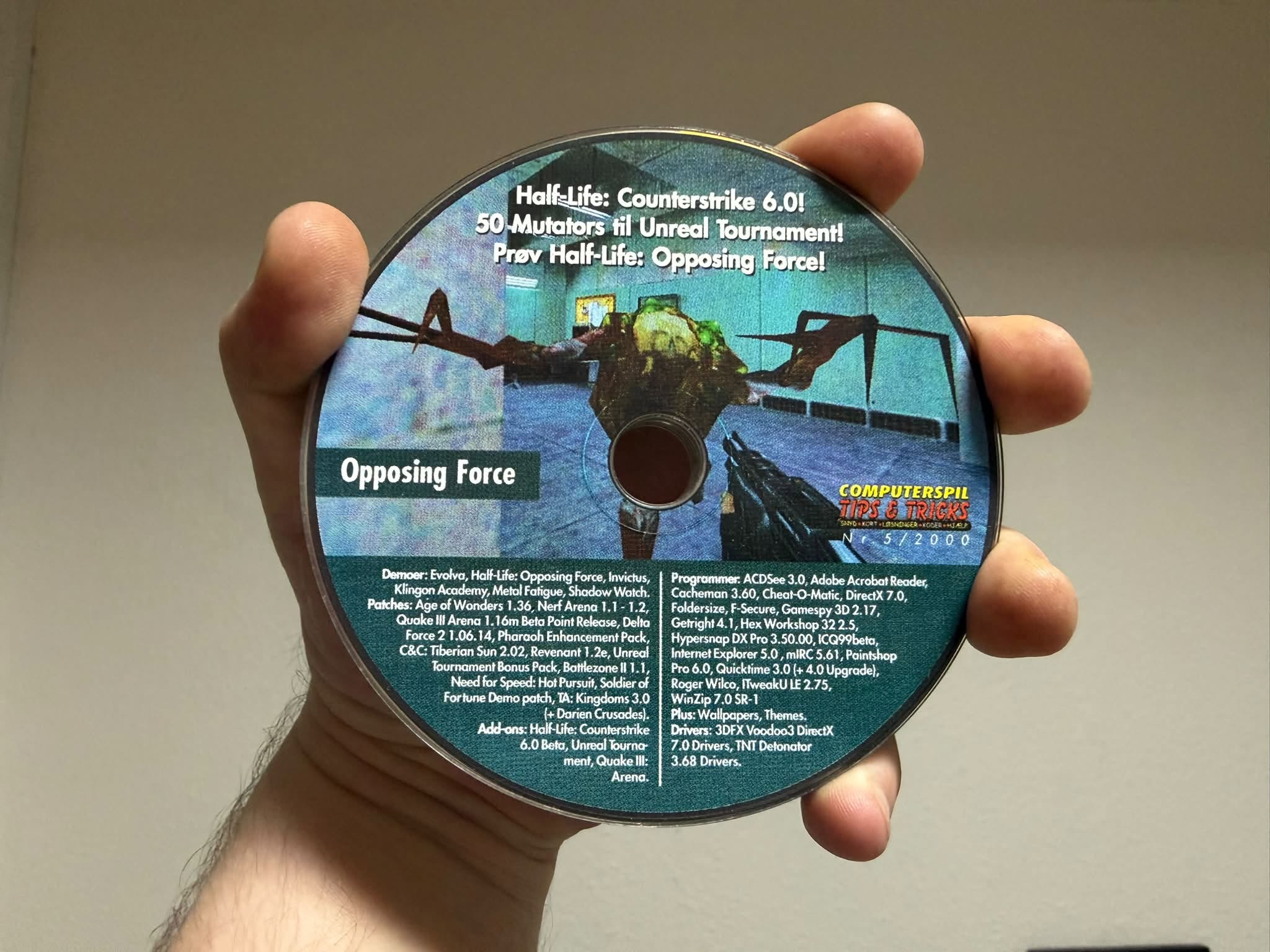
The disc also advertises an Opposing Force demo and a pile of other demos, patches and add-ons. I miss that. A disc like this could give you something you ended up playing for years.
Where Counter-Strike began
Counter-Strike began with Minh “Gooseman” Le and Jess Cliffe. Le had already made Navy SEALs for Quake and worked on Action Quake 2. He wanted to make a modern counter-terrorism game using Half-Life. In his 2001 interview, he described working on the programming, models and animation while studying, with Cliffe handling the website, coordination and recruitment of mapmakers.
Le’s influences included real weapons, counter-terrorist units and films such as Heat, Ronin and Air Force One. He wanted the tactical side of something like Rainbow Six with a faster pace. His later account of the project also makes the importance of modding tools very clear: being able to work with Doom and Quake gave him a way into making games in the first place.
Cliffe’s preserved retrospective dates the naming discussion to 15 March 1999, the website to 24 March and the first public beta to 19 June 1999. The first package contained four maps: Siege, Mansion, Wpndepot and Prison. Hostage rescue was there from the beginning. Bomb defusal came later.
The game was being built by people using somebody else’s game as a starting point. Community mapmakers supplied the places people fought over, and other contributors helped turn the project into something much bigger. Barking Dog Studios also contributed to Beta 5. The familiar names at the front of the project were only part of the work behind it.
The game kept changing through the betas
The earliest Counter-Strike did not arrive with everything people now associate with it. The AK-47 was added in Beta 2. The knife arrived in Beta 3. Dust and bomb defusal came with Beta 4. Looking through the original release documents, you can follow the game being assembled and adjusted in public.
| Release | What arrived or changed |
|---|---|
| Beta 1 · June 1999 | Hostage rescue, nine guns and four maps, including Mansion. Original manual. |
| Beta 2 · August 1999 | AK-47, SG 552, Desert Eagle, silencers, round timer and team round scores. Release notes. |
| Beta 3 · September 1999 | Knife, P90, helmet purchase and improvements to hostage AI. Release notes. |
| Beta 4 · November 1999 | Bomb defusal, HE grenades, Scout and P228, with maps including Dust and Nuke. Release notes. |
| Beta 5 · December 1999 | XM1014, Train and Backalley, along with buying, HUD and objective refinements. Release notes. |
| Beta 6 · March 2000 | AUG, MAC-10, radar, left/right weapon display, VIP assassination and terrorist escape. Release notes. |
| Betas 6.5–7 · June–August 2000 | Rewritten Half-Life networking, smoke grenades, more maps, map voting, graphical buying menus and dual Berettas. Release notes. |
| Version 1.0 · November 2000 | The commercial-release era, with additions including the UMP45, Five-seveN and SG 550. Preserved release history. |
| Versions 1.1–1.3 · 2001 | Dust2, further weapon and movement changes, voice communication and HLTV improvements. Preserved release history. |
| Versions 1.4–1.5 · 2002 | Jumping, bomb and spectator changes, anti-cheat support and more fixes. Version 1.5 arrived on 12 June. Release notes. |
| Version 1.6 · 2003 | FAMAS, Galil, the tactical shield and the Steam release. Valve’s installer announcement. |
My Beta 6 disc comes from a period when CS was still trying different scenarios. VIP assassination put one CT in the role of a player the team had to escort to safety. Escape reversed the familiar idea of terrorists holding a position: they were trying to get out while the CTs stopped them. The Beta 6 readme explains both modes.
Underneath the changing weapons and maps was the round structure. You died, and you stayed dead until the next round. Le said he brought that idea from Action Quake 2 because it encouraged people to play carefully and work together. A death had a consequence beyond immediately appearing somewhere else.
Buying equipment, keeping a weapon alive into another round, listening for footsteps and deciding when to move were all part of the game. The old manual spends time on walking quietly, recoil, short bursts and the weapons that could penetrate cover. A doorway, wall or corner could matter a lot.
The mansion, the garden and that wall
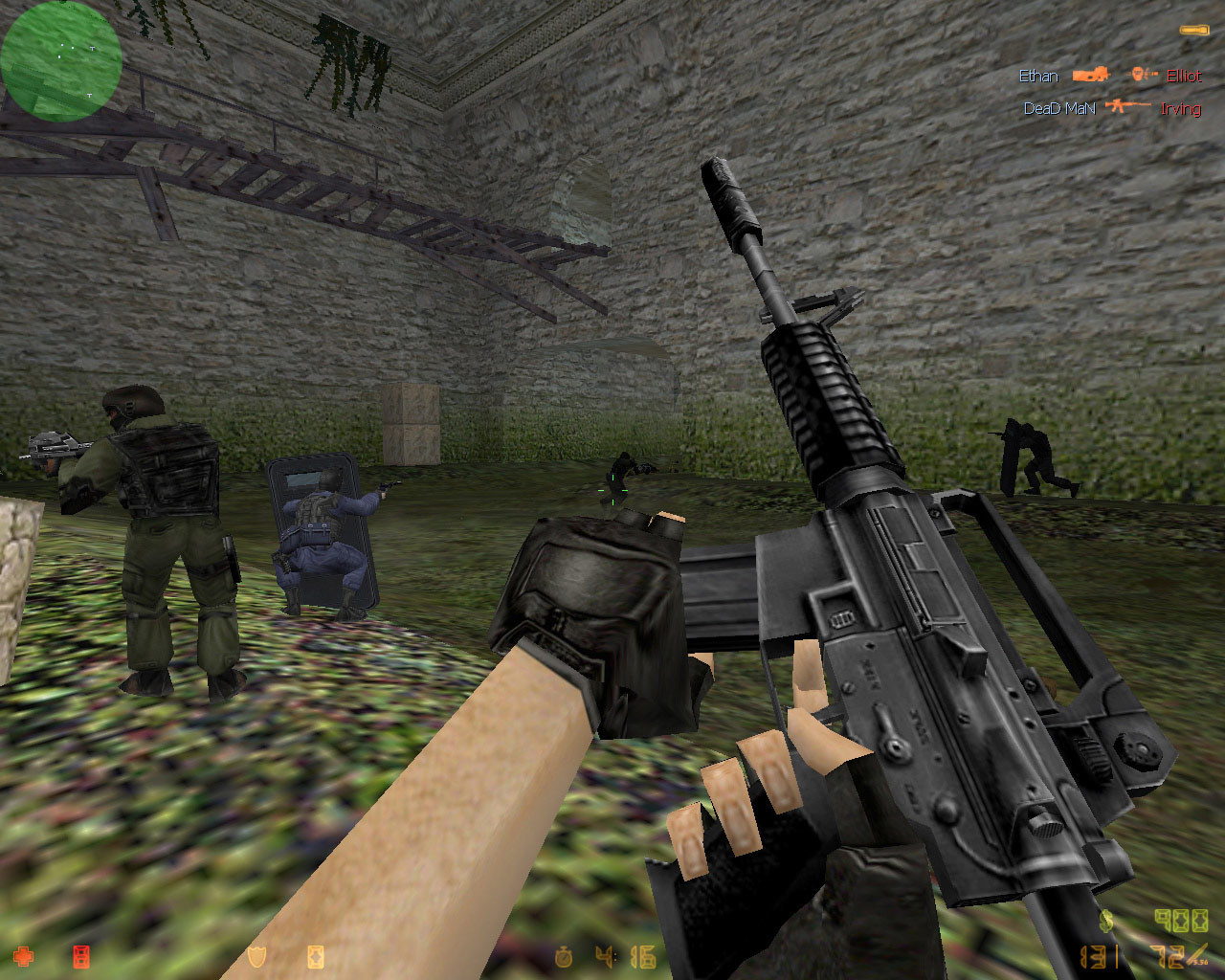
The map that stays in my head is cs_mansion. I remember the house, the garden, what I think was a pool, and the long hedge near the end where the CTs started. The terrorists were in the house, and the CTs had to get inside. There was a stone wall around the whole place.
I also remember getting beyond that wall and being able to see the map from underneath. You could see the other players. I do not remember whether you could actually shoot up through the ground, but I remember being able to look into the game from somewhere you clearly were not meant to be.
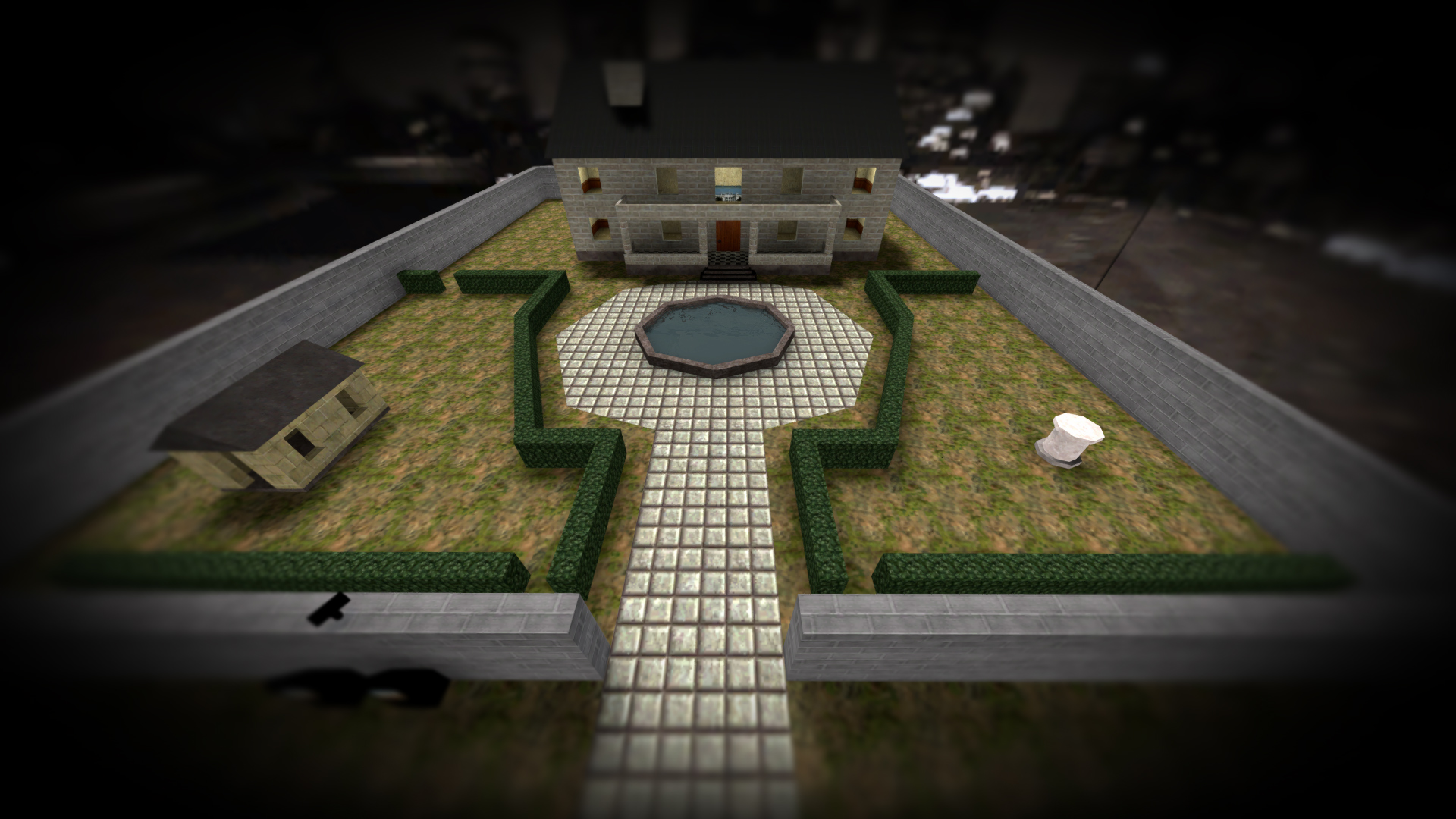
The original Mansion was made by Magnus Lind. In a 2000 interview, he explained that Cliffe had seen his Team Fortress Classic map Spyhard and contacted him through the email address in its readme. Lind had an exam coming up and initially said he did not have time. A few hours later, he decided to make a map anyway.
Mansion made it into the first beta. By the time of that interview, it had left the official map selection, but Lind was still seeing servers running it. Players kept it around.
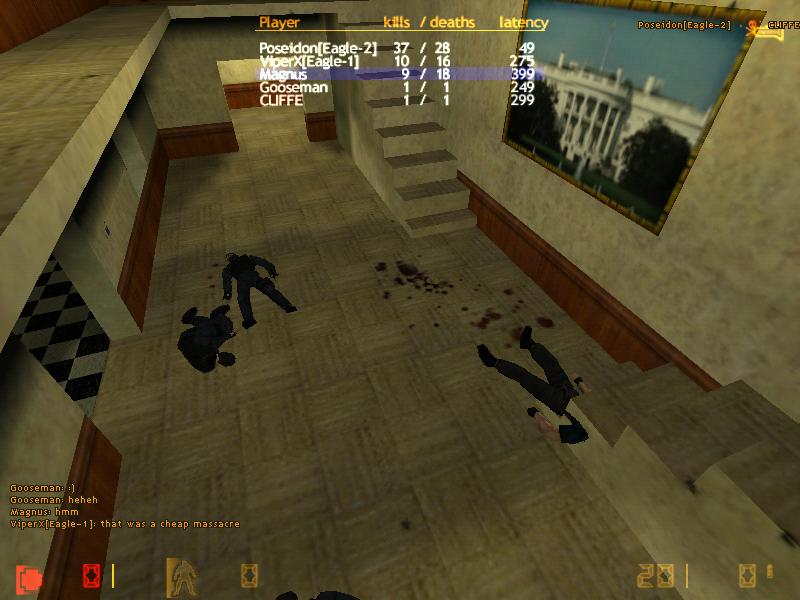
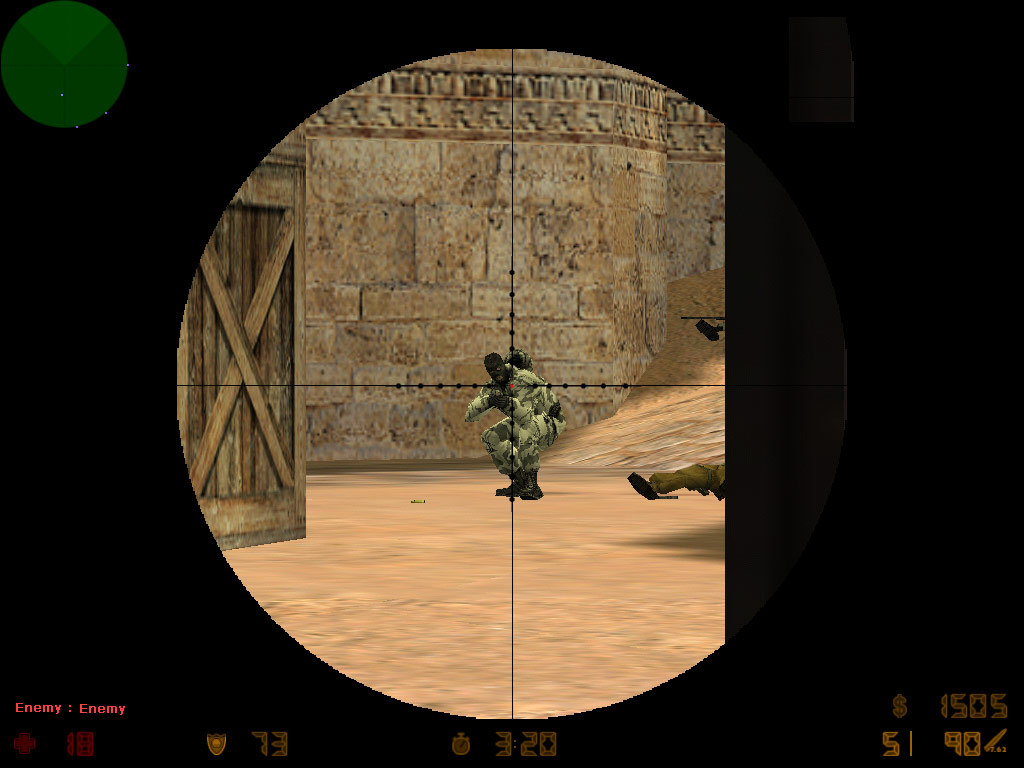
Dust has its own story. Dave Johnston describes taking visual inspiration from early military Team Fortress 2 screenshots and developing the map with textures by Chris “MacMan” Ashton. Its layout changed through playtesting, including the placement of a bomb site. Dust2 followed in version 1.1 in March 2001.
Valve saw what mods could do for Half-Life
Valve’s involvement became public on 12 April 2000, while Counter-Strike was still in beta. The partnership announcement promised financial and technical support and described plans to distribute CS 1.0 as a free upgrade to Half-Life players.
Gabe Newell also credited the mod community with helping Half-Life remain successful at retail and online. His wording was direct: “a lot of the credit for that goes to the MOD community’s support of Half-Life.”
That is the part I wish more companies understood. People needed Half-Life to play the CS mod. Counter-Strike gave them another reason to buy Half-Life, install it and keep coming back. I do not think Half-Life would have had the same attention over those years without CS, however good Half-Life itself was.
Le has spoken positively about selling the rights to Valve and said he was happy with how the legacy had been maintained. Valve helped a mod become a much larger game. The work of the original team and the surrounding community made that opportunity possible.
Steam was where I lost the connection
Steam launched on 12 September 2003. Valve’s anniversary history gives that date, and its 15 September announcement introduced the full-content Counter-Strike 1.6 installer after the Steam client and dedicated-server files had been released.
The official WON authentication service stayed around longer. Its shutdown was scheduled for 26–31 July 2004, with players directed towards Steam and 1.6. The change involved how people obtained updates, browsed for servers and accessed the game.
Counter-Strike 1.6 continued on the old Half-Life engine. By then, the game had already gone through years of changes. Beta 7 had brought graphical buying menus, and version 1.4 had changed jumping and bomb handling. Then 1.6 brought its new weapons and shield into that history.
I only played the Steam version a handful of times, and I never liked it. There was a gulf between me and the game. It was still called Counter-Strike, but it did not feel like the CS I had spent so much time loving.
It gives me a similar feeling to seeing something I already loved reworked into a version I have no connection with. I can understand starting over with a reboot. But I hate watching a good game get pissed on while everybody moves on to the next version. It already worked. Why keep tearing it apart?
The transition itself had real problems too. In his 2024 interview, Le recalled early Steam stability issues, players having to learn the new server-browsing system, and days when people could not log in to play.
Competitive Counter-Strike carried on for years. NIP beat X3 at CPL Winter 2001 before the Steam transition. By June 2012, IEM organiser Michal Blicharz was explaining why 1.6 had been removed as a main title. A later Counter-Strike release did not immediately end the older game’s competitive life.
The updates, bugs and compulsory advertising
One later decision sums up the control a publisher can have over a game people already bought. In December 2006, Valve’s Doug Lombardi told CS-Nation that in-game advertising was coming to CS 1.6. The reason for choosing it was the size of its audience. When asked whether players or server owners could opt out, his answer was: “The ads will not be optional.”
He also suggested successful advertising revenue might help fund future mods. Selling a game and later deciding that its players will become an advertising audience is exactly the sort of decision I do not want a company making over my collection.
The software continued changing in other ways. Valve’s 2013 update brought SteamPipe, Mac and Linux support and rendering changes. Another 2013 update returned Windows-message mouse input as the default after sensitivity changes and added a raw-input checkbox. Later security updates repaired problems involving downloads, server commands and file parsing.
The Half-Life 25th-anniversary engine work also reached Counter-Strike. In November 2023, Valve recommended the steam_legacy branches of both games for players still experiencing compatibility or stability problems. That branch preserves the pre-anniversary build.
As of 18 October 2026, the public issue tracker still contains reports worth knowing about:
| Report | Status and scope |
|---|---|
| Crosshair gaps across resolutions · #3679 | Open, with activity in April 2026. The report concerns inconsistent crosshair spacing at different resolutions. |
| Frame-dependent firing and movement · #403 | A long-running open thread, with comments continuing into July 2026. Valve acknowledged in 2013 that a related firing-rate repair needed porting to CS. |
| Linux demo-viewer crash · #3985 | Reported in April 2026 on Debian 12. Closed as a duplicate of an older report, with a legacy-branch workaround suggested in the discussion. |
The original beta notes also document repairs to hostage AI, aiming, weapons and exploits. Those early releases were being patched as the game grew.
The other Half-Life games around it
I played Opposing Force a couple of times, but I honestly remember very little of it. It was Gearbox’s official Half-Life expansion, released in 1999. The name is also sitting there on my coverdisc because the disc included its demo.
There is a later project called Operation: Black Mesa reimagining Opposing Force and Blue Shift. As of October 2026, its store page still lists the release date as to be announced.
I barely played Team Fortress Classic either. Team Fortress started as a Quake mod before its Half-Life incarnation, TFC. I remember trying it a handful of times, but CS was what I wanted to play.
It was much the same with Team Fortress 2 later on. I played a little, never got heavily into it, and thought it was overhyped. There has also been speculation about Team Fortress and Source 2, but Team Fortress 3 remains unannounced as of 18 October 2026.
The wider mod scene had far more going on than the games I spent time with. Sven Co-op let people work through levels cooperatively. Natural Selection combined a shooter with strategy and helped lead to Unknown Worlds. I did not spend my time exploring all of that. Counter-Strike was the mod that grabbed me.
Why shutting down mods makes so little sense to me
Counter-Strike would not exist today without a mod. That should make companies think very carefully before they start treating people who modify games as a problem to remove.
The original developers were using tools somebody else made available. The maps came from people building things because they wanted to. Players then gave those creations an audience. Valve ended up with one of the most important games in its history out of that process.
When a company closes down a mod or locks a game so tightly that people cannot build anything with it, I see it throwing away potential games, potential developers and good publicity. Whether the name on the company is Sony, Microsoft or anybody else, I struggle to understand that approach.
There are specific cases. In August 2024, the H2M team said it was shutting down after receiving an Activision cease-and-desist. That project was a Modern Warfare Remastered mod, stopped just before its planned release. People had put work into giving an older game another life.
Valve still provides a better example in some areas. Beyond Workshop, the February 2025 TF2 SDK release opened up the client and server game code for free, noncommercial mods and total conversions. Giving people tools to make something substantially different is the sort of support I want to see more of.
That old disc is why preservation matters to me
This is also why I keep coming back to discs. My coverdisc still records a particular moment in CS history: Beta 6.0, distributed with a Danish magazine. A current store page does not give me that version back.
Old files survive online too. The Counter-Strike beta preservation archive contains releases and their original documents. Physical copies give us another way of keeping those versions, separate from whichever update a company currently wants to distribute.
Valve’s own Half-Life anniversary update brought back material from old distribution discs, including the Uplink demo and content from the 1999 Further Data CD. Those old extras were worth keeping.
An old Half-Life installation and the matching mod files also belong to a different kind of setup from today’s Steam release. The original discs and patches can preserve the old LAN game. The official WON service is gone. Steam supplies the current account-based version, and its Subscriber Agreement ties access to subscriptions and restricts transferring accounts and subscriptions except where permitted.
I have pretty much stopped buying digital games and gone back to collecting original discs. I am tired of accounts, services and companies having so much control over access to something I paid for. A box with an account activation code can have the same problem, which is why the actual edition matters.
I want to spend more time talking about the disc games I have and showing gameplay on my channel. Maybe I end up talking into the void. I still want to push back on the direction this is going.
Some of the LitRPG books I read, especially the Russian ones, describe worlds where one company controls the game everyone depends on. Money is tied up inside it, banks are involved, and people earn their living there. That is the direction I see gaming being pushed towards: more of our money and access concentrated inside systems somebody else controls. I do not like it.
We still decide what we buy. We can stop paying for digital releases, subscriptions and extras that put more restrictions between us and our games, and spend that money on copies we can actually keep using. Complaining while continuing to fund the same treatment is not much of a pushback.
I still miss that Counter-Strike
I miss the late 90s and that period of gaming. I still dream about the days when gaming felt like that. They say ignorance is bliss. If I had known then what I know now, I think I would have appreciated those years even more than I did.
For me, the original CS mod was a god of a game. It shaped what Counter-Strike became, brought people into Half-Life and made me love FPS games. The Steam version never gave me that same connection.
If I get hold of an original Half-Life disc and get it working with the old CS mod, I may record some gameplay for the channel.
RIP to the Counter-Strike I grew up with. Until then, stay safe in the memories of the people who loved you.
Sources, image credits and the other Counter-Strike reviews
- The original Counter-Strike files and release notes
- Jess Cliffe’s retrospective
- Minh Le interviews: 2001
- Minh Le interviews: 2017
- Minh Le interviews: 2024
- The April 2000 Valve partnership announcement
- Magnus Lind’s original Mansion interview
- Dave Johnston on Dust
- Dave Johnston on Dust2
- Valve’s September 2003 CS 1.6 installer announcement
- Doug Lombardi on advertising in CS 1.6
- Valve’s Half-Life SDK and public issue tracker
The coverdisc photograph is mine. The historical Mansion image comes from Magnus Lind’s interview. The later Mansion overview is credited to its CS:GO recreation’s creators. The two original-CS promotional screenshots come from Valve’s Steam store listing.
My other Counter-Strike reviews