

I rarely buy duck. I usually find it sweet and fatty without a particularly powerful flavour. I have a similar problem with chicken, but the fat makes it worse with duck. Most of the time, I buy it at Christmas or when I see a discount I cannot say no to.
Netto had a 2.4 kg whole duck reduced to 65 DKK. That was already cheap. Then another offer followed at 49 DKK, which is a crazy price for a whole duck. I bought one. The question was what to make with it and how much food I could get out of it.
What the duck cost
The whole ducks I normally see cost around 100–150 DKK. Here is what this one cost, including the price per kilogram and the duck cost spread over my five days of food.
| Price or calculation | DKK | Approx. USD | Approx. EUR | Approx. GBP |
|---|---|---|---|---|
| The usual prices I see | 100–150 DKK | US$14.97–22.46 | €13.38–20.07 | £11.20–16.80 |
| The first offer | 65 DKK | US$9.73 | €8.70 | £7.28 |
| What I paid | 49 DKK | US$7.34 | €6.56 | £5.49 |
| Whole raw duck, per kg | 20.42 DKK | US$3.06 | €2.73 | £2.29 |
| Duck cost per day, over five days | 9.80 DKK | US$1.47 | €1.31 | £1.10 |
Conversions use European Central Bank reference rates for 23 October 2026, rounded to two decimals. The daily figure is the cost of the duck alone; potatoes, vegetables, gravy ingredients and cooking energy are extra.
My problem with a whole bird is how little convenient meat there seems to be for its size. There are the breasts, thighs and drumsticks. After that, you are picking around the carcass. You can sit there gnawing the rest off the bones like a cannibal if you want. I used the carcass for stock and picked the remaining meat off after cooking it.
Duck also carries a substantial amount of fat with its skin. DTU’s 2026 food-composition reference table lists raw duck meat with skin at 39.3 g fat per 100 g, compared with 5.1 g for raw duck meat without skin.
A rack, vegetables and water underneath
I used a roasting tray with a rack. Underneath the duck, I put vegetables, water and the giblets that came with it. Ginger was one of the vegetables and aromatics in the tray. The duck sat above everything on the rack, with the cooking liquid collecting below.


The oven was set to 175°C. I have never really liked that oven, but the whole duck was too big for my air fryer. I used the thermometer to judge when to take it out. It reached 75°C, and I think it was nearer 78°C before I removed the probe.

Even with that reading, the meat looked too pink for me, with bloody-looking juices. I would not have eaten it looking like that without cooking it further. I took off the breasts and legs, and the breast for my first meal went into the air fryer. I wanted to finish the portion I was eating without giving the whole bird another long cooking and making the meat dry as hell.
For a whole duck, USDA recommends checking the thickest breast and the innermost thigh and wing areas, with at least 74°C throughout. Duck can remain pink after reaching a safe temperature.
The vegetables, giblets and flour-thickened gravy
I blended the roasting vegetables and put them in the freezer. All the liquid from the tray went into the gravy.


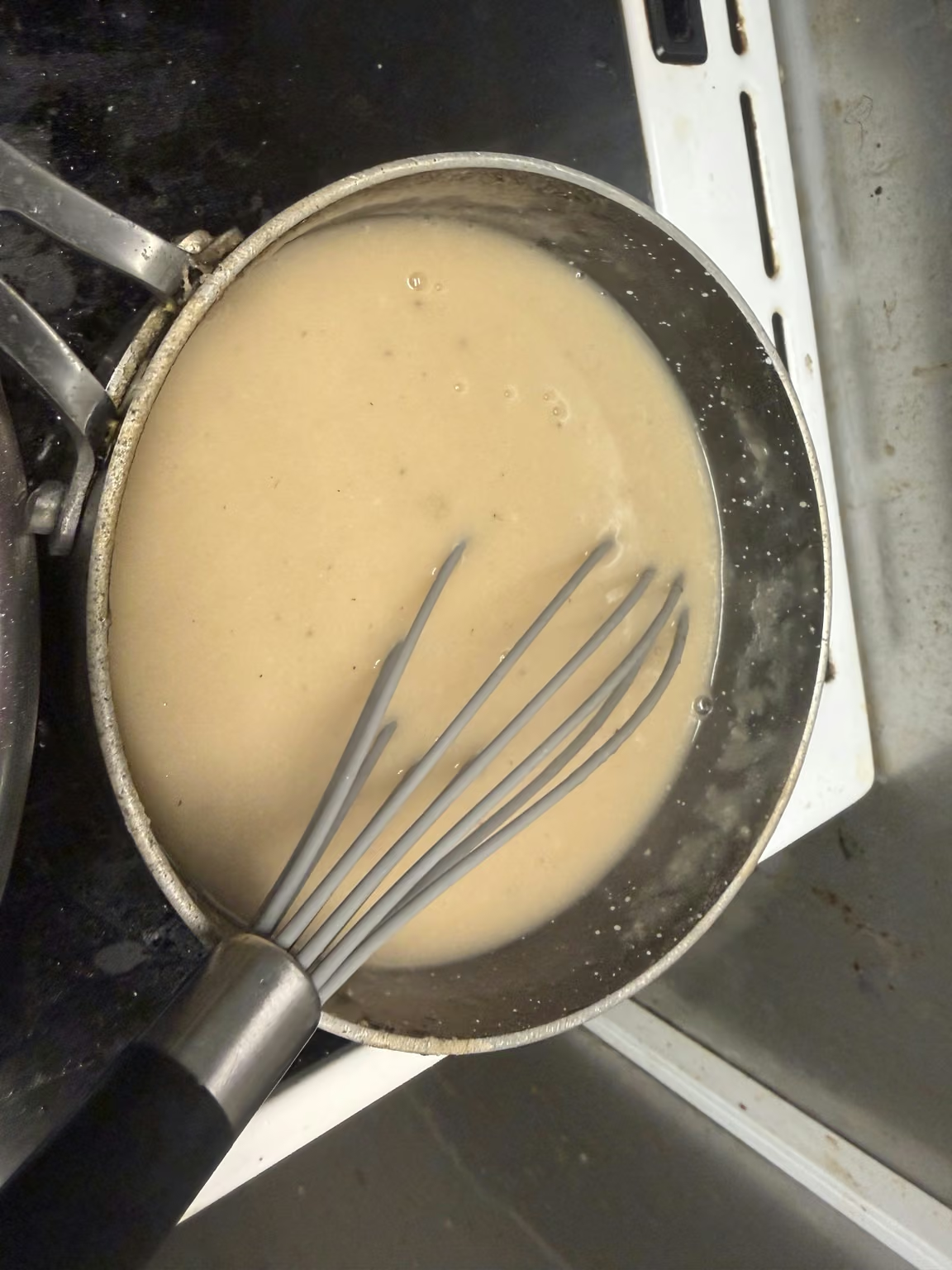
I made what we call opbagt sovs in Danish: a flour-thickened gravy. I hate the word “roux”, but that was the base. I melted a big piece of AMA frying margarine, added flour and cooked it together before whisking in the duck liquid. It made a thick duck gravy.


Normally, I would add kulør, the gravy colouring we use to make the sauce brown. I had none left, and the shop did not have any either, so it stayed pale.
I snacked on the giblets. Because there was ginger in the tray, the liver had a ginger aftertaste. It was not bad. Just weird.
For the first plate, I boiled potatoes and served them with the air-fried duck breast and gravy.

The following day, the carcass went into the pot
There was still a lot left after removing the breasts and legs. I packed the remaining duck into a bag. The following day, the carcass and remaining duck went into a pot of water. I boiled the hell out of it, then picked the meat away from the bones.


I thought I had been through it thoroughly, but I still missed a few small bones. Some were smaller than the ones I normally find when I boil chicken. Picking the meat takes care, especially when you are working through the little pieces around the carcass.


Strain the stock through a fine sieve and check the picked meat separately, spread out in a thin layer, for any remaining bones.
Using a roasted poultry carcass for stock is a standard way to recover more from the bird. The Culinary Institute of America explains how connective tissue gives stock its gelatinous body. A gentle simmer usually gives a clearer result than a hard boil. The fat that rises to the surface is separate from that gelatin-rich liquid and can be skimmed off.
By this point, my cooking liquid had become a rich stock. I used some to loosen the gravy and froze the rest.
Keeping portions for later
For making this ahead, fully cook the duck before chilling it, then reheat individual portions. USDA advises against partially cooking duck, refrigerating it and finishing it another day.
Fødevarestyrelsen recommends cooling leftovers quickly: let them steam off only briefly, divide large quantities into smaller containers and keep the refrigerator at no more than 5°C. That applies to the meat, gravy, blended vegetables and stock. For a five-day plan, freeze the later portions promptly; USDA’s refrigerated storage guidance for cooked duck is 3–4 days at approximately 4°C.
Reheat the meat thoroughly and bring gravy to a rolling boil while stirring. University of Florida food-safety guidance recommends at least 74°C for reheated leftovers. Heat the portion you need instead of repeatedly warming the whole batch.
Pan-fried duck, potatoes and the gravy from the day before
For the next meal, I put some of the recovered duck into my hybrid frying pan and fried it. I reheated the gravy from the day before, adding some of the stock from the pot to thin it, and boiled another batch of potatoes.


I put pickled red cabbage and frozen mixed vegetables on the plate and microwaved them for about two minutes. Then I added the potatoes and fried duck, with gravy over the potatoes.
Frozen vegetables need cooking according to their packet instructions. Food-safety guidance notes that microwave cooking time depends on the food and quantity; stir or turn the food as needed and make sure it is hot throughout.

Altogether, that one duck gave me food for five days, with stock and the blended roasting vegetables saved in the freezer.
Photographs by Kiba Snowpaw.