
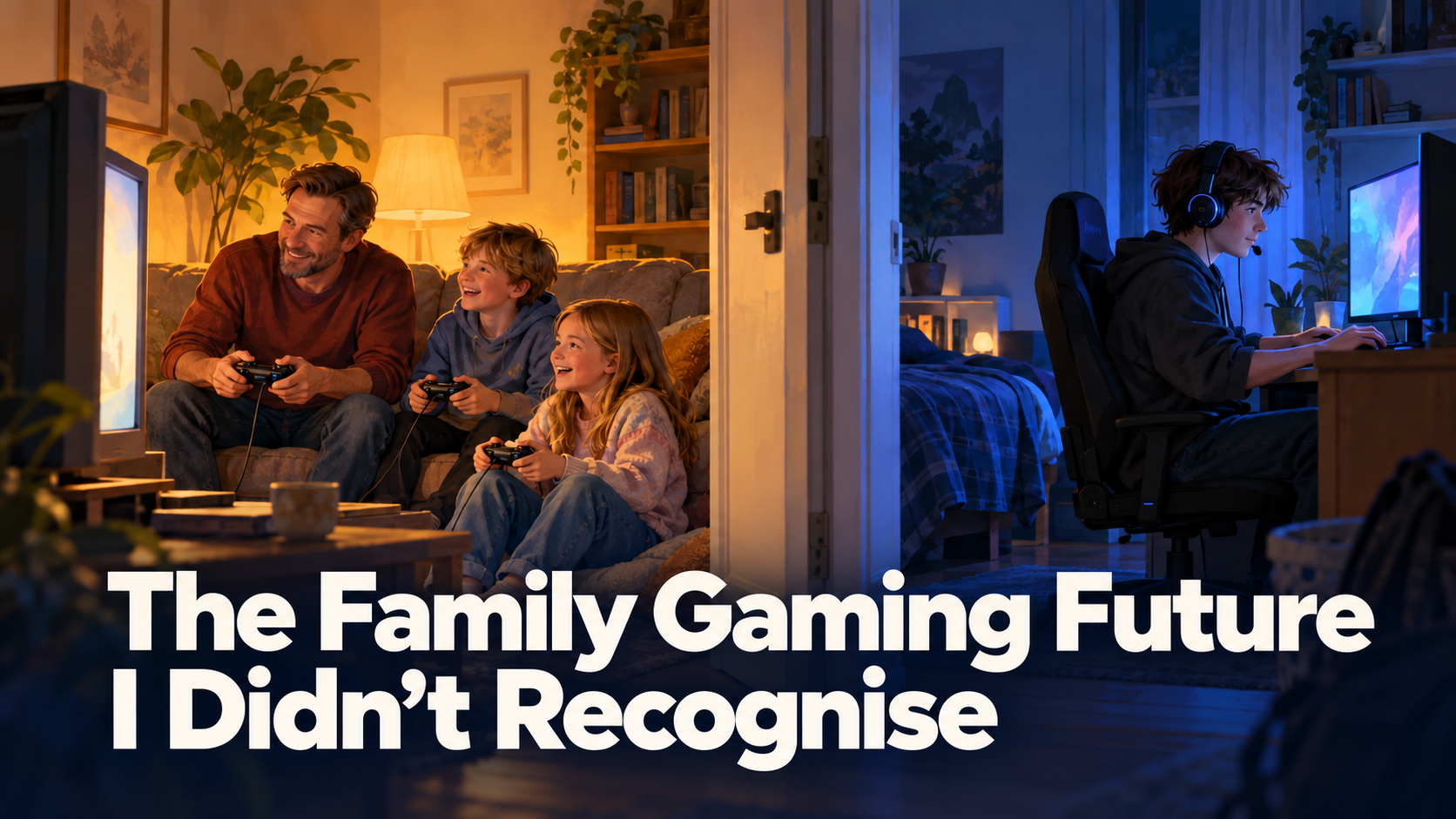
The family gaming future described in this 2005 clipping from Komputer for alle was not the one I recognised around me. Families would spend their evenings together in online games, including parents, children, uncles, aunts and grandparents. Gaming would bring them together instead of leaving everyone isolated.
Family gaming certainly happened. I know someone who played World of Warcraft with their mum. People played Wii games with their families too. What I saw far more often, though, was people playing with friends or strangers online. The family gathered around a game was a much neater picture than ordinary multiplayer life.

What the article was predicting
The researcher quoted is sociologist T. L. Taylor, then at the IT University of Copenhagen. The article describes a visit to its games research centre after a conference about the future of games. It presents her prediction that relatives would use online games to spend time together even when they lived at opposite ends of the country, with friends and colleagues joining them.
There are several claims packed into that small piece. Gaming would become part of everyday life, taking time from television and activities such as sport. Children could sometimes know more than their parents and lead them in the game. Players could develop responsibility and leadership useful outside it. Games would reach different audiences and devices, support smaller groups as well as huge online worlds, and be played both indoors and outdoors. Eventually, being online would barely be something we thought about.
Taylor was challenging the image of the isolated computer nerd. Her 2006 book Play Between Worlds examined the social life of EverQuest, including relationships crossing between the game and the physical world. That work also dealt with demanding forms of play that could resemble work. Her research was broader than this short, optimistic magazine item.
The technology was already capable of connecting people. The bigger question was whether families would choose to use it together regularly, and what would happen to the rest of their lives while they played.
Playing with your mum really did happen
Asmongold is a public example. In the clip below, he describes his mother telling him to go to bed, his explanation that he could not pause an online game, and how he got her interested in playing. She obtained her own account and, according to him, started playing more than he did. Family participation and arguments about bedtime appear in the same story.
There is also nothing new about people sharing games at home. The Magnavox Odyssey arrived in 1972 with two controllers, television overlays and physical accessories. Shared play was part of home video gaming from its beginnings. Online worlds added the possibility of sharing an activity across distance, without everyone needing to be in the same house.
For relatives who already enjoy the same game, that can work very well. They have something to do together, something to talk about and a reason to arrange another evening. The difficult part is getting people with different interests, abilities and schedules to keep wanting that same activity.
How normal was family gaming?
A useful early comparison comes from Pew Research Center’s 2008 US survey. Among parents of teenagers aged 12–17, 69% said they played video games with their children rarely or never. Playing together existed in plenty of households, but it was far from universal.
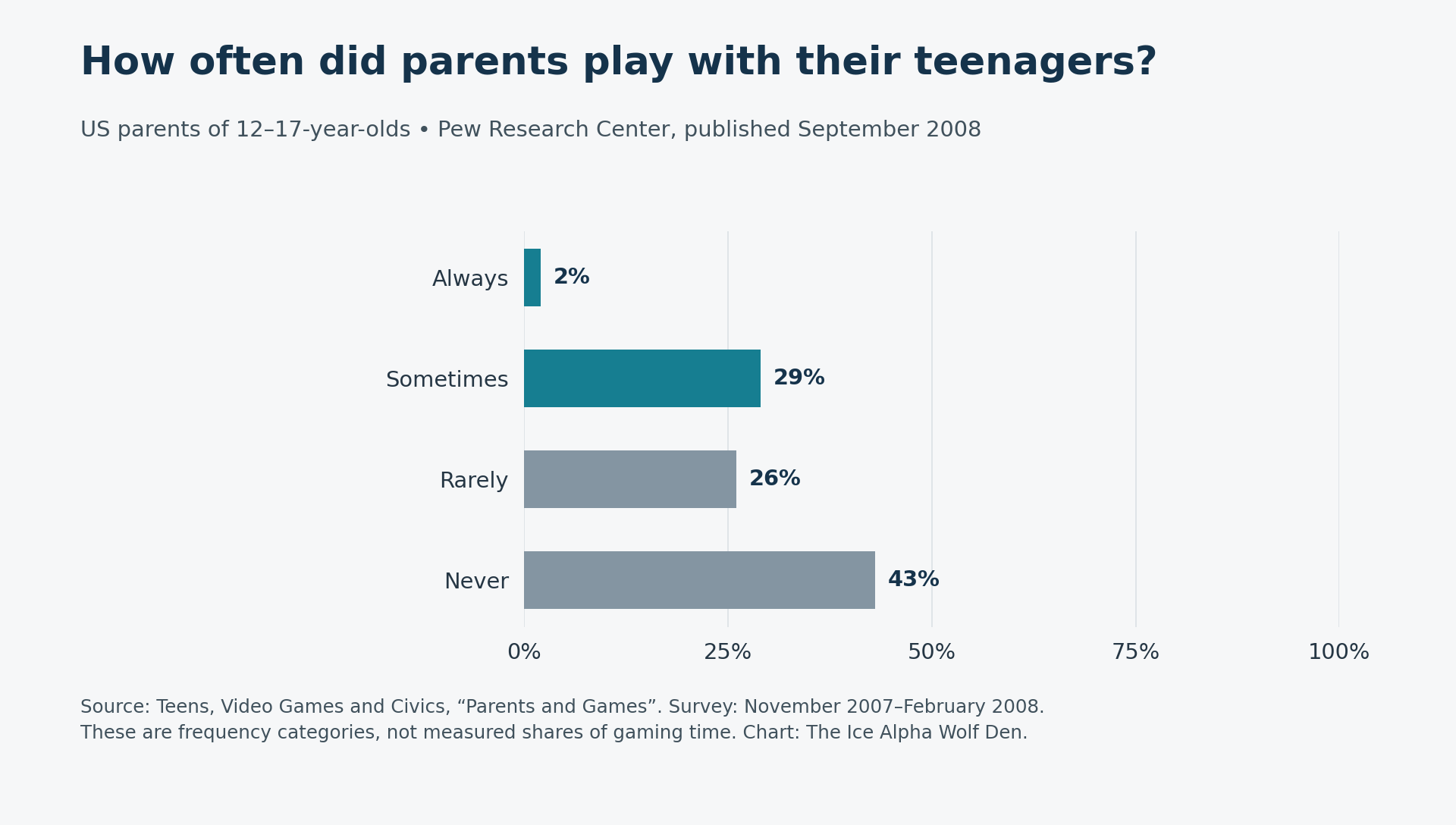
Gaming with other people was much more widespread. In the same report, 76% of teen gamers played with others in some form, including 65% who played with somebody in the same room. That included relationships beyond parents and children. Social gaming was already ordinary; routine parent–child gaming was a different question.
The present-day picture includes much more family participation. The US industry association ESA’s 2026 Essential Facts report says 75% of parents play video games. Among those gaming parents, 81% have played with their children and 52% play with them weekly. Those figures concern gaming parents with children, whereas Pew’s earlier figures concerned parents of teenagers. They establish substantial participation today without giving us a like-for-like measure of change since 2005.
That is a considerable amount of family gaming. It also leaves room for the distinction that bothered me in the first place: playing with a parent sometimes, or even every week, does not tell us who fills the rest of a player’s gaming hours. A shared session can sit alongside many evenings spent with friends, strangers or a single-player game.
Wii gave the family pitch something practical behind it
Nintendo’s Wii, released in 2006, made joining in easier. Wii Sports let people bowl or swing a tennis racket through movements with the Wii Remote. Someone could understand the basic action without first learning a large set of buttons, character classes or equipment statistics. People watching the television could follow what was happening too.
The family message was explicit. In an October 2007 investor presentation, Nintendo president Satoru Iwata described increasing the number of users within each household and encouraging family members in the living room to use the Wii Remote. This was part of Nintendo’s stated aim of expanding the gaming population.
I can see why that sold the idea. A console that everyone might enjoy is easier to justify as a household purchase. The design genuinely made participation easier, and the family image also helped sell the machine. Neither the controller nor the advertising could supply a shared interest that lasted indefinitely.
An occasional game of bowling in the living room also asks much less of somebody than keeping a character ready for a regular online group. Calling both “family gaming” hides a large difference in commitment. The magazine’s extended family would still need compatible games, equipment, time and a willingness to learn.
Steam, separate rooms and the people on the other end
With Steam and online multiplayer, it is easy for an evening’s entertainment to stay at the computer. You can have the game, the people to play it with and the conversation there. There is less practical need to go somewhere and gather around somebody else’s machine. That is the part of modern gaming that makes me question the cheerful family picture most.
A household can have several people playing online from separate rooms, each occupied with a different group. They may all be socialising, while barely spending any of that evening with one another. The presence of multiplayer does not make an activity shared family time.
Steam also supports ways of playing together. Valve’s Remote Play Together lets people play supported local multiplayer games across the internet, with one person hosting the game. Steam Families became generally available in September 2024, adding household library sharing and parental features. Library sharing manages access; it does not determine whether family members actually play together.
The convenience can keep someone in their room, but it can also keep a distant friendship alive. Being physically alone, lacking social contact and feeling lonely are different things. Someone can be alone at a PC and have close friends talking to them. Someone else can have a full voice channel and still feel ignored or unwanted.
A 2025 study following Czech adolescents across four survey waves illustrates the difficulty. Adolescents who generally played more socially also reported more loneliness, yet increases in an individual’s social gaming were associated with less subsequent loneliness overall. The patterns differed by gender, with more favourable results for boys than girls. The relationship depended on whose experience was being followed and how it was measured.
My concern is how easily gaming can become the default for every free evening. If it gradually replaces seeing people, going outside and spending time with the people at home, the household loses something. That can happen even when the online friendships are real. It will not describe every child or every Steam user.
Why games can feel so important
Games offer very concrete reasons to return. You can improve at something, make decisions and feel that other people need you. Research using self-determination theory connects their appeal with competence, autonomy and relatedness: feeling capable, having some control over what you do, and feeling connected to others.
Those needs help explain both the attraction and the possible difficulty. A group that recognises your contribution can be a good part of life. If the game becomes the only place where you feel capable or accepted, leaving it means leaving that recognition too. Problems at school, loneliness or a difficult home life can make the online group especially important. Removing access alone does not repair those other problems.
There is also a difference between wanting another session and feeling obliged to attend. A scheduled group needs its members. Missing a session can mean letting friends down or falling behind. Where rewards depend on returning regularly, the game adds another reason to log in. Enjoyment, habit and obligation can become mixed together.
An Oxford-led study published in 2022 followed nearly 40,000 players across seven games for six weeks, using recorded play data. It found little evidence that changes in playing time caused changes in wellbeing across that period. Players’ motivations, including feeling compelled to play, were more informative than the hour count alone. That is a better account of the problem than treating every long session as the same experience.
Children, family relationships and learning to stop
Taylor’s example of a son knowing more than his father has something useful in it. She also imagines the son having more money inside the game: family authority does not determine who has the better-equipped character or more virtual resources. A child can explain the rules, make a plan and contribute expertise the parent lacks. A parent willing to listen can discover something about the child’s interests instead of only arriving to announce that playing time is over.
That works best when the interaction is enjoyable for both people. An impatient expert ordering a beginner around can make the same activity miserable. A parent joining every session can also turn a child’s time with friends into another supervised activity. Children need opportunities to build their own relationships as well as time with their families.
A 2011 study of 287 adolescents and their parents found favourable associations between parent–child co-play and several behavioural outcomes among girls. It was a questionnaire study, and the findings were not identical for boys. Shared gaming can provide a setting for a good relationship; the quality of that relationship still matters.
The same applies when play ends. An online match or group activity may not have a pause button. The practical answer needs to account for the session’s length before it begins. Starting another lengthy activity just before bedtime creates a predictable conflict. Parents understanding the game and children understanding the time available are both more useful than repeatedly having that argument halfway through.
The time comes from somewhere
The clipping says gaming would take time from television and activities such as sport, while presenting the time spent as worthwhile. Those replacements have different consequences. Replacing an evening of television with a good shared game can add conversation and participation. Replacing sleep, exercise or the only regular meeting with friends costs something else.

Pew’s 2024 report found that 89% of US teen video game players played with other people, online or in person. Nearly half had made an online friend through gaming. At the same time, 41% said gaming had hurt how much sleep they got. Benefits and costs were present in the same population.
A 2021 systematic review also found associations between problematic gaming and shorter sleep, poorer sleep quality and other sleep problems. Most included studies were cross-sectional, leaving the direction of the relationship unresolved. Someone struggling to sleep may play more, and late play may also cut into the time available for sleep.
There is some experimental evidence worth considering closer to home. A Danish trial analysis published in 2024 involved 89 families with 181 children and adolescents. Families assigned to a two-week reduction cut leisure screen use to three hours a week or less per person and handed over smartphones and tablets. The intervention improved questionnaire measures of psychological difficulties and prosocial behaviour compared with the control group. It tested a short, intensive change across the family’s screen habits, rather than isolating gaming or establishing a permanent limit for every child.
Even the physical activity picture resists a simple story of inevitable decline. Sport England’s 2024–25 survey reported its highest proportion of active children since the series began in 2017–18, although only about 49% met the average daily activity guideline. There are substantial problems without every measure becoming worse every year.
When gaming becomes a serious problem
The WHO’s definition of gaming disorder centres on impaired control, gaming taking priority over other activities, and continuing despite harmful consequences. The pattern must cause significant impairment in important areas of life and would normally have been evident for at least 12 months. An enthusiastic player’s hours alone do not establish that pattern.
Recent European data show why concern deserves more than a dismissive answer. In ESPAD’s 2024 survey of 15–16-year-old students, 17% reported four or more hours of gaming on a typical school day during the previous month, rising to 32% on a non-school day. Across participating countries, 22% scored in the high range on a three-item measure of self-perceived gaming problems; Denmark’s figure was 13%. Those are screening results, rather than clinical diagnoses.
The everyday consequences are what make this serious: repeatedly losing sleep, missing school, abandoning other activities, damaging relationships and being unable to change the pattern despite wanting to. Multiplayer does not prevent those problems. A person can have friends inside a game and still have a life outside it that is coming apart.
Do responsibility and leadership carry over?
There are real people behind a multiplayer team. Arranging attendance, explaining a plan, helping a beginner and handling a disagreement all involve social behaviour. A child who does those things is practising them. Whether the experience helps elsewhere depends on what was learnt and how it gets used.
The broad promise of transferable benefits is much less settled. A 2018 meta-analysis found little support for video game training producing general improvements in cognitive ability. Another meta-analysis of action games reported benefits in more specific areas, particularly attention and spatial cognition, while identifying publication bias as a concern. Neither result establishes that managing a game group automatically teaches responsibility or makes somebody a good leader elsewhere.
Leadership inside a game can include patience and useful explanations. It can also include shouting until people obey or excluding anyone who slows the group down. The behaviour being practised matters. A successful raid does not tell us everything about how its leader treats people.
China chose compulsory restrictions
China’s response shows how far policy moved from the magazine’s relaxed forecast. Its 2019 rules limited minors’ online gaming services to 90 minutes on ordinary days and three hours on public holidays, with access prohibited between 10 p.m. and 8 a.m.
From 1 September 2021, the National Press and Publication Administration imposed much stricter limits. Online game companies could provide services to under-18s only between 8 p.m. and 9 p.m. on Fridays, Saturdays, Sundays and statutory public holidays. That means three permitted hours in an ordinary week, with additional permitted days when statutory holidays apply. The notice also required real-name registration and identity verification.
These are restrictions on minors’ access to online gaming services. Broader Regulations on the Protection of Minors in Cyberspace, effective in January 2024, cover additional duties across online services, including protective modes and measures against compulsive use. There is no single three-hours-a-week allowance covering all internet use. NetEase’s summer 2026 gaming schedule, reported by Xinhua, continued the Friday-to-Sunday evening pattern.
The NPPA described parental concerns and harm to children’s studies and healthy development as reasons for tightening the rules. An industry report published on its website in December 2024 claimed substantial reductions in minors’ longer gaming sessions. Independent assessment has been harder. A 2023 study using more than seven billion hours of play records found no meaningful reduction in heavy play in its sample around the 2019 restrictions. The dataset lacked players’ ages, so it could not separate the effect on children from adults’ behaviour.
I understand wanting to protect children’s sleep and stop gaming from taking over everything. A compulsory national timetable also removes a great deal of choice, and identity checks bring their own privacy costs. Enforcing an hour of access does not establish that a child is happier, has better relationships or spends the freed time doing something worthwhile. Those outcomes need attention too.
Some predictions were much closer to the mark
Taylor’s comments about varied audiences, portable devices and different group sizes have aged well. Games do not have to place thousands of people in one world to connect them. A small cooperative group can suit people better, and portable play makes the location much less fixed. Her point about people no longer constantly distinguishing between online and offline also describes much of how connected devices are used now.
The weak part of the clipping is its confidence that this would naturally resolve isolation through family togetherness. The means to play together became widely available. The relationships, shared interests and healthy habits still required work. The item gives those difficulties very little space.
I still find the family image too tidy. I know it happened, and family gaming is an ordinary activity in many homes today. What bothers me is how easily “playing with other people” becomes the answer to every concern. I can be talking to somebody online while spending another whole evening away from everyone in my own house. There are people on both sides of that bedroom door.
Magazine source: Komputer for alle, “Fremtidens familie spiller netspil”, BK, 20.01.05–09.02.05. Photograph supplied by Kiba Snowpaw; magazine text and game imagery remain credited to their respective rights holders. Charts use the linked Pew Research Center data. Research references checked 23 October 2026.