
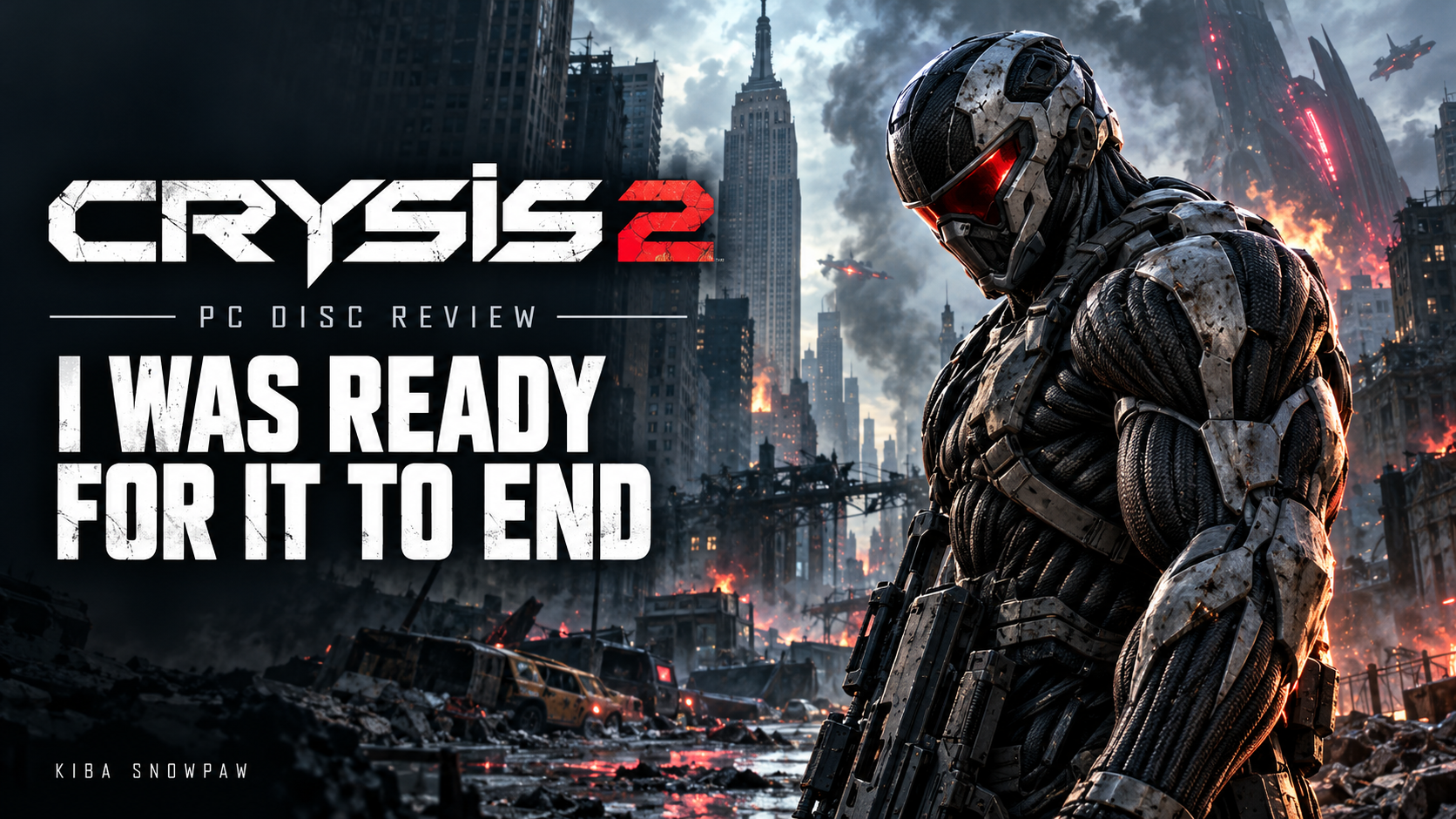
By about halfway through Crysis 2, I was already wondering when I would be done. I finished it on 23 June 2026, after roughly six and a half hours, and I cannot say I enjoyed much of that time. It felt heavy on my PC, the alien collecting became pointless once I had the upgrades I wanted, and the campaign bored me.
This is the original 2011 PC game, installed from my DVD and played through Wine on Linux. My experience with the first two games is in my Crysis disc review and Crysis Warhead disc review. Coming from those, the suit upgrades in this one were a change I really did not like.
My two gameplay sessions
I played the campaign over two sessions on 22 and 23 June 2026. Both recordings are below, in order.
Watch my Crysis 2 disc playthrough — two sessions
- S01P01 — 22 June 2026 — 1:46:42. Play in the player above · Open the original YouTube recording
- S01P02 — 23 June 2026 — 4:21:20. Play in the player above · Open the original YouTube recording
Why Crytek took Crysis to New York
Crytek and EA announced Crysis 2 on 1 June 2009 for PC, Xbox 360 and PlayStation 3. It was built with CryEngine 3 and was Crytek’s first simultaneous move onto those consoles. The game released on 22 March 2011 in North America and 25 March in Europe, taking the alien invasion into New York in 2023.
Executive producer Nathan Camarillo explained the choice in a 2010 interview with Gaming Target. The team wanted a stronger connection to a civilian population than the remote island had provided. They considered several cities; New York offered recognizable buildings, parks, streets and rooftops, with changes in height that could suit the nanosuit.
The platform change also had a financial reason. In the Digital Foundry making-of interview, Crytek’s Tiago Sousa said the scale the studio wanted could not be justified by the PC market alone. He described development across the three platforms without a single lead platform. Console limits also pushed work on memory use and rendering efficiency.
Crytek returned to this history in the second episode of its 25-year documentary, released on 7 August 2025. The retrospective covers the team’s New York research trip and the work involved in moving Crysis into an urban setting.
The result is a more directed series of city spaces. Individual encounters offer choices about cover, height and approach, while the campaign follows a tighter route through the invasion. PC Gamer’s contemporary review also described the reduction in freedom from the original.
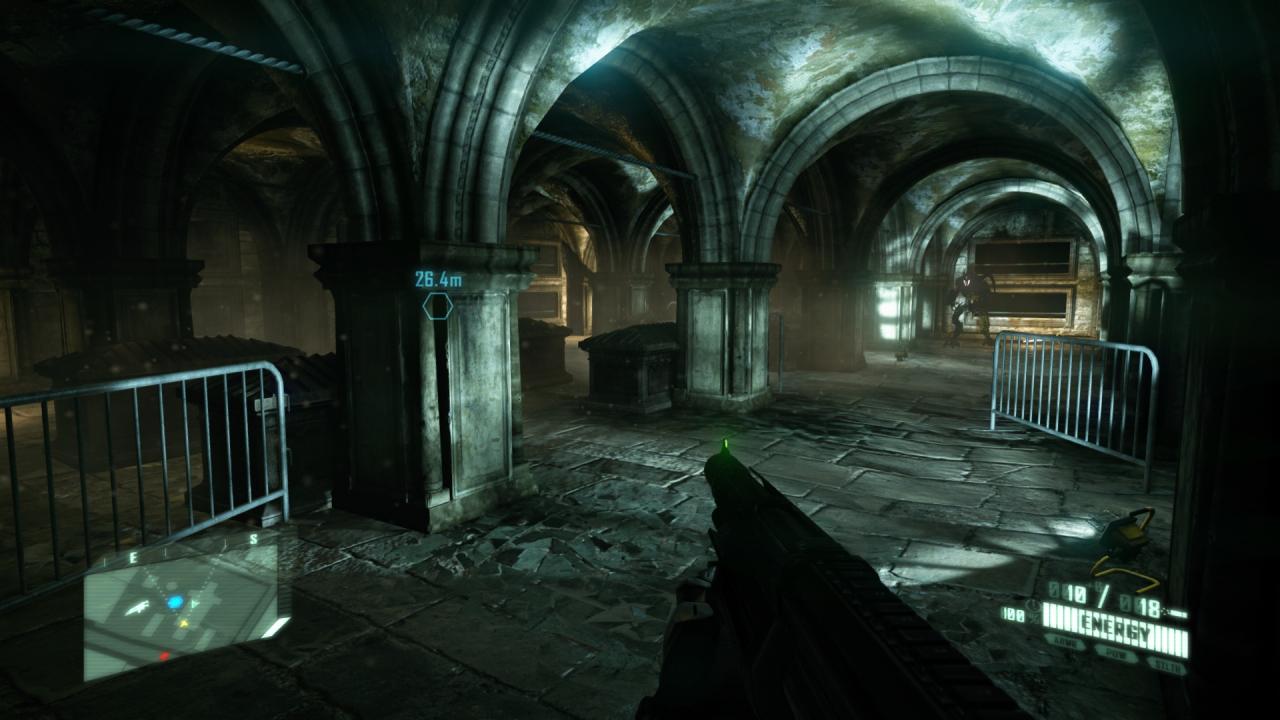
The alien catalyst stopped giving me a reason to fight
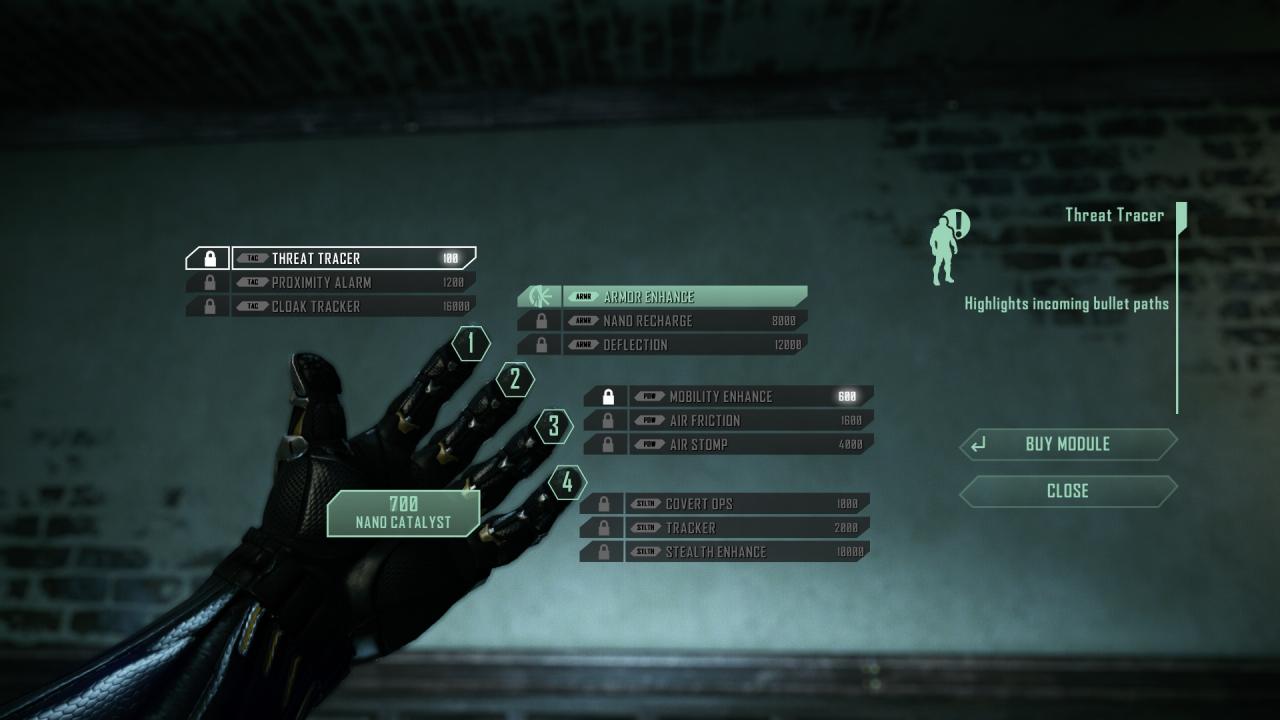
The alien DNA system, or Nano Catalyst as the game calls it, was my biggest problem with the progression. You collect catalyst from dead aliens and spend it on suit modules. The PC manual divides the single-player upgrades into four categories: Tactical, Armor, Power and Stealth.
Each category has three modules, and you can have one from each category active at a time. You can buy alternatives and switch between them. These are passive modifications to the suit, covering things such as enemy information, protection, movement and stealth.
| Category | Modules |
|---|---|
| Tactical | Threat Tracer, Proximity Alarm, Cloak Tracker |
| Armor | Armor Enhance, Nano Recharge, Deflection |
| Power | Mobility Enhance, Air Friction, Air Stomp |
| Stealth | Covert Ops, Tracker, Stealth Enhance |
I saved for the upgrades I thought were best. Once I had those, what was I supposed to do with the rest of the catalyst? I had no interest in collecting everything just to leave most of it inactive. The collecting had already done its job, and the game carried on dropping more.
The collecting felt grindy, then became useless once I had the modules I wanted. I assume it was meant to give me another reason to kill the aliens. For me, that reason disappeared well before the campaign ended.
When I could get past the aliens without fighting, I often did. I would ignore them and keep going. There were still encounters I had to deal with, but I had stopped looking at the next group as something worth clearing out for upgrades.
Camarillo described being able to change modules during the campaign much like changing weapon attachments. That flexibility is there, but I settled on what I wanted and had little interest in the remaining choices. I would have preferred the game to give the catalyst a useful purpose after that, or to make the individual alternatives interesting enough that I actually wanted to use them.
The suit became harder to care about
Story spoilers for Crysis and Crysis 2 follow.
Crysis 2 puts you in the role of Alcatraz, a badly wounded Marine whom Prophet saves by giving him the Nanosuit 2. The suit keeps him alive, while the Ceph invasion, infection and CELL forces close in around him. Its relationship with Alcatraz becomes central to the story.
What bothered me was how much the suit had changed as a story device. In the first game’s opening mission, Prophet vaporizes Aztec’s body and suit to prevent the Koreans getting the technology. In this one, the suit’s biological integration with its wearer becomes a major part of what makes Alcatraz’s situation so unusual. Hargreave still wants the suit and attempts to have it removed from him.
I found that awkward coming from the first game. The sequel turns the suit into something much more closely tied to the person inside it, while also building so much of the plot around people trying to get it. The Nanosuit 2 takes the technology further, but I did not like how suddenly the story leaned into the biological connection and alien technology.
Crytek brought in novelist Richard Morgan to write the story. Peter Watts, who consulted on the suit and wrote the novelization Crysis: Legion, later gave an interesting account of the production. In his interview hosted by Middletown Public Library, Watts said some mission levels were already fixed when he was approached, leaving the writing to fit around them. He also described changes to the plot during development.
The game’s story did not make me want to stay with it. By then I was already tired of the progression, and the suit explanation did very little to help.
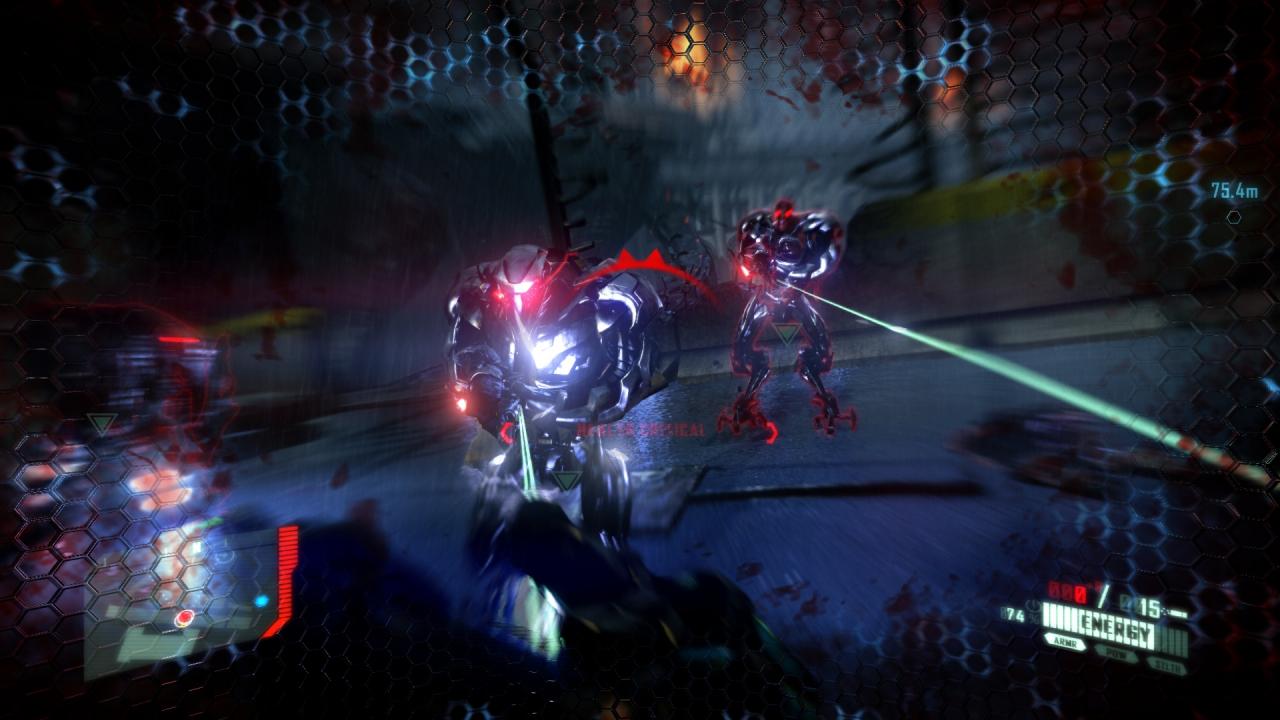
The PC version needed work after release
Crysis had built a reputation around pushing PC hardware, yet Crysis 2 arrived with DirectX 9 and a small set of graphics presets. PC Games Hardware’s launch-period configuration guide describes how limited the in-game controls were and the configuration-file work needed to adjust individual settings.
There were also actual bugs to fix. The patch history includes problems with the same catalyst system I disliked, along with AI interaction, login, statistics and graphics issues.
| Update | Changes recorded at the time |
|---|---|
| 1.2 — April 2011 | A reported fix for catalyst disappearing after restarting, plus crouch-toggle and multiplayer changes. Contemporary patch report. |
| 1.4 — April 2011 | Fixes included a rare failed AI interaction, reduced audio-memory use, graphics optimizations and several multiplayer problems. Preserved Crytek notes. |
| 1.8 — June 2011 | Advanced graphics options were added. Contemporary report. |
| 1.9 — 27 June 2011 | Support for the optional graphics upgrades, further menu and multiplayer fixes, and repaired bullet penetration after a regression. Patch notes and package instructions. |
The DirectX 11 Ultra Upgrade arrived on 27 June 2011, about three months after the game. The installation involved three separate packages: patch 1.9, the DX11 upgrade and the high-resolution texture pack.
Crytek’s DX11 technical paper explains that shipping the first multiplatform game took priority, leaving the expanded DX11 work until afterwards. The upgrade added tessellation and displacement, improved water and shadows, and other rendering changes.
Getting my DVD installation running through Wine
I played on Ubuntu with KDE Plasma under X11, using Lutris and an RTX 2070 SUPER with 8 GB of VRAM. The game ran through its original 32-bit bin32/Crysis2.exe. Wine 11.8 AMD64 and Wine-GE 8-26 were among the runners I tested.
At first I used an existing Wine prefix. The introductory video would play, but loading the actual level crashed. That made it particularly annoying: I could reach the game and watch it begin, then lose it when it was finally time to play.
With DXVK, the logs repeatedly reported DxvkMemoryAllocator: Memory allocation failed around the Direct3D 9 reset. I tried DXVK 2.7.1-1-gplasync and later 2.6.2. Creating a clean prefix called Crysis_2 did not solve it by itself.
I also tried a 60 FPS limit. There were black screens and freezes during the attempts, and one run ended with a stack-smashing termination. A fresh prefix and a frame limit were not enough to get me through the loading problem.
The setup that finally let me play used WineD3D. I got the campaign working and completed it that way. For someone dealing with the same kind of DXVK loading failure, that is the practical change from my attempts worth trying.
Even once the campaign was playable, it still felt heavy on my PC.
EA, Valve and the Steam argument
Crysis 2 disappeared from sale on Steam in June 2011. In EA’s explanation that July, David DeMartini blamed distribution terms that interfered with the direct relationship EA wanted with customers, including updates and additional content.
Valve’s Gabe Newell commented on the wider EA dispute in August. He said the issues were complicated, that Valve wanted EA’s games on Steam, and that Valve had to demonstrate the service’s value and earn EA’s business.
The game returned as Crysis 2 Maximum Edition on 29 May 2012. EA later said changes made by Crytek brought that edition into compliance with Steam’s terms. The companies reached a way to sell it again almost a year after the original removal.
Maximum Edition combined the campaign with the Limited Edition bonuses and the Retaliation and Decimation multiplayer packs. Those two packs added nine multiplayer maps, the FY71 assault rifle and the M18 smoke grenade. The edition announcement describes a larger multiplayer package; there was no additional single-player campaign to change the part I played.
A disc, an activation system and multiplayer that closed
The original PC multiplayer was developed by Crytek UK. It had its own module progression, with six modes and twelve maps at launch. My time here was spent on the campaign. EA’s service-retirement list dates the PC online shutdown to 30 June 2014, following the loss of GameSpy services.
Players have worked on bringing it back. The community Crysis 2 OpenSpy project describes restoring multiplayer server connections for the original 1.9 release in October 2023. Keeping an old game alive can end up depending on people doing that work themselves.
That is one reason the physical copy matters to me, but there were restrictions in the box too. The 2011 PC licence specified Solidshield online authentication and a limit of five concurrent machine authorizations. The optional multiplayer account was a separate part of the game. A DVD with online authorization still leaves a company controlling part of your access to something you bought.
I want the games on my shelf to remain usable. Discs preserve the installation files, and keeping the patches matters as well. An authorization service is another dependency that can outlive the company’s interest in supporting the release.
There is now an official alternative without compulsory game activation: Crysis 2 Remastered on GOG has DRM-free offline installers, with GOG Galaxy optional. That is the later remaster. Crytek released the remastered trilogy on 15 October 2021, and brought it to Steam on 17 November 2022. Crysis 2 Remastered contains the single-player campaign.
I finished it, but I did not come away wanting more
Crysis 2 was well received at release. PC Gamer gave the PC version 89/100, while GameSpot gave it 8.5/10. GameSpot also criticized uneven AI and the slower opening. EA reported roughly three million units sold into retail by late July 2011.
I found it boring, and by halfway through I had already had enough.
Featured image: official promotional screenshot from the original game’s publisher gallery. Game images © Crytek / Electronic Arts.